Spinal Decompression Therapy: Types, Benefits, Risks, and Recovery

Updated: 6 days ago
Written and medically reviewed by Dr. Baraa Alnahhal, MD · Last reviewed: October 2026 · How we review

Quick Answer: What is spinal decompression therapy?
Spinal decompression therapy is a group of treatments that relieve back pain by taking pressure off the spinal cord and nerves. It treats bulging or herniated disks, pinched nerves, sciatica and spinal stenosis. Doctors start with nonsurgical options like physical therapy and traction, and consider surgery only if those don't help. [1]
What the research says
Surgery helped spinal stenosis pain more than nonsurgical care. In a large trial of 654 people with lumbar spinal stenosis (289 randomized, 365 in an observational group), those who had decompression surgery reported better pain relief at 2 years. When people were analyzed by the treatment they actually received, surgery led to greater improvement in pain, function, and disability from 3 months onward. (Weinstein et al., N Engl J Med, 2008)
Evidence for nonsurgical decompression machines is limited. A review of non-surgical spinal decompression found only one small randomized trial plus lower-quality studies, many of questionable quality. It concluded the evidence does not support routine use, especially when cheaper, better-studied options exist. (Daniel, Chiropr Osteopat, 2007)
Matching treatment to the type of back pain may help. A meta-analysis of 23 trials (2,649 people) found that a classification-based approach, which includes traction for people with sciatica, seems useful for acute low back pain, sciatica, and spinal stenosis. The certainty of most of the evidence was low. (Bastos et al., J Man Manip Ther, 2022)
Key takeaways
Spinal decompression is not one treatment. It is a group of nonsurgical and surgical options. [1]
Sudden (acute) back pain often gets better on its own with rest, pain relievers, and hot or cold packs. [1]
Long-lasting (chronic) pain is usually treated first without surgery. [1]
Surgery is considered only when other treatments don't work. [1]
Surgery can relieve pain well, but it may not fix all wear-and-tear changes, and symptoms can return. [1]
What is spinal decompression?
Spinal decompression is a set of treatments that aim to relieve pressure on the spinal cord or nerves and ease the pain that pressure causes. [1]
Your spine supports your body. It is made of bones called vertebrae, held together by ligaments and cushioned by spinal disks that keep it flexible. [1]
A pathway for your nerves runs down the middle of these bones, ligaments, and disks. [1]
When the spine is injured or wears down with age, something can press on the spinal cord or nerves. That pressure (compression) causes pain, and decompression works to relieve it. [1]
What conditions can spinal decompression treat?
Spinal decompression can treat disk problems, pinched nerves, sciatica and spinal stenosis, as shown below. [1]
Condition | What happens in the spine |
Bulging disk | A cushion between vertebrae bulges outward |
Degenerative disk | The cushion between vertebrae starts wearing out |
Part of a disk pushes on a nerve | |
A nerve gets compressed, causing numbness, pain, or tingling | |
The sciatic nerve is damaged or irritated | |
Spaces in the spine narrow because of bone spurs or bulging or herniated disks |
What are the types of spinal decompression therapy?
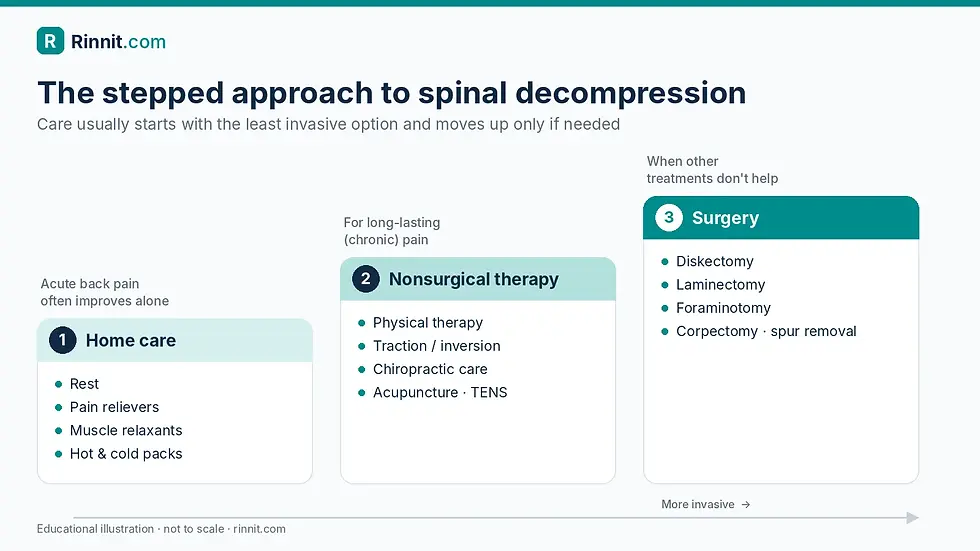
Spinal decompression therapy comes in three levels: home care for sudden back pain, nonsurgical therapies for long-lasting pain, and surgery when other treatments don't help. [1]
First step: home care for acute back pain
Not all back pain needs a doctor. Sudden (acute) back pain usually improves on its own. [1]
While you heal, these can help: [1]
Pain relievers
Muscle relaxants
Hot and cold packs
For chronic (long-lasting) pain, most people start with nonsurgical therapies. If those don't work, surgery may be recommended. [1]
Nonsurgical spinal decompression options
Nonsurgical spinal decompression options aim to relieve pain without surgery. [1]
Option | How it works |
A therapist teaches you stretches, safer ways to lift, and exercises that relieve pain | |
Traction | Pulleys, weights, and a traction table gently stretch your spine |
Inversion therapy | A type of traction that uses gravity: you lie on a table that tilts your body to relieve pressure on your spine |
Chiropractic care | Spinal adjustments realign your bones to ease pain |
Small needles are placed through the skin at specific points to relieve pain | |
TENS (nerve stimulation) | A small device sends mild electrical charges that help muscles relax and nerves stop hurting |
Spinal decompression surgery
Spinal decompression surgery is an option if other therapies don't help. Some procedures use minimally invasive techniques, but not all do, so ask your doctor whether a minimally invasive option could work for you. [1]
Surgery | What the surgeon does |
Diskectomy | Removes part of a disk to take pressure off a nerve |
Laminotomy or laminectomy | Removes part or all of the bony arches (lamina) of the spinal canal to open it up |
Foraminotomy or foraminectomy | Removes bone or tissue to widen the openings where nerve roots exit |
Corpectomy | Removes a vertebra or disk; a spinal fusion (joining two bones) may follow to stabilize the spine |
Osteophyte removal | Removes bone spurs (bony outgrowths that form with age) that press on nerves |

How do doctors choose the right spinal decompression procedure?
Doctors choose the right spinal decompression procedure based on your overall health history and how severe your injury is, usually following a stepped approach. [1]
In a stepped approach, doctors: [1]
Start with less invasive, more cost-effective treatments.
Watch how the injury responds.
Move to surgery only if those treatments don't work.
Tests your doctor may order
Test | What it shows |
Bone scan | Fractures, cancer, or infection in the bones that may cause back pain |
Diskography | Disk damage, using contrast dye followed by a CT scan |
Electromyography (EMG) | Electrical activity in your nerves and muscles |
Evoked potential study | How fast signals travel through a nerve to your brain |
Nerve conduction study (NCS) | How well your nerves work |
CT, MRI, or X-ray | Pictures inside your body that can reveal the cause of pain |
What are the benefits of spinal decompression?
The main benefit of spinal decompression is that the right treatment can fix the problem causing your back pain. [1]
A stepped approach finds the option best suited to you, with the least risk possible.
Treatment can help you get back to work, school, or play.
What are the risks of spinal decompression?
The risks of spinal decompression depend on the treatment: surgery can cause infection, bleeding, blood clots, or nerve damage, while medicines and nonsurgical therapies carry smaller risks. [1]
Treatment type | Possible risks |
Medicines | Allergic reactions |
Alternative (nonsurgical) therapies | They may not work for you |
Surgery | Infection, bleeding, blood clots, or nerve or tissue damage |
Talk through your options and concerns with your doctor before choosing a treatment. [1]
What is recovery like after spinal decompression surgery?
Recovery after spinal decompression surgery can take months, and you may stay in the hospital for up to five days, depending on the type of surgery. [1]
Physical therapy can help you regain strength, movement, and nerve sensation. [1]
How well does it work? Surgery can have a high success rate for relieving pain. In clinical trials for spinal stenosis, people who had surgery improved more than those who had nonsurgical treatment. [1]
Keep in mind that surgery may not fix all wear-and-tear changes, and symptoms can come back. Ask your doctor what to expect in your case. [1]
Is spinal decompression safe during pregnancy?
Spinal decompression during pregnancy is not always safe, so talk to your doctor before trying any option. Back pain is common during pregnancy, and some alternative therapies, such as chiropractic care, have been shown to relieve it. [1]
When should you see a doctor for back pain?
You should see a doctor for back pain that doesn't improve with: [1]
Pain relievers
Rest
Heat and cold packs
Also talk to your doctor if your current treatment isn't helping. Get emergency care right away if back pain comes with loss of bladder or bowel control, numbness in the groin or inner thighs, new leg weakness, or fever. You may need a different spinal decompression option. [1]
Conclusion
No one should have to live with ongoing back pain. Spinal decompression covers a wide range of treatments, from home care and physical therapy to traction, acupuncture, and surgery. Most people start simple, and surgery is saved for when other options don't work.
The best plan depends on what is causing your pain, how severe it is, and your overall health.
Want clear, trusted answers about your spine? Read our complete guide to back pain, save this article to bring to your next appointment, and explore more of our doctor-reviewed health guides.
FAQ
What is spinal decompression therapy?
Spinal decompression therapy is a group of treatments that relieve back pain by taking pressure off the spinal cord and nerves. Options include physical therapy, traction, chiropractic care, acupuncture, TENS, and several types of surgery.
Is spinal decompression surgical or nonsurgical?
Spinal decompression can be both surgical and nonsurgical. Most people start with nonsurgical options, and surgery is considered only if those don't relieve the pain.
What conditions does spinal decompression treat?
Spinal decompression is used for bulging, herniated, and degenerative disks, pinched nerves, sciatica, and spinal stenosis.
Does spinal decompression really work?
Spinal decompression surgery can have a high success rate for relieving pain, and in spinal stenosis trials it led to more improvement than nonsurgical care. Evidence for nonsurgical decompression machines is more limited, so ask your doctor which option fits your condition.
How long is recovery after spinal decompression surgery?
Recovery after spinal decompression surgery can take months, depending on the type of surgery, and you may stay in the hospital for up to five days. Physical therapy helps you rebuild strength and movement.
What are the risks of spinal decompression?
The risks of spinal decompression surgery include infection, bleeding, blood clots, or nerve or tissue damage. Medicines can cause allergic reactions, and nonsurgical therapies may not work for everyone.
Can back pain come back after spinal decompression?
Yes, back pain can come back after spinal decompression. Surgery may not fix all wear-and-tear changes in the spine, so symptoms can return.
Is spinal decompression safe during pregnancy?
Spinal decompression is not always safe during pregnancy. Some alternative therapies, such as chiropractic care, can relieve pain during pregnancy, but always check with your doctor first.
Do I need a doctor for sudden back pain?
Sudden back pain does not always need a doctor. Acute back pain usually gets better on its own with rest, pain relievers, muscle relaxants, and hot or cold packs, so see a doctor if it doesn't improve.
What types of spinal decompression surgery are there?
Common types include diskectomy, which removes part of a damaged disk, and laminectomy or laminotomy, which removes part of the bone at the back of the spine. Others include foraminotomy, corpectomy and removal of bone spurs, and your surgeon will explain which fits your problem.
Related Reading
Cervical Traction: Types, Uses and Benefits explains cervical traction for neck pain.
References
Cleveland Clinic. Spinal Decompression Therapy: Lower Back Pain & Back Pain Relief. Cleveland Clinic. Last updated January 18, 2022. https://my.clevelandclinic.org/health/treatments/10874-spinal-decompression-therapy
Weinstein JN, Tosteson TD, Lurie JD, et al. Surgical versus nonsurgical therapy for lumbar spinal stenosis. N Engl J Med. 2008;358(8):794-810. PMID 18287602. https://doi.org/10.1056/NEJMoa0707136
Daniel DM. Non-surgical spinal decompression therapy: does the scientific literature support efficacy claims made in the advertising media? Chiropr Osteopat. 2007;15:7. PMID 17511872. https://doi.org/10.1186/1746-1340-15-7
Bastos RM, Moya CR, de Vasconcelos RA, et al. Treatment-based classification for low back pain: systematic review with meta-analysis. J Man Manip Ther. 2022;30(4):207-227. PMID 35067217. https://doi.org/10.1080/10669817.2021.2024677
Medical disclaimer
This article is for education only and does not replace advice from your own doctor. Always talk with your care team about your own back pain, treatment options, and recovery.



Comments