Bone Spurs: Symptoms, Causes, and Treatment

Updated: 3 days ago
Medically reviewed by Dr. Baraa Alnahhal, MD · Last reviewed: October 2026

Quick Answer
A bone spur (osteophyte) is a bony growth along a bone edge, usually in a joint or on the spine, most often caused by osteoarthritis joint damage. Most cause no symptoms, but a spur pressing on nerves can cause pain or numbness in the limbs. Many need no treatment; options include pain relievers, weight loss, physical therapy and sometimes surgery.
What the research says
A spur on an image does not always explain pain. A systematic review of 9 studies on hip osteoarthritis found moderate-level evidence that bone marrow lesions on MRI were linked to the severity and progression of hip pain, while evidence for other MRI features, including osteophytes, was limited or conflicting (Fang et al., Rheumatol Int, 2024) [7].
Weight loss plus exercise anchors non-surgical care. A narrative review of guidelines, systematic reviews, and trials concluded that combining dietary weight loss with exercise optimally reduces mechanical joint loading and inflammatory markers, and that stepped conservative care can ease pain, restore function, and delay or prevent joint replacement (Shang and Tian, Front Surg, 2026) [8].
Evidence comparing knee replacement with non-surgical care is still thin. A Cochrane review found a single trial of 100 adults: knee replacement plus a non-surgical program may reduce pain at one year (mean difference 17.60, 95% CI 8.25 to 26.95; low-certainty evidence) but may increase serious adverse events, though this is very uncertain (Pacheco-Brousseau et al., Cochrane Database Syst Rev, 2026) [9].
Study details are from PubMed abstracts.
What are bone spurs?
Bone spurs are bony growths that form along the edges of bones. They are also called osteophytes (say it: OS-tee-oh-fites). They most often form where bones meet each other, in the joints. They can also form on the bones of the spine.
The main cause is the joint damage linked with the most common type of arthritis, called osteoarthritis. This is the type of arthritis that breaks down the cartilage cushioning the ends of bones.
It helps to think of these growths as the body's repair attempt. When cartilage wears away, the body tries to make up for the loss by building extra bone near the damaged area. The growth itself is not an infection or a tumor. It is a sign of a joint that has been under stress.
How common are bone spurs without symptoms?
These growths often cause no symptoms. You might not notice them, and a healthcare team might not happen to find them for years. Many people learn they have a spur only when an X-ray done for another condition reveals the growths.
This is an important point: finding a spur on an image does not automatically mean it is causing pain. Treatment decisions depend on where the spurs are located and how they affect your health.
What symptoms of bone spurs should you watch for?
Often, these growths don't cause symptoms at all. But when they do, they can cause pain and loss of motion in the joints. The symptoms depend on where the spurs are.
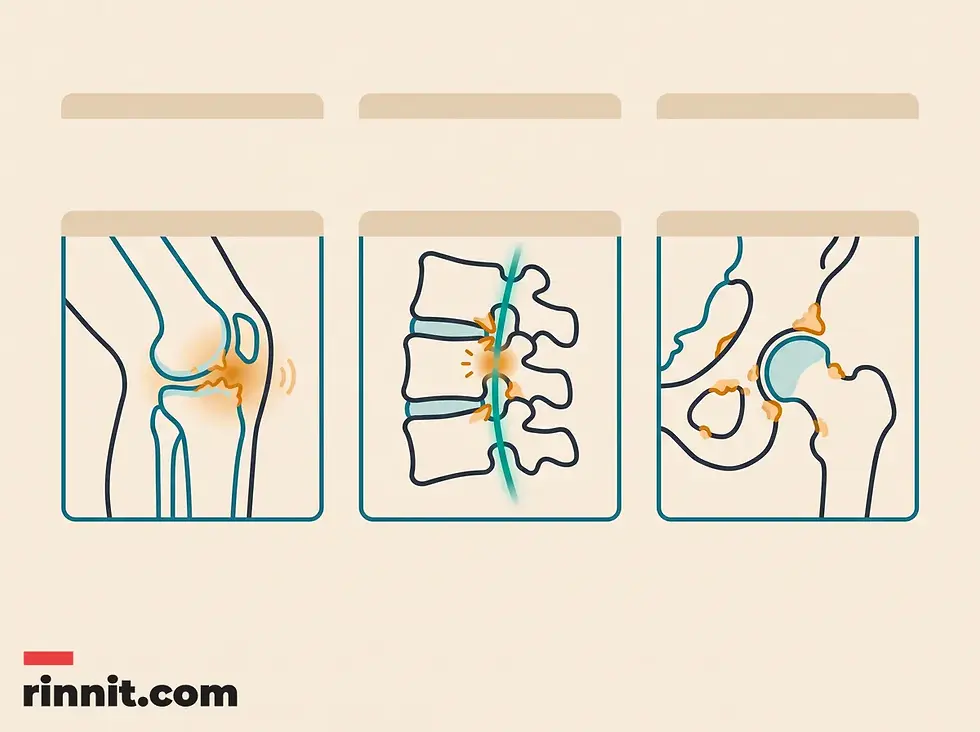
Location | What the spur can do | Symptoms it can cause |
Knee | Forms at the joint edges | Painful to bend and extend the leg |
Spine | Narrows the space that contains the spinal cord; can pinch the spinal cord or nerve roots | Weakness or numbness in the arms or legs |
Hip | Forms at the joint edges | Painful to move the hip; pain that may feel like it is in the knee or thigh; reduced range of motion |
The spine location deserves extra attention. On the small bones that form the spine, these growths can narrow the space that contains the spinal cord. When these spurs pinch the spinal cord or its nerve roots, the result can be weakness or numbness in the arms or legs.
Hip spurs have their own trick: depending on their placement, they can reduce the range of motion in the hip joint, and the pain can feel like it is coming from the knee or thigh rather than the hip itself.
What causes bone spurs to form on a worn joint?
Joint damage from osteoarthritis is the most common cause. Osteoarthritis breaks down connective tissue called cartilage, which cushions the ends of bones. While this happens, the body tries to repair the loss by creating spurs near the damaged area.
Factor | How it connects to bone spurs |
Osteoarthritis | The most common cause: cartilage breakdown prompts the body to build extra bone |
Arthritis in general | The risk of bone spurs is higher in people who have arthritis |
Joint location | Spurs form where bones meet (joints) and on the spine, where stress and wear concentrate |
How are bone spurs diagnosed?
Diagnosis usually starts with a physical exam. A healthcare professional may feel around the joint to pinpoint where the pain is.
X-rays or other imaging tests, such as a CT scan or MRI, may then be done to view the joints and bones. This is often how a spur is discovered in the first place, sometimes as a surprise finding on an X-ray ordered for another reason.
Test | What it shows |
Physical exam | Where the pain is; how the joint moves and what motion is limited |
X-ray | The joints and bones, including bony growths at joint edges |
CT scan | Detailed views of the bones |
MRI | Soft tissue around the joint, and how much a spur presses on nerves |
How are bone spurs treated step by step?
Many spurs need no treatment at all. When treatment is needed, it depends on where the spurs are located and how they affect your health. The approach usually moves from the simplest options to the most involved.

Step 1: Medications. If the spurs cause pain, a healthcare professional might recommend pain relievers sold without a prescription. These include acetaminophen and the anti-inflammatory medicines ibuprofen and naproxen sodium.
Step 2: Physical therapy. Physical therapy can strengthen the muscles around the joints and improve flexibility. This eases pain and helps you move better.
Step 3: Surgery or other procedures. Some people with painful spurs due to osteoarthritis may benefit from surgery if other treatments don't work. Surgical options might include removing the spurs to relieve pressure on nerves, or replacing the affected joint. The decision depends on where the spurs are, how painful they are, and how much they limit movement.
Which home remedies help with bone spurs?
If you are overweight and have osteoarthritis of the hips or knees, weight loss may help ease the pain. Even a small amount of weight loss may help.
Exercise can help people lose extra weight, and it also makes the muscles around the joints stronger. Types of exercise that can help include walking, biking, and swimming.
When should you see a doctor for bone spurs?
See a doctor if you have joint pain or swelling, trouble moving a joint, or weakness or numbness in the arms or legs.
Pain or swelling in one or more joints.
Trouble moving a joint.
Weakness or loss of feeling in the arms or legs.
Prompt attention matters for weakness or loss of feeling in the arms or legs. It can mean a spur on the spine is pressing on the spinal cord or nerve roots.
How should you prepare for a bone spur appointment?
You'll likely first see your primary healthcare professional. You might be referred to a doctor who finds and treats joint conditions, called a rheumatologist.
What you can do
List your symptoms and how long you've had them.
Write down key medical information, including any other conditions you have, all medicines and supplements you take, and any family history of bone or joint disease.
Note recent injuries that affected a joint.
Write down questions to ask your healthcare professional.
Questions worth asking
What's the most likely cause of my symptoms?
Are there other possible causes?
What tests do I need?
What treatment do you recommend, if any?
I have other health conditions. How can I manage them together?
Is surgery an option for me? Why or why not?
What self-care measures can I take to help manage symptoms?
What to expect from your doctor
Your healthcare professional is likely to ask how bad your pain is, whether you're having trouble moving the affected joint, and whether your symptoms affect your ability to complete daily tasks. They may also ask what at-home treatments you've tried and what your typical exercise routine looks like.
What is the bottom line on bone spurs?
Bone spurs sound alarming, but most of them are silent. They form as the body's repair attempt when osteoarthritis wears away joint cartilage, and many people live with them for years without ever feeling them. The ones that do cause trouble are usually the ones sitting where bones meet, the knee, the hip, and the spine, and where they can press on nerves.
The good news is that treatment follows a sensible ladder. Over-the-counter pain relievers, weight loss, and physical therapy help most people. Surgery, whether removing the spur or replacing the joint, is held in reserve for cases that don't improve.
If your joints ache, stiffen, or stop moving freely, a checkup can show whether a spur is behind it, and whether anything needs to be done at all.
Next steps: If joint pain is slowing you down, talk to a healthcare professional about whether your symptoms fit a spur pattern.
FAQ
Are bone spurs the same as osteophytes?
Yes. Osteophyte is simply the medical term for this kind of bony growth, which forms along the edges of bones, most often in joints or on the spine.
Do bone spurs always hurt?
No. Most spurs cause no symptoms at all, and many are found by accident on an X-ray done for another reason. Symptoms depend on where the spur is and whether it presses on surrounding tissue or nerves.
Can a bone spur press on the spinal cord?
Yes. On the spine, these growths can narrow the space that contains the spinal cord. If a spur pinches the spinal cord or a nerve root, it can cause weakness or numbness in the arms or legs, which is a reason to see a doctor promptly.
Why does a hip bone spur sometimes feel like knee pain?
Depending on their placement, hip spurs can cause pain that feels like it is in the knee or thigh. This referred pain is one reason hip problems can be mistaken for knee problems.
Does everyone with a bone spur need surgery?
No. Most spurs need no treatment. When symptoms do occur, treatment usually starts with over-the-counter pain relievers, weight loss, and physical therapy. Surgery, such as spur removal or joint replacement, is considered only when other treatments don't work.
Disclaimer: This article is for general informational purposes only and does not constitute medical advice. Always consult a qualified health care provider for individual questions.
What causes bone spurs?
The most common cause is joint damage from osteoarthritis. As cartilage wears away, the body builds extra bone near the damaged area.
How are bone spurs diagnosed?
A provider examines the joint and asks about your symptoms. X-rays show bone spurs, and a CT scan or MRI may be used for more detail or to see if a spur presses on nerves.
Can bone spurs go away on their own?
No. Bone spurs do not usually shrink or disappear on their own, but many never cause problems. When they do, treatment can ease pain and improve movement.
Can exercise help bone spurs?
Yes. Gentle exercise such as walking, biking, and swimming strengthens the muscles around joints and can help with weight loss, which may ease pain.
What pain relievers help bone spurs?
Over-the-counter options include acetaminophen and anti-inflammatory medicines like ibuprofen or naproxen. Ask your provider which is safe for you, especially if you have other health conditions.
Related Reading
Laminotomy: Procedure, Recovery and Benefits Explained explains how removing a small window of bone from the lamina relieves pinched spinal nerves, plus recovery time and risks.
Surgery that frees a compressed nerve root: Foraminotomy: Purpose, Procedure, Recovery and Risks
References
Sen R, Hurley JA. Osteoarthritis. In: StatPearls [Internet]. Treasure Island (FL): StatPearls Publishing; 2026 Jan-. Updated February 20, 2023. PMID 29493951. https://www.ncbi.nlm.nih.gov/books/NBK482326/
Yaseen K. Osteoarthritis (OA). Merck Manual Professional Edition. Reviewed/Revised May 2026. https://www.merckmanuals.com/professional/musculoskeletal-and-connective-tissue-disorders/joint-disorders/osteoarthritis-oa
National Institute of Arthritis and Musculoskeletal and Skin Diseases. Spinal Stenosis. National Institute of Arthritis and Musculoskeletal and Skin Diseases. Accessed October 15, 2026. https://www.niams.nih.gov/health-topics/spinal-stenosis
Arthritis Foundation. Is Your Back Pain Caused by OA? Arthritis Foundation. Accessed October 14, 2026. https://www.arthritis.org/diseases/more-about/is-your-back-pain-caused-by-oa
Cleveland Clinic. Bone Spur (Osteophyte). Cleveland Clinic. Updated October 14, 2024. https://my.clevelandclinic.org/health/diseases/10395-bone-spurs-osteophytes
National Health Service. Osteophyte (bone spur). nhs.uk. Reviewed June 23, 2026. https://www.nhs.uk/conditions/osteophyte/
Fang H, et al. The relationship between MRI-detected hip abnormalities and hip pain in hip osteoarthritis: a systematic review. Rheumatol Int. 2024;44(10):1887-1896. PMID 39136786. https://doi.org/10.1007/s00296-024-05678-2
Shang Y, et al. Non-surgical management of knee osteoarthritis: a stepped conservative care paradigm for early-stage disease and high-risk populations. Front Surg. 2026;13:1941764. PMID 42841007. https://doi.org/10.3389/fsurg.2026.1941764
Pacheco-Brousseau L, et al. Total and partial knee arthroplasty versus non-surgical interventions of the knee for moderate to severe osteoarthritis. Cochrane Database Syst Rev. 2026;1(1):CD015378. PMID 41494148. https://doi.org/10.1002/14651858.CD015378.pub2



Comments