Cervical Traction: Types, Uses and Benefits

Updated: 2 days ago
Written and medically reviewed by Dr. Baraa Alnahhal, MD · Last reviewed: November 2026 · How we review
Quick Answer
Cervical traction is a treatment for neck pain that gently pulls the head to create space between the bones in the neck, reducing pressure on nerves and easing muscle tension. It's used for pinched nerves, neck sprains, spinal stenosis and degenerative disk disease. It has very few risks, though relief may be temporary.
What the research says
Adding traction to physical therapy eased nerve pain: a meta-analysis of 5 trials in cervical radiculopathy found adding mechanical traction to physical therapy reduced pain in the short and intermediate term and improved disability in the intermediate term (Romeo A et al., Physical Therapy, 2018) [2]
Traction was one of several helpful rehab components: a network meta-analysis of 36 trials found cervical traction was one of the rehabilitation components linked to less pain in cervical radiculopathy, along with nerve-gliding techniques and joint treatment (Núñez de Arenas-Arroyo S et al., Clinical Rehabilitation, 2025) [3]
Key takeaways
Cervical traction gently pulls the head to open space in the neck.
It eases pressure on nerves and muscle tension.
It can be manual or mechanical.
Get a provider's OK before using a home device.
Relief may be temporary.
What is cervical traction?
Cervical traction separates the vertebrae in your neck to reduce pressure and tension. It's also called spinal traction. It can also help nerve and muscle problems around the spine. Sources: [1]
What it treats
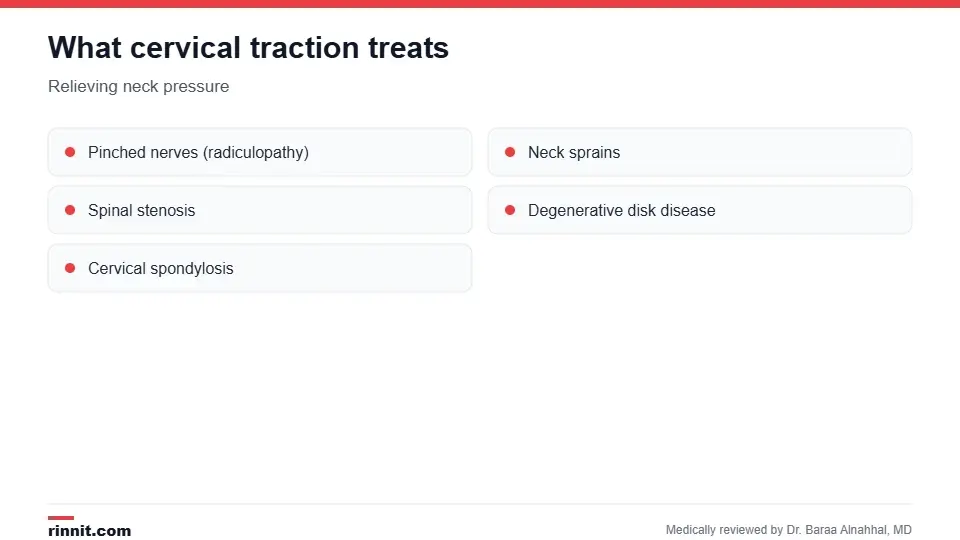
A provider confirms you're a good candidate first.
Short-term conditions | Long-term conditions |
Neck sprains | Degenerative disk disease |
Fractured spine | Cervical spondylosis and scoliosis |
Sources: [1]
Types of cervical traction
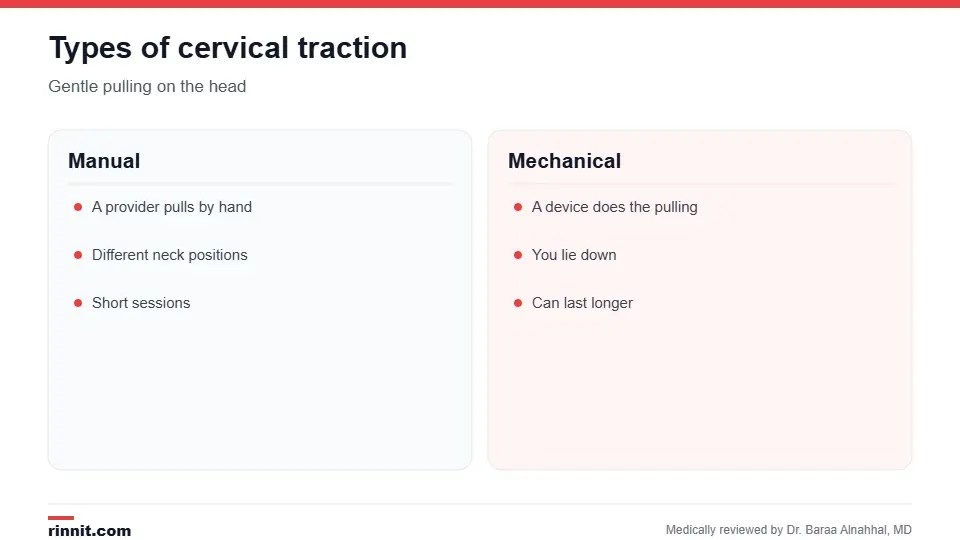
It can be done in an office, during physical therapy or at home.
Type | How it works |
Manual | A provider holds your head and gently pulls, sometimes in different positions |
Mechanical | You lie down while a device applies gentle, even pulling; can last longer |
Sources: [1, 2]
How it's done
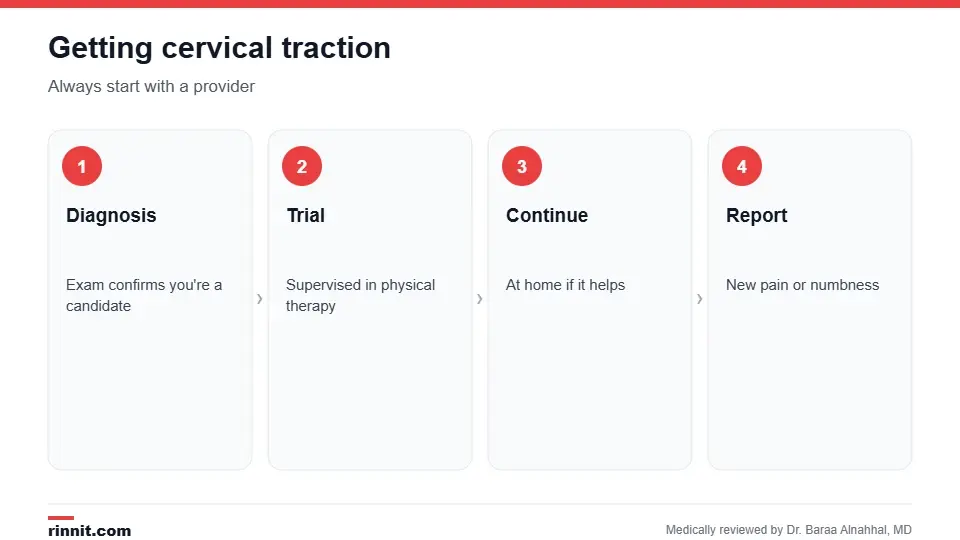
Never start traction without talking to a provider.
A provider diagnoses your condition and examines you.
You usually try traction first under physical therapy supervision.
If it helps, you may use it at home as often as your provider suggests. Sources: [1]
No preparation is needed. Never start traction or other neck treatments without talking to a provider. Sources: [1]
Who shouldn't use it
People who are pregnant.
People who are claustrophobic or anxious about being restrained.
People who've had cervical fusion surgery.
People with aneurysms, osteoporosis, bone infections, spinal cord tumors, spinal cord compression or uncontrolled high blood pressure. Sources: [1]
Risks
Cervical traction has very few risks. It shouldn't apply enough force to injure your neck. Sources: [1]
Benefits
Traction may reduce pain, ease neck muscle stiffness and tension and improve flexibility. Some people feel better after a few treatments. Combining it with stretches and physical therapy may add range-of-motion gains. Long-term benefits haven't been widely studied, and symptoms may return. Sources: [1, 2, 3]
When to call your provider
Before using a home traction device.
New or worse pain.
Numbness or tingling in your arms, hands or legs.
Vision changes or headaches. Sources: [1]
Conclusion
Cervical traction is a low-risk way to relieve neck pain by easing pressure on nerves and muscles. It works best as part of a physical therapy plan guided by your provider.
Keep learning: read about neck pain and radiculopathy.
Frequently asked questions
What is cervical traction?
A treatment that gently pulls the head to create space in the neck.
What does cervical traction treat?
Neck pain from pinched nerves, sprains, stenosis and disk problems.
What's the difference between manual and mechanical traction?
Manual uses a provider's hands; mechanical uses a device.
Can I do cervical traction at home?
Yes, after your provider approves it.
Does it hurt?
It shouldn't. Tell your provider about new or worse pain.
How soon will I feel better?
Some people improve after a few treatments.
Is the relief permanent?
Not always; symptoms may return.
Who shouldn't use it?
People who are pregnant, had neck fusion or have osteoporosis, among others.
Is cervical traction safe?
It has very few risks.
Does it work better with physical therapy?
Studies suggest adding it to physical therapy helps.
Related Reading
Neck Pain: Symptoms, Causes, Diagnosis, and Treatment causes of neck pain.
Cervical Spondylosis: Symptoms, Causes & Treatment neck arthritis.
Spinal Decompression Therapy: Types, Benefits, Risks, and Recovery a related spine therapy.
Cervical Epidural Steroid Injection: Uses, Procedure and Results another neck pain treatment.
References
Cleveland Clinic. Cervical Traction: What It Is, Types & Benefits. Cleveland Clinic. Last updated May 19, 2022. https://my.clevelandclinic.org/health/treatments/23093-cervical-traction
Romeo A, Vanti C, Boldrini V, et al. Cervical radiculopathy: effectiveness of adding traction to physical therapy: a systematic review and meta-analysis of randomized controlled trials. Physical Therapy. 2018;98(4):231-242. PMID 29315428. https://doi.org/10.1093/physth/pzy001
Núñez de Arenas-Arroyo S, Mavridis D, Martínez-Vizcaíno V, et al. What components and formats of rehabilitation interventions are more effective to reduce pain in patients with cervical radiculopathy? A systematic review and component network meta-analysis. Clinical Rehabilitation. 2025;39(10):1296-1310. PMID 40776625. https://doi.org/10.1177/02692155251365193
Medical disclaimer
This article is for general education only and does not replace advice from a qualified healthcare professional. Talk to your doctor about your own diagnosis and treatment, and seek emergency care right away for severe or sudden symptoms.



Comments