Cervical Epidural Steroid Injection: Uses, Procedure and Results

Updated: 2 days ago
Written and medically reviewed by Dr. Baraa Alnahhal, MD · Last reviewed: November 2026 · How we review
Quick Answer
A cervical epidural steroid injection (ESI) delivers anti-inflammatory steroid medicine into the epidural space around the spinal nerves in the neck. It's mainly used for cervical radiculopathy, pain from irritated nerve roots that spreads from the neck into the shoulders, arms or hands. About 40% to 84% of people get temporary or partial relief.
What the research says
Epidural steroids eased short-term nerve pain: an American Academy of Neurology review of 90 trials found epidural steroids probably reduce short-term pain and disability for neck and low back nerve pain, but evidence for long-term relief was insufficient (Armon C et al., Neurology, 2025) [2]
Neck injections improved pain without major complications: six studies of 443 people given cervical transforaminal steroid injections showed meaningful pain improvement, and no major complications were reported (Borton ZM et al., Bone and Joint Journal, 2022) [3]
Key takeaways
A cervical ESI injects steroid around irritated nerves in the neck.
It treats pain that spreads from the neck into the arms.
The injection takes 15 to 30 minutes.
Relief starts in two to seven days.
Relief is usually temporary or partial.
What is a cervical epidural steroid injection?
The neck has seven vertebrae, C1 to C7. The steroid coats irritated nerves, reducing swelling and pressure so they can heal. The medicine is sometimes mixed with a numbing medicine. Learn more about epidural steroid injections. Sources: [1]
What it treats
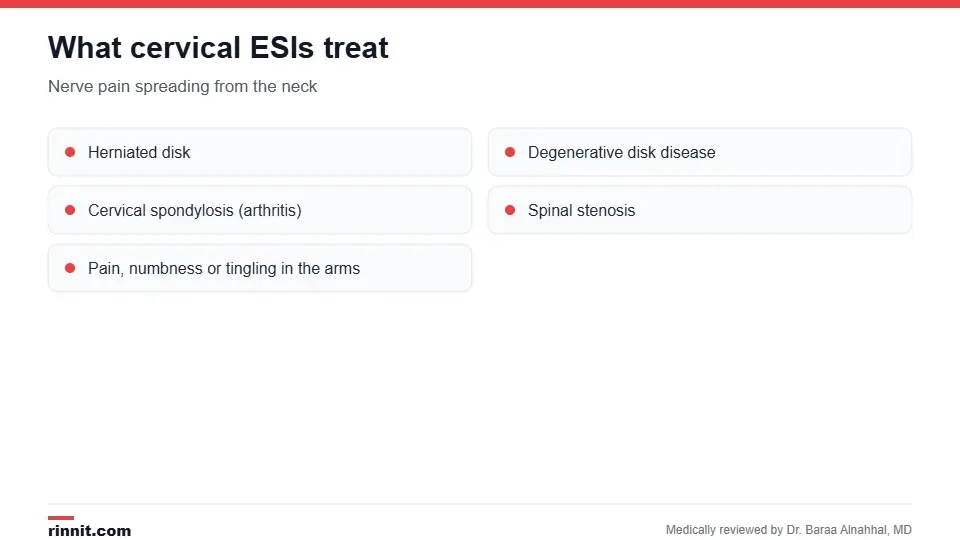
Radiculopathy affects about 1 in 1,000 adults each year.
A herniated disk in the neck.
Degenerative disk disease.
Cervical spondylosis (neck arthritis).
Spinal stenosis. Sources: [1]
Radiculopathy affects about 1 in 1,000 adults each year. Sources: [1]
Types of injection

X-ray guidance helps place the needle.
Type | Where the needle goes |
Through the opening where a nerve root exits | |
Interlaminar (IESI) | Between two bones (laminae) at the back of the spine |
Sources: [1, 3]
How to prepare
Tell your provider if you're pregnant or might be.
Share all medicines, herbs and supplements, especially blood thinners.
You may need to fast or have a neck MRI or CT.
Arrange a driver if you'll be sedated. Sources: [1]
What happens during the injection

The injection takes 15 to 30 minutes.
You lie still, face down.
Your neck is cleaned and numbed.
X-ray (fluoroscopy) guides the needle into the epidural space.
Contrast dye may confirm placement.
The medicine is injected slowly.
You rest for a few minutes to an hour. Sources: [1]
You may feel a pinch, pressure, tingling or brief pain. Tell your provider right away about sharp pain. Sources: [1]
Risks
Low blood pressure.
A spinal fluid leak with a severe headache.
Infection.
Bleeding or a blood clot.
Medication reactions such as hot flashes or rash.
Rarely, stroke, vision loss, nerve damage or paralysis; the FDA requires a warning about these rare but serious problems. Call 911 for sudden weakness, numbness, vision loss or trouble speaking after an injection. Sources: [1]
Frequent injections or high doses may weaken spinal bones or muscles, so most providers limit you to two or three cervical ESIs a year. Sources: [1]
Recovery
Soreness at the needle site lasts only a few hours.
Your arm may feel heavy or numb briefly if numbing medicine was used.
Limit activity for the rest of the day if advised.
Pain may get worse for two to three days before improving. Sources: [1]
Results
About 40% to 84% of people get temporary or partial relief; some get none. Relief may last days to months or longer, but permanent relief is very rare. The goal is to ease pain enough for physical therapy. Sources: [1, 2]
When to call your provider
A severe headache when sitting or standing that eases when lying down.
Fever.
Lasting numbness or weakness in your arms. Sources: [1]
Conclusion
A cervical epidural steroid injection can calm inflamed neck nerves and ease arm pain, often enough to start physical therapy. Relief is usually temporary, so it works best as part of a broader treatment plan.
Keep learning: read about radiculopathy and neck pain.
Frequently asked questions
What is a cervical epidural steroid injection?
A steroid injection around irritated nerves in the neck.
What does it treat?
Pain from pinched or inflamed nerve roots in the neck.
How long does the injection take?
15 to 30 minutes.
Does it hurt?
You may feel a pinch, pressure or brief pain.
When will it start working?
Within two to seven days.
How long does relief last?
From days to months or longer.
How well does it work?
About 40% to 84% of people get temporary or partial relief.
How many injections can I have?
Most providers limit it to two or three a year.
Can I drive home?
Not if you were sedated.
What are the risks?
Headache, infection, bleeding and, rarely, nerve damage.
Related Reading
Cervical Traction: Types, Uses and Benefits explains cervical traction for neck pain.
Epidural Steroid Injection (ESI): How It Works, What to Expect, Risks, and Results an overview of epidural steroid injections.
Transforaminal Epidural Steroid Injection: Procedure, Recovery, Risks, and Results one injection approach.
Lumbar Epidural Steroid Injection: Uses, Procedure and Results the low back version.
Radiculopathy (Pinched Nerve): Symptoms, Causes, Types, and Treatment the main condition treated.
Cervical Spondylosis: Symptoms, Causes & Treatment neck arthritis.
References
Cleveland Clinic. Cervical Epidural Steroid Injections: What It Is, Benefits, Risks & Side Effects. Cleveland Clinic. Last updated January 25, 2022. https://my.clevelandclinic.org/health/treatments/22293-cervical-epidural-steroid-injection
Armon C, Narayanaswami P, Potrebic S, et al. Epidural steroids for cervical and lumbar radicular pain and spinal stenosis systematic review summary: report of the AAN Guidelines Subcommittee. Neurology. 2025;104(5):e213361. PMID 39938000. https://doi.org/10.1212/WNL.0000000000213361
Borton ZM, Oakley BJ, Clamp JA, et al. Cervical transforaminal epidural steroid injections for radicular pain: a systematic review. Bone Joint J. 2022;104-B(5):567-574. PMID 35491579. https://doi.org/10.1302/0301-620X.104B5.BJJ-2021-1816.R1
Medical disclaimer
This article is for general education only and does not replace advice from a qualified healthcare professional. Talk to your doctor about your own diagnosis and treatment, and seek emergency care right away for severe or sudden symptoms.



Comments