Lumbar Epidural Steroid Injection: Uses, Procedure and Results

Updated: 2 days ago
Written and medically reviewed by Dr. Baraa Alnahhal, MD · Last reviewed: November 2026 · How we review
Quick Answer
A lumbar epidural steroid injection (ESI) delivers anti-inflammatory steroid medicine into the epidural space around the spinal nerves in the lower back. It eases sciatica and low back pain caused by irritated nerve roots, most often from a herniated disk or spinal stenosis. Relief can last a few days to a few months. It doesn't cure back pain.
What the research says
Benefits for sciatica are modest and short-term: in 23 placebo-controlled trials, epidural steroids reduced sciatica leg pain by about 6 points on a 100-point scale in the short term (2 weeks to 3 months), with no clear benefit after a year (Pinto RZ et al., Annals of Internal Medicine, 2012) [2]
Steroids added little for spinal stenosis: in 400 people with lumbar spinal stenosis, injections of steroid plus numbing medicine gave no meaningful extra benefit for pain or disability at 6 weeks compared with numbing medicine alone (Friedly JL et al., New England Journal of Medicine, 2014) [3]
Key takeaways
A lumbar ESI injects steroid medicine near irritated nerves in the low back.
It's most helpful for pain from a herniated disk or spinal stenosis.
The procedure takes about 15 to 30 minutes.
Relief usually starts within two to seven days and is often temporary.
Most providers limit injections to two or three a year.
What is a lumbar epidural steroid injection?
The lumbar spine has five vertebrae, L1 to L5. When nerve roots there become inflamed, pain can spread to your hips, legs or feet; this is called lumbar radiculopathy or sciatica. An ESI reduces swelling and pressure on these nerves. Learn more about epidural steroid injections in general. Sources: [1]
Why it's done
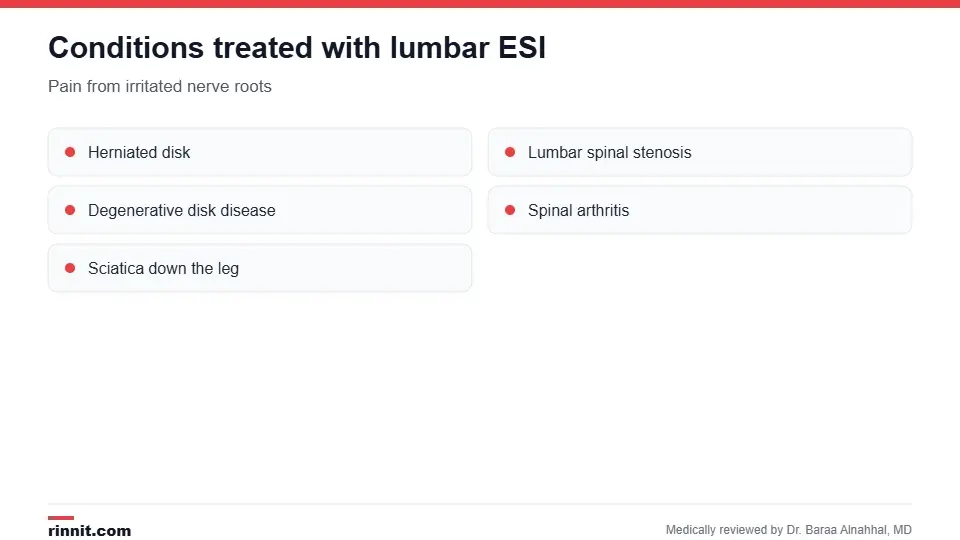
It works best for herniated disks and spinal stenosis.
Degenerative disk disease.
Spinal arthritis (spondylosis).
Low back pain and leg pain from narrowed nerve spaces (neurogenic claudication). Sources: [1]
About 9% to 25% of people have low back pain with leg pain below the knee each year. Sources: [1]
Types of lumbar ESI
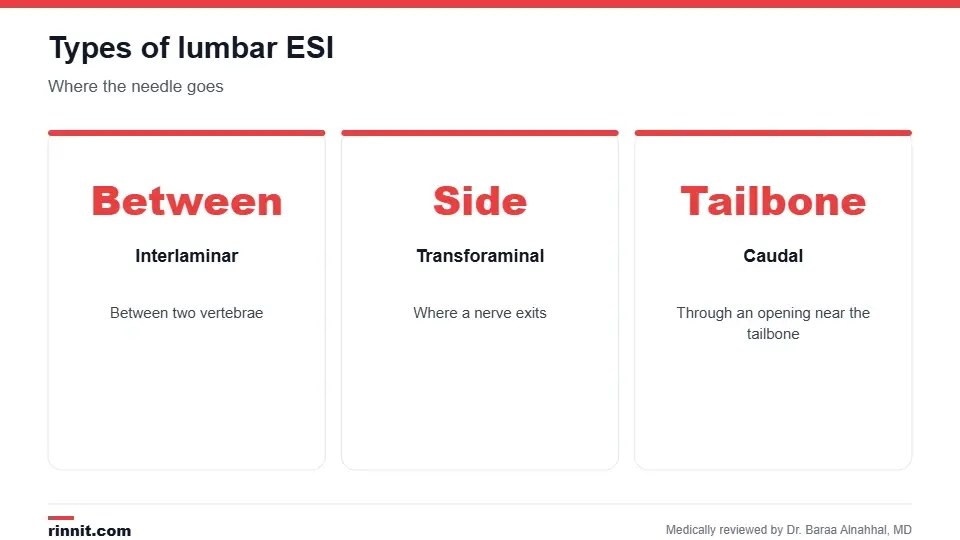
Your provider picks the approach based on your pain.
Type | Where the needle goes | Often used for |
Interlaminar | Between two vertebrae (laminae) | Disk herniation, spinal stenosis, central back pain |
Through the opening where a nerve exits | Pain from one nerve root | |
Through an opening near the tailbone | "Failed back" syndrome; generally fewer risks |
The injection may contain a steroid alone or mixed with saline and a numbing medicine. Sources: [1]
How to prepare
Tell your provider if you're pregnant or could be.
List all your medicines and supplements.
You may need to adjust blood thinners or fast for a short time.
You may have an MRI or CT scan first.
Arrange a ride if you'll get a sedative. Sources: [1]
What happens during the injection

The procedure takes about 15 to 30 minutes.
You lie face down with a pillow under your belly.
Your back is cleaned, and the skin is numbed.
X-ray (fluoroscopy) guides the needle into place.
Contrast dye confirms the needle is in the right spot.
The medicine is injected slowly.
You rest for a few minutes to an hour while the team watches for reactions. Sources: [1]
You may feel a pinch, pressure or brief tingling. Tell your provider right away about sharp pain. Sources: [1]
Risks and side effects
Type | Examples |
Common | Temporary increase in pain, tenderness or bruising at the site |
Health conditions | Higher blood sugar for hours or days in diabetes; higher eye pressure in glaucoma |
Rare | Severe headache from a spinal fluid leak, infection, bleeding, nerve damage, allergic reaction, temporary loss of bladder or bowel control |
Very rare | Permanent nerve damage or paralysis |
Repeated injections can weaken spinal bones and nearby muscles, so most providers limit them to two or three a year. Sources: [1]
Results
Many people get temporary relief, and some get relief for up to 12 months, while others get none. In one study of disk-related nerve pain, up to 70% felt at least 50% better after one to two months. The injection is meant to help you do physical therapy and possibly avoid surgery. Sources: [1, 2, 3]
When to call your provider
A severe headache when sitting or standing that gets better when lying down.
A fever.
Loss of bladder or bowel control.
Numbness or weakness in your legs. Sources: [1]
Conclusion
A lumbar epidural steroid injection can calm inflamed nerves and give you a window of relief to build strength with therapy. Talk with your provider about how much benefit to expect and how it fits into your overall back pain plan.
Keep learning: read about sciatica and herniated disks.
Frequently asked questions
What is a lumbar epidural steroid injection?
An injection of steroid medicine near inflamed nerves in the lower back.
What does it treat?
Sciatica and back pain from a herniated disk, spinal stenosis or arthritis.
How long does the procedure take?
About 15 to 30 minutes.
Does it hurt?
You may feel a pinch or pressure; the skin is numbed first.
How soon does it work?
Usually within two to seven days.
How long does relief last?
From a few days to a few months or longer.
How many injections can I have?
Most providers limit them to two or three a year.
Can my pain get worse after the injection?
Yes, for two or three days before it improves.
Does it cure back pain?
No. It eases pain so you can do physical therapy.
When should I call my provider?
For a severe headache, fever, leg weakness or loss of bladder control.
Related Reading
Cervical Epidural Steroid Injection: Uses, Procedure and Results explains cervical epidural steroid injections.
Sciatica: Complete Guide to Symptoms, Causes, Diagnosis, and Treatment leg pain from an irritated sciatic nerve.
Herniated Disk: Symptoms, Causes & What Actually Helps a common cause of nerve pain.
Spinal Stenosis: Symptoms, Causes, Diagnosis, and Treatment — Complete Guide narrowing of the spinal canal.
Transforaminal Epidural Steroid Injection: Procedure, Recovery, Risks, and Results an injection at the nerve's exit point.
Epidural Steroid Injection (ESI): How It Works, What to Expect, Risks, and Results an overview of epidural steroid injections.
References
Cleveland Clinic. Lumbar Epidural Steroid Injections: What It Is, Benefits, Risks & Side Effects. Cleveland Clinic. Last updated November 19, 2021. https://my.clevelandclinic.org/health/treatments/22091-lumbar-epidural-steroid-injection
Pinto RZ, Maher CG, Ferreira ML, et al. Epidural corticosteroid injections in the management of sciatica: a systematic review and meta-analysis. Annals of Internal Medicine. 2012;157(12):865-877. PMID 23362516. https://doi.org/10.7326/0003-4819-157-12-201212180-00564
Friedly JL, Comstock BA, Turner JA, et al. A randomized trial of epidural glucocorticoid injections for spinal stenosis. New England Journal of Medicine. 2014;371(1):11-21. PMID 24988555. https://doi.org/10.1056/NEJMoa1313265
Medical disclaimer
This article is for general education only and does not replace advice from a qualified healthcare professional. Talk to your doctor about your own diagnosis and treatment, and seek emergency care right away for severe or sudden symptoms.



Comments