Transforaminal Epidural Steroid Injection: Procedure, Recovery, Risks, and Results

Updated: 6 days ago
Written and medically reviewed by Dr. Baraa Alnahhal, MD · Last reviewed: October 2026 · How we review
Quick Answer: What is a transforaminal epidural steroid injection?
A transforaminal epidural steroid injection is a procedure that delivers a numbing medicine and a corticosteroid into the epidural space through the foramen, the opening where a spinal nerve leaves the spine. Guided by live X-ray, it eases radiating back, neck, arm or leg pain from conditions such as sciatica and herniated disks. Report fever or worsening pain promptly. [1]
What the research says
The steroid adds a modest pain benefit at 3 months. In a review of 8 randomized trials (771 patients) with lumbar disk herniation, transforaminal steroid injections lowered pain by about 1 point on a 0–10 scale (−0.97) compared with numbing medicine or saline at 3 months. They did not reduce disability at 1–3 months or the need for surgery at 12 months. (Bhatia et al., Anesthesia & Analgesia, 2016) [2]
About half of people with neck-related nerve pain get major relief. In pooled data on X-ray-guided cervical (neck) transforaminal injections, 48% of patients had at least 50% pain reduction at 1 month and 55% at 3 months. The quality of the evidence was rated very low. (Conger et al., Pain Medicine, 2020) [3]
There were no serious complications in a series of 1,305 injections. In a prospective study of 562 patients who received 1,305 lumbar transforaminal injections, no major complications occurred. Minor complications affected 11.5% and were all temporary; the most common was a vasovagal reaction (feeling faint) at 8.7%. (Karaman et al., Spine, 2011) [4]
Key takeaways
The needle goes through the foramen, close to the irritated nerve root but not into the spinal cord or the nerve itself. [1]
The procedure takes about 30 minutes, and most people return to normal activities the next day. [1]
The steroid can take 24–48 hours to start working and up to two weeks to reach full effect. [1]
Relief can last from several weeks to several months, and it varies from person to person. [1]
Generally, three to six injections per year are considered safe. [1]
What is a transforaminal epidural steroid injection?
A transforaminal epidural steroid injection is an injection of corticosteroid medicine into the epidural space, the area around the protective membrane that covers the spinal cord. [1]
"Transforaminal" describes the route. The needle passes through the foramen, the opening where a nerve exits the spine. This puts the medicine right next to the nerve that is causing pain. [1]
The medicine is placed near the nerve, never into the spinal cord or the nerve itself. [1]
The injection contains two medicines:
Medicine | What it does | When you feel it |
Local anesthetic (numbing medicine) | Numbs the area | Short-term relief |
Corticosteroid (steroid) | Reduces inflammation | Longer-term relief |
Source: [1]
What conditions does a transforaminal injection treat?
A transforaminal injection treats pain caused by irritated or compressed spinal nerves, including lower back pain and sciatica. It can reduce spinal pain and inflammation and ease pain that spreads into the arms, legs or feet. [1]
Conditions it may be used for include: [1]
Lower back pain and sciatica
Spinal stenosis and foraminal stenosis
Spondylolysis, spondylolisthesis and scoliosis
Bone spurs and spinal nerve damage
The injection is named after the part of the spine being treated: [1]
Injection name | Part of the spine |
Lumbar transforaminal injection | Lower back |
Thoracic transforaminal injection | Middle back |
Cervical transforaminal injection | Neck |
How is a transforaminal injection different from an interlaminar injection?
A transforaminal injection enters through the foramen closest to the affected nerve, while an interlaminar injection enters through a bony opening near the middle of the spine. [1]
Transforaminal injections always use X-ray guidance, so the needle can be placed precisely beside the affected nerve. [1]
For a broader overview of all approaches, see our epidural steroid injection guide and our article on the caudal epidural steroid injection.
What happens during a transforaminal epidural steroid injection?
A transforaminal epidural steroid injection is an outpatient procedure that takes about 30 minutes. Live X-ray (fluoroscopy) guides a thin needle to the target nerve root. [1]
Step by step: [1]
Positioning. You lie face-down on an X-ray table.
Numbing. A local anesthetic numbs the skin. Light IV sedation is available if you want it.
Guidance. Fluoroscopy, a real-time X-ray, shows the needle's path as your provider guides it to the targeted nerve root.
Injection. The numbing medicine and steroid are delivered near the nerve.
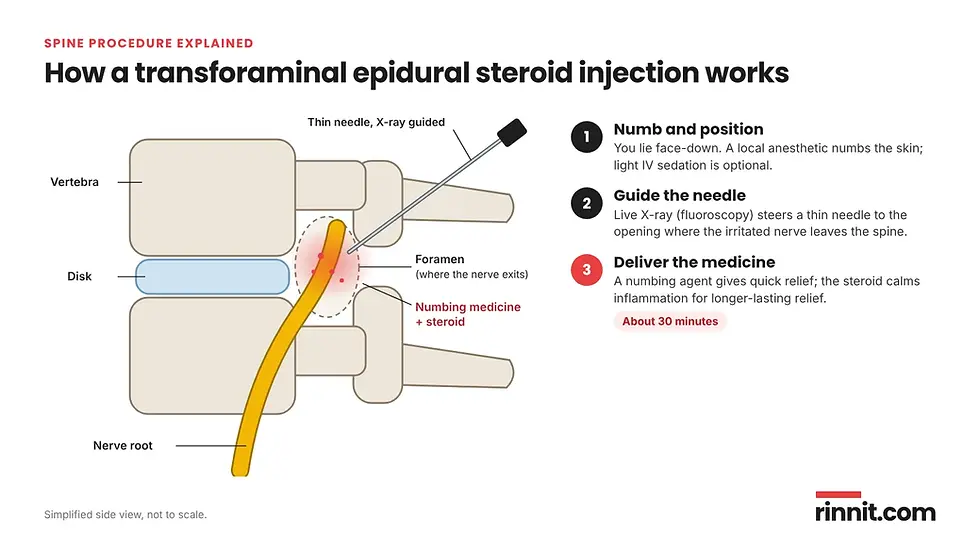
How a transforaminal injection reaches the irritated nerve root.
Does a transforaminal injection hurt?
A transforaminal injection usually causes pressure or a pinching feeling rather than significant pain, because local anesthesia numbs the area first. Most people feel this pressure while the needle is placed and while the medicine is injected. [1]
What is recovery like after a transforaminal injection?
Recovery after a transforaminal injection is usually quick, and most people return to normal activities the next day. You can go back to your usual diet and medicines right away. [1]
Time after the injection | What to expect |
Right away | Resume your normal diet and medicines |
First 12 hours | Do not drive; avoid vigorous exercise |
Next day | Most people return to normal activities |
24–48 hours | The steroid may begin to work |
Up to 2 weeks | The steroid reaches its full effect |
14 days | No improvement? Ask your provider about other options |
Source: [1]

What recovery usually looks like, day by day.
How long does a transforaminal injection last?
Relief from a transforaminal injection can last from several weeks to several months, and how long it lasts differs from person to person. If the treatment works for you, repeat injections from time to time may be an option. [1]
Research shows the benefit is real but often modest. One review found pain scores about 1 point lower (on a 0–10 scale) at 3 months than with a numbing medicine or saline alone. [2]
How many transforaminal injections can you have?
Generally, three to six transforaminal injections per year are considered safe, though each person's needs differ. [1]
What are the risks and side effects of a transforaminal injection?
Serious complications of a transforaminal injection, such as bleeding, infection and nerve injury, are rare. The FDA warns that, rarely, steroid injections into the epidural space can cause spinal cord injury, stroke, paralysis or death, and these steroids are not FDA-approved for this use. Common side effects are short-lived and usually go away within a few hours. [1]
Type | Examples | How common or how long |
Common side effects | Numbness or weakness in the legs or feet, dizziness, headache | Usually a few hours |
Rare complications | Bleeding, infection, nerve injury | Rare |
Source: [1]
In a study of 1,305 lumbar transforaminal injections, no major complications occurred. Temporary minor problems affected 11.5% of injections, most often feeling faint. [4]

Side effects, yearly limits and warning signs at a glance.
When should you call your provider after a transforaminal injection?
Call your provider after a transforaminal injection if numbness, weakness or other side effects last more than a day, or if you notice any of these: [1]
New pain, or pain that gets worse
Fever
Swelling, increasing warmth or redness where the needle went in
Conclusion: Is a transforaminal injection right for you?
A transforaminal epidural steroid injection is a short, X-ray-guided procedure that places medicine right beside an irritated spinal nerve. Many people get weeks to months of relief, with a quick recovery and a low risk of serious problems. [1][2]
Next step: If your provider has suggested this injection, bring this article to your appointment and ask how many injections they plan, what to do if relief doesn't come within two weeks, and what comes next if it works. Then learn more about your diagnosis in our guides to sciatica, herniated disks and dermatomes, the body's sensory map. Questions? Email us at support@rinnit.com.
FAQ
What is a transforaminal epidural steroid injection?
A transforaminal epidural steroid injection is a procedure that places a numbing medicine and a steroid into the epidural space through the foramen, the opening where a spinal nerve exits. It is guided by live X-ray. [1]
What conditions does a transforaminal injection treat?
A transforaminal injection treats lower back pain, sciatica, spinal and foraminal stenosis, herniated disks, pinched nerves, spondylolisthesis and bone spurs. It can ease pain that spreads into the arms, legs or feet. [1]
Is a transforaminal injection painful?
A transforaminal injection usually feels like pressure or pinching rather than significant pain. Local anesthesia numbs the skin first. [1]
How long does it take for a transforaminal injection to work?
A transforaminal injection's steroid may take 24 to 48 hours to start working and up to two weeks to reach its full effect. If you don't improve within 14 days, check with your provider. [1]
How long does a transforaminal injection last?
Relief from a transforaminal injection can last from several weeks to several months. How long it lasts varies from person to person. [1]
How many transforaminal injections can I have in a year?
Generally, three to six transforaminal injections per year are considered safe. If two or three injections don't help, more are unlikely to. [1]
Can I drive after a transforaminal injection?
No. Don't drive for 12 hours after a transforaminal injection, and avoid vigorous exercise. Most people return to normal activities the next day. [1]
When should I seek medical care after a transforaminal injection?
Contact your provider if numbness or weakness lasts more than a day, pain is new or worse, or you have fever, swelling, warmth or redness at the injection site. [1]
How is a transforaminal injection different from an interlaminar injection?
A transforaminal injection places medicine at the opening where a single nerve root leaves the spine. An interlaminar injection enters the epidural space from the back, between two vertebrae, so the medicine spreads more widely.
Can a transforaminal injection raise blood sugar?
Yes. The steroid can raise blood sugar for a few days, especially in people with diabetes. Check your blood sugar more often, and call your provider if it stays high.
Related Reading
Cervical Epidural Steroid Injection: Uses, Procedure and Results explains cervical epidural steroid injections.
Lumbar Epidural Steroid Injection: Uses, Procedure and Results explains epidural steroid injections for low back pain.
References
Cleveland Clinic. Transforaminal Epidural Steroid Injection. Cleveland Clinic. Last updated January 8, 2024. https://my.clevelandclinic.org/health/treatments/17572-transforaminal-injections
Bhatia A, Flamer D, Shah PS, et al. Transforaminal Epidural Steroid Injections for Treating Lumbosacral Radicular Pain from Herniated Intervertebral Discs: A Systematic Review and Meta-Analysis. Anesth Analg. 2016;122(3):857-870. PMID 26891397. https://doi.org/10.1213/ANE.0000000000001155
Conger A, Cushman DM, Speckman RA, et al. The Effectiveness of Fluoroscopically Guided Cervical Transforaminal Epidural Steroid Injection for the Treatment of Radicular Pain; a Systematic Review and Meta-analysis. Pain Med. 2020;21(1):41-54. PMID 31181148. https://doi.org/10.1093/pm/pnz127
Karaman H, Kavak GO, Tüfek A, et al. The complications of transforaminal lumbar epidural steroid injections. Spine (Phila Pa 1976). 2011;36(13):E819-E824. PMID 21217425. https://doi.org/10.1097/BRS.0b013e3181f32bae
Medical disclaimer
This article is for educational purposes only and is not a substitute for professional medical advice, diagnosis or treatment. Always talk with a qualified healthcare professional about back, neck, arm or leg pain and before any spinal procedure.



Comments