Spermicide: How to Use It, Types, Effectiveness & Risks

Updated: 6 days ago
Written and medically reviewed by Dr. Baraa Alnahhal, MD · Last reviewed: October 2026 · How we review
Quick Answer: What is spermicide?
Spermicide is a hormone-free, over-the-counter birth control you put in the vagina before sex that stops sperm from moving so they can't reach an egg. It comes as a gel, cream, foam, suppository, film, sponge or coated condom. Used alone, it fails for about 21 in 100 women each year, so pair it with a condom. It doesn't prevent STIs. [1]
What the research says
Dose and user behavior both affect how well spermicide works. A review of 14 randomized trials found that in the largest trial, the chance of pregnancy by 6 months was 22% with a low-dose gel (52.5 mg nonoxynol-9), 16% at 100 mg, and 14% at 150 mg, and 39% of participants stopped or dropped out. (Grimes et al., Cochrane Database Syst Rev, 2013) [2]
Spermicide does not lower HIV or STI risk, and may cause genital sores. A meta-analysis of 9 trials in 5,096 women found no significant drop in HIV (relative risk 1.12) or other STIs, while genital lesions were 18% more common with nonoxynol-9. (Wilkinson et al., Lancet Infect Dis, 2002) [3]
Vaginal irritation is a real, common complaint. In a 6-month randomized trial of 240 women, 13.3% of nonoxynol-9 gel users reported itching, burning, or discharge, and only 42.5% were satisfied with the product. (Li et al., Contraception, 2013) [4]
Key takeaways
Spermicide stops sperm from moving so they can't fertilize an egg.
Most products contain a chemical called nonoxynol-9 (N-9).
Timing matters: most types go in 10–15 minutes before sex and wear off within 30–60 minutes.
Alone, it's far less reliable than most birth control. Pair it with a condom.
It offers no STI or HIV protection and can irritate the skin.
What is spermicide?
Spermicide is a type of birth control that damages sperm so they can't cause pregnancy. [1]
You place it inside the vagina before sex. Most spermicides contain nonoxynol-9 (N-9), a chemical that stops sperm from moving. If sperm can't swim, they can't reach and fertilize an egg. [1]
Spermicide isn't the most reliable method when used by itself. It works best alongside another form of protection, like a condom. [1]
What are the types of spermicide?
Spermicide comes in six types: gel, cream or jelly; foam; suppositories; film; sponges; and spermicide-coated condoms. Each one has its own timing rules, so always read the label and wash your hands before use. [1]

Type | When to insert | How long it works | Good to know |
Gel, cream, or jelly | 10–15 min before sex | About 1 hour | Comes in tubes or prefilled applicators. Insert deep. |
Foam | At least 10–15 min before | About 30 minutes | Shake the can, fill the applicator. Shortest window. |
Suppository (tablet) | At least 10–15 min before | About 1 hour | Melts inside the vagina. You may or may not feel it. |
Film | At least 15 min before | About 1 hour | A thin sheet that fully dissolves inside. |
Sponge | Up to 24 hours before | — | Wet with water first. Leave in at least 6 hours after sex. Costs more. |
Spermicide-coated condom | — | — | Barrier + spermicide in one. Pricier and expires sooner. |
[1]
Gel, cream, or jelly
These come in tubes, bottles, or prefilled applicators. Some applicators are ready to use; others you fill yourself. [1]
Insert the applicator deep into the vagina, ideally 10 to 15 minutes before sex. It works for about an hour. If you have sex more than once in that hour, apply it again. [1]
Foam
Foam comes in an aerosol can with an applicator. Shake the can, then fill the applicator as directed on the package. [1]
Insert it at least 10 to 15 minutes before sex. Foam starts losing strength after about 30 minutes, so the window is short. [1]
Suppositories
These are tablets that melt inside the vagina. Push the tablet in as deep as possible, at least 10 to 15 minutes before sex, so it has time to melt. [1]
Some people feel it melting; others don't. It stops working after about an hour. [1]
Film
A small, thin sheet coated in spermicide. Place it deep in the vagina at least 15 minutes before sex so it can fully dissolve. It wears off after about an hour. [1]
Sponge
A small sponge that contains spermicide. Wet it with water, then insert it deep into the vagina. [1]
Its big advantage: you can put it in up to 24 hours before sex. Leave it in for at least six hours afterward. It's one of the more expensive options. Don't leave a sponge in for more than 30 hours in total, because that raises the risk of toxic shock syndrome. [1]
Spermicide-coated condoms
These are regular condoms with a spermicide coating. You get two forms of pregnancy protection in one product: a barrier and a spermicide. [1]
The trade-off: they usually cost more than regular condoms and expire sooner. [1]
How do you use spermicide correctly?
You use spermicide correctly by inserting it deep in the vagina at least 10–15 minutes before sex, every time, and leaving it in afterward. Instructions differ by product, so follow the package. These four rules apply to all types: [1]

Go deep. Put it as far into the vagina as you can.
Time it right. Insert it at least 10–15 minutes before sex.
Every single time. Reapply spermicide each time you have sex.
Leave it in. Never wash out or remove spermicide after sex.
How effective is spermicide?
Used alone, spermicide is one of the least effective birth control methods. [1]
About 21 out of 100 women who rely on spermicide get pregnant each year. That's roughly 1 in 5. [1]
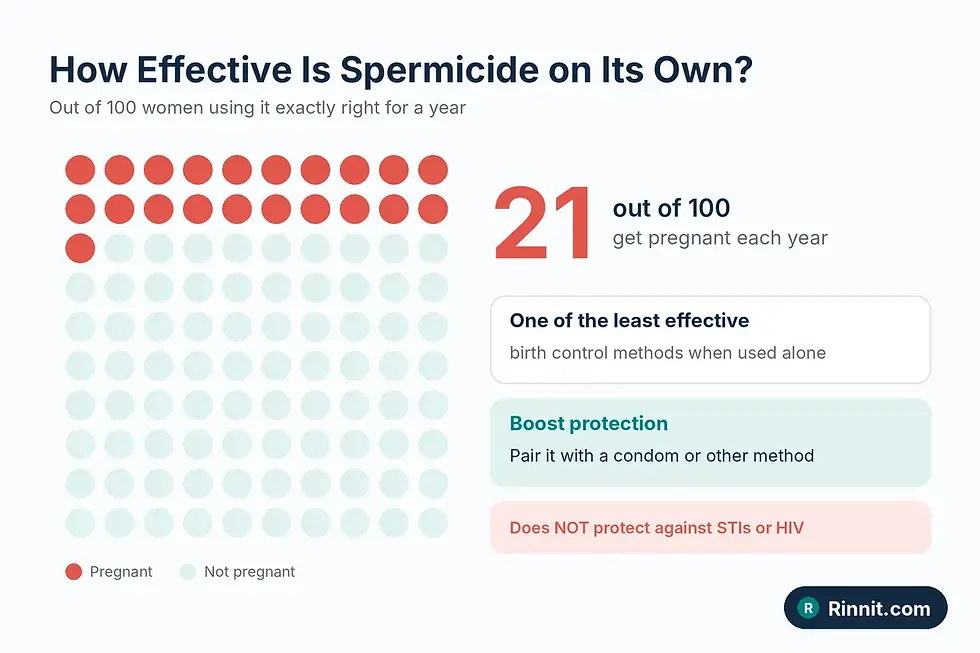
If your goal is to prevent pregnancy, combine spermicide with another method, such as a condom, to raise your protection. [1]
What are the pros and cons of spermicide?
Spermicide is inexpensive, hormone-free and sold without a prescription, but it's less effective than other birth control and offers no STI protection. It is generally safe, but if it causes redness or irritation, stop using it. There are many other birth control options that may suit you better. [1]
✅ Advantages | ❌ Disadvantages |
Inexpensive | Must follow instructions exactly to work |
Easy to use and apply | Must reapply every time you have sex |
Sold in most stores and supermarkets | |
No hormones | No protection against STIs |
Can double as a lubricant | Can cause irritation |
No prescription needed | — |
[1]
What are the side effects of spermicide?
The most common side effect of spermicide is pain and irritation in the vagina or penis. [1]
That irritation matters. Once the skin is irritated, it's easier for germs to get in. This can raise your risk of: [1] [3]
Does spermicide protect against STIs?
Spermicide does not protect against sexually transmitted infections (STIs). [1] [3]
In fact, the skin irritation it can cause may increase your risk of infection. Condoms are the best way to protect against STIs during sex. [1]
When should you call a healthcare provider about spermicide?
Contact a healthcare provider if you use spermicide and notice unusual discharge, sores, pain when you pee, fever, pelvic pain or pain during sex. [1]
Symptom | Why it matters |
Foul-smelling or oddly colored vaginal discharge | Possible infection |
Rash or sores on the vagina | Irritation or infection |
Pain when you pee | Possible UTI |
Fever or chills | Possible infection |
Pelvic or belly pain | Needs checking |
Pain during sex | Irritation or another cause |
[1]
Conclusion
Spermicide is easy to get, simple to use, hormone-free, and doesn't need a prescription. That makes it a convenient option for many people.
But it comes with real limits. On its own, it fails for about 1 in 5 women each year, it can irritate the skin, and it offers no STI protection. The smartest way to use it is as a backup, paired with a condom or another method.
If spermicide irritates you or you want stronger protection, talk with your healthcare provider about birth control that fits your life.
Want more clear, doctor-written health guides? Explore the Rinnit Health Library for plain-language answers you can trust, and bring them to your next doctor's visit.
FAQ
What is spermicide made of?
Most spermicides contain nonoxynol-9 (N-9), a chemical that stops sperm from moving so they can't reach an egg.
How long before sex should I use spermicide?
Most types should go in at least 10 to 15 minutes before sex. Film needs at least 15 minutes. A sponge can go in up to 24 hours before.
How long does spermicide last?
Gels, creams, suppositories, and film work for about an hour. Foam starts losing strength after about 30 minutes.
Can I use spermicide alone as birth control?
You can, but it's one of the least effective methods. About 21 out of 100 women who rely on it get pregnant each year. Pairing it with a condom boosts protection.
Do I need to reapply spermicide for round two?
Yes. Reapply spermicide each time you have sex, even if it's within the same hour.
Should I wash spermicide out after sex?
No. Never wash out or remove spermicide after sex. If you use a sponge, leave it in for at least six hours.
Does spermicide prevent STIs or HIV?
No. It doesn't protect against STIs, and the irritation it can cause may raise the risk of infection, including HIV. Condoms are the best protection.
Do I need a prescription for spermicide?
No. Spermicide is sold over the counter at most drugstores and supermarkets.
What are the side effects of spermicide?
The most common is pain or irritation in the vagina or penis. Irritation can raise the risk of UTIs and HIV. Stop using it if you notice redness or irritation.
Can I use spermicide with a diaphragm or cervical cap?
Yes. Diaphragms and cervical caps are designed to be used with spermicide, which makes them work better. Follow the instructions that come with your device.
Related Reading
Condoms: Types, Effectiveness, and How to Use Them Correctly explains condom types, how to use them and how well they work.
Intrauterine Device (IUD): Long-Acting Reversible Contraception compares hormonal and copper IUDs, including insertion and risks.
Birth Control Pill: Types, Effectiveness and Side Effects explains how birth control pills prevent pregnancy and their side effects.
Sexually Transmitted Diseases (STDs) Guide: Symptoms, Causes, Diagnosis, and Treatment covers common STIs, their symptoms, testing and treatment.
References
Cleveland Clinic. Spermicide: How To Use, Benefits, Risks & Effectiveness. Cleveland Clinic. Last updated March 3, 2026. https://my.clevelandclinic.org/health/treatments/22493-spermicide
Grimes DA, Lopez LM, Raymond EG, et al. Spermicide used alone for contraception. Cochrane Database Syst Rev. 2013;2013(12):CD005218. PMID 24307556. https://doi.org/10.1002/14651858.CD005218.pub4
Wilkinson D, Tholandi M, Ramjee G, et al. Nonoxynol-9 spermicide for prevention of vaginally acquired HIV and other sexually transmitted infections: systematic review and meta-analysis of randomised controlled trials including more than 5000 women. Lancet Infect Dis. 2002;2(10):613-617. PMID 12383611. https://doi.org/10.1016/s1473-3099(02)00396-1
Li W, Huang Z, Wu Y, et al. Effectiveness of an optimized benzalkonium chloride gel as vaginal contraceptive: a randomized controlled trial among Chinese women. Contraception. 2013;87(6):756-765. PMID 23089047. https://doi.org/10.1016/j.contraception.2012.09.012
Medical disclaimer
This article is for general education only and is not a substitute for professional medical advice, diagnosis or treatment. Always talk with your doctor or a qualified healthcare provider about the birth control that is right for you.



Comments