Condoms: Types, Effectiveness, and How to Use Them Correctly

Updated: 2 days ago
Written and medically reviewed by Dr. Baraa Alnahhal, MD · Last reviewed: October 2026 · How we review
Quick Answer: What is a condom?
Condoms are sheaths worn on the penis or in the vagina that block body fluids. Used correctly, they are 98% effective against pregnancy (87% when not used correctly) and lower the risk of chlamydia, gonorrhea, hepatitis B and HIV (consistent use cut HIV risk by 70% to 80%), but protect less against herpes, genital warts and syphilis. [1][2]
What the research says
Always using condoms cut HIV infections by about 80% in couples where one partner had HIV. A systematic review of 14 studies found 1.14 new HIV infections per 100 person-years in couples who always used condoms, compared with 5.75 in long-term studies of couples who never did. (Weller & Davis, Cochrane Database Syst Rev, 2002) [3]
Consistent use gave about 70% protection against HIV during anal sex between men. In two U.S. prospective cohorts, men who always used condoms with an HIV-positive partner had 70% lower risk than never-users, while "sometimes" use gave no significant protection. Only 16% reported consistent use throughout. (Smith et al., J Acquir Immune Defic Syndr, 2015) [4]
A partner's consistent condom use lowered HPV infection risk in newly sexually active women. Among 82 university students, HPV infections occurred at 37.8 per 100 patient-years with 100% condom use versus 89.3 with use under 5% of the time (adjusted hazard ratio 0.3 — roughly a 70% lower risk). No cervical precancer changes were seen in the always-use group. (Winer et al., N Engl J Med, 2006) [5]
Key takeaways
Condoms protect against both pregnancy and many sexually transmitted infections (STIs).
Correct use matters most: effectiveness drops from 98% to 87% when condoms are used incorrectly.
Most condom failures come from human error, not faulty products.
Latex and plastic condoms protect against STIs. Natural skin condoms do not.
Never use oil-based lube with latex or polyisoprene condoms.
If a condom breaks, emergency contraception and STI testing are your next steps.
How does a condom protect against STIs and pregnancy?
A condom protects you by creating a physical barrier between bodies during sex. [1]
That barrier limits skin-to-skin contact and keeps body fluids from passing between partners. Viruses and bacteria that cause sexually transmitted infections can't easily cross it.
It also prevents pregnancy by keeping sperm out of the vagina, so sperm can't reach an egg.
Using a condom every time you have sex is one of the best ways to practice safe sex. You can buy condoms over the counter at pharmacies, grocery stores and general merchandise stores. [1]
How effective are condoms at preventing pregnancy?
Condoms are about 98% effective at preventing pregnancy when you use them correctly every time. [1]
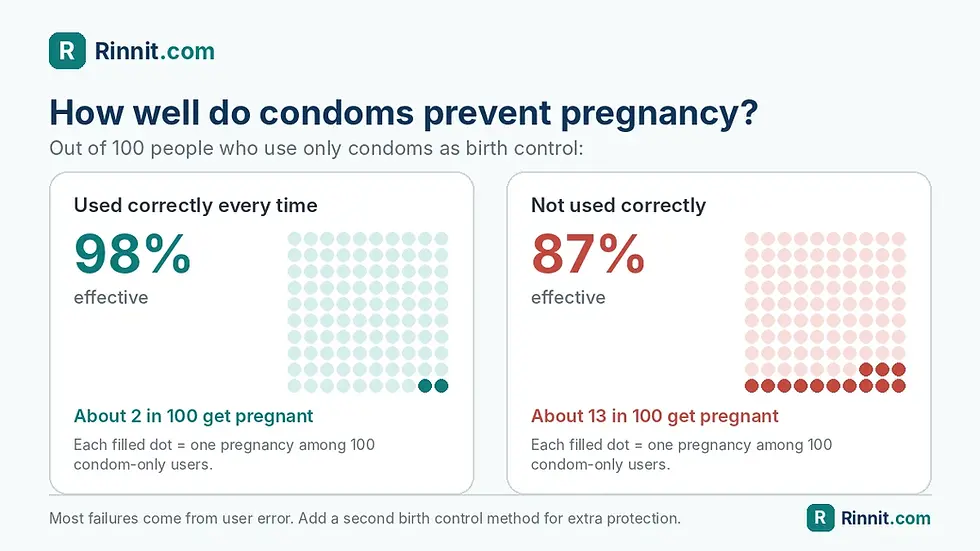
Here's what those numbers mean in real life:
How condoms are used | Effectiveness | Out of 100 people using only condoms |
Correctly, every time | About 98% | About 2 get pregnant |
Not used correctly | About 87% | About 13 get pregnant |
The gap between those two rows comes almost entirely from how people use condoms.
For extra pregnancy protection, it's a good idea to use condoms together with another birth control method. [1]
Which STIs do condoms protect against?
Used correctly every time, condoms greatly lower the risk of chlamydia, gonorrhea, hepatitis B and HIV; studies show consistent use cuts HIV risk by about 70% to 80%. [1][2]
But condoms don't cover the entire genital area. Some infections spread through skin-to-skin contact, so protection against them is lower. [1]
Level of protection | Infections |
High (large risk reduction with consistent use) | Chlamydia, gonorrhea, hepatitis B, HIV |
Lower (can still spread through skin-to-skin contact) |
Condoms greatly reduce your risk, but no condom is guaranteed to work without failure.
Why do condoms fail?
Condoms fail mainly because of human error — a mistake made while using one. [1]
Common mistakes include:
Not putting the condom on properly
Tearing it with long or sharp fingernails, jewelry or piercings
Not using enough lubricant (lube)
Wearing more than one condom at a time
Putting it on after genital contact has already started
Reusing a condom
Using the same condom with more than one partner during group sex
Using a condom that doesn't fit well
Using an expired condom
Condoms can also break, tear, leak or slip off. When that happens, your risk of an STI or unplanned pregnancy goes up. [1]
What are the different types of condoms?
There are four main types of condoms and barrier products, each designed for a different kind of sexual contact. [1]
Type | Also called | How it's used |
External condom | Male condom | Worn over the penis |
Internal condom | Female condom | Placed inside the vagina; a soft outer ring helps you remove it afterward |
Dental dam | — | A thin latex or polyurethane sheet placed between the mouth and a partner's genitals or anus during oral sex; lowers the risk of STIs such as oral HPV |
Finger condom | Finger cot | Fits over one finger for fingering (digital penetration) |
Fingering is low-risk. It can't cause pregnancy unless there's semen on the fingers, and passing an STI this way isn't common — but finger condoms lower the risk even further.
Use only one condom at a time. Two condoms rub against each other, and that extra friction makes them more likely to rip or tear.
What are condoms made of, and which lubricants are safe?
Condoms are made from one of three materials: latex, plastic (latex-free) or natural skin. [1] Each one works with different lubricants.

Material | Water-based lube | Silicone lube | Oil-based lube | Protects against STIs? |
Latex | Safe | Safe | Not safe — can cause breakage | Yes |
Polyurethane or nitrile (plastic) | Safe | Safe | Safe | Yes |
Polyisoprene (plastic) | Safe | Safe | Not safe — can cause breakage | Yes |
Natural skin | Safe | Safe | Safe | Not recommended |
Latex condoms
Latex is a type of rubber and the most common condom material. Latex condoms are effective against both pregnancy and STIs. [1]
Plastic (latex-free) condoms
Plastic condoms are made of polyurethane, polyisoprene or nitrile. They're a good alternative if you or your partner has a latex allergy, and they help prevent both pregnancy and STIs. [1]
Natural skin condoms
Natural skin condoms are made from animal intestinal lining, most often from sheep. They help prevent pregnancy because sperm are too large to pass through them. [1]
However, they have very tiny holes that bacteria and viruses can slip through. That's why they're not recommended for STI prevention.
What is the difference between lubricated and non-lubricated condoms?
Lubricated condoms come pre-coated with lube to reduce friction, while non-lubricated condoms come dry. [1]
Lubricated | Non-lubricated | |
Main benefit | Less friction, so a lower chance of ripping | You choose your own lube — or none |
Good for | Reducing friction during intercourse | Oral sex; using your own lube; people with lube sensitivities or allergies |
Watch out for | Some contain spermicide, which is linked to UTIs | Not enough lube raises the chance of tearing |
Some lubricated condoms contain spermicidal lube. Spermicide is a form of birth control that stops sperm from reaching an egg.
How do you choose the right condom size and feel?
The right condom fits snugly — not too tight, not too loose — when the penis is fully erect. [1]
A poor fit can feel uncomfortable and may not work as well. Check the size guide on the box, which is based on erect penis measurements.
Many condoms are designed to boost pleasure:
Thinner condoms for more sensation
Textured condoms, such as ribbed or with nubs
Warming or cooling gels
Flavored condoms
Everyone is different, and what feels good for one person may not for another. Talk openly with your partner, and expect to try a few kinds before finding the right one for both of you.
How do you put on and remove an external condom correctly?
Put the condom on before the penis touches your partner's vagina, anus or mouth, and follow these eight steps. [1]

Make sure the penis is fully erect.
Check the expiration date. Expired condoms are more likely to break.
Open the package carefully. Tear one end by hand. Never use your teeth or a sharp object.
Check the direction. The rolled rim should face outward.
Place it on the tip. Leave about a quarter of an inch (about 6 mm) of space at the tip for semen.
Pinch the tip to squeeze out any air.
Roll it down to the base. If it won't unroll, it's probably inside out — throw it away and use a new one.
Hold the base while pulling out. Then remove the condom, tie it off and put it in the trash. Don't flush it — condoms can clog pipes.
For a printable version, see this step-by-step condom guide from U.S. public health authorities.
How should condoms be stored, and when do they expire?
Condoms do expire, usually between one and five years after they're made, depending on the material. [1]
Over time, the material breaks down and can become brittle — much like an old rubber hose. The lube in lubricated condoms can also dry out.
Before you use one:
Check the expiration date printed on the box and stamped on the wrapper.
Don't use a condom that feels sticky, dry or stiff when you open it.
To store condoms safely:
Keep them in a cool, dry place away from sunlight.
Avoid wallets, purses and pockets, where they can bend or crease.
What should you do if a condom breaks?
If a condom breaks, act quickly on two fronts: pregnancy prevention and STI testing. [1]
To prevent pregnancy:
Take a morning-after pill (emergency contraception). Used within 72 hours of sex, emergency contraception is up to 89% effective.
Ask your healthcare provider about a stronger prescription pill or a copper IUD, which can also stop pregnancy.
To protect your health:
Talk to your healthcare provider about STI testing, including HIV testing. If HIV exposure is possible, ask right away about post-exposure prophylaxis (PEP), which must be started within 72 hours.
What are the risks and side effects of condoms?
Condoms are safe for most people, but they carry a few risks. [1]
Risk | What it means |
Failure | Condoms can break, tear, leak or slip off |
Incomplete STI coverage | Skin-to-skin infections can still spread |
Latex allergy | Switch to plastic (latex-free) condoms |
Linked to spermicide-lubricated condoms | |
Genital irritation | May come from the material or the lube |
Never use household items as a substitute — such as balloons, latex gloves, plastic bags or plastic wrap. They don't stay in place and can scrape or cut skin. Open wounds on or near the genitals make STIs easier to pass. [1]
What are the alternatives to condoms for birth control?
Other common birth control options include the implant, patch, pill, intrauterine device (IUD), spermicide and vasectomy. [1]
These methods prevent pregnancy, but most don't protect against STIs. Many people combine one of them with condoms for stronger protection. Your healthcare provider can help you choose. You can also read an overview of birth control methods.
Conclusion
Condoms are one of the simplest and most effective ways to protect yourself against both STIs and pregnancy. Used correctly every time, they prevent about 98 out of 100 pregnancies and block most common STIs.
The key is consistency and correct use: choose the right material and size, use a compatible lube, put the condom on before any contact, and store it properly. If something goes wrong, emergency contraception and STI testing can help you act quickly.
Want to protect your sexual health with confidence? Explore our complete guide to sexually transmitted diseases to learn the symptoms, testing options and treatments — and talk with your healthcare provider about the protection plan that fits you best.
FAQ
Are condoms 100% effective?
No. Condoms are about 98% effective against pregnancy with correct use and about 87% when not used correctly. They can break, slip or leak, and they don't fully protect against skin-to-skin STIs such as herpes, genital warts and syphilis.
Can you reuse a condom?
No. Reusing a condom is one of the common mistakes that cause condoms to fail. Use a new condom every time you have sex and with each partner.
Is it safer to wear two condoms?
No. Wearing two condoms creates friction between them, which makes both more likely to rip or tear. Always use one condom at a time.
What lube is safe with latex condoms?
Water-based and silicone-based lubes are safe with latex condoms. Oil-based lubes can weaken latex and cause the condom to break.
Do condoms protect against herpes?
Only partly. Condoms don't cover the whole genital area, so herpes, genital warts and syphilis can still spread through skin-to-skin contact.
How long do condoms last?
Most condoms last between one and five years, depending on the material. Always check the expiration date on the box or wrapper before use.
Is there a minimum age to buy condoms?
In the United States, there is no minimum age — teenagers can buy condoms, and a cashier can't refuse to sell them. Rules may differ in other countries.
What should I do if a condom breaks?
Take emergency contraception as soon as possible — within 72 hours it's up to 89% effective — and contact your healthcare provider about STI and HIV testing, and about HIV PEP, which must start within 72 hours.
What if I am allergic to latex?
Use condoms made of plastic, such as polyurethane or polyisoprene. They protect against both pregnancy and STIs. Natural skin condoms do not protect well against STIs.
What is an internal condom?
An internal condom is a soft pouch worn inside the vagina or anus. It works as a barrier against pregnancy and STIs and can be put in before sex.
Related Reading
Sexually Transmitted Diseases (STDs) Guide: Symptoms, Causes, Diagnosis, and Treatment covers common STIs, their symptoms, testing and treatment.
Latex Allergy: The Complete Guide explains latex allergy symptoms and how to avoid reactions.
Spermicide: How to Use It, Types, Effectiveness & Risks explains how spermicide works, how to use it and its limits.
Intrauterine Device (IUD): Long-Acting Reversible Contraception compares hormonal and copper IUDs, insertion and effectiveness.
References
Cleveland Clinic. Condoms: Types, Use, Effectiveness & How They Work. Cleveland Clinic. Last updated November 18, 2025. https://my.clevelandclinic.org/health/treatments/9404-condoms
Marfatia YS, Pandya I, Mehta K. Condoms: past, present, and future. Indian J Sex Transm Dis AIDS. 2015;36(2):133-139. PMID 26692603. https://doi.org/10.4103/0253-7184.167135
Weller S, Davis K. Condom effectiveness in reducing heterosexual HIV transmission. Cochrane Database Syst Rev. 2002;2002(1):CD003255. PMID 11869658. https://doi.org/10.1002/14651858.CD003255
Smith DK, Herbst JH, Zhang X, et al. Condom effectiveness for HIV prevention by consistency of use among men who have sex with men in the United States. J Acquir Immune Defic Syndr. 2015;68(3):337-344. PMID 25469526. https://doi.org/10.1097/QAI.0000000000000461
Winer RL, Hughes JP, Feng Q, et al. Condom use and the risk of genital human papillomavirus infection in young women. N Engl J Med. 2006;354(25):2645-2654. PMID 16790697. https://doi.org/10.1056/NEJMoa053284
Centers for Disease Control and Prevention. How to Use a Condom. CDC. Last reviewed April 3, 2024. https://www.cdc.gov/condom-use/resources/external.html
U.S. Food and Drug Administration. Birth Control. FDA. Content current as of May 10, 2024. https://www.fda.gov/consumers/womens-health-topics/birth-control
Planned Parenthood. Condom. Planned Parenthood. Accessed October 30, 2026. https://www.plannedparenthood.org/learn/birth-control/condom
Disclaimer
This article is for general educational purposes only and is not a substitute for professional medical advice, diagnosis or treatment. Always talk to a qualified healthcare provider about your specific situation.



Comments