Richter Hernia: Symptoms, Causes, and Emergency Treatment

Updated: 3 days ago
Medically reviewed by Dr. Baraa Alnahhal, MD · Last reviewed: October 2026
Quick Answer: What is a Richter hernia?
A Richter hernia is a rare abdominal wall hernia in which only part of the intestine's circumference becomes trapped in a small, rigid opening, often at surgical incisions or the femoral or inguinal canal. It often lacks an obvious bulge or obstruction symptoms, but the trapped section is highly prone to strangulation and gangrene, making it a life-threatening surgical emergency. [1] [2]
Emergency warning
Seek immediate medical attention or go to the emergency room if you have any of the following (see also our guide to the acute abdomen):
Increasingly severe abdominal or groin pain.
Persistent nausea and vomiting.
Swelling in the belly or groin area.
Fever or signs of infection after a suspected hernia.

What the research says
Richter hernias are uncommon but dangerous. In a clinical review, they accounted for about 10% of strangulated hernias, were most often diagnosed in people in their 50s and 60s, and progressed to gangrene more rapidly than other strangulated hernias, while bowel obstruction was less frequent (Skandalakis et al., Am Surg, 2006). [3]
Normal bowel movements do not rule it out. A case report described a man in his 70s with 3 days of abdominal pain and vomiting despite normal bowel movements. CT suggested an incarcerated left inguinal hernia, and emergency surgery found a Richter hernia with a strangulated but viable loop of bowel. Early surgery led to a good outcome (Smith & Chatzikonstantinou, J Surg Case Rep, 2024). [4]
It can also affect younger people. A case report described a 20-year-old man with 3 days of crampy pain around the navel, a non-reducible umbilical bulge, and vomiting. Surgery found a mildly ischemic loop of ileum, which was reduced and repaired, and he went home on the second day after surgery (Birhanu et al., Int J Surg Case Rep, 2023). [5]
What Is a Richter Hernia?
A Richter hernia occurs when a small portion of the intestinal wall pushes through a defect in the fascia, the connective tissue that covers the abdominal muscles. Unlike most hernias, in which a full loop of intestine is involved, only the outer side of the bowel gets stuck. This makes the condition deceptive, because waste can keep passing through the intestine. For background on hernias in general, see our guide to hernia repair surgery. [1]
These hernias typically occur in small, tight spaces that do not stretch, such as:
What are the symptoms of a Richter hernia, and why can they be misleading?
The symptoms of a Richter hernia can be subtle because it does not usually cause a full bowel obstruction. People may have abdominal discomfort, nausea, or swelling, yet still be able to eat, pass gas, and have normal bowel movements. This lack of an obvious blockage often delays diagnosis. [1]
Symptom | Description |
Abdominal Pain | Discomfort that can become increasingly severe if the tissue is strangulated. |
Nausea and Vomiting | General signs of distress in the digestive system. |
Swelling | May occur in the belly or groin, though it is often less obvious than with other hernias. |
Normal Digestion | You may still be able to eat and pass gas and stool despite the hernia. |
What causes a Richter hernia, and who is at risk?
Richter hernias usually happen when an opening or defect already exists in the abdominal wall that is just big enough for the edge of the bowel to poke through, but too small for the whole loop. [1]
Age: Most Richter hernias are diagnosed in people in their 50s and 60s, because tissues weaken with age and gaps become more likely. [1] [3]
Surgical history: A history of laparoscopic or robotic surgery is a risk factor, and these hernias have become more common with the rise of minimally invasive surgery because they can form at small port-site incisions that do not close completely. [1]
Anatomical defects: Small gaps in the lower abdominal muscles can create openings in the groin canals. [1]
Why is strangulation a dangerous complication of a Richter hernia?
Richter hernias are more likely than other hernias to become incarcerated (stuck) and strangulated (cut off from their blood supply). When the blood supply is lost, the trapped tissue begins to die (necrosis), which can happen quickly. [1]
The risk of gangrene
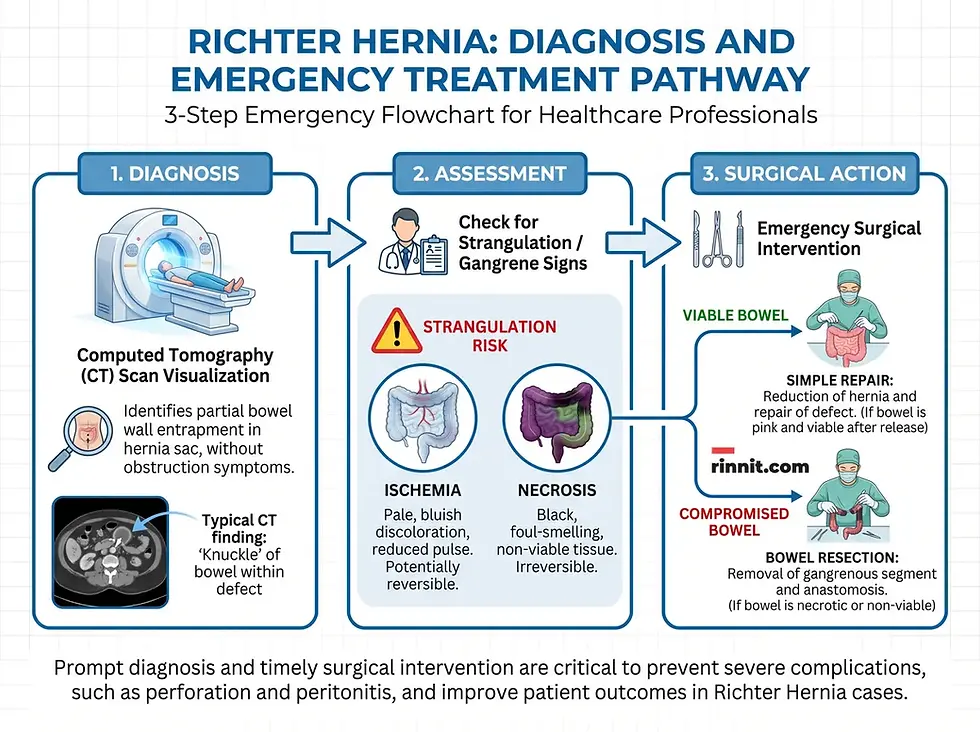
Strangulated Richter hernias progress to gangrene faster than other types. One study cited by Cleveland Clinic found a rate close to 70%. If it is left untreated, dead tissue can lead to a hole (perforation) in the bowel wall, which can cause: [1] [3]
How is a Richter hernia diagnosed?
Richter hernias are rare and may not cause obvious symptoms, so imaging, especially a CT scan, along with blood tests is often needed to find them. [1]
If test results suggest an emergency, you may have additional imaging or even exploratory surgery. [1]
How is a Richter hernia managed and treated with surgery?
A Richter hernia needs surgery, and often quickly. By the time it is found, it may already be strangulated. The type of surgery depends on whether the tissue has already begun to die. [1]
Elective repair: If the hernia is not strangulated, a repair, usually a minimally invasive procedure, moves the tissue back into place and closes the defect. [1]
Emergency laparotomy: If strangulation is suspected, open surgery (laparotomy) is usually needed to assess the damage. [1]
Bowel resection: If gangrene has set in, the surgeon removes the dead section of bowel, and the healthy ends are stitched back together. You may also need IV fluids and antibiotics. [1]
Temporary ostomy: In some cases, a temporary opening in the abdomen is created to divert waste while the bowel heals (see our guides to ostomy surgery and ostomy reversal). [1]
Recovery expectations
Recovery from a simple repair is quick, and you are usually back to your routine within a few days. A bowel resection is major surgery that needs at least a few days in the hospital and about six weeks of recovery at home. Full recovery from severe complications can take many months. [1]

Conclusion
Richter hernias are small but dangerous. Because they do not usually cause the signs of a bowel obstruction, vigilance is important, especially for anyone who has recently had abdominal surgery. Early recognition is the most important factor in preventing life-threatening complications such as gangrene and sepsis.
What are the next steps if you suspect a Richter hernia?
If you have had recent abdominal surgery and develop new pain or swelling, contact your healthcare provider right away. Follow all post-operative instructions for caring for your surgical incisions, and call your provider if you develop new symptoms during recovery.
Trusted resources: Cleveland Clinic: Richter Hernia, ACS Case Reviews in Surgery: A Case of Richter Hernia.
Frequently Asked Questions
Is a Richter hernia the same as a regular hernia?
No. In a regular hernia, a full loop of intestine pushes through the opening, while in a Richter hernia only part of the intestinal wall is trapped. [1]
Can I still poop with a Richter hernia?
Yes. Because the whole intestine is not blocked, most people can still pass gas and stool normally, which often delays diagnosis. [1]
Does laparoscopic surgery increase the risk?
A history of laparoscopic or robotic surgery is a risk factor. Richter hernias can form at the small incision sites (ports) used in these operations. [1]
Can a Richter hernia be treated without surgery?
No. A Richter hernia needs surgery, and it is often urgent because of the risk of strangulation and tissue death. [1]
How do doctors find a Richter hernia?
Imaging is most likely to find it. A CT scan is better than an ultrasound for spotting the small trapped portion of bowel wall. [1]
What is strangulation?
Strangulation happens when the blood supply to the trapped tissue is cut off, which can lead to rapid tissue death. [1]
What is a bowel resection?
A bowel resection is a surgery that removes a diseased or dead part of the intestine and reconnects the healthy ends. [1]
Will I need a permanent ostomy bag?
Usually not. If an ostomy is needed, it is typically temporary to let the bowel heal after a resection, and it can be reversed after you recover. [1]
Can a Richter hernia cause sepsis?
Yes. If the bowel wall develops a hole, bacteria can spread and cause a life-threatening infection called sepsis. [1]
How long is the recovery after a bowel resection?
Expect at least a few days in the hospital and about six weeks of recovery at home. Full recovery from severe complications can take many months. [1]
Are there any visible signs of a Richter hernia?
There may be slight swelling in the belly or groin, but often there is no visible bulge at all. [1]
Can I prevent a Richter hernia?
A Richter hernia cannot always be prevented. If you have had abdominal surgery, follow your surgeon’s aftercare instructions and contact your provider right away if hernia symptoms appear. [1]
Related Reading
Femoral Hernia: Causes, Symptoms, and Treatment explains a groin hernia type often involved in Richter hernias.
Inguinal Hernia: Symptoms, Causes, and When Surgery Is Needed covers the most common groin hernia and when surgery is needed.
Ventral Hernia: Types, Symptoms, and Treatment Options explains abdominal wall hernias, including those at surgical incisions.
Hernia Repair Surgery: Procedures, Recovery, and Outcomes describes open and keyhole hernia repair and the recovery process.
References
Cleveland Clinic. Richter Hernia. Cleveland Clinic. December 29, 2025. https://my.clevelandclinic.org/health/diseases/richter-hernia
Katragadda K, DeStefano LM, Khan MF. A Case of Richter Hernia: A Rare Entity. ACS Case Reviews in Surgery. 2020;2(3). https://www.facs.org/for-medical-professionals/news-publications/journals/case-reviews/issues/v2n3/katragadda-richter/
Skandalakis PN, Zoras O, Skandalakis JE, et al. Richter hernia: surgical anatomy and technique of repair. Am Surg. 2006;72(2):180-184. PMID 16536253. https://pubmed.ncbi.nlm.nih.gov/16536253/
Smith CR, Chatzikonstantinou M. Early surgical intervention is critical for strangulated Richter’s hernia. J Surg Case Rep. 2024;2024(10):rjae642. PMID 39399630. https://doi.org/10.1093/jscr/rjae642
Birhanu AM, Mohammed SH, Mohammed SM, et al. Incarcerated Richter’s congenital umbilical hernia in a young male: a case report. Int J Surg Case Rep. 2023;109:108576. PMID 37524021. https://doi.org/10.1016/j.ijscr.2023.108576
Medical Disclaimer
This article is for informational purposes only and does not constitute medical advice. Richter hernias are life-threatening surgical emergencies. Always seek the advice of your physician or other qualified health provider with any questions you may have regarding a medical condition. Never disregard professional medical advice or delay in seeking it because of something you have read in this article.



Comments