Pulse Volume Recording (PVR Test): What It Is, How It's Done and Results

Updated: 2 days ago
Written and medically reviewed by Dr. Baraa Alnahhal, MD · Last reviewed: November 2026 · How we review
Quick Answer: What is a pulse volume recording (PVR test)?
A pulse volume recording, or PVR test, is a painless test that measures blood pressure and blood flow in the legs using blood pressure cuffs and an ultrasound device. It's used to diagnose or monitor peripheral artery disease (PAD) and find the area of a narrowed or blocked artery. It takes 30 to 60 minutes. [1]
What the research says
Pulse volume waves are very good at ruling out PAD. In 205 patients referred for leg artery checks, pulse volume waveform analysis detected PAD with a sensitivity of 97% and specificity of 81%, compared with 79% and 91% for the ankle-brachial index. Using both tests together caught every case (100% sensitivity). (Lewis et al., SAGE Open Medicine, 2016) [2]
Pulse volume waves help in people with diabetes. In 303 people with type 2 diabetes, pulse volume waveform analysis detected PAD with a sensitivity of 81.8%, higher than the ankle-brachial index measurements (72.7% or lower). All the tests had excellent specificity. (Babaei et al., Primary Care Diabetes, 2020) [3]
Key takeaways
A PVR test measures blood pressure and blood flow in your legs to diagnose or monitor PAD. [1]
It can help locate the general area of a narrowed or blocked artery, but not the exact artery. [1]
Cuffs go on your big toes, ankles, calves, thighs and arms, and a handheld ultrasound device records waveforms. [1]
The test is painless and noninvasive and takes 30 to 60 minutes. [1]
It's often done with an ankle-brachial index, an arterial duplex ultrasound or an exercise stress test. [1]
PVR gives more accurate results than an ABI alone in people with hardened arteries from diabetes or kidney disease. [1]
What is a pulse volume recording?
A pulse volume recording (PVR) measures blood flow in your legs. It uses ultrasound, which is high-frequency sound waves, to check circulation in your arteries. The test is painless and noninvasive, so it doesn't need any needles or cuts in your skin. It's also called pulse volume plethysmography or a segmental pressure test. [1]
When is a PVR test done?
Your provider may recommend a PVR test to diagnose or assess peripheral artery disease (PAD). PAD happens when the blood vessels that carry blood from your heart to your legs get too narrow, usually because of atherosclerosis, a buildup of cholesterol and plaque in the arteries. [1]
A PVR test can also help locate blood clots or other blockages in your legs. If you have unexplained leg pain when walking, your provider may order one to check for blockages. Sometimes it also helps diagnose: [1]
Artery disease in the arms or fingers
Thoracic outlet syndrome (TOS)
How PVR compares with other vascular tests

A PVR is one type of noninvasive vascular test, and your provider may combine it with others: [1]
Test | How it works | How it differs from PVR |
Compares blood pressure at your ankles with your arms | The most common PAD test; PVR measures pulse volume at more points along the leg and is more accurate when arteries are hardened by diabetes or chronic kidney disease | |
Arterial duplex ultrasound | A handheld tool sends high-frequency sound waves through your legs to show narrowed or blocked areas | Doesn't measure blood pressure |
Leg blood pressure is measured before and after walking on a treadmill | Used when a resting PVR is normal but you still have leg pain with exercise |
Sources: [1]
Who performs a PVR test?
Vascular technologists or sonographers usually perform PVR tests and other noninvasive vascular tests. Sometimes a nurse does the test. [1]
How do you prepare for a PVR test?
You don't need to do anything special. Your provider may ask you to stop certain medicines or avoid smoking before the test. Let the technician know if you've had treatment for vascular disease, such as a stent, angioplasty or bypass surgery. [1]
What happens during a PVR test?
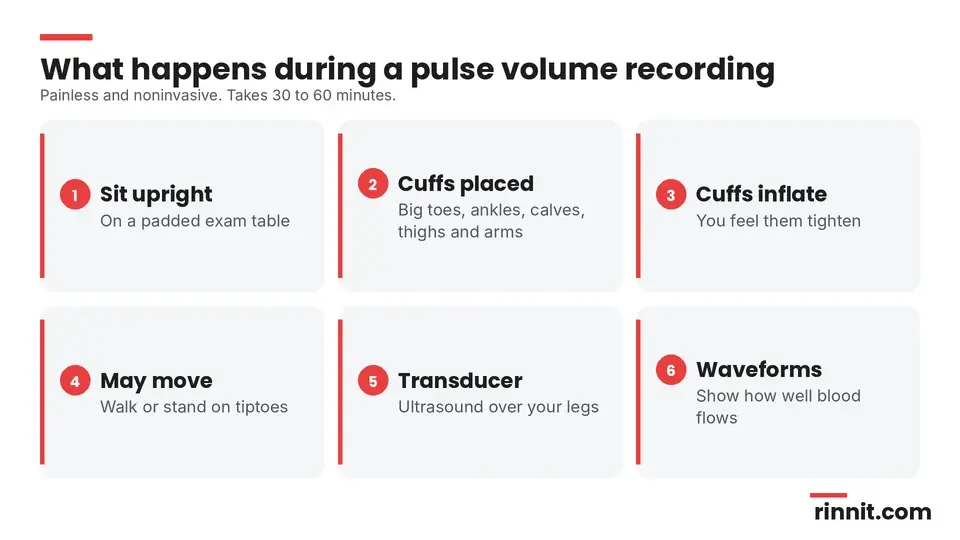
You'll remove your clothes and jewelry and change into a hospital gown. You won't need anesthesia or sedation because the test is painless. During the test: [1]
You sit upright on a padded exam table.
A provider places blood pressure cuffs on your big toes, ankles, calves, upper and lower thighs and arms, and applies a special gel to your skin to help the ultrasound.
The cuffs inflate to measure your blood pressure. You'll feel them tighten, but it shouldn't be uncomfortable.
In some cases, your provider asks you to walk or stand on your tiptoes.
With the cuffs inflated, the provider moves a handheld device called a transducer over different parts of your legs.
The cuffs sense small changes in the volume of your leg with each heartbeat, and the results appear on a monitor as waveforms; a handheld Doppler may be used to check pressures. The shape of the waveforms shows how well blood is flowing.
A PVR test usually takes 30 to 60 minutes. Afterward, you can go home and return to your normal activities. [1]
Is a PVR test safe?
Yes. A PVR test is a safe, noninvasive procedure that doesn't carry any serious risks. [1]
What do PVR results mean?
A vascular technician or sonographer works with a physician to interpret the results, which can take anywhere from a few hours to a few days. [1]
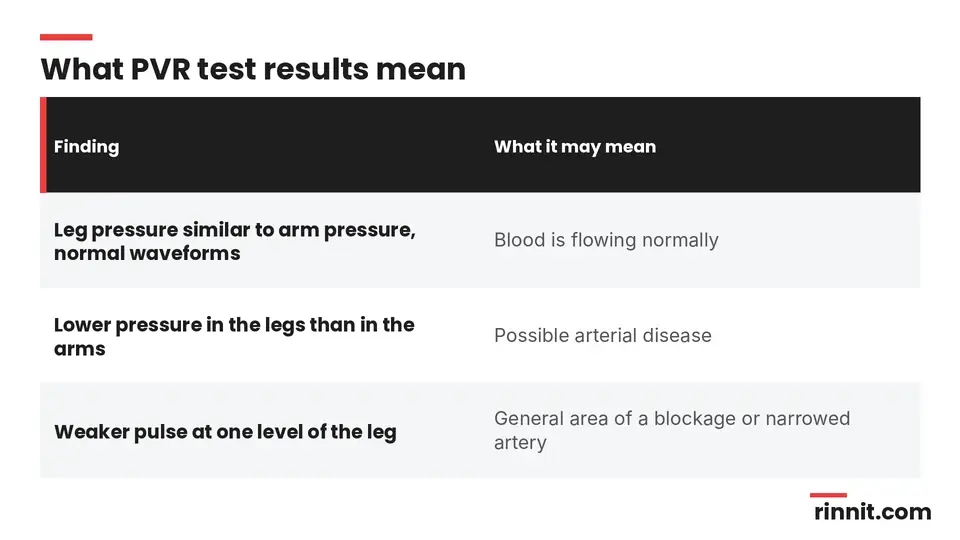
Your provider compares the blood pressure in your legs with the blood pressure in your arms. If the pressure is lower in your legs, you may have arterial disease. Your provider also compares the pulse at different parts of your leg to find the general location of blockages or narrowed arteries. A PVR test doesn't show which specific arteries are affected. [1]
Finding | What it may mean |
Leg pressure similar to arm pressure, normal waveforms | Blood is flowing normally |
Lower pressure in the legs than in the arms | Possible arterial disease |
Weaker pulse at one level of the leg | The general area of a blockage or narrowed artery |
Sources: [1]
The results help your provider plan more testing, such as imaging, or treatment. [1]
Questions to ask your provider
Am I at risk for a blood clot if I have PAD?
How accurate are the results of a PVR test?
What are my treatment options for PAD?
Will I need more tests, such as imaging exams?
Conclusion
A pulse volume recording is a simple, painless way to measure blood pressure and blood flow along your legs. By comparing readings at different levels with your arm pressure, it helps your provider diagnose PAD and find the general area of a blockage.
It takes 30 to 60 minutes, needs no special preparation and carries no serious risks. Your provider will use the results, often together with an ABI or ultrasound, to decide whether you need more tests or treatment.
Keep learning: Read our guides to the ankle-brachial index (ABI), Doppler ultrasound, the exercise stress test and the angiogram.
FAQ
What is a pulse volume recording?
A pulse volume recording (PVR) is a painless, noninvasive test that measures blood pressure and blood flow in your legs. [1]
What does a PVR test diagnose?
It diagnoses or monitors peripheral artery disease and can help find blockages, artery disease in the arms or fingers and thoracic outlet syndrome. [1]
What is another name for a PVR test?
It's also called pulse volume plethysmography or a segmental pressure test. [1]
How long does a PVR test take?
A PVR test typically takes 30 to 60 minutes. [1]
Does a PVR test hurt?
No. The cuffs tighten, but you shouldn't feel discomfort, and no needles are used. [1]
How do I prepare for a PVR test?
No special preparation is needed, but your provider may ask you to stop certain medicines or avoid smoking. [1]
What is the difference between a PVR and an ABI?
Both compare leg and arm blood pressure, but a PVR measures pulse volume at more points along the leg and is more accurate when arteries are calcified. [1]
Can a PVR test show which artery is blocked?
No. It shows the general location of a blockage, not the specific artery. [1]
Who performs a PVR test?
A vascular technologist, sonographer or sometimes a nurse performs the test. [1]
How soon will I get PVR results?
Results can take anywhere from a few hours to a few days. [1]
Related Reading
Learn more in our guide to Peripheral Artery Disease (PAD): Symptoms, Causes, Diagnosis & Treatment Options.
Learn more in our guide to What Is Claudication? Why Your Legs Hurt When You Walk, and What to Do About It.
Learn more in our guide to Arteriosclerosis & Atherosclerosis: Symptoms, Causes, Diagnosis & Treatment — Complete Guide.
Learn more in our guide to What Is Arterial Thoracic Outlet Syndrome? A Plain-Language Guide to the Arm Blood Flow Problem That Rarely Gets Spotted Early.
References
Cleveland Clinic. Pulse Volume Recording: PVR Test. Cleveland Clinic. Last updated July 22, 2022. https://my.clevelandclinic.org/health/diagnostics/17403-pulse-volume-recordings
Lewis JE, Williams P, Davies JH. Non-invasive assessment of peripheral arterial disease: Automated ankle brachial index measurement and pulse volume analysis compared to duplex scan. SAGE Open Med. 2016;4:2050312116659088. PMID 27493755. https://doi.org/10.1177/2050312116659088
Babaei MR, Malek M, Rostami FT, et al. Non-invasive vascular assessment in people with type 2 diabetes: Diagnostic performance of Plethysmographic-and-Doppler derived ankle brachial index, toe brachial index, and pulse volume wave analysis for detection of peripheral arterial disease. Prim Care Diabetes. 2020;14(3):282-289. PMID 31624003. https://doi.org/10.1016/j.pcd.2019.09.005
Medical disclaimer
This article is for general education only and does not replace advice from a qualified healthcare professional. Talk to your doctor about your own diagnosis and treatment, and seek emergency care right away for severe or sudden symptoms.



Comments