Ankle-Brachial Index (ABI): Test, Normal Range and What Your Results Mean

Updated: 2 days ago
Written and medically reviewed by Dr. Baraa Alnahhal, MD · Last reviewed: November 2026 · How we review
Quick Answer: What is an ankle-brachial index (ABI)?
An ankle-brachial index (ABI) is a painless test that compares blood pressure in the ankles and arms to check for peripheral artery disease (PAD), a buildup of plaque in the leg arteries. A normal ABI is 1.0 to 1.3, and 0.9 or lower means you have PAD. It has no needles and takes 10 to 20 minutes. [1]
What the research says
A low ABI signals a higher risk of heart-related death. In a meta-analysis of 16 population studies with 48,294 people, men with an ABI of 0.90 or lower had a 10-year risk of dying from cardiovascular disease of 18.7%, compared with 4.4% in men with a normal ABI. In women, the figures were 12.6% vs 4.1%. (Fowkes et al., JAMA, 2008) [2]
A low ABI reliably points to blocked leg arteries, but can miss some cases. A review of 8 studies with 2,043 patients or limbs found that an ABI of 0.90 or lower had a specificity of 83.3% to 99.0% for detecting arteries narrowed by 50% or more. Sensitivity ranged widely, from 15% to 79%, and was lower in older adults and people with diabetes. (Xu et al., Vascular Medicine, 2010) [3]
Key takeaways
An ABI test compares the blood pressure in your ankles with the blood pressure in your arms to check for PAD. [1]
A normal ABI is 1.0 to 1.3; an ABI of 0.9 or lower means you have PAD. [1]
An ABI above 1.4 may mean stiff, calcified arteries, and other tests may be needed. [1]
Avoid caffeine on the day of the test, and avoid tobacco, alcohol and exercise for an hour beforehand. [1]
The test is noninvasive, and taking the blood pressures usually takes just 10 to 20 minutes. [1]
Finding PAD early gives you a chance to start treatment that may lower the risk of complications. [1]
What is an ankle-brachial index?
An ankle-brachial index (ABI) is a painless test that measures blood pressure in your ankles and arms. It shows whether you have peripheral artery disease (PAD), which is plaque buildup in the arteries of your legs. If your ankle pressure is lower than your arm pressure, blood isn't flowing as well in your legs, and you likely have PAD. [1]
Who should get an ABI test?
Your provider may recommend an ABI if you have PAD symptoms, such as leg pain when you're active. They may also suggest it if you don't have symptoms but you're: [1]
Age 65 or older
Age 50 to 64 with risk factors for atherosclerosis, such as diabetes, high blood pressure, high cholesterol or a history of tobacco use, or with PAD in your biological family
Under age 50 with diabetes plus another risk factor for atherosclerosis
An ABI test can catch PAD before it gets severe. That gives you a chance to start treatment that may lower your risk of complications such as critical limb ischemia and amputation. [1]
How does an ABI test work?
The provider doing your test, usually a nurse, checks the blood pressure of specific arteries in your arms and ankles by wrapping a cuff around each arm and ankle, one at a time. The cuff tightens for several seconds and then slowly releases. The arteries checked include: [1]
The brachial artery in each arm
The dorsalis pedis artery or the posterior tibial artery near each ankle
Your provider also uses a handheld ultrasound device to listen to blood flow in these arteries. The test doesn't involve any needles or cuts. It's very similar to a usual blood pressure check, but it includes all four limbs instead of one. [1]
How do you prepare for an ABI test?

To stay comfortable and get accurate results: [1]
Don't eat or drink anything with caffeine on the day of your test.
Don't use tobacco products or alcohol in the hour before your test.
Don't exercise in the hour before your test.
Wear loose, comfortable clothes so your provider can easily reach your upper arms and ankles.
Empty your bladder just before the test.
Tell your provider if you've had any procedures to improve circulation in your legs, as this may change how they do the test. [1]
What happens during an ABI test?
You'll lie down and rest for about 10 to 30 minutes before the test starts, and you'll stay on your back during it. Your provider may prop up your arms and ankles so they're level with your heart, which helps give the most accurate readings. Then your provider will: [1]
Check the blood pressure in one of your arms.
Check the blood pressure in the ankle on the same side.
Check the blood pressure in your other ankle.
Check the blood pressure in your other arm.
Your provider will tell you if any measurement needs repeating. Taking the blood pressures usually takes just 10 to 20 minutes. [1]
Are there any risks?
An ABI test is safe and usually has no risks. But tell your provider if: [1]
You have open wounds or ulcers. Your provider won't place the cuff over that area, or they may need to use another test.
You've recently had a vascular bypass. Squeezing that area with the cuff could be dangerous and cause blood clots.
How do you calculate the ABI?
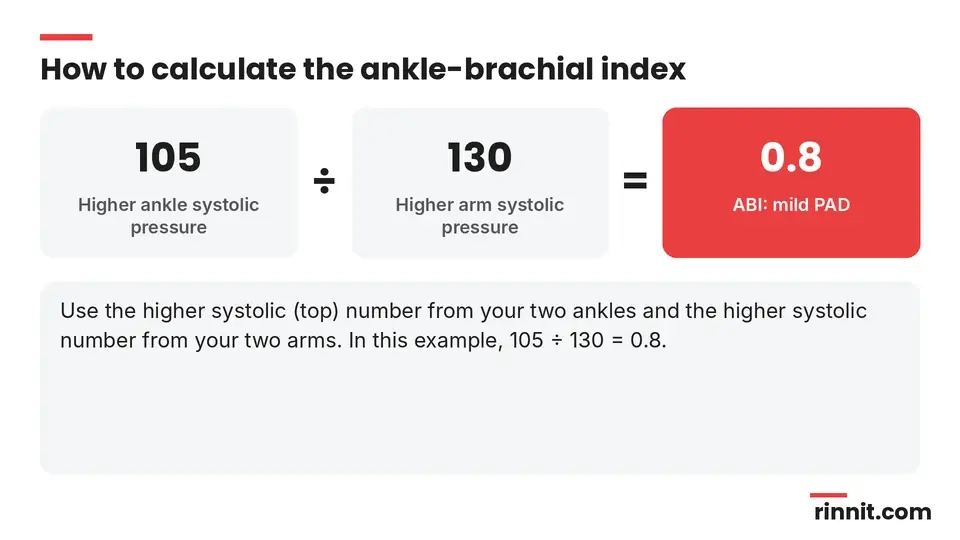
Take the higher systolic (top number) blood pressure from your two ankle readings and divide it by the higher systolic pressure from your two arm readings. [1]
Reading | Blood pressure | Value used |
Left ankle | 105/65 | 105 (higher ankle) |
Right ankle | 100/60 | Not used |
Left arm | 130/85 | 130 (higher arm) |
Right arm | 125/80 | Not used |
ABI | 105 ÷ 130 | 0.8, which means mild PAD |
Sources: [1]
What do ABI results mean?

A normal ABI is 1.0 to 1.3. An ABI of 0.9 or lower means you have PAD. Here's the range healthcare providers use: [1]
ABI | What it means |
1.0 to 1.3 | Normal |
0.9 to 1.0 | Borderline |
0.7 to 0.9 | Mild PAD |
0.4 to 0.7 | Moderate PAD |
Lower than 0.4 | Severe PAD |
Sources: [1]
What does a high ABI mean?
A high ABI, above 1.4, could mean the blood vessels in your limbs are stiff (calcified) because of older age or diabetes. Researchers have found that people with an ABI higher than 1.4 have a higher risk of dying from cardiovascular disease. When arteries are calcified, an ABI can't reliably diagnose PAD, so your provider may use other tests, such as a toe-brachial index, which measures blood pressure in your big toe instead of your ankle. [1]
What happens after the test?
You can go back to your normal activities right away. The provider who did the test may share the results with you, or you'll follow up with the provider who ordered it. Contact your provider if you don't get your results. Depending on your results, you may need other tests or treatments. [1]
You might need to repeat the ABI test from time to time, especially if your number is outside the normal range. Regular testing helps your provider see whether PAD is getting worse and how well treatments to open your blood vessels are working. [1]
Questions to ask your provider
What was my ABI, and is it in the normal range?
Do I have PAD, and how severe is it?
Should I have a toe-brachial index or another test?
How often should I repeat the ABI test?
What treatments or lifestyle changes can improve blood flow in my legs?
Conclusion
The ankle-brachial index is one of the simplest ways to check for peripheral artery disease. It compares the blood pressure in your ankles and arms, takes only minutes, and needs no needles, cuts or sedation. A normal ABI is 1.0 to 1.3, while 0.9 or lower means PAD.
If you're 65 or older, or you have diabetes, high blood pressure, high cholesterol or a smoking history, ask your provider whether an ABI test makes sense for you. Finding PAD early gives you the best chance to protect your legs and your heart.
Keep learning: Read our guides to Doppler ultrasound, the exercise stress test, the angiogram and normal blood pressure by age.
FAQ
What is an ankle-brachial index test?
It's a painless test that compares the blood pressure in your ankles with the blood pressure in your arms to check for peripheral artery disease (PAD). [1]
What is a normal ankle-brachial index?
A normal ABI is 1.0 to 1.3. [1]
What ABI means peripheral artery disease?
An ABI of 0.9 or lower means you have PAD. [1]
How do you calculate the ankle-brachial index?
Divide the higher systolic pressure from your two ankles by the higher systolic pressure from your two arms. [1]
What does a high ABI mean?
An ABI above 1.4 may mean stiff, calcified arteries, often from older age or diabetes, and other tests may be needed. [1]
How long does an ABI test take?
You rest for 10 to 30 minutes first, then taking the blood pressures usually takes 10 to 20 minutes. [1]
How do I prepare for an ABI test?
Avoid caffeine that day, avoid tobacco, alcohol and exercise for an hour before, wear loose clothes and empty your bladder. [1]
Does an ABI test hurt?
No. The cuffs tighten for a few seconds, but there are no needles or cuts. [1]
Who should get an ABI test?
People with PAD symptoms, adults 65 and older, and some younger adults with diabetes or other risk factors for atherosclerosis. [1]
What is a toe-brachial index?
It measures blood pressure in your big toe instead of your ankle and is used when calcified arteries make the ABI unreliable. [1]
Related Reading
Aortobifemoral Bypass: Surgery, Recovery and Results explains aortobifemoral bypass surgery.
Learn more in our guide to Peripheral Artery Disease (PAD): Symptoms, Causes, Diagnosis & Treatment Options.
Learn more in our guide to What Is Claudication? Why Your Legs Hurt When You Walk, and What to Do About It.
Learn more in our guide to Chronic Limb-Threatening Ischemia (Critical Limb Ischemia): Why Leg Pain at Rest Is a Medical Emergency — and How Blood Flow Gets Restored.
Learn more in our guide to Arteriosclerosis & Atherosclerosis: Symptoms, Causes, Diagnosis & Treatment — Complete Guide.
References
Cleveland Clinic. Ankle-Brachial Index: Test & What It Means. Cleveland Clinic. Last updated March 27, 2025. https://my.clevelandclinic.org/health/diagnostics/17840-ankle-brachial-index-abi
Ankle Brachial Index Collaboration; Fowkes FG, Murray GD, Butcher I, et al. Ankle brachial index combined with Framingham Risk Score to predict cardiovascular events and mortality: a meta-analysis. JAMA. 2008;300(2):197-208. PMID 18612117. https://doi.org/10.1001/jama.300.2.197
Xu D, Li J, Zou L, et al. Sensitivity and specificity of the ankle--brachial index to diagnose peripheral artery disease: a structured review. Vasc Med. 2010;15(5):361-369. PMID 20926495. https://doi.org/10.1177/1358863X10378376
Medical disclaimer
This article is for general education only and does not replace advice from a qualified healthcare professional. Talk to your doctor about your own diagnosis and treatment, and seek emergency care right away for severe or sudden symptoms.



Comments