Aortobifemoral Bypass: Surgery, Recovery and Results

Updated: 2 days ago
Written and medically reviewed by Dr. Baraa Alnahhal, MD · Last reviewed: November 2026 · How we review
Quick Answer
An aortobifemoral bypass is open abdominal surgery that places a Y-shaped graft to route blood around blocked arteries in the lower belly and pelvis, improving blood flow to both legs. It treats severe aortoiliac occlusive disease and lowers the risk of gangrene and amputation. Full recovery takes 2 to 3 months.
What the research says
Grafts stayed open for most people: a review of 29 studies with 5,738 people found the graft was still open in 86.3% at five years, with operative mortality of 4.1% and systemic complications in 16.0% (Chiu KW et al., European Journal of Vascular and Endovascular Surgery, 2010) [2]
Open surgery lasted longer than stenting but was harder: in a review of 5,358 people, open bypass kept arteries open longer than endovascular treatment (82.7% vs. 71.4% at five years) but meant longer hospital stays (13 vs. 4 days), more complications and higher 30-day mortality (2.6% vs. 0.7%) (Indes JE et al., Journal of Endovascular Therapy, 2013) [3]
Key takeaways
An aortobifemoral bypass reroutes blood around blocked belly and pelvic arteries.
It treats severe aortoiliac occlusive disease.
Surgery takes 2 to 6 hours.
Full recovery takes 2 to 3 months.
Most grafts work for at least five years.
What is an aortobifemoral bypass?
The polyester graft is shaped like an upside-down "Y." Its top attaches to the aorta and its two branches attach to the femoral arteries in each groin. It's a type of peripheral artery bypass. Sources: [1]
Why it's done

It eases symptoms but doesn't cure the disease.
Leg pain when walking (claudication).
Severe leg pain at rest.
Gangrene.
Risk of amputation. Sources: [1]
It treats aortoiliac occlusive disease but doesn't cure it. Sources: [1]
Open surgery vs. endovascular repair
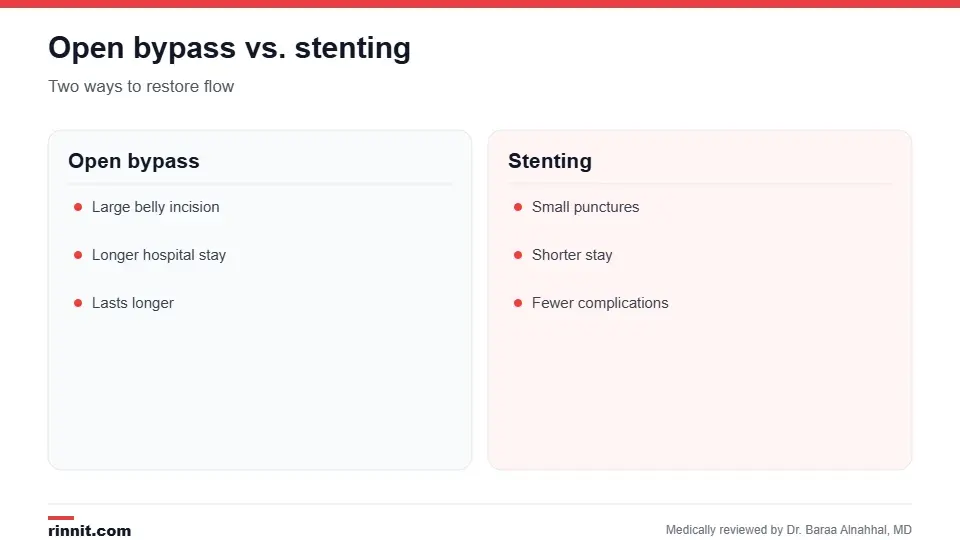
Open surgery may be needed if stenting isn't an option or has failed.
Feature | Open bypass | Endovascular stenting |
Incision | Large belly incision | Small punctures |
Hospital stay | Longer | Shorter |
Complications | More | Fewer |
Durability | Longer-lasting | Less durable |
Open surgery may be needed if you're not a candidate for stenting or stenting has failed. Sources: [1, 3]
How to prepare
Stop smoking and all tobacco at least 3 to 4 weeks before, and stay off it.
Adjust your medicines as directed.
Don't eat after midnight the night before.
Tests may include an ankle-brachial index, vascular ultrasound and heart imaging. Sources: [1]
What happens during surgery

Surgery takes 2 to 6 hours.
You get general anesthesia.
A long incision opens your belly to reach the aorta.
An incision at the top of each thigh reaches the femoral arteries.
The graft is sewn to the aorta above the blockage and to the femoral arteries below it.
Incisions are closed with staples or stitches. Sources: [1]
Risks
Heart attack or stroke.
Bleeding or blood clots.
Wound or graft infection.
Kidney or lung failure. Sources: [1, 2]
Recovery
You'll stay in the hospital 4 to 7 days.
Expect incision pain for the first few weeks.
Some normal activities resume in 4 to 6 weeks.
Full recovery may take 2 to 3 months.
Your team will tell you when to drive, work, lift and exercise. Sources: [1]
Outlook
Benefits include no leg pain at rest, longer pain-free walking and better wound healing. About 80% to 95% of surgeries improve blood flow for at least five years, and the 10-year success rate is 74% to 86%. Sources: [1, 2]
When to call your provider
Fever, nausea or vomiting.
Incision pain, warmth, discoloration or drainage.
Groin or leg redness or swelling.
Leg pain, numbness or tingling.
Cold, pale or blue skin on your leg or foot. Sources: [1]
Call 911 for signs of heart attack or stroke. Sources: [1]
Conclusion
An aortobifemoral bypass can restore strong blood flow to both legs and ease pain for years. Quitting tobacco for good helps the graft last.
Keep learning: read about peripheral artery disease and aortoiliac occlusive disease.
Frequently asked questions
What is an aortobifemoral bypass?
Surgery that routes blood around blocked belly arteries to both legs.
What does it treat?
Severe aortoiliac occlusive disease.
What is the graft made of?
Polyester, shaped like an upside-down "Y."
How long does surgery take?
2 to 6 hours.
How long is the hospital stay?
4 to 7 days.
How long is recovery?
Full recovery may take 2 to 3 months.
Is there a less invasive option?
Yes, aortoiliac stenting, for some people.
How long does the bypass last?
Most keep working for at least five years.
Do I need to quit smoking?
Yes, before and after surgery.
Does it cure the disease?
No, but it eases symptoms and complications.
Related Reading
Aortoiliac Occlusive Disease Explained: Symptoms, Causes, and the Treatment Ladder the condition it treats.
Peripheral Artery Disease (PAD): Symptoms, Causes, Diagnosis & Treatment Options narrowed leg arteries.
What Is Claudication? Why Your Legs Hurt When You Walk, and What to Do About It leg pain when walking.
Peripheral Artery Bypass: Restoring Blood Flow to the Limbs other bypass surgeries.
Ankle-Brachial Index (ABI): Test, Normal Range and What Your Results Mean a test for leg blood flow.
References
Cleveland Clinic. Aortobifemoral Bypass Surgery: What It Is & Procedure Details. Cleveland Clinic. Last updated January 30, 2023. https://my.clevelandclinic.org/health/treatments/24662-aortobifemoral-bypass
Chiu KW, Davies RS, Nightingale PG, et al. Review of direct anatomical open surgical management of atherosclerotic aorto-iliac occlusive disease. European Journal of Vascular and Endovascular Surgery. 2010;39(4):460-471. PMID 20303805. https://doi.org/10.1016/j.ejvs.2009.12.014
Indes JE, Pfaff MJ, Farrokhyar F, et al. Clinical outcomes of 5358 patients undergoing direct open bypass or endovascular treatment for aortoiliac occlusive disease: a systematic review and meta-analysis. Journal of Endovascular Therapy. 2013;20(4):443-455. PMID 23914850. https://doi.org/10.1583/13-4242.1
Medical disclaimer
This article is for general education only and does not replace advice from a qualified healthcare professional. Talk to your doctor about your own diagnosis and treatment, and seek emergency care right away for severe or sudden symptoms.



Comments