Understanding the Femoral Artery: Anatomy, Function, and Vascular Health

Updated: 2 days ago
Medically reviewed by Dr. Baraa Alnahhal, MD | Last reviewed: October 7, 2026
Quick Answer: What is the femoral artery?
The femoral artery is a major blood vessel that starts in the upper thigh near the groin and runs to the back of the knee [1], supplying oxygenated blood to the legs and lower body. A continuation of the external iliac artery [1], it divides into common, deep and superficial branches. Healthy flow through it supports physical activity.
What the research says
Peripheral artery disease is very common worldwide. A 2026 systematic review and modelling study of 157 articles from 37 countries (more than 9.7 million participants) estimated that 6.58% of adults aged 25 and over (about 316.54 million people) had peripheral arterial disease in 2023. Current smoking (OR 2.85), diabetes (OR 1.81), hypertension (OR 1.64) and high cholesterol (OR 1.34) were associated with higher risk (Zhou et al., The Lancet Global Health, 2026) [2].
Ultrasound guidance makes femoral artery access safer. A meta-analysis of 7 randomized trials with 3,180 patients found that ultrasound-guided femoral artery puncture succeeded on the first attempt more often than the standard approach (82.0% vs 58.7%) and lowered vascular complications (1.3% vs 3.0%; RR 0.48, 95% CI 0.25 to 0.91) (Sorrentino et al., Journal of Clinical Medicine, 2020) [3].
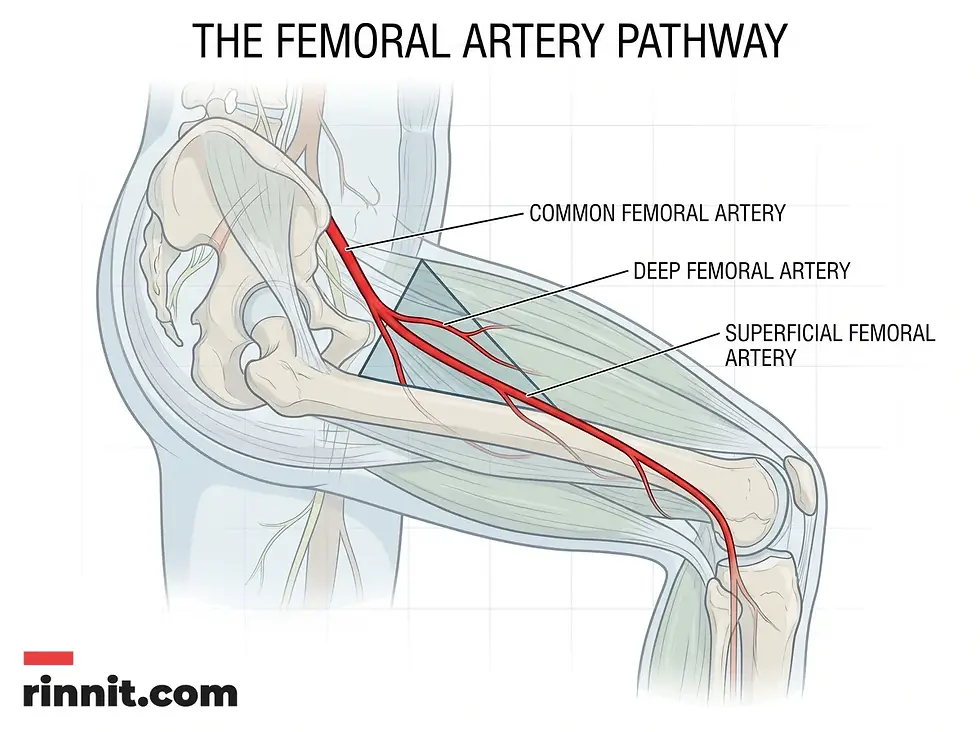
Anatomical Path and Structure
The femoral artery begins its journey as a continuation of the external iliac artery in the pelvis (read more in our guide to the iliac artery). It enters the thigh through the femoral triangle, a wedge-shaped area located just below the groin. From there, it follows a relatively straight path down the front of the thigh before terminating behind the knee, where it transitions into the popliteal artery [1].

The artery wall is composed of three distinct layers that ensure efficient and safe blood transport. The inner layer, or tunica intima, provides a smooth surface for blood flow and helps regulate blood pressure [1]. The middle layer, the media, is elastic and muscular, allowing the vessel to expand and contract as needed [1]. Finally, the outer layer, the adventitia, provides structural support and contains tiny vessels that supply the artery wall itself with nutrients [1].
Layer | Name | Primary Function |
Inner | Tunica Intima | Smooth blood flow, BP regulation, and toxin prevention [1] |
Middle | Media | Elasticity for expansion, contraction, and directional flow |
Outer | Adventitia | Structural support and nutrient delivery to vessel walls |
Major Divisions and Branches
To effectively supply the diverse tissues of the lower body, the femoral artery divides into several key sections. Each branch is specialized to deliver blood to specific muscle groups, bones, and organs.
The common femoral artery is the initial segment, measuring approximately four centimeters in length [1]. Its branches supply the abdominal wall, groin, and pubic area [1]. Branching off from this is the deep femoral artery, which penetrates deep into the thigh to nourish the femur, hip, and buttocks [1]. The superficial femoral artery continues the main path, delivering blood to the front thigh muscles and the knee region.
Clinical Importance and Procedures
Due to its significant diameter—typically between 7 and 8 millimeters [1]—the common femoral artery is a preferred site for endovascular procedures. Surgeons often use it as an entry point to insert catheters [1], which can then be guided to other parts of the circulatory system, including the heart. This makes the femoral artery a cornerstone of modern cardiovascular diagnostics and treatment.
However, its size and location also make it susceptible to various conditions. Peripheral artery disease (PAD) is the most common disorder [1], characterized by the narrowing of the artery due to plaque buildup (related reading: aortoiliac occlusive disease and peripheral artery bypass). Other concerns include blood clots and aneurysms, which are bulges in the vessel wall [1] (see femoral artery aneurysm). A sudden blockage or severe injury to the femoral artery is considered a medical emergency due to the high volume of blood it carries.
Signs of Vascular Dysfunction
Early recognition of femoral artery issues can prevent serious complications, including tissue death or the need for amputation [1]. Chronic issues often manifest as “claudication,” which is painful cramping or fatigue in the leg muscles during physical activity [1]. In contrast, acute blockages present with sudden, severe symptoms that require immediate intervention.
Maintaining Vascular Health
Protecting the femoral artery involves managing systemic vascular health through consistent lifestyle choices. Because the artery is part of the larger circulatory network, habits that benefit the heart will directly support the health of the lower limbs.
Key preventive strategies include:
Dietary Choices: Consuming foods low in sodium, cholesterol, and saturated fats [1].
Physical Activity: Engaging in regular exercise to promote circulation and vessel elasticity.
Blood Pressure Management: Monitoring and controlling hypertension to reduce strain on vessel walls.
Tobacco Avoidance: Eliminating tobacco use to protect the endothelial lining of the arteries.
Blood Sugar Control: Managing glucose levels to prevent long-term vascular damage.

Conclusion
The femoral artery is a vital component of human anatomy, serving as the lifeline for the lower body. Its role in delivering oxygen and nutrients is fundamental to mobility and tissue health, while its accessibility makes it an invaluable tool for modern medicine. By prioritizing vascular health and recognizing the signs of dysfunction, individuals can ensure the continued health and function of this essential blood vessel.
When to See a Healthcare Professional
If you experience persistent leg pain while walking or notice changes in the color and temperature of your skin, consult a healthcare provider for a vascular assessment. Early detection and management are the most effective ways to preserve mobility and prevent serious vascular events.
Frequently Asked Questions (FAQ)
What is the main function of the femoral artery?
The femoral artery is the primary vessel that supplies oxygen-rich blood to the legs and lower body.
Where can I feel the femoral pulse?
The pulse is typically felt in the groin area, where the common femoral artery is closest to the skin.
How large is the femoral artery?
The femoral artery is usually 7 to 8 millimeters in diameter, roughly the width of a quarter-inch.
What is peripheral artery disease (PAD)?
Peripheral artery disease (PAD) is a condition where the femoral or other peripheral arteries narrow due to plaque buildup.
Why is the femoral artery used for heart procedures?
The femoral artery's large diameter and straight path make it an ideal entry point for catheters.
What happens if the femoral artery is blocked?
A blockage can cause severe pain, numbness, and, if untreated, tissue death (gangrene).
What is the difference between the femoral artery and vein?
The artery carries oxygen-rich blood away from the heart, while the vein carries oxygen-poor blood back to it.
What is claudication?
Claudication is the painful cramping or fatigue in the legs during walking caused by reduced blood flow.
Where does the femoral artery end?
The femoral artery ends behind the knee, where it becomes the popliteal artery.
What are the three layers of the artery wall?
The tunica intima (inner), media (middle), and adventitia (outer).
Can smoking affect the femoral artery?
Yes, smoking is a major risk factor for PAD and damages the artery’s inner lining.
What is a femoral aneurysm?
A femoral aneurysm is a weak spot in the artery wall that bulges outward.
How is a blocked femoral artery diagnosed?
Common tests include Doppler ultrasound, CT angiograms, and the ankle-brachial index (ABI).
What are the signs of a severed femoral artery?
Massive, rapid bleeding from the groin or thigh area, which is a life-threatening emergency.
Is exercise good for femoral artery health?
Yes, regular physical activity helps improve circulation and manages blood pressure.
Related reading on Rinnit
The Circulatory System: Your Body’s Life-Sustaining Transport Network
Understanding the Iliac Artery: Anatomy, Function, and Vascular Health
Femoral Artery Aneurysm: Types, Symptoms, Causes, Diagnosis, Treatment and Outlook
Aortoiliac Occlusive Disease Explained: Symptoms, Causes, and the Treatment Ladder
Understanding Pseudoaneurysm: Causes, Symptoms, and Treatment
Sources
Cleveland Clinic. Femoral Artery. Cleveland Clinic. Last updated May 3, 2024. https://my.clevelandclinic.org/health/body/21645-femoral-artery
Zhou J, Liu X, Shan S, et al. Global, regional, and national prevalence of peripheral arterial disease in 2023: an updated systematic review and modelling study. Lancet Glob Health. 2026;14(9):103983. PMID 42480579. https://doi.org/10.1016/j.langlo.2026.103983
Sorrentino S, Nguyen P, Salerno N, et al. Standard Versus Ultrasound-Guided Cannulation of the Femoral Artery in Patients Undergoing Invasive Procedures: A Meta-Analysis of Randomized Controlled Trials. J Clin Med. 2020;9(3):677. PMID 32138283. https://doi.org/10.3390/jcm9030677
Medical disclaimer
This content is for informational purposes only and is not a substitute for professional medical advice, diagnosis, or treatment.



Comments