Femoral Artery Aneurysm: Types, Symptoms, Causes, Diagnosis, Treatment and Outlook — What You Need to Know

Updated: 2 days ago
Medically reviewed by Dr. Baraa Alnahhal, MD · Last reviewed: September 2026
Quick Answer: What Is a Femoral Artery Aneurysm?
A femoral artery aneurysm is a localized bulge or stretching of the major artery in the thigh, where the vessel wall weakens and expands to at least twice its normal size. While rare, affecting approximately 0.007% of men and even fewer women, it carries a significant risk of blood clots or rupture, which can lead to life-threatening blood loss. The condition is most common in men over age 70 and is primarily driven by atherosclerosis, smoking, and high blood pressure. While up to 40% of patients remain asymptomatic, others may notice a pulsating lump in the groin. Treatment typically involves open surgical repair using a fabric graft if the aneurysm exceeds 2.5 centimeters in diameter or causes symptoms.
TL;DR: Femoral Artery Aneurysm at a Glance
A femoral artery aneurysm is a serious vascular condition where the artery wall in the thigh stretches excessively, increasing the risk of tearing or clot formation. Often linked to aging and cardiovascular health, these aneurysms are classified into four types based on their specific location within the femoral artery branches. Diagnosis is confirmed through imaging like CT angiograms or ultrasound. While the risk of rupture is relatively low (1% to 14%), surgery is recommended for larger or symptomatic cases to ensure long-term vascular health.
Prevalence (men): approximately 0.007%.
Typical age: most common in individuals over age 70.
Rupture risk: estimated between 1% and 14%.
Asymptomatic rate: approximately 40% of cases show no symptoms.
Surgical threshold: recommended when the diameter exceeds 2.5 cm.
Post-op survival: mortality rate between 1% and 5% at the time of surgery.
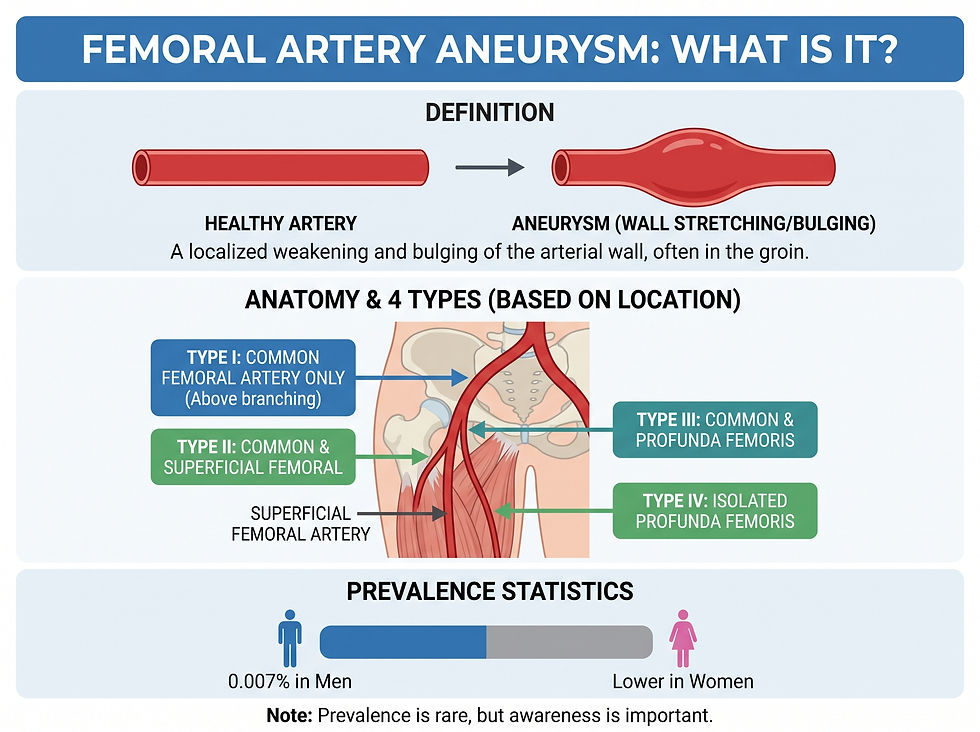
What Is a Femoral Artery Aneurysm?
A femoral artery aneurysm occurs when a segment of the primary blood vessel in the thigh stretches or bulges to roughly twice its normal diameter. This expansion involves all layers of the artery wall, leading to significant weakening. Because the femoral artery is a major conduit for blood flow to the lower extremities, a tear or rupture in this weakened wall can result in rapid and severe internal bleeding.
The Four Types of Femoral Artery Aneurysm
Type I: stops before the common femoral artery branches off.
Type II: includes the branching point and the profunda artery.
Type III: involves only the superficial femoral artery branch.
Type IV: includes only the deep or profunda femoral artery branch.
What Are the Symptoms of a Femoral Artery Aneurysm?
While many individuals with a femoral artery aneurysm do not experience noticeable signs, those who do often report symptoms localized to the groin or leg. These symptoms are typically caused by the physical presence of the bulge or the impact of blood clots forming within the weakened vessel.
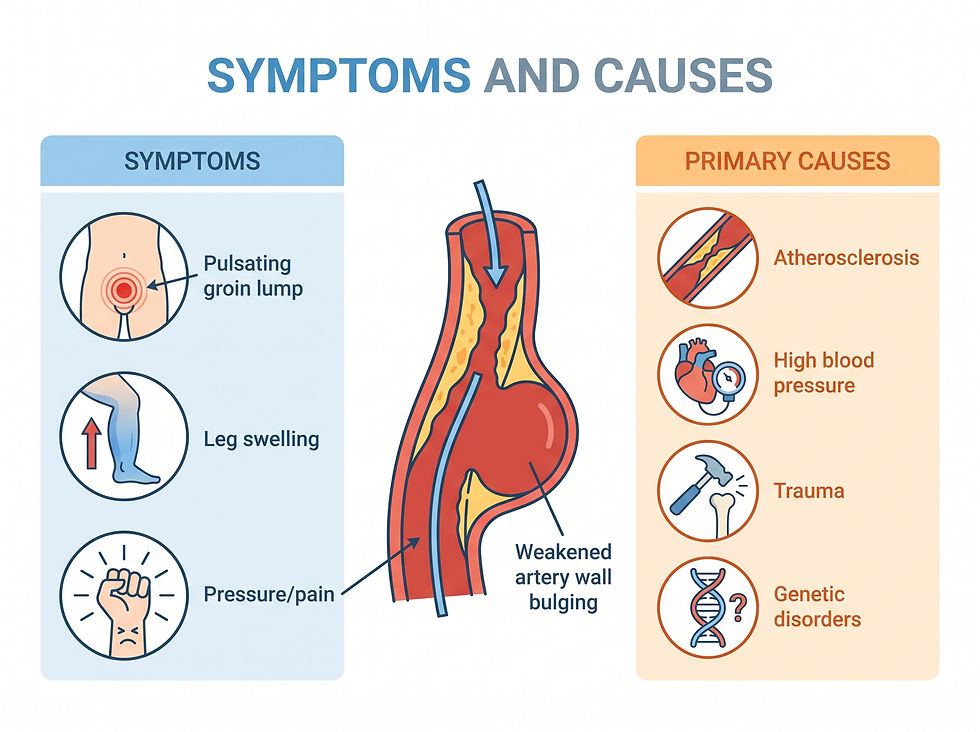
Physical signs: a lump in the groin that may have a pulsating sensation.
Leg changes: swelling in the lower leg or a feeling of pressure.
Pain levels: persistent pain in the groin or throughout the leg.
Complications: formation of blood clots or sudden, severe pain from rupture.
Silent cases: up to 40% of people experience no symptoms at all.
What Causes a Femoral Artery Aneurysm?
The weakening of the femoral artery wall is most frequently caused by long-term cardiovascular issues, though acute injuries and underlying genetic conditions also play a role. Understanding these causes is essential for both diagnosis and the management of risk factors.
Atherosclerosis: hardening of the arteries; the most common primary cause.
Hypertension: high blood pressure puts constant stress on artery walls.
Trauma: direct accidents or injuries to the thigh area.
Genetic disorders: conditions like Ehlers-Danlos or Marfan syndrome.
Vascular disease: Behçet disease or adventitial cystic disease.
How Is a Femoral Artery Aneurysm Diagnosed?
Healthcare providers often discover a femoral artery aneurysm during a routine physical examination. However, because a bulge in the groin can mimic other conditions, such as a hernia, diagnostic imaging is required to confirm the presence and exact location of the aneurysm.
Physical exam: feeling for a pulsating bulge in the groin area.
Ultrasound: using sound waves to visualize blood flow and vessel size.
CT angiogram: detailed X-ray imaging using contrast dye for vessel clarity.
MRA: magnetic resonance imaging focused on the blood vessels.
How Is a Femoral Artery Aneurysm Treated?
Treatment for a femoral artery aneurysm depends on its size and whether it is causing symptoms. Because the risk of rupture is relatively low for smaller aneurysms, a "watch and wait" approach is sometimes appropriate. However, surgical intervention is necessary when the risk of rupture or clot formation becomes significant.
Surgical threshold: required if the diameter is larger than 2.5 centimeters.
Open surgery: traditional repair where the surgeon works directly on the artery.
Fabric graft: replacing the weakened section of the artery with a durable patch.
Hospital stay: typically requires between three and 10 days for recovery.
Recovery time: complete recovery usually takes a month or more.
Complications: risks include infection, bleeding, or new blood clots.
How Can I Prevent a Femoral Artery Aneurysm?
Preventing the formation or worsening of a femoral artery aneurysm involves managing the underlying cardiovascular health issues that weaken artery walls. Lifestyle changes and medical management are the primary tools for risk reduction.
Blood pressure: maintaining a healthy range to reduce arterial stress.
Cholesterol: controlling levels through diet, exercise, or medication.
Tobacco cessation: stopping all tobacco use, as smoking accelerates growth.
Healthy diet: adopting a low-fat diet to combat atherosclerosis.
Regular exercise: supporting overall vascular health and circulation.

What Is the Outlook for Femoral Artery Aneurysm?
The long-term outlook for individuals who undergo surgical repair is generally very positive. Mortality rates during surgery are low, and the majority of grafts remain functional for many years. However, because aneurysms can develop in other locations, lifelong monitoring is essential for anyone diagnosed with this condition.
When to Seek Emergency Care
A femoral artery aneurysm can lead to sudden, severe complications if a clot blocks blood flow or the vessel ruptures. You should go to the emergency room immediately if your leg or foot becomes:
Weak or difficult to move.
Swollen suddenly or severely.
Painful with an intense, sharp sensation.
Numb or tingling (loss of feeling).
Cold to the touch compared to the other leg.
Pale or bluish in color.
Having an aneurysm in your femoral artery is very rare. However, if you have one, you can get a surgical repair before the aneurysm breaks or ruptures. Because this type of aneurysm isn’t common, it may give you peace of mind to find a provider who has a lot of experience with these surgeries.
Conclusion and Next Steps
While rare, a femoral artery aneurysm is a serious condition that requires professional medical oversight. By managing risk factors like high blood pressure and atherosclerosis, you can significantly reduce the likelihood of complications. If you have been diagnosed with an aneurysm, consistent follow-up care is the most effective way to ensure long-term health.
Recommended next steps:
Monitor for symptoms: regularly check for any pulsating lumps or unusual pain in the groin or thigh.
Manage cardiovascular health: work with your provider to control cholesterol and blood pressure levels.
Commit to lifelong screening: attend all scheduled vascular check-ups to detect any new aneurysms early.
Frequently Asked Questions
What is the difference between a femoral aneurysm and a pseudoaneurysm?
A true femoral aneurysm involves all layers of the artery wall stretching out, while a pseudoaneurysm (false aneurysm) usually occurs after a medical procedure and does not affect all layers of the vessel.
Is a femoral artery aneurysm life-threatening?
Yes, if the aneurysm ruptures or causes a major blood clot that blocks circulation to the leg, it can be a life-threatening medical emergency.
Can I have an aneurysm in both legs?
Yes, it is possible to have femoral artery aneurysms in both thighs simultaneously, and they may also occur alongside aneurysms in other parts of the body.
How rare is this condition?
It is very rare, affecting only about 0.007% of men. The rate for women is even lower.
What is the "2.5 centimeter rule"?
Vascular surgeons typically recommend surgical repair once a femoral artery aneurysm reaches a diameter of 2.5 centimeters (about 1 inch) to prevent rupture.
Does smoking affect femoral aneurysms?
Yes, smoking and tobacco use are major risk factors that can cause aneurysms to grow faster and weaken the artery walls further.
What is a fabric graft?
A fabric graft is a synthetic material used by surgeons to replace the weakened, stretched-out section of the artery during an open surgical repair.
How long is the recovery after surgery?
Most patients spend 3 to 10 days in the hospital and require a month or more for a complete recovery at home.
Can atherosclerosis cause an aneurysm?
Yes, atherosclerosis (hardening of the arteries) is the most common cause of the weakened vessel walls that lead to femoral aneurysms.
What are the symptoms of a ruptured aneurysm?
A rupture typically causes sudden, severe pain in the groin or leg, followed by signs of internal bleeding and potential shock.
Why is the condition more common in men?
While the exact reason isn't fully understood, statistics show that men, particularly those over age 70, are significantly more likely to develop femoral aneurysms.
Can exercise prevent aneurysms?
Regular exercise helps manage blood pressure and cholesterol, which are key factors in preventing the arterial weakening that leads to aneurysms.
Is open surgery the only treatment option?
For femoral artery aneurysms, open surgery is the standard repair method, allowing the surgeon to directly replace the damaged section of the vessel.
What imaging is best for diagnosis?
CT angiograms and MRAs are the most effective imaging tests for planning surgery, while ultrasound is often used for initial detection and monitoring.
Can a femoral aneurysm feel like a hernia?
Yes, a bulge in the groin caused by an aneurysm can look and feel very similar to a hernia, which is why imaging is necessary for a correct diagnosis.
What are the risks of the surgery?
The primary risks of surgical repair include infection at the incision site, bleeding, and the formation of new blood clots.
How often should I have check-ups?
Once diagnosed, you will likely need regular vascular check-ups for the rest of your life to monitor the graft and check for new aneurysms.
Does high cholesterol cause aneurysms?
High cholesterol contributes to atherosclerosis, which weakens the artery walls and is the leading cause of femoral aneurysms.
Can trauma to the leg cause an aneurysm?
Yes, a significant accident or injury to the thigh can damage the femoral artery and lead to the formation of an aneurysm.
What is Behçet disease?
Behçet disease is a rare disorder that causes blood vessel inflammation throughout the body, which can weaken the femoral artery.
Is a pulsating lump always an aneurysm?
Not necessarily, but a pulsating lump in the groin is a hallmark symptom of a femoral aneurysm and should be evaluated by a doctor immediately.
What is the profunda femoral artery?
The profunda femoral artery is one of the two main branches that the common femoral artery splits into in the thigh.
Can a femoral aneurysm cause leg swelling?
Yes, if the aneurysm or an associated blood clot interferes with circulation, it can cause noticeable swelling in the lower leg.
What is Ehlers-Danlos syndrome?
It is a group of inherited disorders that affect connective tissues, making artery walls more prone to stretching and tearing.
Can I travel after aneurysm surgery?
You should consult your surgeon before traveling, as long periods of sitting can increase the risk of blood clots during the recovery phase.
What is a vascular surgeon?
A vascular surgeon is a medical specialist who focuses on the health and surgical repair of the body's blood vessels, including the femoral artery.
Are there medications to shrink an aneurysm?
No, medications cannot shrink an existing aneurysm, but they can help manage blood pressure and cholesterol to prevent it from growing larger.
What happens if a clot travels?
If a blood clot breaks loose from the aneurysm, it can travel down the leg and block smaller vessels, potentially leading to tissue damage or loss of the limb.
Is the surgery mortality rate high?
No, the mortality rate for femoral aneurysm repair is relatively low, typically ranging between 1% and 5%.
Can I live a normal life after surgery?
Yes, most people return to their normal activities after a full recovery, provided they maintain their cardiovascular health and attend regular screenings.
Sources and External References
Medical Disclaimer: This article is for informational purposes only and does not constitute medical advice. Always seek the advice of your physician or other qualified health provider with any questions you may have regarding a medical condition. Never disregard professional medical advice or delay in seeking it because of something you have read in this article.
Comments