Pleurodesis: Chemical vs. Mechanical, Procedure, Success Rates and Recovery

Updated: 2 days ago
Written and medically reviewed by Dr. Baraa Alnahhal, MD · Last reviewed: November 2026 · How we review
Quick Answer: What is pleurodesis?
Pleurodesis is a procedure that makes the two layers of the pleura (the thin linings around the lungs) stick together, so fluid or air can't keep building up and squeezing the lung. It's used for pleural effusions that keep coming back and for repeated collapsed lung. Talc pleurodesis works for at least 8 in 10 people. [1]
What the research says
Talc is one of the most effective agents. A Cochrane network meta-analysis of 80 randomized trials (5,507 people with malignant pleural effusion) found talc slurry and talc poudrage are effective, and talc slurry may lead to fewer failures than bleomycin (odds ratio 2.24 for failure with bleomycin). (Dipper et al., Cochrane Database of Systematic Reviews, 2020) [2]
Indwelling catheters are an alternative, not a replacement. In the same review, indwelling pleural catheters achieved definitive pleurodesis less often than talc slurry but cut the risk of needing another invasive pleural procedure (odds ratio 0.25), with similar breathlessness control. (Dipper et al., Cochrane Database of Systematic Reviews, 2020) [2]
Catheters may mean fewer hospital days. In the AMPLE randomized trial of 146 people, those with an indwelling catheter spent a median of 10 days in hospital vs. 12 days after talc pleurodesis, and fewer needed further drainage (4.1% vs. 22.5%). Breathlessness and quality of life improved similarly in both groups. (Thomas et al., JAMA, 2017) [3]
Key takeaways
Pleurodesis seals the pleural space so fluid or air can't return. [1]
It treats recurrent pleural effusion and repeated collapsed lung. [1]
Chemical pleurodesis uses talc (most common) or doxycycline; mechanical pleurodesis scrapes the pleura during surgery. [1]
Talc pleurodesis is successful in at least 8 out of 10 people. [1]
Expect a few days in the hospital with a chest tube and several weeks of rest. [1]
What is pleurodesis?
Your lungs are covered by a thin membrane called the pleura. One layer wraps the lung and the other lines the inside of the chest wall. Normally there is only a small amount of fluid between them. When fluid (pleural effusion) or air (pneumothorax) builds up in this space, it presses on the lung and makes breathing hard. [1]
Pleurodesis irritates the pleura on purpose. The irritation causes inflammation and scarring that makes the two layers stick together, so there is no space left for fluid or air to collect. [1]

Pleurodesis closes the space where fluid or air was collecting.
Why is pleurodesis done?
Your provider may recommend pleurodesis if you have: [1]
Recurrent pneumothorax, when a lung collapses more than once (see our guide to pneumothorax)
Recurrent pleural effusion, when fluid keeps returning after it's drained
Pleural effusions that may need pleurodesis can come from: [1]
Cancers such as lung, breast or ovarian cancer, and mesothelioma
Nephrotic syndrome
Heart failure
Pleurodesis doesn't treat cancer itself, but it can make breathing easier and improve comfort. [1]
What are the types of pleurodesis?
There are two main types. Your provider chooses based on your condition and overall health. [1]

Chemical pleurodesis is common for effusions; mechanical pleurodesis is mostly used for repeated lung collapse.
Feature | Chemical pleurodesis | Mechanical pleurodesis |
How it works | A drug irritates the pleura | The pleura is scraped with gauze or a tool |
Agent | Talc (most common), doxycycline | None (surgical abrasion) |
How it's done | Through a chest tube or sprayed during surgery | During VATS or thoracotomy |
Anesthesia | Local, sometimes light sedation | General |
Main use | Recurrent pleural effusion and lung collapse | Mainly repeated lung collapse |
Sources: [1]
Mechanical pleurodesis is usually done with video-assisted thoracic surgery (VATS), which uses small incisions and a camera, or with a thoracotomy, which opens the chest between the ribs. [1]
How do you prepare for pleurodesis?
Before the procedure: [1]
You may have a chest X-ray or CT scan.
Tell your provider about all medicines, supplements and allergies.
Stop any medicines your provider tells you to stop.
Follow instructions about when to stop eating and drinking.
Wear loose, comfortable clothing.
What happens during pleurodesis?
Pleurodesis takes from about 30 minutes to a few hours, depending on the type. [1]
Chemical pleurodesis
Anesthesia. You get local anesthesia and sometimes light sedation.
Chest tube. Your provider places a chest tube between your ribs.
Drainage. Fluid or air drains out through the tube.
Talc or drug. The irritating agent goes into the pleural space through the tube, or is sprayed in during surgery. You may be asked to change positions to spread it.
Sources: [1]
Mechanical (surgical) pleurodesis
Anesthesia. You receive general anesthesia, so you're asleep.
Incisions. The surgeon makes small incisions (VATS) or a larger incision between the ribs.
Draining the lung. Fluid or air is removed and the lung may be partly collapsed.
Irritating the pleura. The surgeon rubs the pleura with gauze or a special tool.
Re-expanding the lung. The lung is inflated again.
Chest tube. A tube is placed to drain fluid and air while you heal.
Sources: [1]
What happens after pleurodesis?
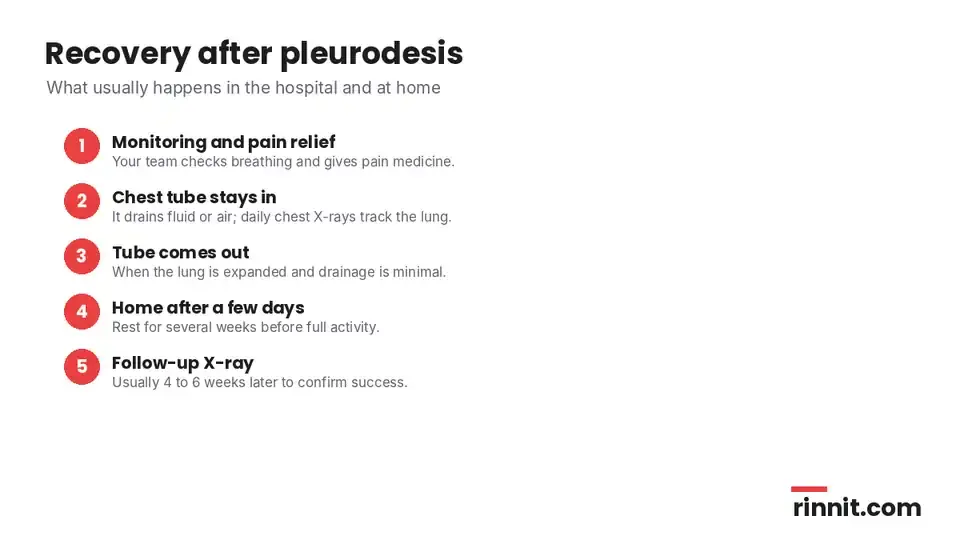
Most people go home after a few days and have a follow-up X-ray in 4 to 6 weeks.
In the hospital, your care team will: [1]
Monitor your breathing and vital signs
Give you pain medicine
Keep the chest tube in to drain fluid or air
Take chest X-rays, often daily, to check your lung
The tube comes out when your lung has fully expanded and very little fluid is draining. Most people stay in the hospital for a few days. [1]
What is recovery like?
Plan to rest for several weeks before returning to all your usual activities. You'll usually have a follow-up chest X-ray about 4 to 6 weeks later to confirm the procedure worked. [1]
How successful is pleurodesis?
Talc pleurodesis is successful in at least 8 out of 10 people. It may not work if your lung can't fully expand, for example when scar tissue traps the lung (trapped lung). In that case, your provider may suggest other options, such as a long-term drainage catheter. [1] [2]
What are the risks of pleurodesis?
Possible risks include: [1]
Risk | What to know |
Chest pain | Common after the procedure; treated with pain medicine |
Infection | Can occur in the pleural space or at the tube site |
Shortness of breath | Usually improves as you heal |
Collapsed lung | The lung may not stay fully inflated |
Bleeding | Possible, especially with surgery |
Fluid in the lungs or low oxygen | Rare |
When should you call your provider?
Call your provider if you have: [1]
Chest pain that gets worse
Swelling, redness, warmth or leaking at the chest tube site
Trouble breathing
Fever or chills
Conclusion
Pleurodesis seals the space around your lung so fluid or air can't keep coming back. Chemical pleurodesis with talc is the most common approach and works for most people, while mechanical pleurodesis is mainly used for repeated lung collapse. Recovery usually means a few days in the hospital with a chest tube and several weeks of rest. [1]
If you have a pleural effusion or pneumothorax that keeps returning, ask your care team whether pleurodesis, or an alternative such as an indwelling catheter, fits your situation.
Keep learning: Read our guides to pleurisy and thoracentesis, the procedure used to drain pleural fluid. For more on pleural effusion, see MedlinePlus.
FAQ
What is pleurodesis?
Pleurodesis is a procedure that makes the two layers of the pleura stick together, closing the space where fluid or air can build up around the lung.
Why is pleurodesis done?
It treats pleural effusions that keep coming back and repeated collapsed lung (pneumothorax).
What is talc pleurodesis?
Talc pleurodesis is a chemical pleurodesis that uses sterile talc to irritate the pleura so the layers fuse. It's the most common and effective agent.
What is the difference between chemical and mechanical pleurodesis?
Chemical pleurodesis uses talc or a drug delivered through a chest tube or during surgery. Mechanical pleurodesis scrapes the pleura during surgery.
Is pleurodesis painful?
Chest pain is common afterward, so you get pain medicine. Chemical pleurodesis uses local anesthesia, and surgical pleurodesis uses general anesthesia.
How long does pleurodesis take?
It takes from about 30 minutes to a few hours, depending on the type.
How long is the hospital stay after pleurodesis?
Most people stay a few days, until the lung is expanded and drainage is minimal so the chest tube can come out.
How successful is pleurodesis?
Talc pleurodesis is successful in at least 8 out of 10 people.
Why might pleurodesis fail?
It may fail if the lung can't fully expand, such as when scar tissue traps the lung.
Does pleurodesis treat cancer?
No. It doesn't treat cancer, but it can make breathing easier when cancer causes fluid around the lungs.
How do I prepare for pleurodesis?
You may have a chest X-ray or CT scan first. Tell your provider about all medicines, supplements and allergies, stop any medicines you are told to stop, follow instructions on when to stop eating and drinking, and wear loose, comfortable clothing [1].
When should I call my doctor after pleurodesis?
Call your provider if you have chest pain that gets worse, swelling, redness, warmth or leaking at the chest tube site, trouble breathing, or fever or chills [1].
Related Reading
Learn more in our guide to Pneumothorax: Understanding Collapsed Lung Causes and Care.
Learn more in our guide to Pleurisy: Complete Guide to Symptoms, Causes, and Treatment.
Learn more in our guide to What Is Mesothelioma? The Rare Cancer Linked to Asbestos — and What Treatment Looks Like.
Learn more in our guide to What Is Catamenial Pneumothorax? Symptoms, Causes, and Treatment.
Learn more in our guide to Decortication: Freeing a Trapped Lung, Open vs. VATS Surgery, Risks and Recovery.
References
Cleveland Clinic. Pleurodesis: Procedure, Types & Recovery. Cleveland Clinic. Last updated January 14, 2026. https://my.clevelandclinic.org/health/procedures/pleurodesis
Dipper A, Jones HE, Bhatnagar R, et al. Interventions for the management of malignant pleural effusions: a network meta-analysis. Cochrane Database Syst Rev. 2020;4(4):CD010529. PMID 32315458. https://doi.org/10.1002/14651858.CD010529.pub3
Thomas R, Fysh ETH, Smith NA, et al. Effect of an Indwelling Pleural Catheter vs Talc Pleurodesis on Hospitalization Days in Patients With Malignant Pleural Effusion: The AMPLE Randomized Clinical Trial. JAMA. 2017;318(19):1903-1912. PMID 29164255. https://doi.org/10.1001/jama.2017.17426
Medical disclaimer
This article is for general education only and does not replace advice from a qualified healthcare professional. Talk to your doctor about your own diagnosis and treatment, and seek emergency care right away for severe or sudden symptoms.



Comments