What Is Mesothelioma? The Rare Cancer Linked to Asbestos — and What Treatment Looks Like

Updated: 3 days ago
Medically reviewed by Dr. Baraa Alnahhal, MD · Last reviewed: October 2026
Quick Answer: Key Facts About Mesothelioma
Mesothelioma is a rare, aggressive cancer that starts in the mesothelium, the thin tissue layer covering internal organs, most commonly around the lungs. [1] [3] In many cases it is caused by asbestos exposure. [1] A biopsy is the only way to confirm it. [2] For many people it cannot be cured, but surgery, chemotherapy, radiation and immunotherapy can help manage the disease. [1] [2]
Question | Answer |
What is mesothelioma? | A rare, aggressive cancer that starts in the mesothelium, the thin tissue layer covering internal organs. |
What causes it? | In many cases, exposure to asbestos fibers — though some people with mesothelioma were never around asbestos. |
Where does it happen most? | In the tissue around the lungs (pleural mesothelioma), which is the most common type. |
How is it diagnosed? | By a biopsy — removing a tissue sample for lab testing. A biopsy is the only way to confirm or rule out mesothelioma. |
Can it be cured? | For many people, no — but surgery, chemotherapy, radiation, immunotherapy, targeted therapy, and clinical trials can all help manage the disease. |
What the research says
Immunotherapy has extended survival in pleural mesothelioma. In a phase 3 trial of 605 people with previously untreated, unresectable pleural mesothelioma, nivolumab plus ipilimumab beat platinum-based chemotherapy: median overall survival was 18.1 vs 14.1 months, and 2-year survival was 41% vs 27%. (Baas et al., Lancet, 2021) [5]
Risk is concentrated in specific asbestos industries. In a 29-year follow-up of Taiwanese asbestos workers, 18 cases of pleural mesothelioma occurred across eight factories, with estimated rate ratios of 113.6 in asbestos cement, 87.5 in thermal insulation, and 15.8 in shipbuilding. (Lee et al., BMJ Open, 2018) [6]
Heated belly chemotherapy (HIPEC) is still being studied for peritoneal mesothelioma. A systematic review of studies from 1985 to 2019 found insufficient evidence to recommend HIPEC with cytoreductive surgery as standard of care for malignant peritoneal mesothelioma, and advised referral to specialty centers as part of research protocols. (Auer et al., Eur J Cancer, 2020) [7]
What is mesothelioma in plain language?
Mesothelioma is a rare, fast-growing cancer that starts in the mesothelium — a thin layer of tissue that covers many internal organs. [1] [3] It is pronounced me-zoe-thee-lee-O-muh. [1] The cancer most often develops in the tissue surrounding the lungs, which is called pleural mesothelioma, but it can also appear in the belly, around the heart, or around the testicles. [1]
Because mesothelioma often behaves aggressively and is usually found after it has spread past the point where surgery can remove it, many people with the disease are not cured. [2] Treatment exists for every form of the cancer, and the goals of that treatment are real: extending life, easing symptoms, and improving daily comfort. [2] [5] Understanding the disease early — including how it starts, who is at risk, and what treatment options look like — is one of the most useful things a patient or family member can do.

What are the four types of mesothelioma?
Mesothelioma is named after the organ lining where it begins. The four types differ in location, symptoms, and how common they are.
Type | Where it starts | How common | Typical first symptoms |
Pleural mesothelioma | Tissue around the lungs (the pleura) | Chest pain, shortness of breath, painful cough [1] | |
Peritoneal mesothelioma | Tissue in the belly (the peritoneum) | Second most common [3] | Belly pain, belly swelling, nausea [1] |
Pericardial mesothelioma | Tissue around the heart | Very rare [1] | Trouble breathing, chest pains [1] |
Mesothelioma of tunica vaginalis | Tissue around the testicles | Very rare [1] | Swelling or a mass on a testicle [1] |
Pleural mesothelioma accounts for the large majority of cases. [3] Pericardial mesothelioma and mesothelioma of tunica vaginalis are so uncommon that less is known about them. [1]
What are the symptoms of mesothelioma?
Mesothelioma symptoms depend on where the cancer starts. [1] Because early symptoms — tiredness, chest pain, shortness of breath — overlap with many everyday conditions, the disease is often not recognized right away.
The most common form, pleural mesothelioma, typically produces chest pain, painful coughing, shortness of breath, lumps under the skin on the chest, tiredness, and unexplained weight loss. Peritoneal mesothelioma usually presents as belly pain, belly swelling, nausea, tiredness, and unexplained weight loss. The rare pericardial form can cause trouble breathing and chest pains, while mesothelioma of tunica vaginalis often first appears as swelling or a mass on a testicle. [1]
When should you see a doctor?
See a doctor or healthcare professional if you have any symptoms that worry you — especially unexplained chest or belly pain, persistent shortness of breath, or an unexplained lump. The risk conversation matters too: if you have a history of asbestos exposure or a family history of mesothelioma, mention it at your appointment, because exposure can take 15 to 40 years or more to produce the disease. [1]
How does asbestos cause mesothelioma?

It is not always clear what causes mesothelioma, but experts believe asbestos exposure causes many cases. Asbestos is a natural mineral with strong, heat-resistant fibers, which is why it was used in insulation, brakes, shingles, flooring, and many other products. When asbestos is mined or disturbed — such as when old insulation is removed — the mineral breaks up into dust. Breathing in or swallowing that dust lets fibers settle in the lungs or the stomach, where they may eventually lead to mesothelioma. [1]
The cancer itself begins with DNA changes in the cells of the mesothelium. DNA is the set of instructions inside every cell. In healthy cells, DNA tells cells to grow and multiply at a set rate and to die at a set time. In cancer cells, the changed DNA gives new instructions: multiply quickly and keep living when healthy cells would die. This produces too many cells, which can form a tumor, invade healthy tissue, and eventually break away and spread to other parts of the body — a stage called metastatic cancer. [1]
Not everyone exposed to asbestos develops mesothelioma, and not everyone with mesothelioma has been exposed to asbestos. The exact way asbestos causes the cancer is not fully known, and other factors — including genes that can run in families — likely play a role. [1]
Who is at risk for mesothelioma?
The biggest known risk factor is being around asbestos. [1] Workers who may be around asbestos include asbestos miners, electricians, plumbers, pipefitters, insulators, shipyard workers, demolition workers, brake mechanics, some military personnel, and home remodelers. But risk also reaches the home, and it stretches far into the future.
Risk factor | How it raises risk |
Direct asbestos exposure at work or home | Breathing or swallowing asbestos dust lets fibers settle in the lungs or stomach [1] |
Living with someone who works with asbestos | Fibers carried home on skin and clothing can expose family members over many years [1] |
Family history of mesothelioma | A parent, sibling, or child with the disease suggests a possible inherited component [1] |
Radiation therapy to the chest | Prior chest radiation for another cancer may raise mesothelioma risk [1] |
One practical note: the disease usually appears 15 to 40 years or more after exposure. [1] Most people who were around asbestos never develop mesothelioma, which suggests other factors are involved [1] — but exposure history still matters enormously when doctors are evaluating symptoms.
What complications can mesothelioma cause?
As pleural mesothelioma spreads within the chest, it presses on the structures in that area. That pressure produces real, sometimes serious complications: trouble breathing, chest pain, trouble swallowing, pain from pressure on nerves and the spinal cord, and pleural effusion — a buildup of fluid in the chest that presses on the lung and makes breathing harder. [1]
How is mesothelioma diagnosed?
Diagnosis usually begins with a physical exam and imaging tests, but imaging alone cannot confirm the disease. The definitive step is always a biopsy. [2]
Test | What it shows |
Physical exam | Checks for lumps or other signs of the cancer [2] |
Chest X-ray | Looks at the lungs and chest for abnormal findings [2] |
CT scan of the chest or belly | Produces detailed cross-sectional images to locate the cancer [2] |
Biopsy | Removes a tissue sample for lab testing — the only way to confirm or rule out mesothelioma [2] |
A biopsy is performed in one of two ways. A thin needle can pass through the skin of the chest or belly to remove fluid or a small piece of tissue. Alternatively, a surgeon can make a small cut and insert a tube with a video camera into the chest or belly, passing tools through the tube to collect a sample during the procedure. The sample then goes to a lab for testing. [2]
Once mesothelioma is confirmed, doctors use CT scans of the chest and belly, MRI, and PET scans (positron emission tomography) to determine how far the cancer has spread to lymph nodes or other areas. [2]
What do the stages mean?
Pleural mesothelioma is staged from 1 to 4. A lower number means the cancer is more likely to be confined to the area around the lungs. As the cancer grows larger and spreads to nearby lymph nodes, the stage number rises. Stage 4 means the cancer has spread to other areas of the body. The stage helps the healthcare team choose the right treatments. The other, rarer types of mesothelioma do not have formal staging systems. [2]
How is mesothelioma treated?
Treatment depends on the person's health, the cancer's stage, and where it is located. Because mesothelioma often spreads quickly and is most often diagnosed past the point where surgery can remove it, many treatment plans focus on managing the cancer to increase comfort and extend life. [2] [5]
A critical early conversation is about treatment goals. Some patients want to do everything possible to treat the cancer, accepting side effects for a small chance of improvement. Others prefer treatments that help them live their remaining time with as few symptoms as possible. There is no single right answer — only the right answer for the person and family involved. [2]
What are the treatment options?
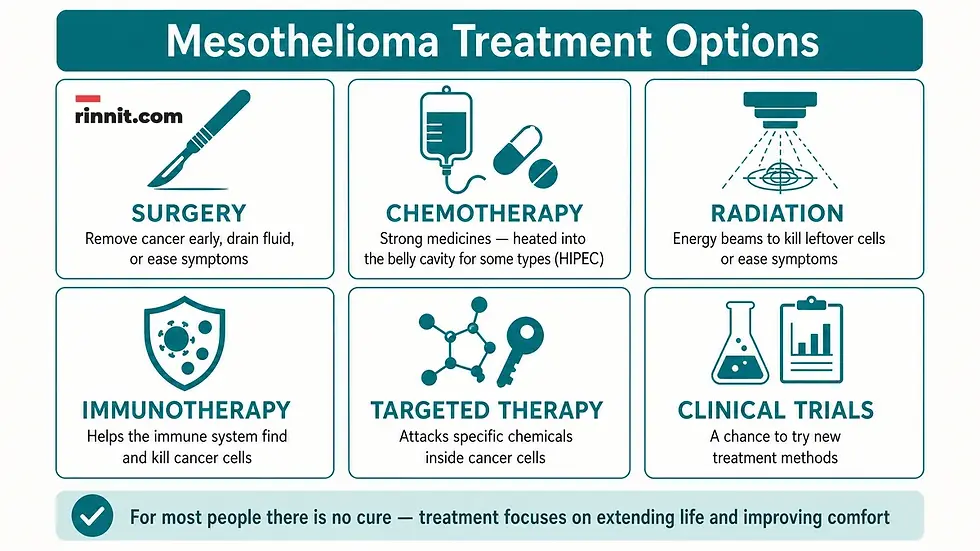
Mesothelioma treatment options include surgery, chemotherapy, radiation therapy and immunotherapy, and surgery can sometimes cure the cancer when it is caught early. [2]
Treatment | What it does | When it is used |
Surgery | Removes cancer or relieves symptoms | Early-stage disease; symptom relief from fluid or spreading cancer [2] |
Chemotherapy | Uses strong medicines to treat cancer | Before surgery, for large or spread cancer, or heated into the belly cavity (HIPEC) [2] |
Radiation therapy | Uses energy beams (X-rays, protons) to kill cancer cells | After surgery to kill remaining cells, before surgery to shrink the tumor, or to ease symptoms [2] |
Immunotherapy | Helps the immune system find and kill cancer cells | After surgery, or when surgery is not an option [2] |
Targeted therapy | Attacks specific chemicals inside cancer cells | Combined with chemotherapy, or when other treatments have not helped [2] |
Clinical trials | Studies new treatment methods | For a chance to try emerging therapies and help future patients [2] |
Surgery is the approach used when the disease is caught early — and in those cases it can sometimes cure the cancer. More often, surgery cannot remove all the cancer, and it serves to reduce symptoms. Four surgical approaches are used. Surgeons can drain the fluid that builds up in the chest and put medicine into the chest to keep the fluid from returning, a procedure called pleurodesis. They can remove the tissue lining the ribs and lungs — a pleurectomy — which will not cure mesothelioma but may ease symptoms. They can remove the affected lung along with the surrounding tissue, which eases symptoms and, if radiation follows surgery, allows higher radiation doses since the lung no longer needs protection. For peritoneal mesothelioma, surgery aims to remove as much of the cancer as possible, sometimes with chemotherapy before or after. [2]
Chemotherapy treats cancer with strong medicines, either before surgery, for cancer that has grown large or spread, or in a specialized form called hyperthermic intraperitoneal chemotherapy (HIPEC), where heated chemotherapy is placed directly into the belly cavity to treat peritoneal mesothelioma. [2]
Radiation therapy delivers powerful energy beams — from X-rays, protons, or other sources — that can kill cancer cells left behind after surgery, shrink the cancer before surgery, or ease symptoms that surgery cannot treat. [2]
Immunotherapy uses medicines that help the body's own immune system kill cancer cells. Cancer cells often survive by hiding from the immune system; immunotherapy works to remove that hiding advantage. For mesothelioma it may be used after surgery or when surgery is not possible. [2]
Targeted therapy uses medicines that attack specific chemicals in cancer cells. By blocking those chemicals, the treatment causes cancer cells to die. These medicines may be combined with chemotherapy or used when other treatments have not helped. [2]
Clinical trials offer a chance to try new treatment methods. A cure is not guaranteed, but participation helps experts learn how to treat mesothelioma better in the future. [2]
How are the rare types of mesothelioma treated?
Pericardial mesothelioma and mesothelioma of tunica vaginalis are very rare. Surgeons may remove small cancers that have not spread from where they started. For cancers that have spread, doctors have not yet found the best treatment approach, and the focus shifts to treatments that improve quality of life. [2]
Can mesothelioma be prevented?
Reducing asbestos exposure may lower mesothelioma risk. [1] For most people, the practical prevention story comes down to three settings: the workplace, the home, and the habits that protect family.
Prevention step | What to do |
Know your workplace risk | Ask your employer whether your job involves asbestos exposure [1] |
Follow safety rules | Wear protective gear; change out of work clothes and wash with soap and water before eating or going home [1] |
Protect your home | Leave undisturbed asbestos in place rather than removing it yourself, and hire trained experts to test and handle it [1] |
Protect your family | Keep work clothes and fibers out of the home — fibers carried on skin and clothing can expose loved ones [1] |
Older homes and buildings often contain asbestos. In many cases it is better to leave the asbestos in place rather than try to remove it, because breaking it up can release fibers into the air where they can be inhaled. Experts trained to find asbestos can test the air and determine whether it is a health risk — and removal, if needed, should always be handled by a professional, never as a DIY project. [1]
Conclusion and next steps
Mesothelioma is a rare but serious cancer of the tissue lining the lungs, belly, heart, and testicles. It is most strongly linked to asbestos exposure — an exposure that can take 15 to 40 years or more to produce symptoms. The disease is usually diagnosed through imaging followed by a biopsy, staged from 1 to 4, and treated with a combination of surgery, chemotherapy, radiation, immunotherapy, targeted therapy, or clinical trials. For many patients there is no cure, but treatment meaningfully improves comfort and time. [1] [2] [5]
The single most useful step for anyone with an asbestos exposure history — occupational or through a family member's work clothes — is to mention it to a healthcare professional, and to seek prompt evaluation for unexplained chest pain, shortness of breath, belly swelling, or persistent tiredness.
Talk with a healthcare professional. If you have a history of asbestos exposure, work in an at-risk trade, or are experiencing unexplained chest or belly symptoms, contact a healthcare provider. For plain-language guides to rare conditions and how to prepare for specialist appointments, explore the related articles on Rinnit.com.
Frequently Asked Questions
Is mesothelioma contagious?
No. Mesothelioma cannot spread from person to person. It develops when cells in the mesothelium undergo DNA changes, and experts believe asbestos exposure causes many cases. [1]
Can mesothelioma be cured?
For many people, no. Surgery can sometimes cure the cancer when it is found at an early stage, but mesothelioma is most often diagnosed past the point where surgery can remove it. Treatment then focuses on managing the cancer to extend life and increase comfort. [2] [5]
How long after asbestos exposure does mesothelioma appear?
It can take 15 to 40 years or more for mesothelioma to develop after asbestos exposure. [1] That long delay is one reason the disease is often found in older adults.
Is mesothelioma the same as lung cancer?
No. Lung cancer starts in the lung tissue itself. Mesothelioma starts in the mesothelium — the thin layer of tissue that covers the lungs and other organs. [1] The two are different diseases with different causes and treatments, though their symptoms can overlap.
What is a pleural effusion?
Pleural effusion is a buildup of fluid in the chest. As pleural mesothelioma spreads, fluid can accumulate and press on the nearby lung, making breathing difficult. Surgeons can drain the fluid through a tube and use a procedure called pleurodesis to keep it from returning. [1] [2]
What is HIPEC?
Hyperthermic intraperitoneal chemotherapy (HIPEC) is heated chemotherapy placed directly into the belly cavity. It is used to help treat peritoneal mesothelioma, the type that affects the tissue in the belly. [2]
Related Reading
Read next on Rinnit.com:
Learn more in our guide to Pleurodesis: Chemical vs. Mechanical, Procedure, Success Rates and Recovery.
Learn more in our guide to Decortication: Freeing a Trapped Lung, Open vs. VATS Surgery, Risks and Recovery.
Thoracoscopy: Types, How It's Done, Risks and Recovery explains the camera procedure used to see inside the chest and sample the pleura.
References
Mayo Clinic Staff. Mesothelioma: Symptoms & causes. Mayo Clinic. December 5, 2024. https://www.mayoclinic.org/diseases-conditions/mesothelioma/symptoms-causes/syc-20375022
Mayo Clinic Staff. Mesothelioma: Diagnosis & treatment. Mayo Clinic. December 5, 2024. https://www.mayoclinic.org/diseases-conditions/mesothelioma/diagnosis-treatment/drc-20375028
Centers for Disease Control and Prevention. Incidence of Malignant Mesothelioma. Centers for Disease Control and Prevention (CDC). Updated September 10, 2025. https://www.cdc.gov/united-states-cancer-statistics/publications/mesothelioma.html
Mazurek JM, et al. Malignant Mesothelioma Mortality - United States, 1999-2015. MMWR Morb Mortal Wkly Rep. 2017;66(8):214-218. PMID 28253224. https://doi.org/10.15585/mmwr.mm6608a3
Baas P, et al. First-line nivolumab plus ipilimumab in unresectable malignant pleural mesothelioma (CheckMate 743): a multicentre, randomised, open-label, phase 3 trial. Lancet. 2021;397(10272):375-386. PMID 33485464. https://doi.org/10.1016/S0140-6736(20)32714-8
Lee LJ, et al. Clustering of malignant pleural mesothelioma in asbestos factories: a subgroup analysis in a 29-year follow-up study to identify high-risk industries in Taiwan. BMJ Open. 2018;8(12):e021063. PMID 30530573. https://doi.org/10.1136/bmjopen-2017-021063
Auer RC, et al. Indications for hyperthermic intraperitoneal chemotherapy with cytoreductive surgery: a systematic review. Eur J Cancer. 2020;127:76-95. PMID 31986452. https://doi.org/10.1016/j.ejca.2019.10.034
Medical disclaimer
This article is for informational purposes only and is not medical advice. Always consult a qualified healthcare professional for diagnosis and treatment decisions.



Comments