Pheochromocytoma: Rare Adrenal Tumor Explained — Symptoms, Causes, and Treatment

Updated: 3 days ago
Medically reviewed by Dr. Baraa Alnahhal, MD · Last reviewed: October 2026
Pheochromocytoma is a rare tumor of the adrenal gland that releases adrenaline-type hormones. It causes episodes ("spells") of high blood pressure, headache, heavy sweating, and rapid heartbeat. Most of these tumors are benign [1]. Blood pressure medicines are used before surgery, and surgical removal often returns blood pressure to a healthy range [1] [2].
Quick Answer: What is pheochromocytoma, and how is it treated?
A pheochromocytoma is a rare tumor that grows in an adrenal gland, one of two small glands on top of the kidneys. It releases adrenaline-type hormones that cause sudden high blood pressure, headache, sweating and a racing heartbeat. Most are benign [1]. Treatment is surgery, usually after 7 to 14 days of blood pressure medicines to keep surgery safe [2].
What the research says
Pheochromocytoma is very rare worldwide. A meta-analysis of 14 studies (13 pooled) estimated a prevalence of 19.8 cases per 1,000,000 people (95% CI 9.6 to 40.8) and an incidence of 1.9 cases per million person-years (95% CI 1.2 to 2.6), with large differences between studies (Vitturi et al., J Endocrinol Invest, 2025) [3].
[18F]FDOPA PET/CT is the most accurate PET tracer for finding the tumor. A meta-analysis of 16 studies found 97% sensitivity (95% CI 91% to 99%) and 94% specificity (95% CI 86% to 98%) for initial diagnosis, with an AUC of 0.99. Diagnostic accuracy was 86.9% for [68Ga]DOTATATE and 85.2% for FDG PET/CT (Zhao et al., Acad Radiol, 2025) [4].
Sparing part of the adrenal gland cures nearly everyone, but tumors return more often. A meta-analysis of 33 articles on partial adrenalectomy for bilateral or inherited pheochromocytoma found pooled biochemical cure of 99.7% and clinical cure of 99.8%, with a 5.9% complication rate. Compared with total adrenalectomy, recurrence was higher (OR 2.55, 95% CI 1.24 to 5.23), while the need for steroid supplementation was significantly lower (7.6% overall) (Araujo-Castro et al., Rev Endocr Metab Disord, 2025) [5].
Research summaries are based on article abstracts retrieved from PubMed.
What Is Pheochromocytoma?
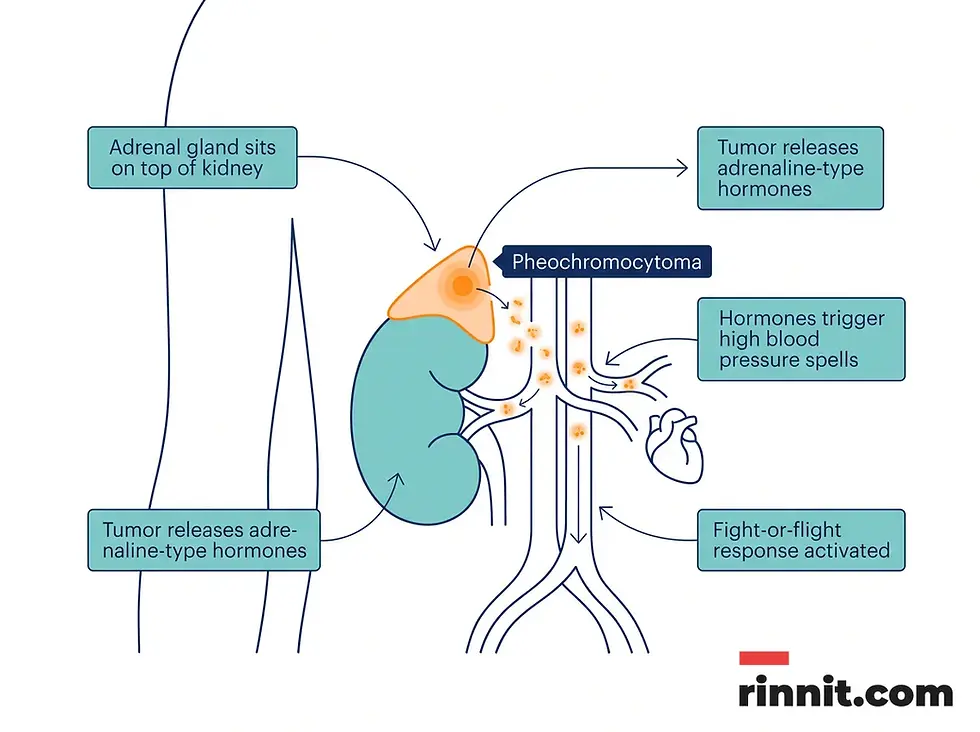
A pheochromocytoma (fee-o-kroe-moe-sy-TOE-muh) is a rare tumor that grows in an adrenal gland. You have two adrenal glands, one at the top of each kidney. These glands make hormones that help control key processes in the body, such as blood pressure [1].
Most often, the tumor is not cancer and has not spread. This is called a benign or nonmetastatic pheochromocytoma. Rarely, the tumor is cancer and has spread to other parts of the body. This is called malignant or metastatic pheochromocytoma [1].
Usually, a pheochromocytoma forms in only one adrenal gland, but tumors can grow in both. The tumor releases hormones that cause symptoms such as high blood pressure, headache, sweating, and panic attack-type symptoms. Left untreated, it can cause serious or life-threatening damage to other body systems [1].
The good news: surgery to remove a pheochromocytoma often returns blood pressure to a healthy range [1].
What are the symptoms of pheochromocytoma?
Pheochromocytoma often causes four main symptoms: high blood pressure, headache, heavy sweating and a rapid heartbeat [1].
High blood pressure
Headache
Heavy sweating
Rapid heartbeat
Some people with pheochromocytomas also have other symptoms [1]:
Nervous shaking (tremor)
Skin that turns a lighter color, called pallor
Shortness of breath
Panic attack-type symptoms, including sudden intense fear
Anxiety or a sense of doom
Vision problems
Constipation
Weight loss
Notably, some people have no symptoms at all. They do not realize they have the tumor until an imaging test done for another reason happens to find it [1].
Symptom Spells
Most often, the symptoms of pheochromocytoma come and go. When they start suddenly and keep coming back, they are known as spells or attacks. These spells may or may not have a trigger that can be found. Blood pressure may return to a healthy range between spells, which can make the condition harder to diagnose [1]. In one example covering a nine-day period, the first burst of high blood pressure reached 250/110 millimeters of mercury on day two [1].
Certain activities or conditions can lead to a spell [1]:
Physical hard work
Anxiety or stress
Changes in body position, such as bending over or going from sitting or lying down to standing
Labor and delivery
Surgery and anesthesia
Foods high in tyramine, a substance that affects blood pressure, can also trigger spells. Tyramine is common in fermented, aged, pickled, cured, overripe, or spoiled foods, including some cheeses, some beers and wines, soybeans and soy products, chocolate, and dried or smoked meats [1].
Certain medicines and drugs can trigger spells as well [1]:
Tricyclic antidepressants, such as amitriptyline and desipramine (Norpramin)
Monoamine oxidase inhibitors (MAOIs), such as phenelzine (Nardil), tranylcypromine (Parnate), and isocarboxazid (Marplan). The risk of spells is even higher if these medicines are taken with tyramine-rich foods or drinks
Stimulants such as caffeine, amphetamines, or cocaine
Symptom | What You Might Notice |
High blood pressure | Elevated readings, sometimes recurring large rises or spikes |
Headache | Pounding headaches, often during a spell |
Heavy sweating | Sudden, unexplained perspiration |
Rapid heartbeat | Fast, pounding heart, especially with spells |
Tremor | Nervous shaking |
Pallor | Skin turns a lighter color |
Shortness of breath | Difficulty catching your breath |
Panic-type symptoms | Sudden intense fear, anxiety, or a sense of doom |
Vision problems | Changes in eyesight |
Digestive changes | Constipation |
Weight loss | Unexplained drop in body weight |
No symptoms | Some tumors are found incidentally on imaging |
When should you see a doctor for pheochromocytoma?
High blood pressure is one of the main symptoms of a pheochromocytoma. But most people who have high blood pressure do not have an adrenal tumor [1].
Talk to your healthcare professional if any of these factors apply to you [1]:
Spells of symptoms linked with pheochromocytoma, such as headaches, sweating, and a fast, pounding heartbeat
Trouble controlling high blood pressure with your current treatment
High blood pressure that starts before the age of 20
Recurring large rises in blood pressure
A family history of pheochromocytoma
A family history of a related genetic condition, such as multiple endocrine neoplasia type 2 (MEN 2), von Hippel-Lindau disease, inherited paraganglioma syndromes, or neurofibromatosis 1
Warning Sign | Why It Matters |
Recurring symptom spells | Spells of headache, sweating, and fast heartbeat are a hallmark pattern |
Uncontrolled high blood pressure | Hard-to-control pressure can point to an adrenal cause |
High blood pressure before age 20 | Early-onset hypertension raises suspicion of a secondary cause |
Family history of pheochromocytoma | Genetic conditions can run in families |
Related genetic condition in the family | MEN 2, von Hippel-Lindau, paraganglioma syndromes, and neurofibromatosis 1 all raise risk |
What causes pheochromocytoma to develop?
Researchers do not know exactly what causes a pheochromocytoma. The tumor forms in cells called chromaffin cells. These cells are located in the center of an adrenal gland and release certain hormones, mainly adrenaline and noradrenaline. These hormones help control many body functions, such as heart rate, blood pressure, and blood sugar [1].
Adrenaline and noradrenaline trigger the body's fight-or-flight response. That response happens when the body thinks there is a threat. The hormones cause blood pressure to rise and the heart to beat faster. They also prepare other body systems so you can react quickly [1].
A pheochromocytoma causes more of these hormones to be released, and it causes them to be released when you are not in a threatening situation [1].
Most chromaffin cells are in the adrenal glands. But small clusters of these cells also exist in the heart, head, neck, bladder, stomach area, and along the spine. Chromaffin cell tumors located outside of the adrenal glands are called paragangliomas. They may cause the same effects on the body as a pheochromocytoma [1].
What are the risk factors for pheochromocytoma?
A person's age and certain medical conditions can raise the risk of a pheochromocytoma. Most pheochromocytomas are found in people between the ages of 20 and 50, but the tumor can form at any age [1].
People who have certain rare genetic conditions have a higher risk. Often, tumors related to these conditions form in both adrenal glands. The tumors usually are benign, but rarely they are cancerous [1].
Genetic Condition | How It Raises Risk |
Multiple endocrine neoplasia type 2 (MEN 2) | Causes tumors in more than one part of the hormone-making (endocrine) system; two types exist (2A and 2B), both can involve pheochromocytomas; other tumors can appear in the thyroid, parathyroid glands, lips, mouth, and digestive system [1] |
Von Hippel-Lindau disease | Can cause tumors in many parts of the body, including the brain, spinal cord, endocrine system, pancreas, and kidneys [1] |
Neurofibromatosis 1 | Causes skin tumors called neurofibromas and can cause tumors of the optic nerve [1] |
Hereditary paraganglioma syndromes | Passed down in families; can result in pheochromocytomas or paragangliomas [1] |

What complications can pheochromocytoma cause?
Pheochromocytoma can lead to other health problems, mainly through organ damage caused by its high blood pressure. The high blood pressure linked with the tumor can damage organs, especially tissues of the heart and blood vessel system, the brain, and the kidneys. This damage can cause dangerous conditions, including [1]:
Heart disease
Stroke
Kidney failure
Vision loss
Cancerous Tumors
Rarely, a pheochromocytoma spreads to other parts of the body. The tumor is then considered cancerous, also called malignant, and is referred to as metastatic pheochromocytoma. Cancer cells from a pheochromocytoma or paraganglioma most often travel to the lymph system, bones, liver, or lungs [1].
Can pheochromocytoma be prevented?
No specific way to prevent pheochromocytoma is known, because the exact cause is not understood. For people with a known family history of a related genetic condition, discussing screening with a healthcare professional is the most practical step. Early detection through monitoring can help prevent the complications that come from long-standing high blood pressure.
How is pheochromocytoma diagnosed?
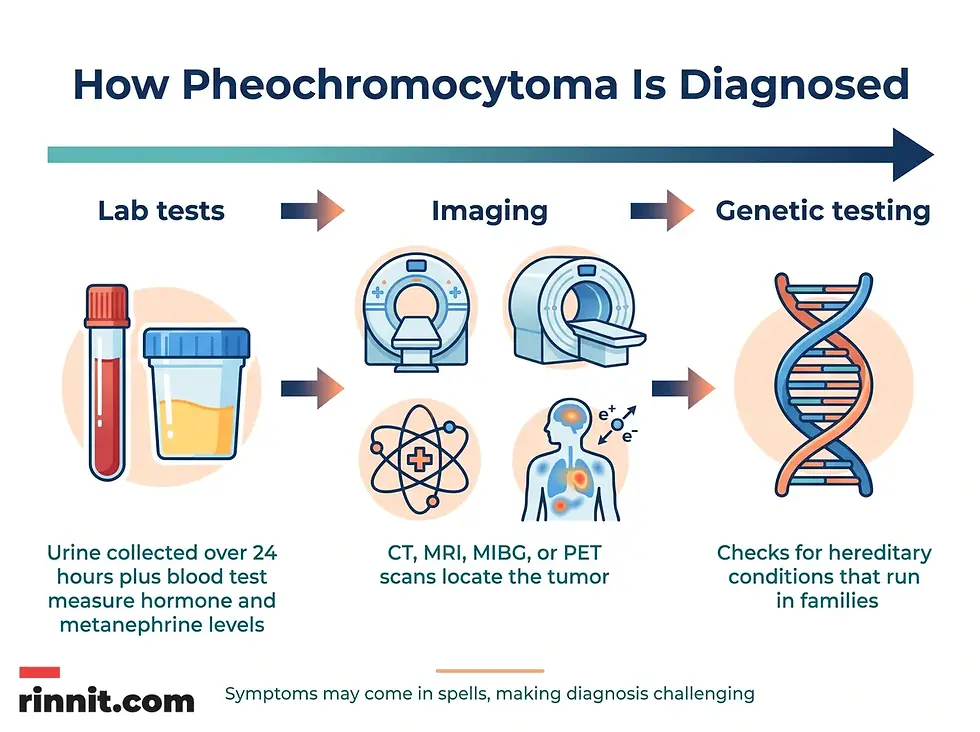
To find out if you have a pheochromocytoma, your healthcare professional likely will order various tests [2].
Lab Tests
These tests measure levels of the hormones adrenaline and noradrenaline, and substances that can come from those hormones called metanephrines. Raised levels of metanephrines are more common when a person has a pheochromocytoma. Metanephrine levels are less likely to be high when a person has symptoms due to something other than pheochromocytoma [2].
For both tests, ask if you need to do anything to prepare. You may be asked not to eat for a certain amount of time before the test (fasting) or to skip a certain medicine. Do not skip a medicine dose unless your healthcare team tells you to and gives you directions [2].
Imaging Tests
If the lab results find signs of a pheochromocytoma, imaging tests are needed to locate the tumor. These may include [2]:
CT scan, which combines a series of X-ray images taken from different angles
MRI, which uses radio waves and a magnetic field to make detailed images
M-iodobenzylguanidine (MIBG) imaging, a scan that detects tiny amounts of an injected radioactive compound taken up by pheochromocytomas
Positron emission tomography (PET), a scan that also can detect radioactive compounds taken up by a tumor
A tumor in an adrenal gland might even be found during imaging studies done for other reasons. If that happens, healthcare professionals often order more tests to find out if the tumor needs to be treated [2].
Genetic Testing
Your healthcare professional might recommend genetic tests to see whether a pheochromocytoma is related to a genetic condition. Test results matter for several reasons: some genetic conditions can cause more than one medical problem, so results may suggest screening for other conditions; some conditions are more likely to recur or be cancer, which affects treatment decisions and long-term tracking; and results may suggest that other family members should be screened [2].
Genetic counseling can help you understand the results of genetic testing. It also can help your family manage any mental health issues tied to the stress of genetic testing [2].
Diagnostic Step | What It Shows |
24-hour urine test | Metanephrine and hormone levels collected across a full day [2] |
Blood test | Adrenaline, noradrenaline, and metanephrine levels in the bloodstream [2] |
CT scan | Detailed images from combined X-ray angles to locate a tumor [2] |
MRI | Detailed images made with radio waves and a magnetic field [2] |
MIBG imaging | Radioactive compound absorbed by pheochromocytoma tissue [2] |
PET scan | Radioactive compounds taken up by the tumor [2] |
Genetic testing | Whether the tumor is linked to a hereditary condition [2] |
How is pheochromocytoma treated?
The main treatment for a pheochromocytoma is surgery to remove the tumor. Before surgery, your healthcare professional likely will prescribe certain blood pressure medicines. These medicines block high-adrenaline hormones to lower the risk of dangerously high blood pressure during surgery [2].
Preparing Before Surgery
You will likely take medicines for 7 to 14 days before surgery to help lower blood pressure. These medicines either replace or are added to other blood pressure medicines you take. You also may be told to eat a high-sodium diet [2].
Alpha blockers, sometimes with calcium channel blockers, keep smaller veins and arteries open and relaxed. Beta blockers may be added only after alpha blockers have been started, never before, because taking them first can cause a dangerous spike in blood pressure. This improves blood flow and lowers blood pressure. Some of these medicines also may cause the heart to beat more slowly and with less force, which can lower blood pressure further [2].
Because these medicines widen the blood vessels, the amount of fluid within the blood vessels becomes low. This can cause dangerous drops in blood pressure when you stand up. A high-sodium diet draws more fluid inside the blood vessels. This helps prevent low blood pressure during and after surgery [2].
Surgery
Most often, a surgeon makes a few small cuts, called incisions, in the stomach area. Wandlike devices equipped with video cameras and small tools are placed through the cuts to do the surgery. This is called laparoscopic surgery. Some surgeons use robotic technology, sitting at a nearby console and controlling robotic arms that hold a camera and surgery tools [2].
If the tumor is very large, surgery that involves a larger incision and opening the abdominal cavity may be needed [2].
Often, the surgeon removes the entire adrenal gland that has the pheochromocytoma. But the surgeon might remove only the tumor, leaving some healthy adrenal gland tissue. This may be done when the other adrenal gland also has been removed, or when there are tumors in both adrenal glands [2].
If you have metastatic pheochromocytoma, surgery may not be able to remove all of the cancer tissue. Removing as much of the tumor as possible along with medical therapy might ease symptoms and make blood pressure easier to control [2].
After Surgery
If one healthy adrenal gland remains, it can carry out the functions usually done by two glands. Blood pressure usually returns to a healthy range after surgery. You will need regular checkups and blood tests for the rest of your life. These appointments help track your health, find other health concerns, and check to see if the tumor has come back [2].
If both adrenal glands are removed, you will need to take steroid medicines for the rest of your life. These medicines replace certain hormones that the adrenal glands make [2].
Cancer Treatments
Very few pheochromocytomas spread through the body as cancer. Because metastatic cases are rare, research about the best treatments is limited. Treatments may include [2]:
Targeted therapies, which use a medicine combined with a radioactive substance that seeks out cancer cells and kills them
Chemotherapy, powerful drugs that kill fast-growing cancer cells and may help ease symptoms
Radiation therapy, intense energy beams that kill cancer cells and may relieve symptoms of tumors that have spread to the bone and cause pain
Ablation, which can destroy cancer tumors with freezing temperatures, high-energy radio waves, or ethanol alcohol
Treatment Stage | Approach |
Before surgery (7–14 days) | Alpha blockers first (sometimes with calcium channel blockers), beta blockers only after alpha blockade, plus a high-sodium diet to protect blood pressure [2] |
Standard surgery | Laparoscopic or robotic removal of the tumor or entire gland; open surgery for very large tumors [2] |
After surgery | Lifelong checkups and blood tests to watch for recurrence; steroid medicines for life if both glands were removed [2] |
Metastatic disease | Targeted therapy, chemotherapy, radiation therapy, or ablation to control cancer and ease symptoms [2] |
How can people cope with pheochromocytoma and find support?
Connecting with others who understand your situation can help. Patient communities, including support groups for neuroendocrine tumors, offer a place to share experiences and ask questions about living with this rare condition [2].
How should you prepare for a pheochromocytoma appointment?
You are likely to start by seeing your primary healthcare professional. Then you might be referred to a specialist in hormonal conditions, called an endocrinologist. Take a family member or friend along if you can, because this person can help you remember the information your care team gives you [2].
When you make the appointment, ask if there is anything you need to do in advance, such as fasting or making medicine changes before a specific test [2].
Before your appointment, make a list of [2]:
Your symptoms, including any changes from how you typically feel, when they began, and how long they last
Key personal information, including major stresses, recent life changes, and family medical history
All medicines, vitamins, herbs, and other supplements you take, including doses
Questions to ask your healthcare professional
Questions to ask may include [2]:
What is likely causing my symptoms?
Other than the most likely cause, what are other possible causes for my symptoms?
What tests do I need?
Is my condition likely short term or ongoing?
What treatment do you recommend?
Are there other treatment options aside from the main one you have suggested?
I have other health conditions. How can I best manage them together?
Are there restrictions I need to follow?
Should I see a specialist?
Are there brochures or other printed material I can have? What websites do you recommend?
Your healthcare professional is likely to ask you questions too, including [2]:
Have your symptoms been constant, or do they come and go?
Does anything seem to make your symptoms better?
What, if anything, appears to trigger your symptoms or make them worse?
Do you have any other medical conditions? If so, what treatment are you getting?
Do you have a family history of adrenal tumors or other endocrine tumors?
Conclusion
Pheochromocytoma is rare, but it matters. A small tumor in an adrenal gland can drive dramatic spikes in blood pressure through sudden bursts of adrenaline-type hormones [1]. The pattern of headaches, heavy sweating, and a racing heart, especially when it comes in spells, deserves medical attention [1].
The encouraging reality is that most of these tumors are benign, and surgery to remove the tumor often returns blood pressure to a healthy range [1]. If you or a family member experience recurring symptom spells, uncontrolled high blood pressure, or carry a family history of related genetic conditions, the most important next step is to see a healthcare professional [1]. Early diagnosis, careful preparation, and surgical treatment give the best chance of long-term health.
Talk to your healthcare professional about your symptoms, especially sudden spells of high blood pressure, headache, sweating, and rapid heartbeat [1]. Proper testing can find out what is really behind them.
Related Reading
Catecholamines Test: How to Prepare and What High Levels Mean explains the stress hormone test used to look for this tumor.
MIBG Scan: How It Finds Neuroendocrine Tumors, Preparation and Results explains the nuclear scan used to find and stage this type of tumor.
Frequently Asked Questions
What is a pheochromocytoma?
A pheochromocytoma is a rare tumor that grows in an adrenal gland, one of two small glands sitting on top of each kidney. It releases adrenaline-type hormones that cause high blood pressure, headaches, heavy sweating, and a rapid heartbeat. Most pheochromocytomas are benign, meaning they are not cancer [1].
What are the main symptoms of pheochromocytoma?
The four most common symptoms are high blood pressure, headache, heavy sweating, and a rapid heartbeat. Other possible symptoms include nervous shaking, pale skin, shortness of breath, panic attack-type feelings, anxiety, vision problems, constipation, and weight loss. Some people have no symptoms at all [1].
What causes a spell of symptoms?
A spell is a sudden burst of symptoms caused by the tumor releasing extra adrenaline-type hormones when the body is not under threat. Spells can be triggered by physical hard work, stress, changes in body position, labor and delivery, surgery and anesthesia, tyramine-rich foods, certain antidepressants, and stimulants such as caffeine or cocaine [1].
Is pheochromocytoma cancer?
Usually not. Most pheochromocytomas are benign, meaning they are not cancer and have not spread. Rarely, the tumor is malignant and metastatic, spreading most often to the lymph system, bones, liver, or lungs [1].
What makes pheochromocytoma hard to diagnose?
Symptoms often come and go in spells, and blood pressure may return to a healthy range between spells. This irregular pattern can make it look like other conditions, and some people have no symptoms until a tumor is found by chance on an imaging test [1].
What tests are used to diagnose pheochromocytoma?
Lab tests measure adrenaline, noradrenaline, and metanephrines in a 24-hour urine sample or blood. If those results suggest a tumor, imaging tests such as CT, MRI, MIBG, or PET scans locate it. Genetic testing may follow to check for a hereditary condition [2].
When should I see a doctor about my blood pressure?
See a healthcare professional if you have spells of headaches, sweating, and a fast, pounding heartbeat; trouble controlling high blood pressure; high blood pressure that starts before age 20; recurring large rises in blood pressure; or a family history of pheochromocytoma or a related genetic condition [1].
How is pheochromocytoma treated?
The main treatment is surgery to remove the tumor. Before surgery, you typically take an alpha blocker, sometimes with a calcium channel blocker, for 7 to 14 days, along with a high-sodium diet, to keep blood pressure safe during the operation; a beta blocker is added only after the alpha blocker has been started [2].
Does blood pressure return to normal after surgery?
If one healthy adrenal gland remains, it can carry out the work of both glands, and blood pressure usually returns to a healthy range after surgery. Regular checkups and blood tests are needed for the rest of your life to watch for recurrence [2].
What happens if both adrenal glands are removed?
You will need to take steroid medicines for the rest of your life. These medicines replace certain hormones that the adrenal glands normally make [2].
What treatments are used if the tumor has spread?
Metastatic pheochromocytoma is rare, so research on the best treatments is limited. Options include targeted therapies that deliver a radioactive substance to cancer cells, chemotherapy, radiation therapy (especially for painful bone spread), and ablation using freezing, radio waves, or ethanol to destroy tumors [2].
References
Mayo Clinic Staff. Pheochromocytoma: Symptoms and causes. Mayo Clinic. Updated May 8, 2025. https://www.mayoclinic.org/diseases-conditions/pheochromocytoma/symptoms-causes/syc-20355367
Mayo Clinic Staff. Pheochromocytoma: Diagnosis and treatment. Mayo Clinic. Updated May 8, 2025. https://www.mayoclinic.org/diseases-conditions/pheochromocytoma/diagnosis-treatment/drc-20355372
Vitturi G, Crisafulli S, Alessi Y, et al. Global epidemiology of pheochromocytoma: a systematic review and meta-analysis of observational studies. J Endocrinol Invest. 2025;48(12):2813-2825. PMID: 40601232. DOI: 10.1007/s40618-025-02639-9
Zhao J, Liu K, Yu H, et al. Diagnostic performance of [18F]FDOPA PET/CT and other tracers in pheochromocytoma: a meta-analysis. Acad Radiol. 2025;32(2):734-742. PMID: 39307649. DOI: 10.1016/j.acra.2024.08.060
Araujo-Castro M, Mínguez Ojeda C, Gómez Dos Santos V, et al. Surgical outcomes of partial adrenalectomy for pheochromocytoma: a systematic review and meta-analysis. Rev Endocr Metab Disord. 2025;26(4):625-640. PMID: 40214691. DOI: 10.1007/s11154-025-09962-9
Medical disclaimer
This article is for informational purposes only and is not a substitute for professional medical advice, diagnosis, or treatment. Always seek the advice of your physician or other qualified health provider with any questions you may have about a medical condition.



Comments