Adrenal Gland Disorders: Too Much or Too Little Hormone — Types, Symptoms, and When It Becomes an Emergency

Updated: 2 days ago
Medically reviewed by Dr. Baraa Alnahhal, MD · Last reviewed: September 2026
TL;DR
Adrenal gland disorders occur when your adrenal glands — the small, triangular glands sitting just above each kidney — make too much or too little hormone. These glands produce cortisol, adrenaline, and aldosterone, which keep your metabolism, blood pressure, immune system, and stress response in balance. The most common disorders include Addison's disease (adrenal insufficiency), adrenal gland suppression from synthetic hormone medications, Cushing syndrome (too much cortisol), congenital adrenal hyperplasia (CAH), hyperaldosteronism (too much aldosterone), and virilization (too much male hormone). Tumor-related disorders — from benign adrenal adenomas to rare pheochromocytomas and adrenocortical carcinoma — complete the picture. Some of these disorders are potentially life-threatening: people with adrenal insufficiency can develop an adrenal crisis requiring immediate emergency care. Early diagnosis and treatment make successful management possible.
Quick Answer
What it is: Adrenal gland disorders occur when the adrenal glands — small, triangular glands above each kidney — produce too much or too little hormone. They make cortisol, adrenaline, and aldosterone, which regulate metabolism, blood pressure, immunity, and the stress response.
The main types: Ten disorders fall into two groups: hormone-balance disorders (Addison's disease, adrenal gland suppression, Cushing syndrome, congenital adrenal hyperplasia, hyperaldosteronism, virilization) and growth/tumor-related disorders (adrenal gland tumors, adrenocortical carcinoma, pheochromocytoma, pituitary adenomas).
The symptoms: They vary by hormone involved. High cortisol causes upper-body weight gain with thinner limbs, easy bruising, and abdominal stretch marks. High aldosterone causes high blood pressure, low potassium, and muscle spasms. Too much male hormone causes facial hair, balding, and a deeper voice in females or young boys.
The emergency to know: Adrenal insufficiency can trigger an adrenal crisis — a life-threatening severe lack of cortisol. Call 911 for sudden severe lower-body pain, vomiting with diarrhea, weakness, confusion or fainting, low blood sugar, or low blood pressure. People with adrenal insufficiency should ask their provider about carrying an injectable glucocorticoid.
What Are Adrenal Gland Disorders?
Adrenal gland disorders occur when your adrenal glands make too much or too little hormone. Your adrenal glands, located just above each kidney, are small and triangular. They make hormones that help keep your metabolism, blood pressure, immune system, and stress response in balance.
These hormones are:
Hormone | Role |
Cortisol | Stress response, metabolism, and immune regulation |
Adrenaline | Fight-or-flight response |
Aldosterone | Blood pressure and fluid balance |

Your adrenal glands are small, triangular glands above each kidney that make cortisol, adrenaline, and aldosterone. Disorders fall into too-little categories (Addison's disease — not enough cortisol and/or aldosterone; adrenal gland suppression — from outside cortisol sources like synthetic hormone medications), too-much categories (Cushing syndrome — high cortisol; hyperaldosteronism — too much aldosterone; virilization — too much male sex hormone), and CAH — congenital adrenal hyperplasia, where the glands lack the enzymes needed to make enough hormones.
Adrenal gland disorders can happen to anyone. Within the individual conditions, some — like Cushing syndrome — occur more often in women.
What Types of Adrenal Gland Disorders Are There?
Ten disorders make up the adrenal disorder family, and they fall into two groups.
Hormone-Balance Disorders
Disorder | What Goes Wrong |
Addison's disease (adrenal insufficiency) | The body does not produce enough cortisol and/or aldosterone |
Adrenal gland suppression | A type of adrenal insufficiency relating to outside sources of cortisol; often affects people who take synthetic hormones like prednisone or dexamethasone |
Cushing syndrome | The body has high levels of cortisol |
Congenital adrenal hyperplasia (CAH) | The body lacks the enzymes the adrenal glands need to make enough hormones |
Hyperaldosteronism | The body produces too much aldosterone |
Virilization | The body produces too much of the male sex hormones; only apparent in females or boys before puberty |
Tumor-Related Disorders
There are also adrenal gland disorders that relate to growths (tumors):
Disorder | What Goes Wrong |
Adrenal gland tumors | Can disrupt hormone output but are usually benign (noncancerous); an adrenal adenoma is the most common adrenal gland tumor |
Adrenocortical carcinoma | A rare disorder in which cancer forms in the adrenal gland's outer layer |
Pheochromocytoma | The glands make too much epinephrine and norepinephrine, which can raise blood pressure or make your heart race |
Pituitary adenomas | Benign tumors on the pituitary gland; they can cause adrenal gland disorders because they affect hormone production in the adrenal glands |
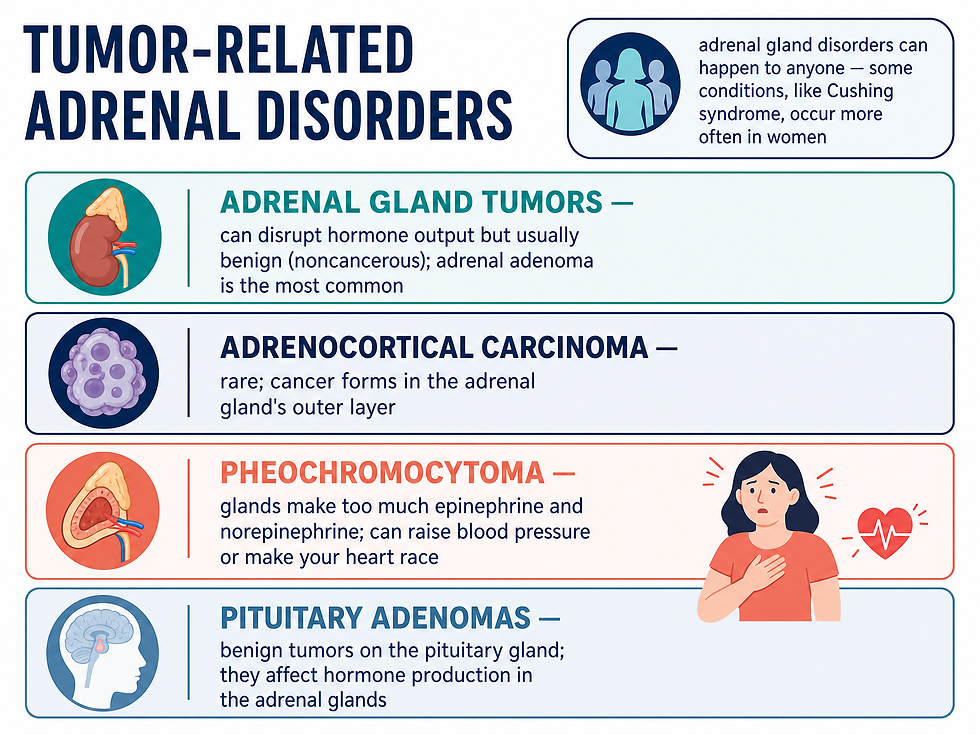
Four tumor-related disorders affect the adrenal system. Adrenal gland tumors can disrupt hormone output but are usually benign — the adrenal adenoma is the most common. Adrenocortical carcinoma is rare: cancer in the gland's outer layer. Pheochromocytoma causes excess epinephrine and norepinephrine, raising blood pressure or racing the heart. Pituitary adenomas are benign tumors on the pituitary gland that indirectly disrupt adrenal hormone production. These disorders can happen to anyone; some conditions, like Cushing syndrome, occur more often in women.
What Are the Symptoms of Adrenal Gland Disorders?
Adrenal gland disorder symptoms vary depending on which hormones play a role. Some symptoms are similar to those of other conditions, so it is important to visit a healthcare provider for proper diagnosis and treatment.
Symptoms of High Cortisol
Symptom | Detail |
Upper-body obesity | Arms and legs stay thinner while the torso gains weight |
Confusion | A cognitive warning sign |
Diabetes | Tied to cortisol's effect on blood sugar |
Easy bruising | Skin bruises easily |
Fatigue | Persistent tiredness |
High blood pressure | A shared signal of hormone excess |
Wide discolored streaks on abdominal skin | Stretch marks on the abdomen |
Symptoms of High Aldosterone
Symptom | Detail |
High blood pressure | The hallmark sign |
Low potassium (hypokalemia) | A defining laboratory finding |
Muscle pain | Often with spasms |
Muscle spasms | Involuntary contractions |
Weakness | Generalized loss of strength |
Symptoms of High Male Sex Hormones (Virilization)
High levels of male sex hormones are only apparent in women or in young male children before puberty. These symptoms indicate virilization — when a prepubescent male child or woman develops masculine traits:
Symptom | Detail |
Facial hair | Increased hair growth on the face |
Balding | Male-pattern hair loss |
Acne | Hormone-driven breakouts |
Deeper voice | Voice pitch change |
More muscular | Increased muscle development |
Greater sex drive | Elevated libido |
What Causes Adrenal Gland Disorders?
Adrenal gland disorders can happen for a few different reasons:
Cause | Explanation |
Hormone overproduction or underproduction | Your adrenal glands make too much — or too little — hormone |
Another gland's condition | A condition affecting another gland, like your pituitary gland |
Outside sources | Medications or chemicals in your environment raise or lower your hormone levels |
Genetic mutation | A change in your DNA raises or lowers your hormone levels |
Healthcare providers don't always know why some people get adrenal gland disorders and others don't.
What Are the Complications?
The adrenal glands and the hormones they control are important to many of your body's functions. Untreated disorders can have serious complications — some of them may be life-threatening.
How Are Adrenal Gland Disorders Diagnosed?
Your healthcare provider will likely start by asking questions about your symptoms and doing a physical exam. Then they'll order tests to determine the levels of hormones in your saliva, blood, and urine.
If your provider suspects tumors, they might recommend:
Imaging Test | When It Is Used |
CT (computed tomography) scan | When tumors are suspected |
MRI (magnetic resonance imaging) | When tumors are suspected |
Nuclear medicine imaging | When tumors are suspected |
Your regular healthcare provider may refer you to an endocrinologist — a specialist in hormones and diseases of the endocrine system. There are also pediatric endocrinologists who treat babies and children.

Adrenal disorder symptoms depend on the hormone involved: high cortisol brings upper-body obesity with thinner limbs, fatigue, high blood pressure, diabetes, easy bruising, abdominal streaks, and confusion; high aldosterone brings high blood pressure, low potassium, weakness, spasms, and pain; high male hormones bring facial hair, balding, acne, a deeper voice, more muscle, and greater sex drive — but only in females or boys before puberty. Diagnosis uses symptom questions, physical exam, saliva/blood/urine hormone tests, CT/MRI/nuclear imaging if tumors are suspected, and an endocrinologist referral. The emergency panel shows the adrenal-crisis signs that warrant calling 911, plus the injectable glucocorticoid precaution.
How Are Adrenal Gland Disorders Treated?
Treatment depends on the specific condition:
Treatment | When It Is Used |
Medications to increase hormone levels | Some disorders, such as adrenal insufficiency, require hormone replacement |
Surgery | For conditions that involve tumors |
Radiation therapy | For conditions that involve tumors |
What Can I Expect If I Have an Adrenal Gland Disorder?
Your outlook varies depending on the condition you have. But early diagnosis and treatment can get you back on track and help you manage your condition successfully. Talk to your healthcare provider about what to expect in your situation.
Can Adrenal Gland Disorders Be Prevented?
Since researchers don't know why certain adrenal gland disorders happen, there is currently no way to prevent them.
One risk-lowering step exists: if you are thinking about taking male hormones to build muscle mass, reconsider your strategy. It can cause adrenal gland disorders and result in damage to other glands.
Living With an Adrenal Gland Disorder
When Should I See My Healthcare Provider?
Contact your healthcare provider whenever you have symptoms that concern you, with or without a diagnosis of an adrenal disorder. Some of these might include:
Symptom to Watch | Description |
Unexplained weight loss | Losing weight without trying |
Upper-body weight gain | Gaining weight primarily in your upper body |
Debilitating fatigue | Feeling so tired that you can't get through your daily tasks |
Severe or nonstop pain | Being in any type of pain that's severe or that doesn't stop |
Hair-growth changes | Experiencing changes in hair growth |
Skin changes | Bruising easily or developing stretch marks |
When Should I Go to the ER?
If you have adrenal insufficiency, you could experience an adrenal crisis. This life-threatening condition happens due to a severe lack of cortisol.
Call 911 or go to your local emergency room if you develop:
Emergency Sign | Detail |
Sudden severe lower-body pain | Pain that comes on quickly |
Vomiting and diarrhea | Bouts of both |
Weakness | Sudden loss of strength |
Confusion and fainting | Loss of consciousness |
Low blood sugar (hypoglycemia) | A metabolic danger signal |
Low blood pressure | A circulatory danger signal |
If you have adrenal insufficiency, ask your provider for an injectable glucocorticoid that you can carry with you. This is an injectable medication that reduces pain and inflammation. Make sure you know how to inject yourself, and that your family and friends also know how and when to inject you.
Other potentially life-threatening symptoms of adrenal gland disorders include having too much potassium (hyperkalemia) or not enough sodium (hyponatremia) in your blood. If you experience severe symptoms like these, don't wait for a regular appointment — seek emergency care right away.
Questions to Ask Your Provider
What type of adrenal gland disorder do I have?
Is it curable? Or will I need to find ways to manage it?
Will I need medication? If so, what kind?
Do I have any tumors causing my symptoms?
What are my treatment options?
Conclusion
Adrenal gland disorders are deceptively hidden problems. The glands themselves are small and triangular, sitting above each kidney, and you almost never think about them — until they make too much or too little hormone, or until a growth changes what they secrete. What emerges is a family of ten disorders split between hormone-balance problems and tumor-related problems, each with its own signature: too much cortisol reshapes the body with upper-body weight and thin limbs; too much aldosterone raises blood pressure and drains potassium; too much male hormone shows up as facial hair, a deeper voice, and balding in women and young boys; and too little cortisol sets the stage for the one true emergency in this category — the adrenal crisis. Diagnosis leans on saliva, blood, and urine hormone tests plus imaging when tumors are suspected, and treatment ranges from hormone-replacement medications to surgery and radiation for tumor cases. The reassuring constant across all ten is that early diagnosis and treatment make successful management possible.
CTA: If you are noticing unexplained weight loss, upper-body weight gain, fatigue that won't let you finish your day, easy bruising, or changes in hair growth, book an appointment with your healthcare provider and ask specifically whether your hormone levels should be checked. If you have already been diagnosed with adrenal insufficiency, carry your injectable glucocorticoid, teach your family how and when to use it, and keep the adrenal-crisis warning signs posted where everyone can see them.
Frequently Asked Questions
What are adrenal gland disorders?
Adrenal gland disorders occur when the adrenal glands — small, triangular glands located just above each kidney — make too much or too little hormone. These glands produce cortisol, adrenaline, and aldosterone, which keep metabolism, blood pressure, the immune system, and the stress response in balance.
What are the most common adrenal gland disorders?
The most common adrenal gland disorders are Addison's disease (adrenal insufficiency, not enough cortisol and/or aldosterone), adrenal gland suppression (caused by outside cortisol sources such as prednisone or dexamethasone), Cushing syndrome (high cortisol), congenital adrenal hyperplasia (missing the enzymes needed to make enough hormones), hyperaldosteronism (too much aldosterone), and virilization (too much male sex hormone, apparent only in females or boys before puberty).
What symptoms do high cortisol levels cause?
Symptoms of high cortisol include upper-body obesity while arms and legs stay thinner, fatigue, high blood pressure, diabetes, skin that bruises easily, wide discolored streaks on the abdominal skin, and confusion.
What are the symptoms of high aldosterone?
High aldosterone causes high blood pressure, low potassium (hypokalemia), weakness, muscle spasms, and muscle pain.
What causes adrenal gland disorders?
They can occur when the adrenal glands make too much or too little hormone, when a condition affects another gland like the pituitary, when outside sources such as medications or environmental chemicals alter hormone levels, or when a genetic mutation changes hormone production. Providers don't always know why some people develop these disorders and others do not.
Are adrenal gland disorders preventable?
No. Since researchers don't know why certain adrenal gland disorders happen, there is currently no way to prevent them. One risk-lowering step is to avoid taking male hormones to build muscle mass, which can cause adrenal gland disorders and damage other glands.
What is an adrenal crisis, and when should I go to the ER?
An adrenal crisis is a life-threatening condition caused by a severe lack of cortisol, possible in anyone with adrenal insufficiency. Call 911 or go to the emergency room for sudden severe lower-body pain, bouts of vomiting and diarrhea, weakness, confusion and loss of consciousness, low blood sugar, or low blood pressure. Too much potassium (hyperkalemia) or too little sodium (hyponatremia) are also potentially life-threatening.
How are adrenal gland disorders treated?
Treatment depends on the specific condition. Some disorders require medications to increase hormone levels. Conditions involving tumors may be treated with surgery or radiation therapy. Early diagnosis and treatment make successful long-term management possible.
Internal Links
External References
Medical Disclaimer
This article is for general informational purposes only and is not a substitute for professional medical advice, diagnosis, or treatment. Adrenal gland disorders can be potentially life-threatening, and some — such as adrenal crisis caused by a severe lack of cortisol — are medical emergencies requiring immediate care. Only a licensed healthcare provider can diagnose an adrenal disorder through hormone testing of saliva, blood, and urine, imaging, and specialist evaluation by an endocrinologist. Anyone with adrenal insufficiency should have an emergency plan that includes a prescribed injectable glucocorticoid and trained family members. Never delay seeking medical care because of something you have read here.
Comments