
Adrenal Crisis: What It Is, Why It Is an Emergency, and How It Is Treated

Updated: 2 days ago
Medically reviewed by Dr. Baraa Alnahhal, MD · Last reviewed: September 2026
This article is for general education only. It is not medical advice and does not replace evaluation and treatment by a qualified healthcare provider. An adrenal crisis is a medical emergency — call emergency services or go to the nearest emergency department if you suspect one. Statistics are drawn from the cited sources and reflect published research; individual cases vary.
TL;DR
An adrenal crisis is a life-threatening condition in which the adrenal glands fail to make enough cortisol, the hormone that controls stress response, blood pressure, blood sugar, and metabolism. It most often strikes people who already have adrenal insufficiency (such as Addison's disease) when a stressor — infection, missed medication, surgery, or dehydration — overwhelms their body's limited hormone supply. Symptoms include severe abdominal pain, vomiting, weakness, confusion, and dangerously low blood pressure. Treatment is immediate intravenous hydrocortisone plus fluids, and it must begin as soon as a crisis is suspected — never wait for lab results to confirm it.
Quick Answer
An adrenal crisis is a medical emergency caused by a sudden, severe drop in cortisol. The hallmark signs are extreme weakness, abdominal or flank pain, vomiting, confusion, and low blood pressure that can progress to shock. It affects people with adrenal insufficiency and, less often, people on long-term steroid therapy whose medication is stopped too quickly. Survival depends on speed: prompt hydrocortisone injections and IV fluids reverse most crises, while untreated crises can be fatal in up to 25% of cases.
What Exactly Is an Adrenal Crisis?
An adrenal crisis — also called an Addisonian crisis or acute adrenal crisis — is an acute, life-threatening episode of adrenal insufficiency. Your adrenal glands are two small, triangle-shaped glands sitting just above each kidney. Among the hormones they produce, cortisol is the most critical for surviving physical stress.
Cortisol touches nearly every organ system. It regulates your stress response, controls metabolism, suppresses inflammation, maintains blood pressure, regulates blood sugar, and helps manage your sleep-wake cycle. When cortisol suddenly drops far below what your body needs — especially during stress — blood pressure collapses, blood sugar falls, and organs begin to lose their blood supply. That is the crisis.
Adrenal crisis / Addisonian crisis: the acute, life-threatening episode itself — a medical emergency.
Adrenal insufficiency: the underlying condition of low cortisol output (chronic, not the crisis itself).
Primary adrenal insufficiency (Addison's disease): the adrenal glands themselves are damaged.
Secondary adrenal insufficiency: the pituitary gland fails to signal the adrenals, most often from long-term steroid use.
Shock: dangerously low blood flow to organs — the main danger in an untreated crisis.
Hydrocortisone: the replacement medication used in emergency treatment.
Why Is an Adrenal Crisis an Emergency?
The short answer is shock. A crisis can cut off blood flow to your organs, and shock progresses quickly and can cause permanent organ damage. Even in the intensive care era, the numbers remain sobering:
Without treatment, up to 20% of people in shock may die from an adrenal crisis.
Some studies suggest that up to 25% of people who experience an adrenal crisis die from it.
Measured against a large patient population, cortisol deficiency deaths run at roughly 0.5 per 100 patient-years among people with adrenal insufficiency.
But the flip side matters just as much: when a crisis is recognized promptly and treated with glucocorticoids, in-hospital mortality drops to under 1%.
Speed is the single biggest factor between those two outcomes. That is why emergency guidance is always the same: treat first, confirm later. If a crisis is suspected, high-dose glucocorticoids are given immediately — short courses are not harmful, but delay can be fatal.
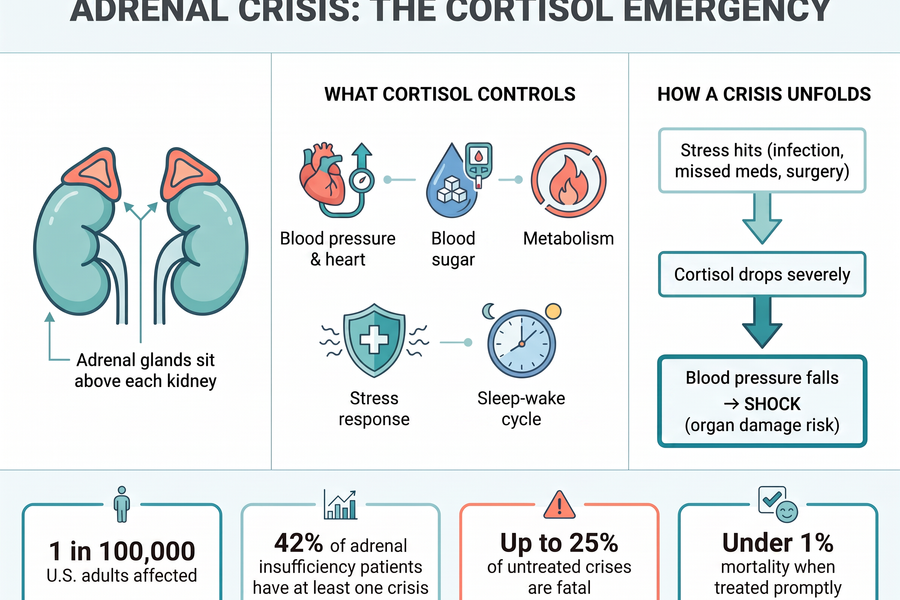
Adrenal crisis overview: where cortisol comes from, how a crisis unfolds, and the key statistics every person with adrenal insufficiency should know.
What Are the Symptoms of an Adrenal Crisis?
Symptoms develop as cortisol levels collapse, and they can look like many other illnesses — which is exactly what makes adrenal crisis hard to recognize. The most common symptoms include:
Abdominal pain or pain in the side (flank)
Long-lasting fatigue
Loss of appetite
Darker patches of skin (hyperpigmentation) — a clue that points toward Addison's disease
Weakness
Unexplained weight loss
As the crisis deepens, warning signs spread across the whole body. Dehydration, diarrhea, dizziness, confusion, light-headedness, fainting, or even coma can appear. Fever, headache, and joint pain are common. Blood glucose drops, blood pressure drops, nausea and vomiting worsen, and breathing and heart rate speed up as the body struggles.
Abdominal / flank pain: often severe and out of proportion; can mimic a surgical abdomen.
Fatigue and weakness: profound, sudden, beyond ordinary tiredness.
Nausea, vomiting, diarrhea: gastrointestinal distress that often triggers or worsens the crisis.
Dizziness, fainting: from falling blood pressure; can progress to confusion or coma.
Low blood sugar: shakiness, sweating, confusion.
Low blood pressure: may not respond normally to fluids alone.
Rapid breathing and heart rate: the body compensating for falling circulation.
Fever, headache, joint pain: non-specific, but common in crisis.
A critically important clinical fact: lab abnormalities are absent in nearly half of patients. Serum chemistry changes — hyponatremia, hyperkalemia, hypoglycemia, metabolic acidosis — appear in up to 56% of patients, which means the other half can have normal-looking labs and still be in crisis. The absence of abnormal labs never rules out an adrenal crisis.
Who Gets Adrenal Crises?
An adrenal crisis can affect anyone, but it most commonly strikes people between the ages of 30 and 50. Understanding the size of the affected population helps put the risk in context:
Adrenal insufficiency prevalence (U.S.): about 1 in 100,000 people.
Addison's disease prevalence (international): roughly 40–60 per 1 million population.
Crisis risk among people with adrenal insufficiency: about 42% will experience at least one crisis.
Crisis risk — primary adrenal insufficiency: ~47% (42% overall average).
Crisis risk — secondary adrenal insufficiency: ~35%.
Annual crisis incidence: estimated 5–10 cases per 100 patient-years.
Crisis as the first presentation of Addison's disease: about 50% of newly diagnosed patients.
Crisis mortality (untreated or delayed): up to 25% of episodes.
Crisis mortality (promptly treated, in-hospital): under 1%.
Two patterns stand out. First, roughly half of all people newly diagnosed with Addison's disease arrive at that diagnosis through a crisis — meaning the crisis was their first sign of an unrecognized condition. Second, crises are not limited to people with known adrenal disease: a Japanese study of 504 crisis patients found that only about one-third had preexisting primary or secondary adrenal insufficiency; the rest had comorbidities such as cardiovascular disease (31.6%), cancer (19.1%), infection (18.8%), and diabetes (16.5%).
What Can Trigger an Adrenal Crisis?
A crisis happens when a stressor demands more cortisol than the body can produce. For someone with adrenal insufficiency, even ordinary stressors can tip the balance. The recognized triggers include:
Not receiving treatment for an adrenal insufficiency such as Addison's disease
Damage to the adrenal gland, including gland diseases or surgery
Dehydration
Hypopituitarism (a pituitary gland that fails to signal the adrenals)
Infection — gastrointestinal and flu-like illnesses are the most common trigger
Stopping glucocorticoid medications (such as prednisone) after long-term use
Mental or emotional stress
The steroid-withdrawal trigger deserves special attention. The hypothalamic-pituitary-adrenal axis can be suppressed by doses as low as 5 mg of prednisone daily for four weeks or more — and suppression can also come from corticosteroid joint injections, steroid skin creams, and inhaled steroids. Abruptly stopping these medications leaves the body unable to meet even normal cortisol demands.
Untreated / undertreated adrenal insufficiency: no replacement therapy, missed doses, wrong dosage.
Infection and illness: GI infections, flu-like illness (most common), COVID-19, tuberculosis.
Medication changes: stopping steroids too fast; drug interactions (mitotane, ketoconazole, metyrapone); checkpoint-inhibitor immunotherapy.
Physical stressors: surgery, trauma, childbirth, pregnancy, extreme heat or cold, strenuous exercise.
Emotional stressors: significant mental or emotional distress.
Other endocrine events: thyrotoxicosis; starting levothyroxine in untreated adrenal insufficiency.
How Is an Adrenal Crisis Diagnosed?
Diagnosis is deliberately fast and imperfect. Because crisis shares symptoms with gastroenteritis, sepsis, and many common conditions, and because lab abnormalities are missing in up to half of patients, the standard of care is to start treatment on clinical suspicion and confirm afterward. The following tests support the diagnosis:
Cortisol blood test: the defining measurement — cortisol levels far below normal for the stress level.
ACTH blood test: high ACTH points to primary (adrenal) failure; low ACTH points to pituitary-driven (secondary) failure.
Sodium blood test: hyponatremia (low sodium) is common.
Potassium blood test: hyperkalemia (high potassium) often accompanies primary insufficiency.
Blood sugar tests: hypoglycemia (low glucose) is a classic finding.
pH blood test: metabolic acidosis may be present.
If this is your first crisis, your provider will perform an ACTH stimulation test afterward to pin down the underlying cause — autoimmune destruction, pituitary problems, infection, hemorrhage, or other gland damage.
How Is an Adrenal Crisis Treated?
Treatment begins immediately, often before any lab result comes back. Your provider will place an IV and deliver a hydrocortisone injection (hydrocortisone phosphate or hydrocortisone sodium succinate) along with a saline solution directly into your vein. The injection replaces the missing cortisol, and the saline restores blood volume.
From there, treatment follows the cause. If a bacterial infection triggered the crisis, antibiotics are given. Dehydration and electrolyte problems are corrected with fluids; low blood sugar is corrected with carbohydrates. And if blood pressure stays dangerously low despite fluids and steroids, medications that raise blood pressure may be needed.
Core emergency treatment: IV hydrocortisone injection plus saline solution immediately.
Bacterial infection as trigger: antibiotics alongside steroids.
Dehydration / electrolyte imbalance: fluids (water, oral rehydration); electrolyte correction.
Low blood sugar: fast carbohydrates.
Persistent low blood pressure: additional fluids; blood-pressure medications if needed.
After stabilization: ACTH stimulation test to find the underlying cause (if first crisis).
Hydrocortisone injections can cause side effects, including allergic reactions, bloody or black stool, fever, sore throat, cough, mood swings, and pain in the hips, back, ribs, arms, shoulders, or legs. One reassuring note for expectant mothers: hydrocortisone is safe during pregnancy — it does not cross the placenta to the fetus, whereas an untreated crisis can end a pregnancy.
Most people begin to feel better within 24 hours or longer after treatment starts. The prognosis is excellent with timely care: short-course high-dose glucocorticoids are not harmful, and survival rates for promptly treated patients approach those of people without crisis. The lasting consequence is that most people who have had a crisis must take hydrocortisone pills for the rest of their lives — and always keep a reserve supply.
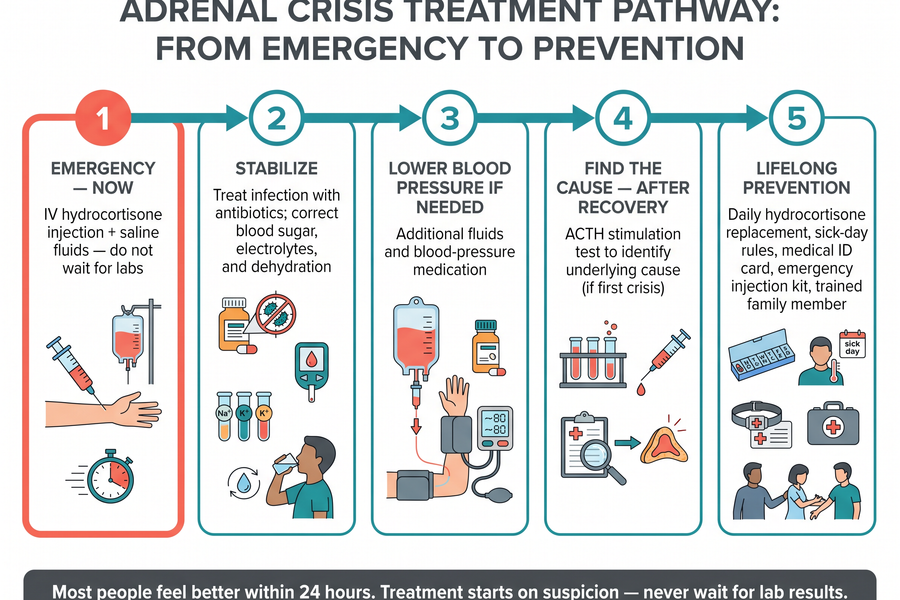
Adrenal crisis treatment pathway: from emergency hydrocortisone and IV fluids through stabilization, cause-finding tests, and lifelong prevention planning.
How Can You Prevent an Adrenal Crisis?
Prevention is largely in the hands of the person living with adrenal insufficiency. The first step is learning your personal triggers — infection, dehydration, emotional stress, missed medication — and acting early when they appear. Key prevention practices include:
Tell every provider about your adrenal insufficiency before any surgery or dental procedure. Surgery and pregnancy are recognized triggers, and hormone doses often need adjusting ahead of time.
Carry medical identification — a card, necklace, or bracelet stating your condition, plus the exact medication type and dosage you need. This information lets emergency providers treat you immediately if you cannot speak for yourself.
Follow "sick-day rules." Standard guidance is to increase hydrocortisone to two or three times the normal dose for two to three days during minor illness, and more during major illness.
Keep an emergency injection kit and learn to give yourself an intramuscular cortisol shot. Teach a family member or close friend to administer it if you are too weak to do it yourself.
Make a plan for vomiting. Work with your provider in advance on what to do when nausea or vomiting keeps your pills down — this is one of the most common crisis pathways.
Weigh yourself regularly and check your blood pressure. Report unexplained weight loss or unusual blood pressure readings to your provider.
Report major stress promptly. After any injury, illness, or significant emotional stress, contact your provider — you may need a medication adjustment.

How to prevent an adrenal crisis: sick-day rules, medical ID, emergency injection kit, when to call for help, and the red-flag signs that need 911.
What Is the Outlook?
With rapid treatment, most people recover fully from an adrenal crisis within a day or two, and in-hospital mortality for treated crises is under 1%. The condition that caused the crisis, however, usually persists: most people will take replacement hydrocortisone for life, and some studies estimate that about 5–10 crisis episodes occur per 100 patient-years among people with adrenal insufficiency despite treatment. That is why living well with adrenal insufficiency means treating every fever, every surgery, and every missed dose as a prevention task — not a minor inconvenience.
Key Takeaways and What to Do Next
An adrenal crisis is a cortisol emergency: it strikes people with adrenal insufficiency when stress overwhelms a body that cannot make more hormone, and it can be fatal within hours if untreated. The practical rules are simple. If you have adrenal insufficiency, know your triggers, follow sick-day rules, carry medical identification, and keep an emergency injection kit with someone trained to use it. If you take daily steroid medication, never stop it abruptly — taper only under medical supervision. And if anyone shows signs of a crisis — severe abdominal pain, vomiting, weakness, confusion, fainting, or shock — treat it as a 911-level emergency and make sure responders know steroids are needed immediately.
If you have adrenal insufficiency, work with your endocrinologist or healthcare provider to build your personal crisis plan today: your medication card, your sick-day rules, your emergency kit, and the people in your life who know how to help. Your future self will thank you.
Frequently Asked Questions
What is the difference between adrenal insufficiency and an adrenal crisis?
Adrenal insufficiency is the chronic condition of low cortisol production. An adrenal crisis is the acute, life-threatening episode that happens when a stressor pushes the body beyond what its limited cortisol can handle. The first is managed daily; the second is a 911-level emergency.
Can you die from an adrenal crisis?
Yes. Studies suggest up to 25% of people who experience an adrenal crisis die from it, and up to 20% of people in shock from a crisis may die without treatment. With prompt hydrocortisone and fluids, in-hospital mortality falls to under 1%.
What does an adrenal crisis feel like?
Commonly: severe abdominal or flank pain, vomiting, extreme weakness, dizziness or fainting, confusion, low blood sugar symptoms (shakiness, sweating), and low blood pressure. Because these mimic flu or food poisoning, the combination and severity — especially with known adrenal insufficiency — are what raise the alarm.
Can stopping prednisone cause an adrenal crisis?
Yes. Taking as little as 5 mg of prednisone daily for four weeks or more can suppress your adrenal system, and abrupt discontinuation can trigger a crisis. Steroid creams, inhaled steroids, and joint injections carry the same risk. Always taper under medical supervision.
How common are adrenal crises?
Adrenal insufficiency affects about 1 in 100,000 people in the U.S., and about 42% of those individuals will experience at least one crisis. Researchers estimate 5–10 crisis episodes per 100 patient-years among treated patients.
What is the first thing to do in an adrenal crisis?
Call 911 or get emergency care immediately. People with adrenal insufficiency are typically taught to self-inject intramuscular hydrocortisone at the first signs of crisis and then seek emergency care. In the emergency department, IV hydrocortisone and saline are given right away — treatment should not wait for lab confirmation.
Is hydrocortisone safe during pregnancy?
Yes. Hydrocortisone does not cross the placenta to the fetus, while an untreated adrenal crisis can end a pregnancy. Pregnant patients with adrenal insufficiency should work with their provider on dose planning for pregnancy and delivery.
How long does it take to recover from an adrenal crisis?
Most people begin feeling better within 24 hours of receiving hydrocortisone and fluids, and full recovery typically follows within days. Most will then need lifelong hydrocortisone replacement and should keep extra medication on hand.
Related Reading
References
Cleveland Clinic. "Adrenal Crisis." Medically reviewed; last updated 08/03/2022. https://my.clevelandclinic.org/health/diseases/23948-adrenal-crisis
Elshimy G, et al. "Adrenal Crisis." StatPearls, National Institutes of Health. Last update: February 15, 2025. https://www.ncbi.nlm.nih.gov/books/NBK499968/
Puar TH, et al. "Adrenal Crisis: Still a Deadly Event in the 21st Century." American Journal of Medicine, 2016;129(3):339.e1-339.e7. https://www.amjmed.com/article/S0002-9343(15)00827-X/abstract
Amrein K, et al. "Understanding Adrenal Crisis." Intensive Care Medicine, 2017. https://pmc.ncbi.nlm.nih.gov/articles/PMC6006214/
Kirkland L, Griffing GT. "Adrenal Crisis." Medscape eMedicine. Updated: March 28, 2024. https://emedicine.medscape.com/article/116716-overview
Quinkler M, et al. "Clinical Unmet Needs in the Treatment of Adrenal Crisis." Frontiers in Endocrinology, 2021. https://www.frontiersin.org/journals/endocrinology/articles/10.3389/fendo.2021.701365/full
Society for Endocrinology. "Adrenal Crisis Information — Clinical Guidance." https://www.endocrinology.org/clinical-practice/clinical-guidance/adrenal-crisis/
Medscape eMedicine. "Addison Disease: Epidemiology." Updated: March 27, 2024. https://emedicine.medscape.com/article/116467-overview
National Adrenal Diseases Foundation. "Primary Adrenal Insufficiency (Addison's Disease)." https://www.nadf.us/addisons
ScienceDirect / Elsevier. "Adrenal Crisis — an overview (Medicine and Dentistry)." https://www.sciencedirect.com/topics/medicine-and-dentistry/adrenal-crisis
Comments