Catecholamines Test: How to Prepare and What High Levels Mean

Updated: 2 days ago
Written and medically reviewed by Dr. Baraa Alnahhal, MD · Last reviewed: November 2026 · How we review
Quick Answer
A catecholamines test measures stress hormones made by the adrenal glands and nerves: epinephrine (adrenaline), norepinephrine and dopamine. It's mainly used to look for rare tumors that make too much of them, such as pheochromocytoma. It can be done on a 24-hour urine sample or a blood sample. A high result doesn't confirm a tumor on its own.
What the research says
Metanephrines are the best first test: in a multicenter study comparing biochemical tests for pheochromocytoma, plasma free metanephrines, breakdown products of catecholamines, performed best for both ruling the tumor in and out; urinary and plasma catecholamines had specificities of about 88% and 81%, and combining tests didn't add value (Lenders JW et al., JAMA, 2002) [2]
Guidelines favor metanephrine testing: the Endocrine Society's clinical practice guideline on pheochromocytoma and paraganglioma recommends measuring plasma free or urinary fractionated metanephrines as the initial biochemical test, followed by imaging to locate the tumor (Lenders JW et al., Journal of Clinical Endocrinology & Metabolism, 2014) [3]
Key takeaways
Catecholamines are stress hormones: epinephrine, norepinephrine and dopamine.
The test looks for rare adrenal and nerve tumors.
A 24-hour urine test is usually preferred over a blood test.
Avoid caffeine, chocolate, bananas, citrus and vanilla, and stay calm before testing.
High levels need more tests; they don't confirm a tumor alone.
What are catecholamines?
Catecholamines are hormones released mainly by the inner part of the adrenal glands when you're under physical or emotional stress. They raise your heart rate, blood pressure and blood sugar to prepare your body to react. Adrenaline is the best known. Some tumors release large amounts of these hormones, causing symptoms. Sources: [1]
Why it's done
Adult symptoms: high blood pressure that doesn't respond to treatment, severe headaches, palpitations, anxiety, nausea, or tingling in the arms and legs.
Child symptoms: a lump in the belly, bone pain, unusual eye movements or unexplained weight loss.
Family history of these tumors. Sources: [1]
Urine vs. blood test
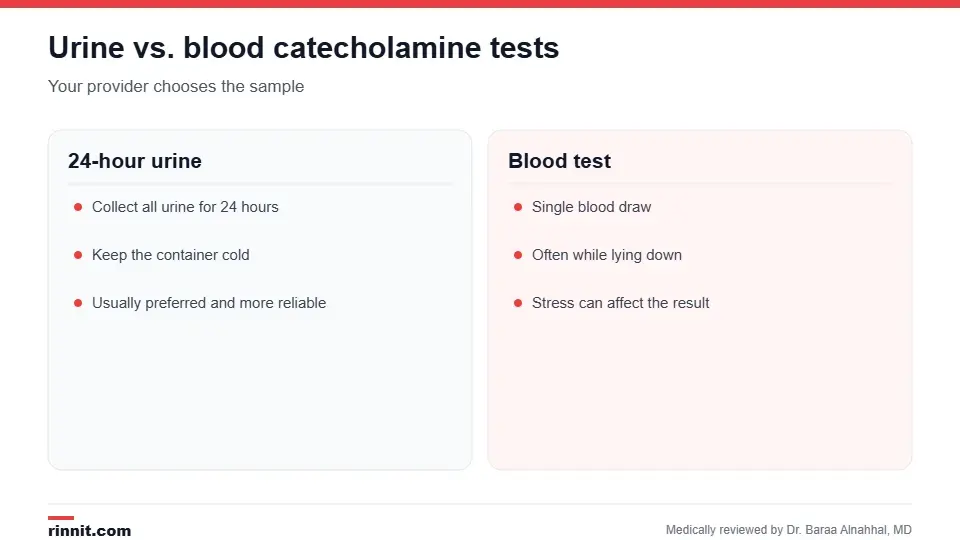
Your provider chooses the type of sample.
Test | How it's done | Notes |
24-hour urine | Collect all urine for 24 hours in a lab container kept cold | Usually preferred; more reliable |
Blood | A single blood draw, often while lying down | May be used if pheochromocytoma is suspected; stress can affect it |
Many labs also measure metanephrines, which are breakdown products of catecholamines and are now often the first-choice test. Sources: [1, 2, 3]
How to prepare
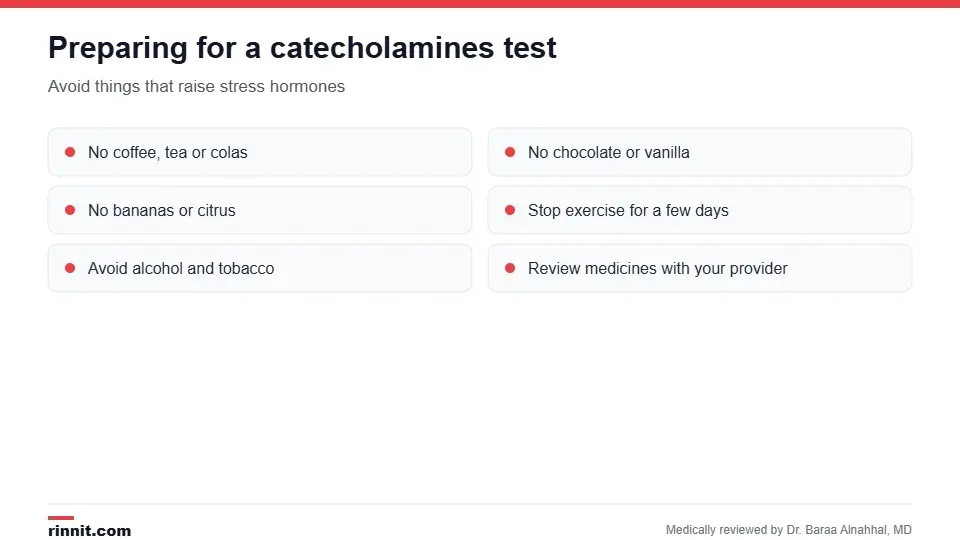
Following preparation steps helps avoid false results.
Avoid coffee, tea, caffeinated colas, energy drinks, chocolate, bananas, citrus fruits and vanilla for a few days, as instructed.
Stop exercising for a few days and try to stay calm.
Avoid alcohol, tobacco and recreational drugs.
Tell your provider about all medicines; some, such as certain antidepressants, cold medicines, diuretics and acetaminophen, can affect results. Don't stop any medicine without asking. Sources: [1]
How to collect a 24-hour urine sample
Empty your bladder into the toilet when you start, and note the time.
Collect all urine for the next 24 hours in the lab container.
Keep the container cold, in a refrigerator or on ice.
Urinate into the container one last time at the 24-hour mark, then return it to the lab. Sources: [1]
Understanding results

A high result is a clue, not a diagnosis.
Low or normal levels usually aren't a concern. High levels can point to a tumor, but stress, illness, foods and medicines can also raise them. Your provider may repeat the test or order more tests, such as imaging, an MIBG scan or a biopsy, to confirm or rule out a tumor. Sources: [1, 3]
Conclusion
A catecholamines test helps screen for rare hormone-producing tumors. Careful preparation is the key to an accurate result, and an abnormal result is the start, not the end, of the workup.
Keep learning: read about pheochromocytoma and the MIBG scan.
Frequently asked questions
What are catecholamines?
Stress hormones: epinephrine, norepinephrine and dopamine.
Why would I need this test?
To check for rare tumors such as pheochromocytoma, paraganglioma or neuroblastoma.
Is urine or blood better?
A 24-hour urine test is usually preferred.
What foods should I avoid?
Coffee, tea, colas, chocolate, bananas, citrus and vanilla, as instructed.
Can stress affect the result?
Yes. Exercise and strong emotions can raise levels.
Should I stop my medicines?
Only if your provider tells you to.
Does a high result mean I have a tumor?
Not necessarily; more tests are needed.
What are metanephrines?
Breakdown products of catecholamines, often tested instead.
What happens after a high result?
Repeat testing, imaging or other tests to look for a tumor.
Are low levels a concern?
Usually not.
Related Reading
Pheochromocytoma: Rare Adrenal Tumor Explained — Symptoms, Causes, and Treatment the main tumor this test looks for.
Paraganglioma: Symptoms, Causes, and Treatment — A Clear Guide for Patients and Families a related tumor outside the adrenal gland.
Neuroblastoma: What It Is, Symptoms, Causes, and Treatment Options a childhood cancer that can raise catecholamines.
MIBG Scan: How It Finds Neuroendocrine Tumors, Preparation and Results the scan often used after high results.
Adrenal Gland and Medulla: Essential Functions and Health where catecholamines are made.
References
Cleveland Clinic. Catecholamines Test. Cleveland Clinic. Last updated October 22, 2026. https://my.clevelandclinic.org/health/diagnostics/22144-catecholamines-test
Lenders JW, Pacak K, Walther MM, et al. Biochemical diagnosis of pheochromocytoma: which test is best? JAMA. 2002;287(11):1427-1434. PMID 11903030. https://doi.org/10.1001/jama.287.11.1427
Lenders JW, Duh QY, Eisenhofer G, et al. Pheochromocytoma and paraganglioma: an Endocrine Society clinical practice guideline. Journal of Clinical Endocrinology & Metabolism. 2014;99(6):1915-1942. PMID 24893135. https://doi.org/10.1210/jc.2014-1498
Medical disclaimer
This article is for general education only and does not replace advice from a qualified healthcare professional. Talk to your doctor about your own diagnosis and treatment, and seek emergency care right away for severe or sudden symptoms.



Comments