MIBG Scan: How It Finds Neuroendocrine Tumors, Preparation and Results

Updated: 3 days ago
Written and medically reviewed by Dr. Baraa Alnahhal, MD · Last reviewed: November 2026 · How we review
Quick Answer
An MIBG scan is a nuclear medicine test that uses a radioactive tracer called iobenguane (MIBG) to find certain neuroendocrine tumors, such as pheochromocytoma, paraganglioma and neuroblastoma. These tumors absorb the tracer, so they light up on the camera. You take iodine drops beforehand to protect your thyroid, and scans are done about 24 hours after the injection.
What the research says
It reliably detects adrenal-type tumors in adults: in a prospective multicenter trial of 140 patients with confirmed diagnoses, 123I-MIBG imaging had a sensitivity and specificity of about 82% for pheochromocytoma and paraganglioma, rising to 88% sensitivity for adrenal pheochromocytomas but only 67% for tumors outside the adrenal gland (Wiseman GA et al., J Nucl Med, 2009) [2]
It works well in children with neuroblastoma: a prospective multicenter trial found 123I-MIBG scintigraphy had 88% sensitivity and 83% specificity in known or suspected neuroblastoma; most missed cases had only minimal remaining disease (Vik TA et al., Pediatr Blood Cancer, 2009) [3]
Key takeaways
MIBG is a tracer taken up by certain neuroendocrine tumors.
It helps find tumors, see if they've spread and check treatment response.
Iodine drops protect your thyroid from the tracer.
Scans start about a day after the injection and may take 2 to 4 visits.
It isn't done during pregnancy; breastfeeding needs a short pause.
What is an MIBG scan?
MIBG (metaiodobenzylguanidine) is a substance similar to the stress hormone norepinephrine. Cells in some neuroendocrine tumors take it up and store it. When MIBG is tagged with a small amount of radioactive iodine, a special camera can see where it collects. It is a type of nuclear medicine imaging. Sources: [1]
Why it's done

MIBG scans help diagnose, stage and follow certain tumors.
Find a tumor: such as pheochromocytoma, paraganglioma, neuroblastoma or some carcinoid tumors.
Check for spread: see whether a tumor has reached other parts of the body.
Check treatment response: see how well treatment is working.
Plan treatment: decide whether MIBG-based radiation therapy may help. Sources: [1, 2, 3]
How to prepare
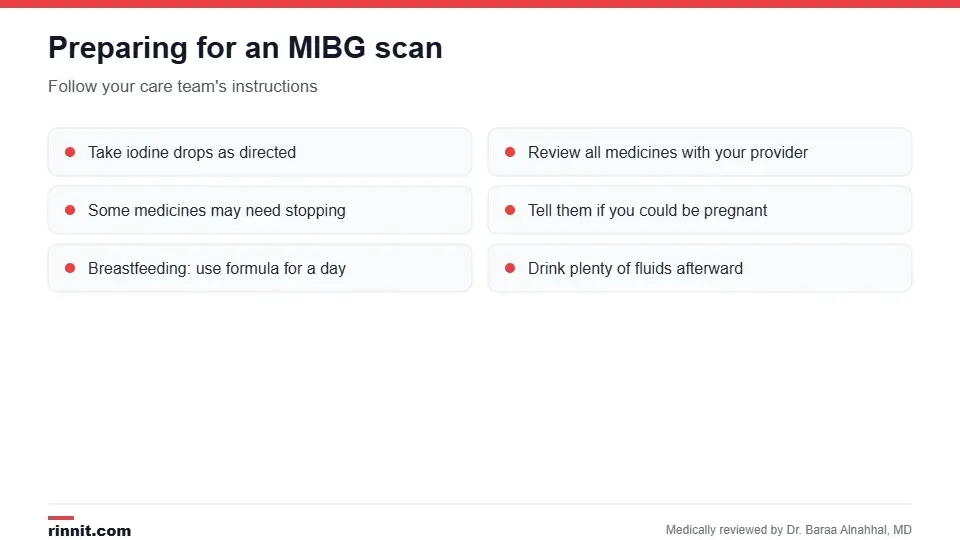
Preparation protects your thyroid and improves image quality.
Start Lugol's iodine (or a similar iodine medicine) the day before, as instructed, to block your thyroid from absorbing the tracer.
Tell your provider about all medicines; some blood pressure medicines, antidepressants and cold medicines can block MIBG uptake and may need to be stopped.
Tell your provider if you are or could be pregnant; the test isn't done in pregnancy.
If you're breastfeeding, plan to use formula for at least a day. Sources: [1]
What happens during the scan
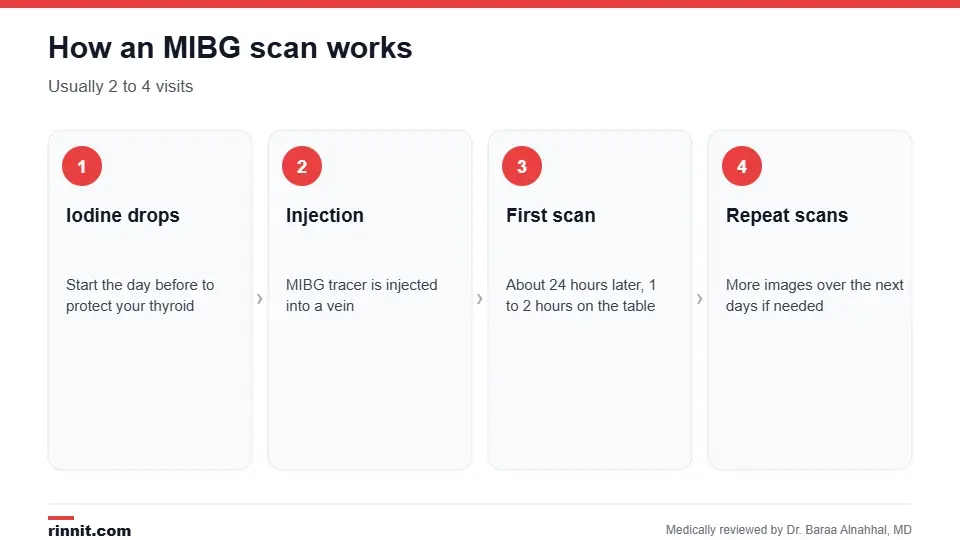
The tracer needs time to collect in tumor cells before scanning.
A provider injects the MIBG tracer into a vein in your arm.
You go home and come back for the first scan, usually about 24 hours later.
You lie still on a table while a camera passes over your body; each session takes about 1 to 2 hours.
You may need repeat scans over the next days, for a total of 2 to 4 visits. Sources: [1]
Some centers add SPECT or CT images to show exactly where the tracer collects. Sources: [1, 2]
Risks and side effects
The radiation dose is small. The injection can briefly raise blood pressure, so your provider monitors you. Drink plenty of fluids afterward to help flush the tracer out through your urine. Sources: [1]
Results
Result | What it may mean |
No abnormal uptake | No MIBG-avid tumor seen |
Uptake in one spot | A tumor that absorbs MIBG |
Uptake in several areas | The tumor may have spread |
Results are usually ready in a couple of days. A small tumor or one that doesn't take up MIBG can be missed, so results are read with blood or urine tests such as catecholamines and other imaging. Sources: [1, 2, 3]
Conclusion
An MIBG scan is a targeted way to find and follow certain neuroendocrine tumors. Careful preparation, especially the iodine drops and medicine review, helps you get accurate results.
Keep learning: read about neuroendocrine tumors and pheochromocytoma.
Frequently asked questions
What does MIBG stand for?
Metaiodobenzylguanidine, also called iobenguane.
What does an MIBG scan look for?
Neuroendocrine tumors such as pheochromocytoma, paraganglioma and neuroblastoma.
Why do I need iodine drops?
To protect your thyroid from absorbing the radioactive tracer.
How long does an MIBG scan take?
Usually 2 to 4 visits of about 1 to 2 hours each.
When is the first scan?
Usually about 24 hours after the injection.
Is the radiation dangerous?
The dose is small and leaves your body over a few days.
Can I have it while pregnant?
No, it isn't done during pregnancy.
Can I breastfeed after the scan?
Use formula for at least a day, or as your provider advises.
Do I need to stop any medicines?
Possibly. Some medicines block MIBG uptake, so review them with your provider.
How accurate is an MIBG scan?
Cleveland Clinic notes about 85% accuracy.
Related Reading
Catecholamines Test: How to Prepare and What High Levels Mean explains the stress hormone test used to look for this tumor.
Pheochromocytoma: Rare Adrenal Tumor Explained — Symptoms, Causes, and Treatment the adrenal tumor MIBG scans most often look for.
Neuroblastoma: What It Is, Symptoms, Causes, and Treatment Options a childhood cancer often staged with MIBG.
Paraganglioma: Symptoms, Causes, and Treatment — A Clear Guide for Patients and Families a tumor outside the adrenal gland that MIBG can detect.
Neuroendocrine Tumors: Symptoms, Causes, Diagnosis and Treatment — What You Need to Know the wider group of tumors that take up MIBG.
Carcinoid Tumors: Symptoms, Diagnosis, Treatment and Support another neuroendocrine tumor that may show on MIBG.
References
Cleveland Clinic. MIBG Scan: What It Is, Purpose, Procedure & Results. Cleveland Clinic. Last updated May 10, 2022. https://my.clevelandclinic.org/health/diagnostics/17226-mibg-scan
Wiseman GA, Pacak K, O'Dorisio MS, et al. Usefulness of 123I-MIBG scintigraphy in the evaluation of patients with known or suspected primary or metastatic pheochromocytoma or paraganglioma: results from a prospective multicenter trial. J Nucl Med. 2009;50(9):1448-1454. PMID 19690028. https://doi.org/10.2967/jnumed.108.058701
Vik TA, Pfluger T, Kadota R, et al. (123)I-mIBG scintigraphy in patients with known or suspected neuroblastoma: results from a prospective multicenter trial. Pediatr Blood Cancer. 2009;52(7):784-790. PMID 19185008. https://doi.org/10.1002/pbc.21932
Medical disclaimer
This article is for general education only and does not replace advice from a qualified healthcare professional. Talk to your doctor about your own diagnosis and treatment, and seek emergency care right away for severe or sudden symptoms.



Comments