Von Hippel-Lindau Disease (VHL): Symptoms, Causes, and Management

Updated: 3 days ago
Medically reviewed by Dr. Baraa Alnahhal, MD · Last reviewed: October 2026
Quick Answer
Von Hippel-Lindau disease is a rare inherited condition caused by a mutation in the VHL tumor suppressor gene, raising the risk of tumors such as clear cell kidney cancer, pancreatic neuroendocrine tumors, pheochromocytomas and hemangioblastomas. [1] Symptoms depend on tumor location, such as headaches or vision problems. [1] There is no cure, so care focuses on early detection and removal. [1]
What the research says
VHL is likely under-diagnosed, and survival has been improving. In a Danish national cohort analysis, the birth incidence was about 1 in 27,300 live births and the prevalence about 1 in 46,900 people. Penetrance at age 60 was 87% (80% in people who had not attended surveillance before diagnosis). Survival improved over time, and the mean life expectancy of mutation carriers born in 2000 was estimated at 67 years for men and 60 years for women. Estimates vary between studies and populations (Binderup, Dan Med J, 2018) [2].
Age at onset, family history, and mutation type affect survival. In a study of 340 patients from 127 Chinese families, the median life expectancy was 62 years. Earlier onset, a positive family history, and truncating mutations were linked to poorer survival. Patients whose first symptom was a hemangioblastoma had a higher risk of dying from a central nervous system hemangioblastoma than those who first had abdominal lesions (hazard ratio 8.84; 95% CI 2.04 to 38.37) (Wang et al., J Med Genet, 2018) [3].
What Is Von Hippel-Lindau Disease?
Von Hippel-Lindau disease, also called von Hippel-Lindau syndrome, is a rare genetic disorder in which multiple tumors and cysts develop in different parts of the body. These growths can be cancerous (malignant) or noncancerous (benign). [1] The condition is caused by an inherited mutation in a gene that normally acts as a tumor suppressor. Cleveland Clinic reports that by age 65, about 97% of people who carry the mutation will develop VHL-related tumors or other associated conditions. [1] It affects roughly 1 in 36,000 people, and most people develop symptoms in their mid-20s. [1]
Associated Cancers and Tumors
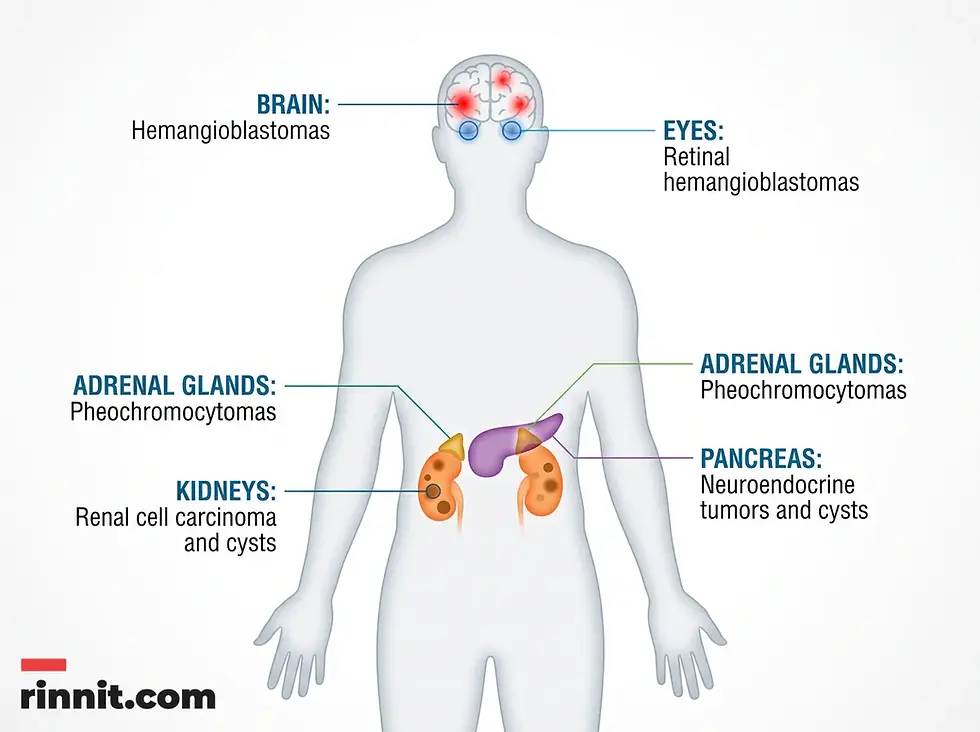
VHL is best known for raising the risk of specific cancers and noncancerous growths. The most common cancer is clear cell renal carcinoma, which affects an estimated 25% to 60% of people with the disorder. Other associated cancers include pancreatic neuroendocrine tumors and pheochromocytomas, which are adrenal gland tumors that start as noncancerous but can become cancerous. [1]
Common Noncancerous Growths
Hemangioblastomas are the most common noncancerous tumors in VHL. [1] They grow in the blood vessels of the brain, spinal cord, or retina. [1] They do not spread to other parts of the body, but as they grow they can press on nearby tissue and cause serious problems such as vision loss or balance difficulties. VHL can also cause cysts in the kidneys and pancreas, cystadenomas in the epididymis (in males) or broad ligament (in females), and, rarely, tumors of the inner ear. [1]
Growth type | Affected area | Estimated prevalence in VHL |
Retinal hemangioblastoma | Retina (eye) | 60% [1] |
Brain stem and cerebellar hemangioblastoma | Brain | 13% to 72% [1] |
Spinal cord hemangioblastoma | Spinal cord | 13% to 50% [1] |
Clear cell renal carcinoma | Kidneys | 25% to 60% [1] |
Pheochromocytoma | Adrenal glands | 10% to 20% [1] |
Pancreatic neuroendocrine tumors | Pancreas | 9% to 17% [1] |
Endolymphatic sac tumor | Inner ear | 10% to 25% [1] |
Symptoms and Causes
The symptoms of VHL vary widely with the location, size, and type of tumors. Because growths can appear in several organ systems, people may notice a broad range of problems. Common symptoms include:
Headaches
Hearing loss or ringing in the ears (tinnitus)
High blood pressure
Loss of balance, muscle strength, or coordination
Vision problems
Vomiting
Genetic Foundation
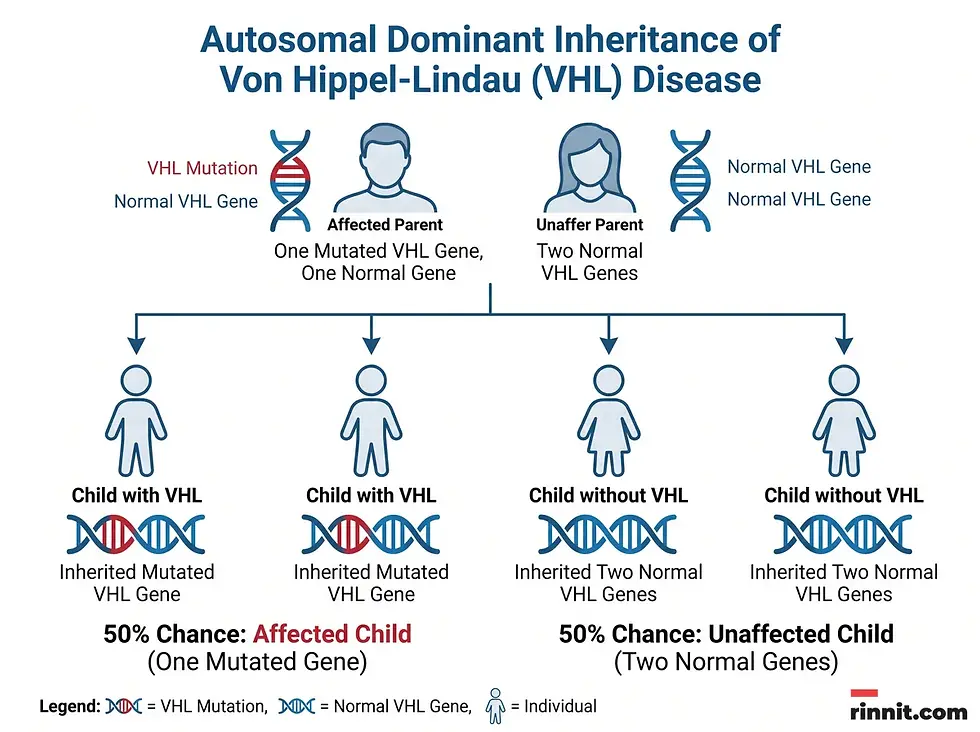
VHL is inherited in an autosomal dominant pattern. This means that one abnormal copy of the VHL gene is enough to cause the condition, and each child of a parent with VHL has a 50% chance of inheriting it. [1] The VHL gene is a tumor suppressor gene that helps control cell growth. [1] When it mutates, it loses its ability to regulate cell division, which leads to the overgrowth of tissue seen in VHL. Up to 10% of people with VHL have no known family history of the disorder. [1]
Diagnosis and Management
Providers usually suspect VHL when someone has a condition typical of the disorder, such as a hemangioblastoma or kidney cancer. Genetic testing is the only way to confirm the diagnosis. [1] If anyone in your family has VHL, ask your provider whether genetic testing and genetic counseling are right for you, since early identification allows closer monitoring.
Treatment Strategies
There is currently no cure for VHL. [1] The goal of care is to find and remove tumors as early as possible to prevent complications and protect organ function. Surgery is the most common treatment [1], and other therapies are chosen according to the type of tumor.
Treatment type | Application in VHL |
Surgery | The most common method for removing tumors and cysts that cause symptoms or are growing. |
Targeted therapy | Includes belzutifan, a pill the FDA approved in 2021 for certain VHL-related kidney cancers, brain and spinal cord hemangioblastomas and pancreatic tumors, plus tyrosine kinase inhibitors (TKIs) and peptide receptor radionuclide therapy (PRRT) for certain tumor types. [1] |
Radiation therapy and other drug treatments | Radiation, chemotherapy, immunotherapy, or hormone therapy may be used depending on the tumor. |
Monitoring | Regular imaging such as MRI, along with eye exams, to catch new growths early. There are no universal screening guidelines; for example, some providers recommend an abdominal MRI about every two years. [1] |

Living With VHL
Living with VHL can mean living with uncertainty, and a diagnosis can have a real emotional impact. Ask your care team about mental health support, eat a balanced diet, stay physically active, and ask which vaccinations make sense for you. Call your healthcare provider if you notice changes in your vision or hearing, headaches, nausea or vomiting not caused by another illness, a sharp rise in blood pressure, or sudden trouble with walking, balance, or coordination. [1]
Conclusion
Von Hippel-Lindau disease is a complex, multi-system disorder that calls for lifelong follow-up. It cannot be prevented, but better monitoring and surgical techniques have improved the outlook for many people. With a consistent surveillance plan and early treatment, people with VHL can manage their symptoms and protect their quality of life.
Next Steps
If you have a family history of VHL, or symptoms such as persistent headaches or vision changes, talk with a genetic counselor or healthcare provider about an evaluation and possible genetic testing. If you plan to have a child and carry the VHL gene, a genetic counselor can explain the risk of passing it on.
Frequently Asked Questions
1. Is VHL a type of cancer?
VHL is a genetic disorder that raises the risk of both cancerous and noncancerous tumors. The disorder itself is the underlying genetic cause, not a cancer.
2. Can VHL be cured?
No. There is currently no cure. Treatment focuses on finding and removing the tumors it causes.
3. How is VHL inherited?
VHL follows an autosomal dominant pattern, so one mutated gene from one parent is enough to cause the condition.
4. What is the most common tumor in VHL?
Hemangioblastomas, particularly in the retina and brain, are the most common noncancerous growths. Clear cell renal carcinoma is the most common cancer.
5. At what age do symptoms usually start?
Most people begin to develop symptoms in their mid-20s, though this varies.
6. Can you have VHL without a family history?
Yes. Up to 10% of people with VHL have no known family history of the disorder.
7. Is surgery always necessary?
Surgery is the most common treatment for tumors that cause symptoms or are growing, but your team will choose treatment based on the tumor type and location.
8. What organs are most affected by VHL?
The brain, spinal cord, eyes, kidneys, adrenal glands, and pancreas are most commonly involved.
9. How is VHL diagnosed?
Genetic testing is the only way to confirm a VHL gene mutation. Providers may suspect VHL based on tumors typical of the disorder.
10. What is a hemangioblastoma?
A hemangioblastoma is a noncancerous tumor of blood vessels, most often found in the brain, spinal cord, or retina in people with VHL.
11. Can VHL cause vision loss?
Yes. Retinal hemangioblastomas can cause vision loss if they are not found and treated.
12. Does VHL affect hearing?
Rare endolymphatic sac tumors in the inner ear can cause hearing loss or tinnitus.
13. What is clear cell renal carcinoma?
Clear cell renal carcinoma is the most common form of kidney cancer, and it is the cancer most often linked to VHL.
14. How often should VHL patients be screened?
Schedules are personalized. There are no universal guidelines, but your team may recommend regular imaging, such as an abdominal MRI about every two years, plus eye exams.
15. Can VHL be prevented?
No, because it is inherited. Knowing your risk and monitoring closely allows tumors to be found and treated early.
Related Reading
Trusted External Resources
References
Cleveland Clinic. von Hippel-Lindau Disease (VHL). Cleveland Clinic. Last updated February 12, 2024. https://my.clevelandclinic.org/health/diseases/6118-von-hippel-lindau-disease-vhl
Binderup MLM. von Hippel-Lindau disease: diagnosis and factors influencing disease outcome. Dan Med J. 2018;65(3):B5461. PMID 29510814. https://pubmed.ncbi.nlm.nih.gov/29510814/
Wang JY, Peng SH, Li T, et al. Risk factors for survival in patients with von Hippel-Lindau disease. J Med Genet. 2018;55(5):322-328. PMID 29330336. https://doi.org/10.1136/jmedgenet-2017-104995
Medical Disclaimer
This article is for informational purposes only and does not constitute medical advice. Always seek the advice of your physician or other qualified health provider with any questions you may have regarding a medical condition. Never disregard professional medical advice or delay in seeking it because of something you have read here.



Comments