Perineal Urethrostomy: Procedure, Recovery, and Outcomes

Updated: 3 days ago
Medically reviewed by Dr. Baraa Alnahhal, MD · Last reviewed: October 2026
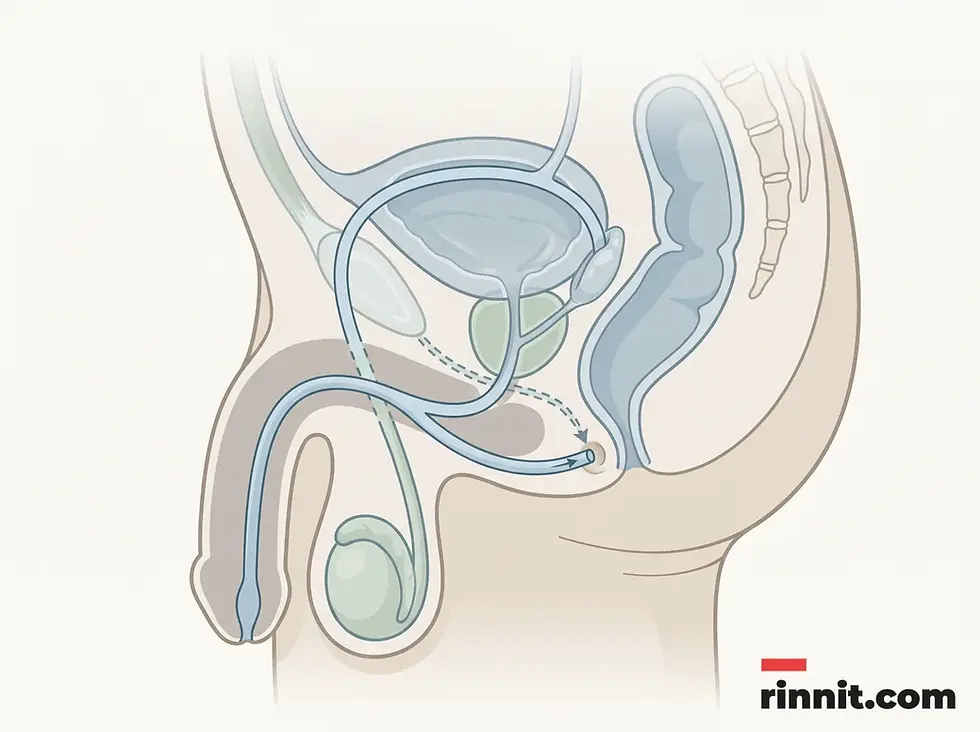
Perineal urethrostomy is a surgical procedure that reroutes the urethra to a new opening in the perineum, allowing urine to bypass obstructions in the penis. It is primarily used for complex or recurrent urethral strictures when other repairs have failed. The procedure has a high success rate, significantly improving urinary flow and quality of life [1]. Recovery typically involves a short hospital stay and several weeks of activity restrictions while the new opening heals.
Quick Answer
Perineal urethrostomy is a surgery that creates a new opening for urination in the perineum, the area between the scrotum and anus, rerouting the urethra past the penis tip. It is typically recommended for men with severe or recurrent urethral strictures that other methods cannot correct. Studies report success rates of about 50% to 95% without further corrective surgery.
What the research says
Most men avoided further treatment for years after perineal urethrostomy. In 76 men treated at a reconstructive referral center, 84% needed no retreatment at a median follow-up of 55 months, with very high satisfaction scores; a review of published studies found success rates ranging from 51% to 95% (Klemm et al., J Urol, 2024).
Urine flow improved sharply after surgery. Among 56 men with anterior urethral stricture, the operation succeeded in 92.9% at a median of 34 months; maximum urine flow rose from 3.8 to 17.6 mL/s, and 84.6% of those surveyed were satisfied or very satisfied (Shinchi et al., World J Urol, 2021).
Long-term success depends on patient factors. In 115 operations using the Blandy technique, overall success was 51.3% over a median of 71 months, rising to 75% in the most recent 8 years; older age, higher BMI and a prior suprapubic catheter predicted failure, while 88.7% were satisfied with their voiding (Ponce de León et al., World J Urol, 2023).
Research summaries are based on article abstracts retrieved from PubMed.
What is a perineal urethrostomy?
Perineal urethrostomy is a specialized urological surgery designed to address severe obstructions in the male urethra. Unlike standard urethral repairs that attempt to maintain the natural opening at the tip of the penis, this procedure creates a permanent alternative exit point. This rerouting is particularly effective when the penile portion of the urethra is too damaged or scarred to function correctly.
Aspect | Description |
|---|---|
New opening location | Perineum (area between the scrotum and anus) |
Primary goal | Reroute urine flow to bypass urethral obstructions |
Primary indication | Complex or recurrent urethral strictures |
Surgical technique | Often involves the Blandy technique using a perineal skin flap |
Indications for the Procedure
Healthcare providers recommend perineal urethrostomy when traditional treatments for urethral narrowing have proven insufficient. Scarring from infections, injuries, or previous surgeries can lead to strictures that partially or completely block urine flow.
The procedure may be necessary if:
The urethra cannot be adequately repaired to allow drainage from the penis tip
The patient prefers to avoid extensive reconstructive surgery
Previous procedures, such as urethroplasty, have failed to resolve the stricture
Other conditions are present, including penile cancer, hypospadias, or a history of penectomy
How is a perineal urethrostomy performed?
The procedure is performed under general anesthesia and typically lasts between one and three hours. The most common approach is the Blandy technique, which utilizes the patient's own skin to form the new urethral opening.
Surgical Steps
During the surgery, the urologist makes a U-shaped incision in the perineum to create a skin flap. A corresponding incision is made in the urethra, and the skin flap is carefully sutured to the urethral edges. This creates a wide, stable opening that allows for easy passage of urine. A Foley catheter is then inserted into the bladder to drain urine and support the healing tissues during the initial recovery phase.
Procedure phase | Key actions |
|---|---|
Preparation | Antibiotics, fasting, and preoperative X-rays |
Incision | U-shaped cut in the perineum and lengthwise urethral cut |
Construction | Suturing the skin flap to the urethra to form the stoma |
Completion | Catheter placement and initial anesthesia recovery |
What is recovery and long-term outlook after perineal urethrostomy?
Following the surgery, patients usually remain in the hospital for two to three days for monitoring. The Foley catheter typically remains in place for two to three weeks to ensure the new opening heals properly without narrowing.
Post-Operative Care
Recovery involves a gradual return to normal activities. For the first few weeks, patients must avoid strenuous exercise, heavy lifting, driving, and sexual activity. A significant change for patients is the requirement to sit down to urinate, which requires adjustment in daily habits. Proper hygiene in the perineal area is essential to prevent irritation or infection at the surgical site.

Prognosis and Success Rates
The long-term outlook for perineal urethrostomy is generally very positive. Research indicates that about 50% to 95% of patients do not require further corrective surgery, with 84% avoiding retreatment in one large recent series [1]. Most individuals report a marked improvement in their urinary symptoms and overall quality of life once the initial healing period is complete.
What are the risks and complications of perineal urethrostomy?
Perineal urethrostomy is generally safe with rare complications, but risks include bleeding, infection, a returning stricture, bladder emptying problems and, uncommonly, effects on erectile function. Complications are relatively rare but can occur.
Potential risks include:
Bleeding or swelling at the incision site
Localized infection or urinary tract infections (UTIs)
Recurrence of the stricture at the new opening, which may necessitate further surgery
Difficulty completely emptying the bladder or low urinary flow rates
Potential impact on erectile function, although this is uncommon

What is the bottom line on perineal urethrostomy?
Perineal urethrostomy is a highly effective surgical solution for men facing complex urethral obstructions. By providing a reliable alternative for urine drainage, it avoids the need for more invasive reconstructions and offers a high probability of long-term success. Patients considering this procedure should discuss the functional changes, such as sitting to urinate, with their urologist to ensure they are fully prepared for life after surgery.
Take action today: If you live with a recurrent or complex urethral stricture, ask your urologist whether perineal urethrostomy is an option for you, and bring your questions about recovery and daily life after surgery.
Frequently Asked Questions
Who is not a suitable candidate for perineal urethrostomy?
The procedure may not be ideal for individuals with severe obesity, a history of multiple previous perineal surgeries, or those who have received radiation therapy for prostate cancer, as these factors can complicate healing.
How does the procedure affect ejaculation?
After the surgery, semen will pass through the new opening in the perineum rather than the tip of the penis. This does not typically affect the sensation of orgasm.
Will I be incontinent after the surgery?
No, the surgery does not cause incontinence. The muscles responsible for controlling urine flow (the urinary sphincter) are located above the new opening and remain functional.
How long does the catheter need to stay in?
The Foley catheter is usually left in place for two to three weeks to allow the new urethral opening to stabilize and heal.
Do I have to sit down to urinate?
Yes, because the new opening is located between the scrotum and the anus, patients must sit down to urinate after the procedure.
Is the procedure permanent?
Yes, a perineal urethrostomy is intended to be a permanent solution for urethral rerouting, although it can sometimes be reversed if the original urethral stricture is later repaired.
What are the signs of a complication?
Patients should contact their provider if they experience heavy bleeding, significant swelling, fever, a frequent urge to urinate, or a feeling that the bladder is not emptying completely.
How successful is the surgery?
The procedure is usually successful, with about 50% to 95% of patients in published studies needing no further surgery and most reporting better urinary flow. [1]
Can I still have sex after recovery?
Yes, most patients can resume sexual activity after the initial healing period of two to three weeks, as directed by their surgeon.
Will my urinary flow rate be normal?
Most patients experience a much stronger and more consistent urinary flow compared to their pre-surgery state, although flow rates are monitored during follow-up appointments.
Related Resources
Related reading on Rinnit:
External resources for deeper reading:
Cleveland Clinic. Perineal Urethrostomy. Cleveland Clinic Health Library. Last updated July 13, 2026. https://my.clevelandclinic.org/health/treatments/16565-perineal-urethrostomy
Related Reading
Urethral Stricture: Symptoms, Causes, Diagnosis, and Treatment Explained explains urethral narrowing, the main reason for this surgery.
Urethroplasty: Procedure, Recovery and Success Rate describes surgery to repair or rebuild a narrowed urethra.
Restoring Urinary Flow: A Guide to Posterior Urethral Reconstruction covers reconstruction of the deeper part of the urethra.
Retrograde Urethrogram (RUG): Why It's Done, What to Expect and Results explains the X-ray test used to map urethral narrowing.
References
Cleveland Clinic. Perineal Urethrostomy. Cleveland Clinic Health Library. Last updated July 13, 2026. https://my.clevelandclinic.org/health/treatments/16565-perineal-urethrostomy
Klemm J, Dahlem R, Schulz RJ, et al. Perineal Urethrostomy for Complex Urethral Strictures: Long-Term Patient-Reported Outcomes From a Reconstructive Referral Center and a Scoping Literature Review. J Urol. 2024;212(5):738-748. PMID 39092698. https://doi.org/10.1097/JU.0000000000004169
Shinchi M, Horiguch A, Ojima K, et al. Evaluation of the efficacy of perineal urethrostomy for patients with anterior urethral stricture: insights from surgical and patient-reported outcomes. World J Urol. 2021;39(12):4443-4448. PMID 34328540. https://doi.org/10.1007/s00345-021-03795-2
Ponce de León J, Salas D, Calderón J, et al. Analysis of prognostic factors of failure in perineal urethrostomy. World J Urol. 2023;41(4):1109-1115. PMID 36932283. https://doi.org/10.1007/s00345-023-04343-w
Medical disclaimer
This article is for informational purposes only and is not a substitute for professional medical advice, diagnosis, or treatment. Always seek the advice of your physician or other qualified health provider with any questions you may have about a medical condition.



Comments