Necrosectomy: Types, Procedure, Risks and Recovery

Updated: 3 days ago
Written and medically reviewed by Dr. Baraa Alnahhal, MD · Last reviewed: November 2026 · How we review
Quick Answer: What is a necrosectomy?
A necrosectomy is a procedure that removes dead tissue (necrosis) in or around the pancreas. It treats necrotizing pancreatitis, a severe form of pancreatitis that kills pancreatic tissue. Care teams try nonsurgical treatment first and use the least invasive approach possible. Most people stay in the hospital one to three weeks, and full recovery takes one to three months. [1]
What the research says
Endoscopic and surgical step-up approaches had similar rates of major complications or death. In a randomized trial of 98 people with infected necrotizing pancreatitis at 19 Dutch hospitals, major complications or death occurred in 43% of the endoscopy group and 45% of the surgery group, and death rates did not differ (18% vs. 13%). The endoscopic group had fewer pancreatic fistulas and shorter hospital stays. (van Brunschot et al., The Lancet, 2018) [2]
An endoscopic approach caused fewer complications than minimally invasive surgery. In a single-center trial of 66 people with infected necrotizing pancreatitis, major complications or death occurred in 11.8% after the endoscopic approach versus 40.6% after minimally invasive surgery. No one in the endoscopic group developed a fistula, compared with 28.1% after surgery, and mean costs were lower. (Bang et al., Gastroenterology, 2019) [3]
Key takeaways
A necrosectomy removes dead tissue in or around the pancreas caused by necrotizing pancreatitis. [1]
Dead tissue can become infected and lead to sepsis or systemic inflammatory response syndrome (SIRS). [1]
Care follows a step-up approach: nonsurgical treatment first, then the least invasive procedure, and bigger surgery only if needed. [1]
Endoscopic or percutaneous procedures take about one to three hours; VARD or open surgery takes about two to four hours. [1]
Many people need more than one procedure, a hospital stay of one to three weeks and one to three months to recover fully. [1]
What is a necrosectomy?
A necrosectomy is a procedure to remove dead tissue (necrosis) in or around the pancreas. It treats necrotizing pancreatitis, a severe type of pancreatitis that causes pancreatic tissue to die. [1]
Dead tissue is dangerous because it can lead to serious complications. The main concern is infection, which can progress to septicemia and sepsis. Dead tissue can also trigger systemic inflammatory response syndrome (SIRS), a body-wide inflammatory reaction. [1]
Because people who need this procedure are already very ill, providers try to treat necrosis without surgery first and consider a necrosectomy when complications develop. [1] For background on the condition itself, see our guide to pancreatitis symptoms, causes and treatment.
What are the types of necrosectomy?
There are four main approaches, listed here from the least invasive to the most invasive: [1]
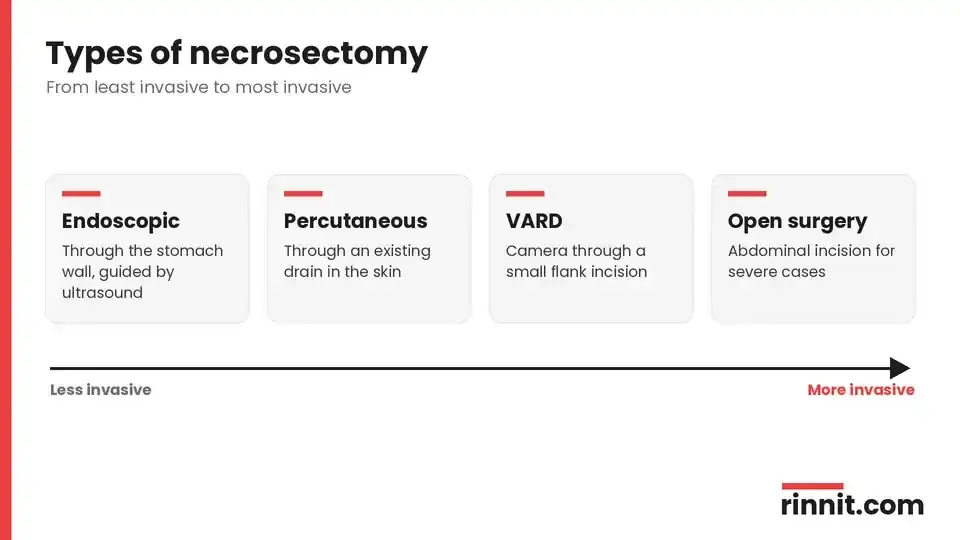
The four necrosectomy approaches, from least invasive to most invasive.
Type | How the dead tissue is reached | Notes |
Endoscopic transluminal necrosectomy | Through the digestive tract, with endoscopic ultrasound helping place a stent | Can be repeated |
Percutaneous direct endoscopic pancreatic necrosectomy (PDEN) | Through an existing portal (drain opening) in the skin | Uses access already in place |
Video-assisted retroperitoneal debridement (VARD) | A laparoscope (camera) passed through the flank | Minimally invasive surgery |
Open necrosectomy | An incision in the abdomen (laparotomy) | Usually for severe cases that need emergency surgery |
Sources: [1]
When is a necrosectomy needed?
A necrosectomy is planned when noninvasive treatments, such as antibiotics or drainage, have not worked. [1]
Timing matters. Providers may delay the procedure until the inflammation settles, typically after the first few weeks, or until the collections of dead tissue become well defined. [1]
What happens during a necrosectomy?
Providers follow a step-up approach. They start with the least invasive method, sometimes reusing a portal left from an earlier drainage procedure, and move up to VARD or open surgery only if needed. [1]

Care escalates step by step, only as far as needed.
Nonsurgical treatment, such as antibiotics or drainage, is tried first.
When possible, the team waits for inflammation to settle and for dead-tissue collections to become well defined.
The least invasive approach is used first, sometimes through an existing drainage portal.
If needed, the team steps up to VARD or open surgery.
The surgeon removes as much dead tissue as possible and closes any incisions.
A portal may be left in place for future procedures.
Sources: [1]
Necrosectomy at a glance
Item | Typical detail |
Endoscopic or percutaneous procedure | About 1–3 hours |
VARD or open surgery | About 2–4 hours |
Repeat procedures | Common, because new dead-tissue collections can form over the following weeks |
Hospital stay | About 1–3 weeks |
Full recovery | About 1–3 months |
Sources: [1]
Complications can make the procedure take longer, and many people need more than one procedure. [1]
What are the risks of a necrosectomy?
People who need a necrosectomy are already critically ill, so bleeding and infection are both common and dangerous. Inflammation makes blood vessels easier to injure, and a weakened immune system makes bacteria harder to control. [1]
A new bleed or infection can make the necrosis worse and lead to sepsis, SIRS or multiple organ dysfunction. For this reason, surgeons do only as much surgery as is necessary. [1]
What happens after a necrosectomy?
Your care team monitors you closely after the procedure. After open surgery, a drainage tube is usually left in place so the area can be flushed with saline or reached again if another operation is needed. [1]
Additional procedures may be needed. New infections can cause abscesses (pockets of pus) or fistulas (abnormal openings between organs or to the skin). [1]
How long does recovery from a necrosectomy take?
Most people stay in the hospital for about one to three weeks. During this time you receive pain medicine and tube feeding, and the team keeps watching for complications. [1]
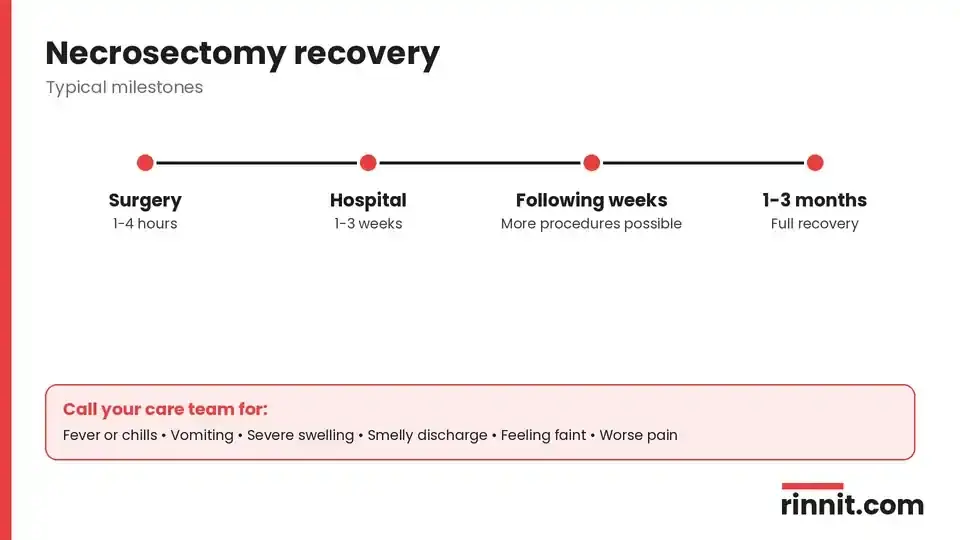
Full recovery usually takes about one to three months.
Full recovery takes about one to three months. It includes tapering off pain medicine, returning to normal eating and caring for any surgical drains at home. [1]
When should you call your provider?
Contact your care team if you notice any of these signs: [1]
Fever and chills
Nausea or vomiting
Severe swelling
Smelly discharge
Weakness or feeling faint
Pain that gets worse
What is the outlook after a necrosectomy?
A necrosectomy can save a life, but not always: about 2 in 10 people do not survive. Outcomes depend on overall health, how much tissue has died and whether complications develop. [1]
Losing a large part of the pancreas can have long-term effects that may need lifelong care: [1]
Exocrine pancreatic insufficiency: the pancreas cannot make enough digestive enzymes, which may require enzyme replacement. See our guide to exocrine pancreatic insufficiency.
Type 3c diabetes: the pancreas cannot make enough insulin and other hormones, which may require insulin. See our guide to type 3c diabetes.
Conclusion
A necrosectomy removes dead tissue in or around the pancreas when necrotizing pancreatitis causes dangerous complications. Care moves step by step, from nonsurgical treatment to the least invasive procedure and, only when needed, to bigger surgery. [1]
Recovery is often long, with a hospital stay of one to three weeks and one to three months before full recovery. If you or a loved one is facing this procedure, ask the care team which approach they plan, how many procedures may be needed and what long-term care to expect.
Keep learning: Read our guides to gallstone pancreatitis, pancreatic pseudocysts and the pancreas.
FAQ
What is a necrosectomy?
A necrosectomy is a procedure that removes dead tissue in or around the pancreas caused by necrotizing pancreatitis.
Why is a necrosectomy done?
It is done when dead pancreatic tissue causes complications such as infection, which can lead to sepsis, and nonsurgical treatments like antibiotics or drainage have not worked.
What are the types of necrosectomy?
The main types are endoscopic transluminal necrosectomy, percutaneous direct endoscopic necrosectomy (PDEN), video-assisted retroperitoneal debridement (VARD) and open necrosectomy.
What is the step-up approach to necrosectomy?
Providers start with the least invasive method and move up to VARD or open surgery only if needed.
How long does a necrosectomy take?
Endoscopic or percutaneous procedures take about one to three hours, and VARD or open surgery takes about two to four hours.
Will I need more than one necrosectomy?
Often, yes. New collections of dead tissue can form over the following weeks, so many people need more than one procedure.
How long will I stay in the hospital after a necrosectomy?
Most people stay in the hospital for about one to three weeks.
How long is recovery after a necrosectomy?
Full recovery usually takes about one to three months.
What are the risks of a necrosectomy?
Bleeding and infection are the main risks, and they can lead to sepsis, SIRS or multiple organ dysfunction.
When should I call my doctor after a necrosectomy?
Call your care team for fever or chills, nausea or vomiting, severe swelling, smelly discharge, weakness or feeling faint, or worsening pain.
How do I prepare for a necrosectomy?
Your care team plans a necrosectomy if noninvasive treatments such as antibiotics or drainage haven't worked. [1] They may wait a few weeks until the inflammation calms down and the dead tissue separates from healthy tissue, because well-defined collections are easier to remove. [1]
Will I have pain after a necrosectomy?
You'll receive pain medicine during your hospital stay, which usually lasts one to three weeks. [1] As you recover at home, you'll slowly taper off pain medicines; contact your provider if your pain gets worse. [1]
Related Reading
Learn more in our guide to Pancreatitis: Symptoms, Causes, and Treatment — A Clear Guide to Understanding and Managing the Condition.
Learn more in our guide to Exocrine Pancreatic Insufficiency (EPI): Symptoms, Causes, Diagnosis, Treatment and Outlook — What You Need to Know.
Learn more in our guide to Type 3c Diabetes: Causes, Symptoms, and Pancreatic Health.
References
Cleveland Clinic. Necrosectomy: What It Is, Procedure & Recovery. Cleveland Clinic. Last updated September 10, 2025. https://my.clevelandclinic.org/health/procedures/necrosectomy
van Brunschot S, van Grinsven J, van Santvoort HC, et al. Endoscopic or surgical step-up approach for infected necrotising pancreatitis: a multicentre randomised trial. Lancet. 2018;391(10115):51-58. PMID 29108721. https://doi.org/10.1016/S0140-6736(17)32404-2
Bang JY, Arnoletti JP, Holt BA, et al. An Endoscopic Transluminal Approach, Compared With Minimally Invasive Surgery, Reduces Complications and Costs for Patients With Necrotizing Pancreatitis. Gastroenterology. 2019;156(4):1027-1040.e3. PMID 30452918. https://doi.org/10.1053/j.gastro.2018.11.031
Medical disclaimer
This article is for general education only and does not replace advice from a qualified healthcare professional. Talk to your doctor about your own diagnosis and treatment, and seek emergency care right away for severe or sudden symptoms.



Comments