LASIK Eye Surgery: Procedure, Recovery and Results

Updated: 2 days ago
Written and medically reviewed by Dr. Baraa Alnahhal, MD · Last reviewed: November 2026 · How we review
Quick Answer
LASIK eye surgery (laser-assisted in situ keratomileusis) uses a laser to reshape the cornea so the eye focuses light correctly. It treats nearsightedness, farsightedness and astigmatism. About 9 in 10 people get 20/20 vision. Dry eye is the most common side effect. You need to be over 18 with a stable prescription.
What the research says
Most people are happy with LASIK: across 19 high-quality studies of 2,198 patients, 95.4% were satisfied after LASIK, including 95.3% after nearsighted and 96.3% after farsighted correction (Solomon KD et al., Ophthalmology, 2009) [2]
LASIK and SMILE give similar results: in 11 randomized trials for nearsightedness, LASIK and SMILE were equally safe with the same chance of 20/20 vision, but LASIK hit the target prescription more reliably (Yao L et al., Semin Ophthalmol, 2023) [3]
Key takeaways
LASIK reshapes the cornea with a laser to correct vision.
It treats nearsightedness, farsightedness and astigmatism.
The procedure takes 30 minutes or less, and you're awake.
About 9 in 10 people reach 20/20 vision.
Dry eye is the most common side effect and usually improves.
What is LASIK?
Your cornea is the clear front window of your eye. When its shape is off, light doesn't focus on the retina, causing refractive errors. LASIK changes the cornea's shape so light focuses correctly. Other laser options include PRK and SMILE. Sources: [1]
What LASIK treats
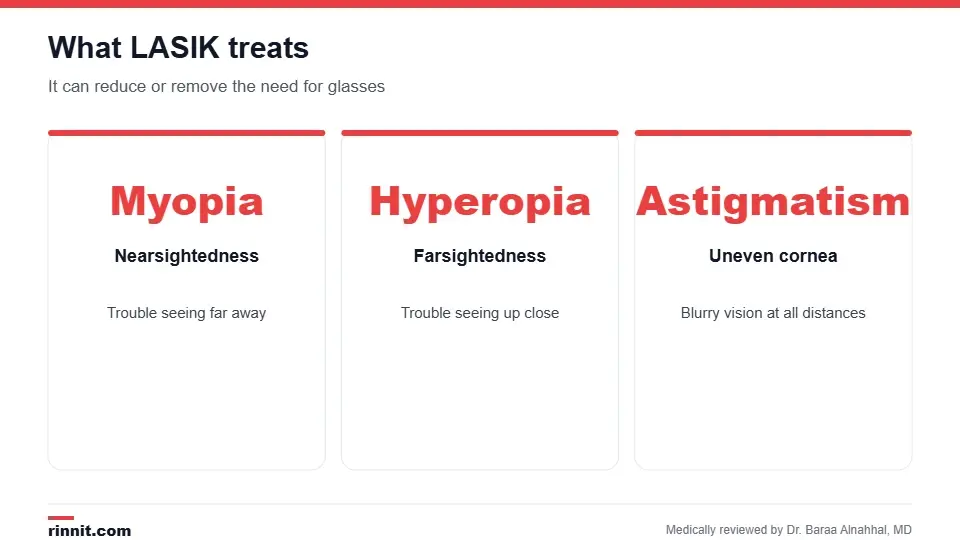
LASIK can reduce or remove the need for glasses or contacts.
Nearsightedness (myopia).
Presbyopia, in some cases. Sources: [1]
Who can get LASIK
Adults over 18 whose eyes have stopped changing.
A prescription that hasn't changed much in about a year.
Healthy eyes, confirmed by a full eye exam. Sources: [1]
How to prepare
Have a full eye exam to make sure LASIK is right for you.
On the day of surgery, don't wear lotion, makeup, perfume or other products on your face.
Arrange for someone to drive you home. Sources: [1]
What happens during LASIK

The whole procedure takes 30 minutes or less.
You get numbing eye drops and may get a mild sedative.
A suction ring and speculum hold your eye open. You'll feel pressure and your vision may dim briefly.
The surgeon makes a thin flap in the cornea.
You look at a light while the laser reshapes the cornea. You may hear clicking or notice an odd smell; nothing is burning.
The flap is laid back in place. No stitches are needed. Sources: [1]
Risks and side effects
Type | Examples |
Common and temporary | Dry eye (most common), gritty feeling, blurry vision for a day or two, reduced night vision, red spots on the white of the eye, light sensitivity |
Rare but serious | Weakened or damaged cornea, infection, worse vision (usually treatable) |
Most side effects ease within weeks. Dry eye can last several months but is treatable. Sources: [1]
Recovery

Most people see clearly within a few days.
When | What to expect |
First day or two | Wear an eye shield; use lubricating, antibiotic and steroid drops; follow-up visit |
After 3 days | Light exercise |
After 2 weeks | Lotion and makeup near the eyes |
After 1 month | Contact sports |
After 1 to 2 months | Swimming and hot tubs |
Don't drive until your eye doctor says it's safe. Full healing takes a few weeks. Sources: [1]
Results
Almost everyone reaches 20/40 or better, enough to pass a U.S. driver's vision test without glasses.
About 9 in 10 people get 20/20 vision.
Improvement usually starts in less than a day.
Results last for many years, but you may still need reading glasses as you age. Sources: [1, 2]
When to call your eye doctor
Side effects get worse instead of better.
Severe eye pain; get care right away. Sources: [1]
Conclusion
LASIK is a fast, effective way to correct common vision problems, and most people are very satisfied with the results. A full eye exam shows whether it's a good choice for you.
Keep learning: read about PRK eye surgery and refractive lens exchange.
Frequently asked questions
What is LASIK?
Laser eye surgery that reshapes the cornea to correct vision.
What does LASIK treat?
Nearsightedness, farsightedness and astigmatism.
Does LASIK hurt?
No. Numbing drops are used, though you'll feel pressure.
How long does LASIK take?
30 minutes or less, with under 30 seconds of laser time.
How successful is LASIK?
About 9 in 10 people reach 20/20 vision.
How long is recovery?
Vision clears within a few days; full healing takes a few weeks.
What is the most common side effect?
Dry eye, which usually improves.
Who can get LASIK?
Adults over 18 with healthy eyes and a stable prescription.
Is LASIK permanent?
Results last for many years, but you may need reading glasses later.
When can I swim after LASIK?
After one to two months.
Related Reading
SMILE Eye Surgery: How It Works, Candidates and Recovery explains SMILE laser eye surgery.
Artificial Tears: Types, Uses and How to Use Them explains artificial tears for dry eyes.
Photorefractive Keratectomy (PRK) Eye Surgery another laser vision surgery.
Refractive Errors: Symptoms, Causes, Types, and Treatment the vision problems LASIK corrects.
Astigmatism: Symptoms, Causes & Treatment Options — Complete Guide an uneven cornea that LASIK can fix.
Refractive Lens Exchange: A Permanent Solution for Clearer Vision a lens-based alternative.
Dry Eyes: Symptoms, Causes, Treatment & Relief — Complete Guide the most common side effect.
References
Cleveland Clinic. LASIK Eye Surgery: What It Is, Procedure & Recovery. Cleveland Clinic. Last updated May 26, 2026. https://my.clevelandclinic.org/health/treatments/21805-lasik-eye-surgery
Solomon KD, Fernández de Castro LE, Sandoval HP, et al. LASIK world literature review: quality of life and patient satisfaction. Ophthalmology. 2009;116(4):691-701. PMID 19344821. https://doi.org/10.1016/j.ophtha.2008.12.037
Yao L, Zhang M, Wang D, et al. Small incision lenticule extraction (SMILE) and laser in situ keratomileusis (LASIK) used to treat myopia and myopic astigmatism: a systematic review and meta-analysis of randomized clinical trials. Semin Ophthalmol. 2023;38(3):283-293. PMID 35912896. https://doi.org/10.1080/08820538.2022.2107399
Medical disclaimer
This article is for general education only and does not replace advice from a qualified healthcare professional. Talk to your doctor about your own diagnosis and treatment, and seek emergency care right away for severe or sudden symptoms.



Comments