Photorefractive Keratectomy (PRK) Eye Surgery

Updated: 3 days ago
Medically reviewed by Dr. Baraa Alnahhal, MD · Last reviewed: October 2026
Photorefractive Keratectomy (PRK) is a time-tested laser eye surgery designed to correct common vision problems like nearsightedness, farsightedness, and astigmatism. Unlike LASIK, which creates a corneal flap, PRK involves removing the cornea’s outer layer so it can regenerate naturally [1]. This makes PRK an ideal choice for patients with thin corneas, dry eyes, or highly active lifestyles [1]. While recovery takes a few days longer than LASIK, PRK offers comparable long-term results and exceptional safety [1] [2].
Quick Answer
Photorefractive keratectomy (PRK) is a refractive surgery in which an excimer laser reshapes the cornea to improve how the eye focuses light. During the outpatient procedure, the surgeon removes the corneal epithelium before using the laser, then applies a bandage contact lens while it regrows [1]. PRK suits people who cannot have LASIK because of corneal thickness or dryness [1].
What the research says
LASIK recovers faster and hurts less, but results at one year are similar. A Cochrane review of 13 randomized trials (1,135 people, 1,923 eyes) found that LASIK gave a faster visual recovery and was less painful than PRK, while outcomes one year after surgery were comparable and most differences were not statistically significant. The authors rated the overall quality of evidence as low for most outcomes (Shortt et al., Cochrane Database Syst Rev, 2013) [2].
PRK may be gentler on tear function than LASIK. In a meta-analysis of dry eye after refractive surgery (14 studies reached data extraction), LASIK significantly reduced tear break-up time (standardized mean difference −0.30) and tear production (−0.23), while the reductions after PRK were not statistically significant (−0.11 and −0.07). The authors call for more high-quality randomized trials (Sambhi et al., Can J Ophthalmol, 2020) [3].
Visual outcomes are broadly similar to LASIK and SMILE. A 2026 meta-analysis of 17 studies (5,686 eyes) comparing transepithelial PRK with LASIK or SMILE found no statistically significant differences in efficacy or predictability, although LASIK showed a safety advantage in the astigmatism and low-to-moderate myopia subgroup. The authors conclude that the choice of procedure should rest on patient characteristics, laser availability, complication risk, and surgeon experience (Serfözö et al., Eur J Ophthalmol, 2026) [4].
Research summaries are based on article abstracts retrieved from PubMed.
What is PRK Eye Surgery?
Photorefractive Keratectomy, or PRK, was the first type of laser eye surgery approved by the FDA for vision correction, debuting in 1995. It serves as a predecessor to the more widely known LASIK procedure [1]. The fundamental goal of PRK is to reshape the cornea—the clear front window of the eye—to correct refractive errors. By changing the cornea’s curvature, the eye can more accurately focus light onto the retina, reducing or eliminating the need for glasses or contact lenses [1].
While LASIK eventually became more popular due to its faster recovery time, PRK remains a vital and common treatment option [1]. Its primary distinction lies in how the surgeon accesses the deeper layers of the cornea. Instead of creating a flap that must be folded back and later replaced, PRK removes the epithelium entirely. This layer regrows naturally within a few days [1], providing a stable and resilient surface that is often preferred for specific medical or lifestyle reasons.
What conditions does PRK eye surgery treat?
PRK is a versatile procedure capable of addressing all four primary types of refractive errors [1]. By precisely thinning specific areas of the cornea, the laser corrects how light rays converge within the eye [1].
Condition | Description | PRK Correction Goal |
Nearsightedness (Myopia) | Difficulty seeing distant objects clearly. | Flattening a cornea that is too steep. |
Farsightedness (Hyperopia) | Difficulty seeing near objects clearly. | Steepening a cornea that is too flat. |
Astigmatism | Blurred vision due to an irregular corneal shape. | Smoothing an asymmetrical cornea. |
Presbyopia | Age-related loss of near-focusing ability. | Creating “monovision” (one eye for near, one for far) [1]. |
For many patients, PRK provides a level of vision correction that surpasses what is achievable with traditional corrective lenses, offering a new degree of visual freedom [1].

What happens during PRK eye surgery?
PRK is a streamlined, outpatient procedure that typically takes between 5 and 15 minutes to complete [1] for both eyes. Patients remain awake throughout the process, but the use of numbing eye drops ensures the experience is painless [1].
Step 1: Epithelium Removal
Once the eye is fully numbed, the surgeon removes the epithelium, the thin outermost layer of the cornea. This can be done using a laser, specialized manual tools, or a gentle liquid solution. While patients may feel slight pressure during this stage, there is no pain. The epithelium is a regenerative layer, meaning it will naturally grow back after the surgery [1].
Step 2: Laser Reshaping
After the epithelium is removed, the patient looks at a target light on the laser device. Modern lasers use sophisticated tracking technology to monitor eye position, ensuring the invisible beam ablates (removes) corneal tissue with extreme precision. The laser thins specific areas of the cornea to achieve the desired new shape without generating heat [1].
Step 3: Bandage and Protection
Once the reshaping is complete, the surgeon applies medicated eye drops and places a clear bandage contact lens over the eye. This lens acts as a protective shield, reducing discomfort and guarding the eye while the epithelium regenerates over the following few days [1].
What is recovery like after PRK eye surgery?
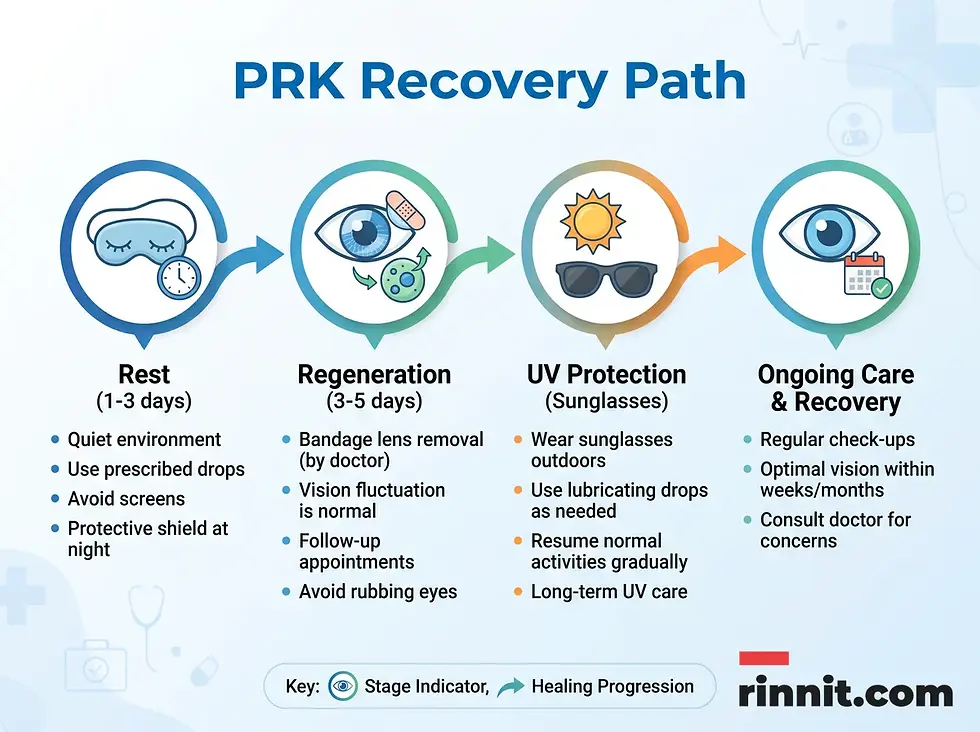
Recovery from PRK is a gradual process that requires diligent adherence to a prescribed care regimen. Because the epithelium must regrow, the initial healing phase is longer than that of LASIK [1].
The First Few Days
Patients can return home shortly after the procedure but must arrange for a driver. The first few days should be dedicated to rest, as physical activity can interfere with the healing process. It is normal for vision to be somewhat blurry or for the eyes to feel slightly irritated during this time [1].
Long-Term Maintenance
Medicated eye drops are typically prescribed for several weeks to prevent infection and promote smooth healing. One of the most critical aspects of PRK recovery is UV protection. Patients must wear sunglasses whenever outdoors during the day for as long as recommended by their eye care specialist to prevent corneal scarring and ensure the best possible visual outcome [1].
PRK vs. LASIK: Which is Better?
Neither procedure is universally “better”; rather, the choice depends on the individual patient’s ocular health and lifestyle [1] [4].

When PRK is Preferred
PRK is often the superior choice for patients with thin corneas, as it avoids the risks associated with cutting a deeper corneal flap [1]. It is also preferred for individuals with chronic dry eyes, as it causes less disruption to the corneal nerves responsible for moisture [1] [3]. Furthermore, because there is no flap that could potentially be dislodged by trauma, PRK is the standard recommendation for athletes in contact sports or individuals in high-impact professions like the military.
When LASIK is Preferred
LASIK remains the most popular choice for the general population primarily due to its rapid recovery [1] [2]. Most LASIK patients experience significant vision improvement within 24 hours and report less post-operative discomfort. PRK, by comparison, requires a longer commitment to medication and a few extra days of downtime [1].
Conclusion
Photorefractive Keratectomy (PRK) continues to be a highly effective and safe option for vision correction [1]. Its unique approach to corneal reshaping provides a resilient solution for those who may not be ideal candidates for other laser surgeries. By understanding the procedure and committing to the recovery process, patients can achieve lasting visual clarity and significantly reduce their dependence on glasses or contacts [1].
Frequently Asked Questions
Is PRK surgery painful?
The procedure itself is painless due to numbing eye drops. However, as the epithelium regrows over the first few days, you may experience some irritation, watering, or a “gritty” sensation. Your doctor will provide drops to manage this discomfort [1].
How long does the epithelium take to grow back?
The outermost layer of the cornea typically regenerates within three to five days. The bandage contact lens is usually removed by your doctor once this process is complete [1].
When can I drive after PRK?
Most patients need to avoid driving for at least a few days. You should only resume driving once your eye care specialist confirms your vision has reached a safe and stable level [1].
Will I still need reading glasses after PRK?
If you are over 40, you may still need reading glasses due to presbyopia unless you opt for a “monovision” correction, where one eye is set for distance and the other for near vision.
What are the main risks of PRK?
Complications are rare but can include infection, corneal scarring, or temporary dry eyes. Most issues are minor and can be effectively managed with medicated eye drops.
How soon will I see results?
While you will notice an improvement quickly, your vision will fluctuate as the eye heals. It often takes several weeks to a few months to reach your final, stable vision goal [1].
Can I have PRK if I have thin corneas?
Yes. Because PRK does not require a corneal flap, it is often the safest laser vision correction option for individuals with thin or unusually shaped corneas [1].
Why do I have to wear sunglasses after PRK?
UV rays can cause scarring on the healing cornea [1], which could permanently affect your vision. Wearing sunglasses is a critical step in ensuring a clear and successful recovery.
Is the bandage contact lens the same as a regular contact lens?
The bandage contact lens is similar in material but does not have a corrective prescription. Its sole purpose is to act as a protective “bandage” for the surface of your eye while it heals [1].
How many people achieve 20/20 vision with PRK?
The vast majority of patients achieve their vision goals. Most people end up within 0.50 diopters of their target, which is generally clear enough to function without glasses for most daily activities [1].
How do I prepare for PRK?
Your eye care specialist guides most of the preparation: an eye exam to check your vision and overall eye health, and precise measurements of your eye surface, especially the cornea. They will also talk through realistic expectations, since PRK improves sight but may not fully correct it. Arrange for someone to drive you to and from the procedure [1].
When should I call my doctor after PRK?
Call your eye care specialist if you have sudden vision loss, eye pain that medications do not help or that keeps getting worse after a few days, or signs of eye infection such as swelling, discharge or excessive watering [1].
Related Reading
SMILE Eye Surgery: How It Works, Candidates and Recovery explains SMILE laser eye surgery.
LASIK Eye Surgery: Procedure, Recovery and Results explains how LASIK corrects vision.
Corneal Topography: Mapping the Cornea and Reading the Results explains the eye test that maps the shape of the cornea.
References
Cleveland Clinic. Photorefractive Keratectomy (PRK). Cleveland Clinic Health Library. Last updated June 28, 2024. https://my.clevelandclinic.org/health/procedures/photorefractive-keratectomy-prk-eye-surgery
Shortt AJ, Allan BD, Evans JR. Laser-assisted in-situ keratomileusis (LASIK) versus photorefractive keratectomy (PRK) for myopia. Cochrane Database Syst Rev. 2013;(1):CD005135. PMID: 23440799. https://doi.org/10.1002/14651858.CD005135.pub3
Sambhi RS, Sambhi GDS, Mather R, et al. Dry eye after refractive surgery: a meta-analysis. Can J Ophthalmol. 2020;55(2):99-106. PMID: 31712000. https://doi.org/10.1016/j.jcjo.2019.07.005
Serfözö A, Abu Dail Y, Munteanu C, et al. The efficacy, safety and predictability in transepithelial photorefractive keratectomy versus LASIK/SMILE: a meta-analysis. Eur J Ophthalmol. 2026;36(4):837-855. PMID: 41734035. https://doi.org/10.1177/11206721261425379
Medical disclaimer
This article is for informational purposes only and is not a substitute for professional medical advice, diagnosis, or treatment. Always seek the advice of your physician or other qualified health provider with any questions you may have about a medical condition.



Comments