SMILE Eye Surgery: How It Works, Candidates and Recovery

Updated: 2 days ago
Written and medically reviewed by Dr. Baraa Alnahhal, MD · Last reviewed: November 2026 · How we review
Quick Answer
SMILE eye surgery (small incision lenticule extraction) is a minimally invasive laser procedure that reshapes the cornea to correct nearsightedness (myopia) and astigmatism. Unlike LASIK, there's no corneal flap, so it causes less nerve and tissue damage. Surgery takes minutes per eye with no stitches, and most people return to normal routines in one to two days.
What the research says
SMILE caused less dry eye than LASIK: pooling 18 studies, SMILE kept the tear film stable longer than femtosecond LASIK at 3 and 6 months and better preserved corneal sensation, though dry-eye symptom scores didn't differ significantly (Chen KY et al., Journal of Refractive Surgery, 2025) [2]
SMILE matched LASIK for vision results: in 12 studies of 1,385 eyes, SMILE and wavefront-guided LASIK were similarly safe, effective and predictable for nearsightedness (Tian H et al., Acta Ophthalmologica, 2023) [3]
Key takeaways
SMILE corrects nearsightedness and astigmatism with a laser.
It uses a tiny incision and no corneal flap.
Surgery takes only minutes per eye.
Most people recover in one to two days.
It doesn't treat farsightedness or presbyopia.
What is SMILE eye surgery?
SMILE has been available in the U.S. since 2016 and elsewhere for about 10 years longer, with about 5 million procedures worldwide. Like LASIK and PRK, it's a type of refractive surgery for refractive errors. Sources: [1]
Who's a good candidate

It may suit people with high prescriptions or dry eyes.
At least 22 years old.
No major prescription change in the past year.
Nearsightedness between -1 and -10 diopters.
Astigmatism up to 3 diopters.
Healthy corneas. Sources: [1]
It may not be right if you're pregnant or breastfeeding, have frequent prescription changes, severe glaucoma, corneal scars, keratoconus, unmanaged diabetes or a cataract affecting vision. Sources: [1]
SMILE vs. LASIK

SMILE may suit active people.
Feature | SMILE | LASIK |
Incision | Under 4 mm, no flap | Corneal flap |
Nerve and tissue damage | Less | More |
Treats | Nearsightedness and astigmatism | More conditions |
Experience | Fewer surgeons and studies | Widely studied |
Both are very safe. Sources: [1, 2, 3]
How to prepare
An eye exam checks for other conditions and measures your cornea.
Review your medicines and supplements with your surgeon.
Follow fasting instructions.
Arrange for an adult to drive you home. Sources: [1]
What happens during surgery
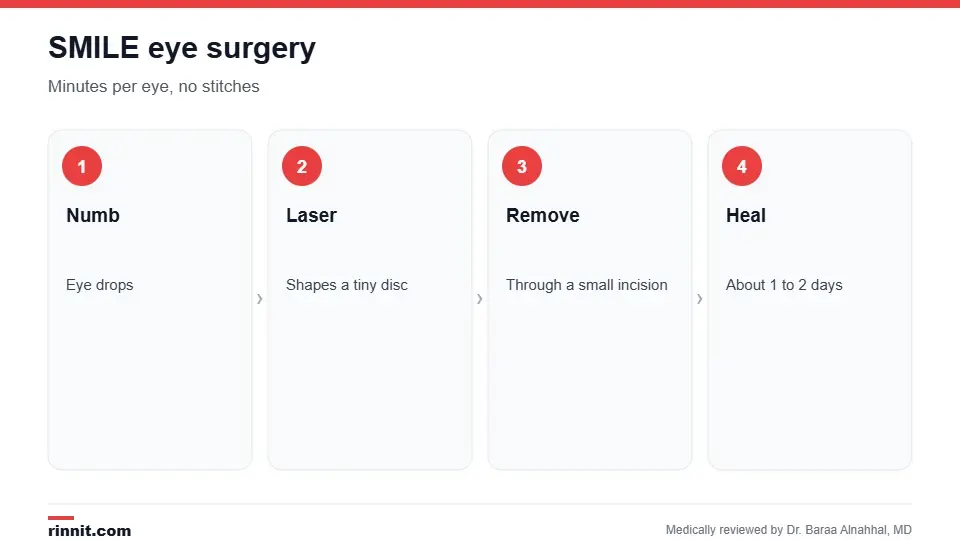
Surgery takes just minutes per eye.
Your eye is numbed.
A femtosecond laser creates a small disc of tissue inside the cornea in about 30 seconds.
The surgeon removes the disc through a tiny incision.
No stitches are needed. Sources: [1]
Risks
Halos and glare, especially at night.
Dry eyes.
Needing another surgery.
Very rarely, vision loss. Sources: [1]
Choose a surgeon with a lot of SMILE experience. Sources: [1]
Recovery
Your eye heals in about one to two days.
Keep water out of your eyes for at least a few days.
Wear protective eyewear and skip eye makeup until cleared.
Use your prescribed eye drops.
Avoid swimming and hot tubs for the first few days. Sources: [1]
Vision may seem better right away and keeps improving over days to weeks. Sources: [1]
Outlook
In one study, 99% of people had at least 20/40 vision and 88% had 20/20 vision six months after SMILE. Sources: [1]
When to call your provider
Severe eye pain.
Sudden vision loss.
Signs of infection, such as swelling or fever.
Eye discharge. Sources: [1]
Conclusion
SMILE offers a quick, flap-free way to correct nearsightedness and astigmatism with a fast recovery. An experienced surgeon can tell you whether you're a good candidate.
Frequently asked questions
What is SMILE eye surgery?
A laser procedure that reshapes the cornea to correct nearsightedness and astigmatism.
How is SMILE different from LASIK?
SMILE uses a tiny incision and no flap.
Can SMILE fix farsightedness?
No. It treats only nearsightedness and astigmatism.
How long does surgery take?
Minutes per eye; the laser runs about 30 seconds.
Does SMILE hurt?
Your eye is numbed with drops.
How long is recovery?
About one to two days.
Is SMILE good for dry eyes?
It may be a better option for people with dry eyes.
How old do I need to be?
At least 22.
Will I need glasses afterward?
Most people see much better; 88% had 20/20 vision in one study.
What are the risks?
Halos, glare, dry eyes and, rarely, vision loss.
Related Reading
LASIK Eye Surgery: Procedure, Recovery and Results a common alternative.
Photorefractive Keratectomy (PRK) Eye Surgery another laser option.
Refractive Errors: Symptoms, Causes, Types, and Treatment vision problems SMILE treats.
Astigmatism: Symptoms, Causes & Treatment Options — Complete Guide an uneven cornea.
Refractive Lens Exchange: A Permanent Solution for Clearer Vision a lens-based option.
References
Cleveland Clinic. SMILE Eye Surgery: What It Is, Details & Recovery. Cleveland Clinic. Last updated June 15, 2023. https://my.clevelandclinic.org/health/treatments/25076-smile-eye-surgery
Chen KY, Chan HC, Chan CM. How effective is keratorefractive lenticule extraction surgery (KLEx) in reducing dry eye outcomes compared to LASIK? A systematic review and meta-analysis. Journal of Refractive Surgery. 2025;41(8):e839-e854. PMID 40778870. https://doi.org/10.3928/1081597X-20250506-07
Tian H, Gao W, Xu C, et al. Clinical outcomes and higher order aberrations of wavefront-guided LASIK versus SMILE for correction of myopia: a systemic review and meta-analysis. Acta Ophthalmologica. 2023;101(6):606-618. PMID 36726315. https://doi.org/10.1111/aos.15638
Medical disclaimer
This article is for general education only and does not replace advice from a qualified healthcare professional. Talk to your doctor about your own diagnosis and treatment, and seek emergency care right away for severe or sudden symptoms.



Comments