Refractive Lens Exchange: A Permanent Solution for Clearer Vision

Updated: 3 days ago
Medically reviewed by Dr. Baraa Alnahhal, MD · Last reviewed: October 2026
Definition: A surgical procedure that replaces the eye's natural lens with a customized artificial intraocular lens (IOL) to correct vision errors. [1]
How it differs: Unlike laser surgeries that reshape the cornea, RLE addresses focus problems directly at the lens, making it an option for high prescriptions or age-related farsightedness. [1]
Results: The procedure is quick, permanent, and significantly reduces or eliminates the need for glasses. [1]
Cataracts: Because the natural lens is removed, patients will not develop cataracts in the treated eye. [1]
Quick Answer: What is refractive lens exchange (RLE)?
Refractive lens exchange (RLE) is an elective outpatient surgery that replaces the eye's natural lens with a permanent artificial intraocular lens to correct nearsightedness, farsightedness, astigmatism and presbyopia. [1] The 15-to-30-minute procedure especially benefits adults over 40 who want less reliance on glasses. [1] It has a 95% satisfaction rate and also prevents future cataracts. [1]
What the research says
Retinal detachment is about twice as common after RLE as after cataract surgery. A systematic review and meta-analysis of 40 studies (8,592,380 eyes, including 20,264 RLE eyes) found that with at least 24 months of follow-up (median 4 years), retinal detachment occurred roughly twice as often after RLE as after cataract surgery. The authors classed it as an uncommon complication after RLE (about 1 in 500) and a rare one after cataract surgery (about 1 in 1,000) (Passaro et al., Br J Ophthalmol, 2025) [2].
Careful patient selection matters. A narrative review concluded that retinal detachment risk should be considered in patients younger than 60 years with an axial length above 23 mm, and that only 25% of eyes had visual acuity better than 20/40 after a detachment in the nine articles that reported it (Rodríguez-Calvo-de-Mora et al., Arch Soc Esp Oftalmol, 2023) [3].
Why Consider Refractive Lens Exchange?
Refractive Lens Exchange represents a significant advancement in vision correction, particularly for individuals whose prescriptions fall outside the range of traditional laser treatments like LASIK or PRK. While laser surgeries focus on altering the surface of the eye, RLE targets the internal lens, providing a more comprehensive solution for complex refractive errors. This makes it a preferred choice for patients with extreme nearsightedness or those experiencing the natural loss of near-focus capabilities that occurs with aging.
The procedure is highly personalized, with surgeons selecting from various types of intraocular lenses to match a patient's specific lifestyle and visual needs. Whether the goal is sharp distance vision for driving or clear near vision for reading, RLE offers a path toward visual independence. Because the artificial lens is made of durable, biocompatible materials, the results are permanent and do not degrade over time, offering a lifetime of improved clarity.
Feature | Refractive Lens Exchange (RLE) | LASIK / PRK |
Method | Replaces the internal natural lens | Reshapes the external cornea |
Primary Goal | Corrects high refractive errors & presbyopia | Corrects mild to moderate errors |
Cataract Prevention | Eliminates future cataract risk | No effect on future cataracts |
Best Candidate | Adults over 40 | Adults 18 to 40 |
Permanence | Lifetime internal implant | Surface reshaping may shift |
How is refractive lens exchange surgery performed?
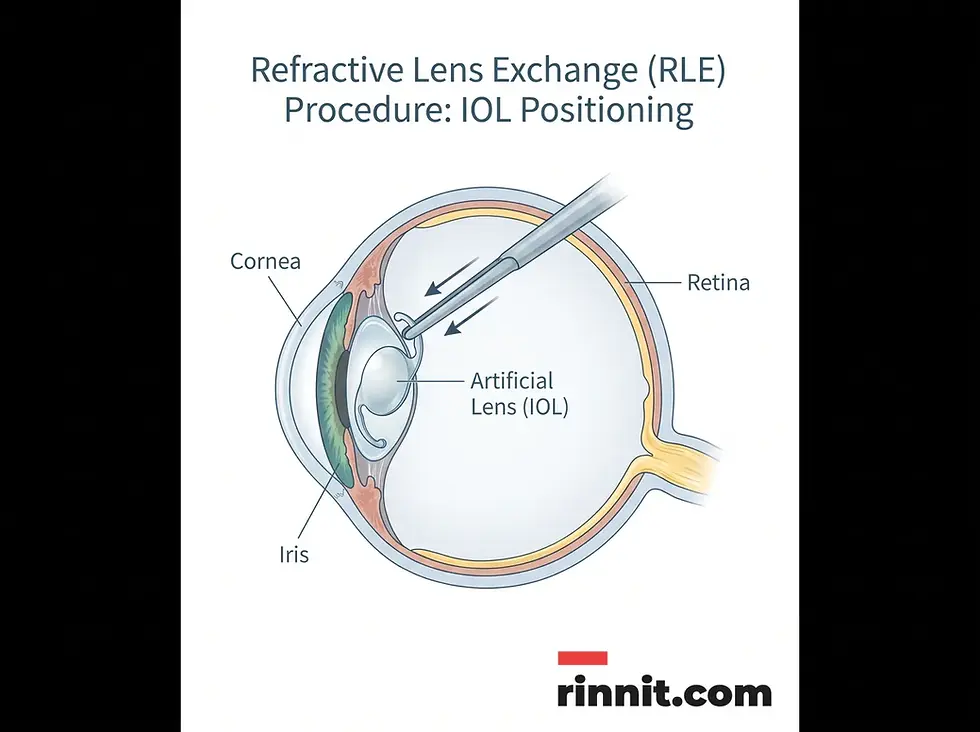
Refractive Lens Exchange is a sophisticated yet efficient procedure that typically takes between 15 and 30 minutes per eye. The surgery begins with the application of numbing eye drops and optional relaxation medication to ensure patient comfort. [1] Using a precision laser or a specialized blade, the surgeon creates a microscopic incision where the clear outer layer of the eye meets the white part. [1]
The natural lens is then gently broken into tiny pieces using ultrasound waves, a process known as phacoemulsification, and carefully vacuumed out. [1] The new, customized intraocular lens is inserted through the same small opening and positioned securely within the lens capsule. [1] Because the incision is so small, it is designed to be self-sealing, meaning most patients do not require any stitches and can begin their recovery immediately after a brief period of monitoring.
How do you choose the right intraocular lens (IOL) for refractive lens exchange?
One of the most critical steps in the RLE journey is selecting the appropriate IOL. Patients can choose between monofocal lenses, which provide clear vision at a single range, or multifocal lenses, which allow for focus at multiple distances. [1] While multifocal lenses offer the greatest independence from glasses, they may cause minor visual side effects such as glare or halos around lights, especially at night.
Another popular strategy is monovision, where the surgeon sets one eye for distance vision and the other for near vision. [1] The brain quickly adapts to this balance, providing a functional range of sight for most daily tasks. Discussing these options with an ophthalmologist is essential to ensure the chosen lens aligns with the patient's daily activities, such as driving, using a computer, or reading fine print.

What are the recovery, side effects and success rates of refractive lens exchange?
The recovery period following RLE is generally rapid, with most patients noticing a significant improvement in their vision within a few days. [1] It is normal to experience temporary side effects such as blurred vision, a gritty sensation, or mild redness as the eyes heal. [1] Visual phenomena like shimmering arcs of light or halos are also common in the early stages but typically diminish as the brain and eyes adjust to the new lens.
Clinical data shows that RLE is exceptionally successful, with approximately 95% of patients reporting high satisfaction with their post-operative vision. [1] About 80% of individuals find they no longer need to wear glasses or contact lenses for any of their daily activities. Beyond the immediate vision improvement, a major long-term benefit is the total prevention of cataracts, as the artificial lens cannot become cloudy like a natural one. [1]

What are the risks and long-term safety of refractive lens exchange?
Refractive lens exchange is considered very safe, but as a surgical procedure it still carries potential risks. The most serious complication is retinal detachment, which occurs more frequently in patients with extreme nearsightedness or those under the age of 50. [1] Other possibilities include a "secondary cataract," which is a clouding of the membrane holding the lens rather than the lens itself. [1] This can be easily corrected with a quick, non-invasive laser treatment months or years after the initial surgery.
Risk Category | Potential Complication | Management / Treatment |
Serious (Uncommon) | Retinal Detachment | Immediate surgical repair |
Visual | Glare or Halos | Often improves over time; lighting adjustments |
Long-Term | Secondary Cataract (PCO) | Simple, non-invasive laser procedure |
Temporary | Grittiness or Redness | Lubricating eye drops; time |
Conclusion and Next Steps
Refractive Lens Exchange offers a transformative and permanent solution for those seeking to overcome the limitations of glasses and contact lenses. By replacing the aging or imperfect natural lens with a high-tech artificial implant, RLE provides clear, stable vision for a lifetime. With its high success rates and the added benefit of preventing future cataracts, it remains one of the most effective options for comprehensive vision correction in adults.
If you are ready to explore a life with clearer vision and less reliance on glasses, schedule a consultation with a qualified ophthalmologist to see if Refractive Lens Exchange is right for you. A thorough eye exam is the first step toward achieving the visual freedom you deserve.
Frequently Asked Questions
How does RLE differ from cataract surgery?
The primary difference is the reason for the surgery. Cataract surgery is performed because the eye's natural lens has become cloudy, interfering with vision. [1] RLE is an elective procedure performed on a clear natural lens to correct refractive errors like nearsightedness or farsightedness. [1]
Is the Refractive Lens Exchange procedure painful?
No, the procedure is not typically painful. Surgeons use numbing eye drops and may provide mild sedation to keep you relaxed. [1] You may feel slight pressure during the surgery, but most patients report very little discomfort.
Will I still need reading glasses after RLE?
This depends on the type of intraocular lens (IOL) you choose. Multifocal lenses or a monovision strategy can eliminate the need for reading glasses for most patients, while monofocal lenses may still require glasses for close-up tasks.
Can I have RLE if I've already had LASIK?
In many cases, yes. If your vision has changed after LASIK or if you have developed presbyopia, RLE can still be an option. Your eye surgeon will perform a detailed evaluation to ensure your eyes are healthy enough for the procedure.
How long do the results of RLE last?
The results of RLE are permanent. [1] The artificial intraocular lens does not age or change its shape, and it will not develop cataracts. Once implanted, the lens is designed to provide clear vision for the rest of your life.
What is a "secondary cataract" after RLE?
A secondary cataract, or posterior capsular opacification (PCO), is a clouding of the thin membrane that holds the new lens in place. [1] It is not a return of a cataract on the lens itself and can be quickly fixed with a simple laser treatment.
Are both eyes treated at the same time?
Typically, surgeons treat one eye at a time, usually scheduled a week or two apart. This allows the first eye to begin healing and ensures you have functional vision throughout the process.
What are the main risks of the surgery?
The most significant risk is retinal detachment, which is uncommon but serious. [1] [2] Other risks include infection, inflammation, or visual side effects like glare and halos. Your surgeon will discuss your individual risk profile during your consultation.
Who is the ideal candidate for RLE?
The ideal candidate is usually over age 40, has a high refractive error (extreme nearsightedness or farsightedness), or has presbyopia and wants to reduce their reliance on glasses. [1] They must also have generally healthy eyes.
How soon can I drive after the procedure?
Most patients can drive within a few days once their vision has cleared and their surgeon confirms it is safe. You will need someone to drive you home on the day of surgery and to your first follow-up appointment. [1]
Related Reading
SMILE Eye Surgery: How It Works, Candidates and Recovery explains SMILE laser eye surgery.
Progressive Lenses: Types, How They Work and Adjusting explains progressive lenses for presbyopia.
LASIK Eye Surgery: Procedure, Recovery and Results explains how LASIK corrects vision.
Cataract Surgery: What to Expect, Recovery and Results explains how cataract surgery restores clear vision.
References
Cleveland Clinic. Refractive Lens Exchange. Cleveland Clinic Health Library. Accessed October 11, 2026. https://my.clevelandclinic.org/health/treatments/24840-refractive-lens-exchange
Passaro ML, Kilic D, Virgili G, et al. Retinal detachment incidence in refractive lens exchange versus cataract surgery: uncommon versus rare - systematic review and meta-analysis. Br J Ophthalmol. 2025;109(7):756-764. PMID: 40015940. DOI: https://doi.org/10.1136/bjo-2024-326592
Rodríguez-Calvo-de-Mora M, Rocha-de-Lossada C, Rodríguez-Vallejo M, et al. Retinal detachment after refractive lens exchange: a narrative review. Arch Soc Esp Oftalmol (Engl Ed). 2023;98(9):507-520. PMID: 37364678. DOI: https://doi.org/10.1016/j.oftale.2023.06.013
Medical disclaimer
This article is for informational purposes only and is not a substitute for professional medical advice, diagnosis, or treatment. Always seek the advice of your physician or other qualified health provider with any questions you may have about a medical condition.



Comments