Cataract Surgery: What to Expect, Recovery and Results

Updated: 2 days ago
Written and medically reviewed by Dr. Baraa Alnahhal, MD · Last reviewed: November 2026 · How we review
Quick Answer
Cataract surgery removes the cloudy lens of the eye and replaces it with a clear artificial lens called an intraocular lens (IOL). It's the only proven treatment for adult cataracts. It takes about 10 to 15 minutes, and you go home the same day. It improves vision for about 97% of people. Serious complications are rare.
What the research says
Cataract surgery was linked to lower dementia risk: in 3,038 adults 65 and older followed for years, those who had cataract surgery had a 29% lower risk of dementia, while glaucoma surgery, which doesn't restore vision, showed no link (Lee CS et al., JAMA Intern Med, 2022) [2]
Serious surgical problems are rare: in more than 1.7 million cataract surgeries in 18 European countries, a dropped lens fragment (a serious complication) happened in only 0.071% of eyes, and the rate fell over time (Lundström M et al., J Cataract Refract Surg, 2020) [3]
Key takeaways
Cataract surgery replaces a cloudy lens with a clear artificial lens.
It's the only proven treatment for cataracts.
Surgery takes 10 to 15 minutes, and you're awake.
About 97% of people see better afterward.
Full recovery usually takes about four weeks.
What is cataract surgery?
Your eye's natural lens is mostly water and protein. As you age, the proteins break down and the lens becomes cloudy and yellow, which is called a cataract. Aging is the most common cause, but medical conditions, some medicines, eye injuries and past eye surgery can also cause cataracts. Cataract surgery is one of the most common operations: more than 3 million are done in the U.S. each year. Sources: [1]
Why it's done

Cataract surgery isn't an emergency, so you can choose the timing.
Blurry or cloudy vision that makes reading, driving or other daily tasks hard.
Halos around bright lights or glare when driving at night.
Double vision.
So your eye doctor can see and check the back of your eye for conditions such as macular degeneration or diabetic eye disease. Sources: [1]
Cataracts aren't an emergency. You and your eye doctor decide on surgery when cataracts start to limit your daily life. Sources: [1]
Types of surgery and lenses
Option | What it means |
Phacoemulsification | The most common method; ultrasound breaks up the lens so it can be suctioned out |
Laser or blade incision | A tiny cut in the cornea; stitches usually aren't needed |
Standard IOL | Used for most people; corrects nearsightedness or farsightedness |
Specialty IOL | Can also correct astigmatism or presbyopia; usually not covered by insurance |
If both eyes need surgery, they're usually done a week or two apart. Some people choose a monovision setup, with one eye set for distance and one for near. Sources: [1]
How to prepare
Have a full eye exam so your doctor can check your eye health and measure your eye for the right lens power.
Ask which lens is best for you and whether you'll need glasses afterward.
Ask about eye drops you'll use before and after surgery.
Arrange for someone to drive you home. Sources: [1]
What happens during surgery
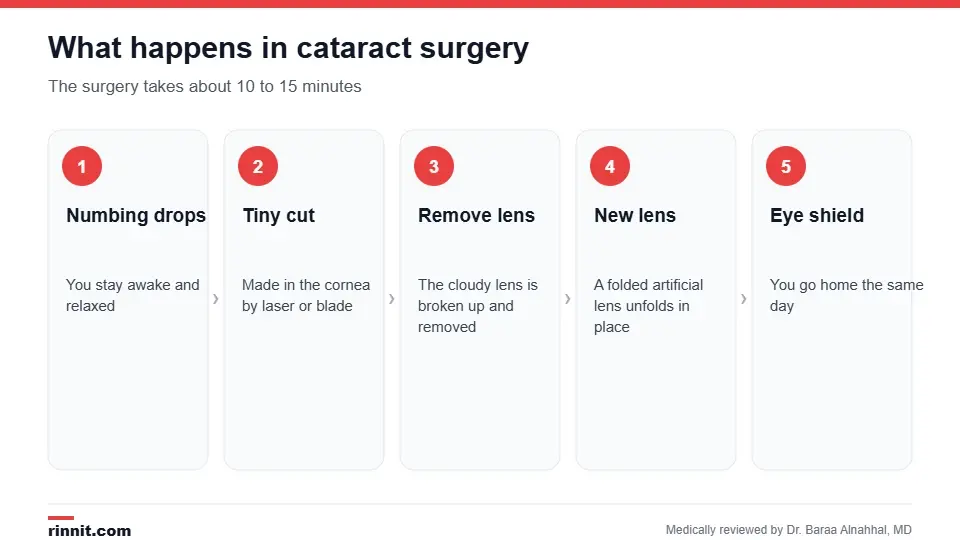
The surgery takes 10 to 15 minutes.
You get numbing eye drops and may get medicine to help you relax. You stay awake and see only light and movement.
The surgeon makes a tiny cut in the cornea with a laser or blade.
The cloudy lens is broken up and removed.
A folded artificial lens is inserted through the same cut, where it unfolds into place.
A protective shield is placed over your eye. You're watched for 15 to 30 minutes, then go home. Sources: [1]
Risks
Complication | How often |
Retinal detachment | About 2 in 1,000 people |
Infection | Fewer than 1 in 1,000 people |
Other | Bleeding or swelling, ongoing pain, blurry vision, glare or halos, lens movement, clouding behind the new lens (posterior capsular opacification) |
Complications are rare in experienced hands and most can be treated. Risk is higher if you have other eye diseases. Sources: [1, 3]
Recovery

About 97% of people see better after surgery.
Blurry vision, redness, watery eyes and a gritty feeling are normal at first.
Vision often improves within a few days, and pain is usually mild.
Use your prescribed eye drops and wear the shield while you sleep.
Don't rub your eye, and keep soap and water out of it.
Wear sunglasses outdoors.
Ask when you can drive, exercise, swim, wear eye makeup or lift heavy things. Full recovery takes about four weeks. Sources: [1]
When to call your doctor
Eye pain or redness.
Crusting or discharge from your eye.
Worse vision or vision loss.
New floaters or flashes of light. Sources: [1]
Conclusion
Cataract surgery is a quick, safe operation that restores clear vision for almost everyone who has it. Talk to your eye doctor when cataracts start getting in the way of the things you enjoy.
Keep learning: read about cataracts and refractive lens exchange.
Frequently asked questions
What is cataract surgery?
Surgery that replaces your cloudy lens with a clear artificial lens.
Is cataract surgery painful?
No. Numbing drops are used, and pain afterward is usually mild.
Am I awake during surgery?
Yes, but you may get medicine to help you relax.
How long does it take?
About 10 to 15 minutes, though the visit takes a few hours.
How successful is it?
About 97% of people see better afterward.
Can cataracts be treated with eye drops?
No. Surgery is the only proven treatment.
When can I see clearly?
Often within a few days; full recovery takes about four weeks.
Will I still need glasses?
Maybe. Specialty lenses can reduce the need for glasses.
Are both eyes done at once?
Usually not. Most people have the second eye done a week or two later, though same-day surgery on both eyes is sometimes offered.
What are the main risks?
Rarely, retinal detachment, infection or swelling.
Related Reading
Cataracts: Symptoms, Causes, Diagnosis and Treatment — What You Need to Know the condition this surgery treats.
Eye Exam: What Happens, Tests Included and How Often to Go the exam used to plan cataract surgery.
Presbyopia: Complete Guide to Age-Related Near Vision Loss, Symptoms, and Treatment Options age-related loss of near vision.
Monovision: Complete Guide to One-Eye-Near, One-Eye-Far Vision Correction a lens setup some people choose.
Refractive Lens Exchange: A Permanent Solution for Clearer Vision a similar lens replacement for vision correction.
References
Cleveland Clinic. Cataract Surgery: Recovery and How It Works. Cleveland Clinic. Last updated April 5, 2023. https://my.clevelandclinic.org/health/treatments/21472-cataract-surgery
Lee CS, Gibbons LE, Lee AY, et al. Association between cataract extraction and development of dementia. JAMA Intern Med. 2022;182(2):134-141. PMID 34870676. https://doi.org/10.1001/jamainternmed.2021.6990
Lundström M, Dickman M, Henry Y, et al. Risk factors for dropped nucleus in cataract surgery as reflected by the European Registry of Quality Outcomes for Cataract and Refractive Surgery. J Cataract Refract Surg. 2020;46(2):287-292. PMID 32126043. https://doi.org/10.1097/j.jcrs.0000000000000019
Medical disclaimer
This article is for general education only and does not replace advice from a qualified healthcare professional. Talk to your doctor about your own diagnosis and treatment, and seek emergency care right away for severe or sudden symptoms.



Comments