Monovision: Complete Guide to One-Eye-Near, One-Eye-Far Vision Correction

Updated: 6 days ago
Written and medically reviewed by Dr. Baraa Alnahhal, MD · Last reviewed: October 2026 · How we review
Quick Answer: What is monovision?
Monovision is a vision correction technique that sets one eye to focus on distant objects and the other to focus on close-up objects. It is mainly used for presbyopia or after cataract surgery and can be done with contact lenses, laser surgery, or an artificial lens. A trial run is recommended first because not everyone adapts. [1]
What the research says
Monovision LASIK satisfies most patients. In a study of 608 monovision LASIK patients and 590 lens-exchange patients, satisfaction among people with moderate to high nearsightedness was 94.3% after monovision LASIK versus 79.1% after lens exchange, and 95.6%–100% of monovision LASIK patients could read at 20/40 or better with both eyes. (Schallhorn et al., Journal of Refractive Surgery, 2017) [5]
Mini-monovision after cataract surgery cuts glasses use. In 56 patients (112 eyes), 93% said surgery met their expectations for less glasses use, and 93% used little or no glasses for computer work and distance viewing; 18% still used glasses for night driving. (Goldberg et al., BMC Ophthalmology, 2018) [6]
A contact lens trial first predicts success. Among 82 monovision LASIK patients, overall success was 97.6%; none of the 30 who tried monovision contact lenses first asked for reversal, compared with 2 of the 52 who skipped the trial. (Reilly et al., Cornea, 2006) [7]
Key takeaways
Monovision makes one eye best for distance and the other best for near vision; it is also called "blended vision." [1]
It is most often used for presbyopia and for people having cataract surgery in one eye. [1]
You can get it with contact lenses (temporary) or with laser or lens surgery (permanent). [1]
Downsides include trouble adapting, weaker depth and contrast perception, and misjudging motion and distance. [1][2]
A trial period is almost always recommended before any permanent procedure. [1]
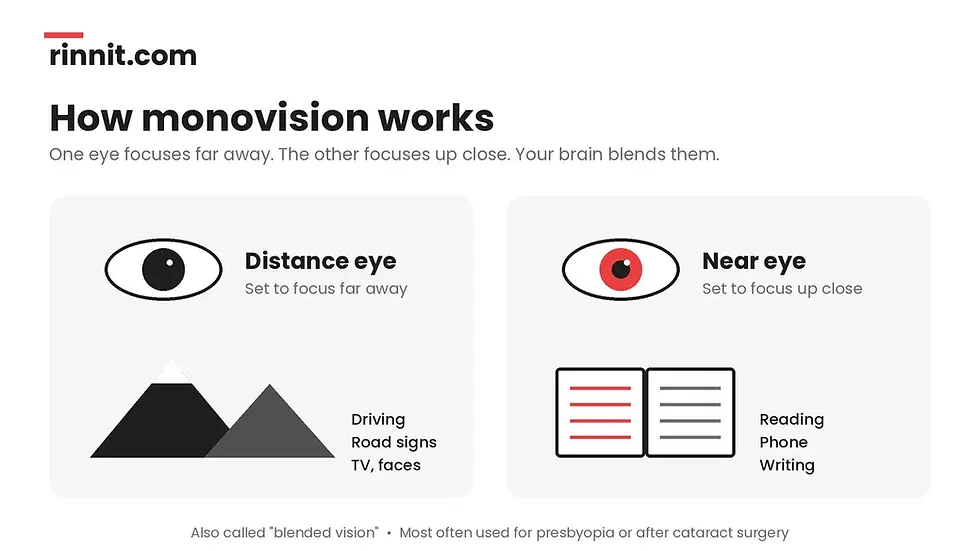
What is monovision and how does it work?
Monovision is a technique that changes your eyesight so one eye is best at focusing on objects up close and the other is best at focusing on objects far away. [1]
You need close-up focus for everyday tasks like reading and writing. Monovision restores that ability while keeping your ability to see things in the distance. [1]
Some forms of monovision are permanent. Others are temporary, so you can switch between monovision and your normal eyesight whenever you want. [1]
Why is monovision used?
Monovision is used because many people slowly lose the ability to focus on close-up objects as they age. [1][4]
Here is what happens step by step:
Normal focusing: Small muscles in the ciliary body of your eye change the shape of your lens. This focuses light onto your retina, whatever distance you are looking at. This is called the accommodation reflex. [1]
Loss of near focus: Eventually, the muscles can't change the lens shape enough to focus up close. [1]
This age-related loss of near focus is called presbyopia, from Ancient Greek words meaning "old eyes." It is why many older adults hold things farther away to read them. [1]
People who have cataract surgery in only one eye may also benefit. The eye surgeon can place a monovision artificial lens when removing the cloudy natural lens. [1]
How common is monovision?
Monovision is a very common treatment, with about 10 million people in the United States using some form of it. [1] The condition it most often treats, presbyopia, is extremely common. [1][4]
What are the different types of monovision?
The three main types of monovision are contact lenses, laser vision correction surgery, and intraocular lens surgery. [1]
Type | How it works | Permanent? | Good to know |
Contact lenses | One lens corrects for distance, the other for near | No — wear them only part of the day | No surgery needed; the easiest way to test monovision |
Laser vision correction | LASIK or PRK sets one eye for distance and one for near | Yes | Try monovision with contacts first |
Intraocular lens (IOL) surgery | An artificial lens is placed during cataract surgery or lens replacement | Yes | Try monovision first when possible |
Source: [1]

What are the advantages of monovision?
The main advantage of monovision is that it restores close-up focus without making both eyes nearsighted. [1]
Other benefits include:
You can try it first. A trial run shows how monovision works for you before you commit to a permanent procedure. [1]
Surgery is optional. If you can't or don't want to have surgery, contact lenses can give you monovision. [1]
Less reliance on glasses. Monovision helps people who want to depend less on glasses or contacts, especially those with presbyopia or a cataract in one eye. [1]
What are the disadvantages of monovision?
The main disadvantages of monovision are trouble adapting, loss of depth and contrast perception, and a distance-judging problem related to the Pulfrich effect. [1]
Disadvantage | What it means for you |
Trouble adapting | Some people struggle to adjust, or can't adjust at all, to using one eye for near and the other for far. [1] |
Weaker depth (3D) perception | Both eyes can't focus on the same object, so depth perception and 3D vision are reduced. [1] |
Lower contrast perception | Your brain can't compare light and shadow from both eyes as well. [1] |
Motion and distance misjudgment |

What is the Pulfrich effect in monovision?
The Pulfrich effect is a visual illusion that happens when your brain processes input from one eye slightly later than the other, making it hard to judge distance, direction of movement, and whether objects are 3D. [1]
It is named after German scientist Carl Pulfrich, who described it in 1922. [1]
It is the same effect that makes 3D movie glasses work: the glasses slow input from one eye by a tiny fraction of a second, and your brain turns that delay into depth. [1]
Some medical conditions, such as multiple sclerosis, can slow signals traveling through the optic nerve and cause it. [1]
In 2019, researchers found that the brain also processes a sharply focused eye and a blurry eye at different speeds, causing the same distance errors. [1][2]
Is it safe to drive with monovision?
Driving with monovision needs extra care, because the motion and distance misjudgment it causes can create dangerous situations on the road. [1][2]
The errors can be larger at higher speeds and in low light. [1] If driving is a concern, talk to your eye care specialist before choosing monovision. They may prescribe glasses you wear only while driving, so you can still rely on monovision the rest of the time. [1]
Why should you do a monovision trial before surgery?
A monovision trial is recommended because some people can't adapt to it, and surgery is much harder to undo than contact lenses. [1]
Experts almost always advise a trial period before any surgery that gives you permanent monovision. [1] Wearing monovision contact lenses lets you test it in your daily life — reading, screens, and driving — before making a long-term decision. [1]
How do you take care of your eyes with monovision?
Taking care of your eyes with monovision means getting regular eye exams every one to two years, or more often if your eye care specialist recommends it. [1]
Regular exams: Your specialist checks your eye health and eyesight over time. [1]
More frequent checks if needed: Some conditions, like type 2 diabetes, affect eye health and may need more frequent exams. [1]
Task-specific glasses: If monovision causes problems in certain situations, such as driving, glasses for just those tasks can help. [1]
Who is a good candidate for monovision?
A good candidate for monovision is someone with presbyopia or a cataract in one eye who wants to rely less on glasses or contacts and adapts well during a trial. [1]
Monovision may be less suitable if you depend heavily on depth perception or drive often in low light. An eye care specialist can weigh your concerns and daily needs when recommending options. [1] If you also have other focusing problems, like farsightedness or astigmatism, discuss them during your eye exam. People with eye-teaming problems may want to read about binocular vision dysfunction first.
Conclusion
Monovision is a common, safe and effective way to read up close and see far away with less need for glasses. It works by giving each eye a different job, and your brain blends the two images. [1]
It isn't right for everyone. Some people can't adapt, and it can weaken depth perception and distance judgment, especially when driving. The good news is that you can test it first with contact lenses before choosing a permanent option. [1]
Thinking about monovision? Book an eye exam and ask your eye care specialist about a contact lens trial. Then keep learning with our guides on presbyopia, cataracts and PRK eye surgery — and share this article with someone who's tired of switching between reading glasses.
FAQ
What is monovision?
Monovision is a vision correction technique that makes one eye best for distance vision and the other best for close-up vision. It can be done with contact lenses or vision correction surgery.
What is the difference between monovision and blended vision?
Monovision and blended vision are the same thing. "Blended vision" is simply another name for monovision.
Is monovision permanent?
Monovision is permanent only when it is done with surgery, such as LASIK, PRK or intraocular lens surgery. Monovision contact lenses are temporary, so you can switch back to your normal eyesight at any time.
Who is monovision used for?
Monovision is used mainly for people with presbyopia, the age-related loss of close-up focus. It can also help people having cataract surgery in one eye.
What are the side effects of monovision?
The main side effects of monovision are trouble adapting, weaker depth perception, lower contrast perception, and misjudging the distance and movement of objects. These problems can be worse at high speeds and in low light.
Can you drive with monovision?
Driving with monovision is possible, but it can cause motion and distance misjudgment that may be dangerous, especially at night or at high speed. Your eye care specialist may prescribe glasses to wear only while driving.
Can you try monovision before surgery?
Monovision can be tried before surgery using contact lenses. Experts almost always recommend this trial period before any procedure that makes monovision permanent.
How often should you get an eye exam with monovision?
People with monovision should get an eye exam every one to two years, or more often if their eye care specialist recommends it. Conditions like type 2 diabetes may require more frequent exams.
Which eye is set for distance in monovision?
Usually your dominant eye is set for distance and the other eye for near vision. Your eye doctor tests which eye is dominant before treatment.
How long does it take to adjust to monovision?
Many people adjust within a few days to a few weeks as the brain learns to use the clearer eye for each task. If you still struggle after your trial period, tell your eye doctor.
Related Reading
Cataract Surgery: What to Expect, Recovery and Results explains how cataract surgery restores clear vision.
References
Cleveland Clinic. Monovision. Cleveland Clinic. Last updated March 26, 2024. https://my.clevelandclinic.org/health/treatments/monovision
Burge J, Rodriguez-Lopez V, Dorronsoro C. Monovision and the Misperception of Motion. Curr Biol. 2019;29(15):2586-2592.e4. PMID 31353183. https://doi.org/10.1016/j.cub.2019.06.070
Rodriguez-Lopez V, Dorronsoro C, Burge J. Contact lenses, the reverse Pulfrich effect, and anti-Pulfrich monovision corrections. Sci Rep. 2020;10(1):16086. PMID 32999323. https://doi.org/10.1038/s41598-020-71395-y
Singh P, Zeppieri M, Tripathy K. Presbyopia. In: StatPearls [Internet]. Treasure Island (FL): StatPearls Publishing. Last updated June 2, 2025. https://www.ncbi.nlm.nih.gov/books/NBK560568/
Schallhorn SC, Teenan D, Venter JA, et al. Monovision LASIK Versus Presbyopia-Correcting IOLs: Comparison of Clinical and Patient-Reported Outcomes. J Refract Surg. 2017;33(11):749-758. PMID 29117414. https://doi.org/10.3928/1081597X-20170721-03
Goldberg DG, Goldberg MH, Shah R, et al. Pseudophakic mini-monovision: high patient satisfaction, reduced spectacle dependence, and low cost. BMC Ophthalmol. 2018;18(1):293. PMID 30413145. https://doi.org/10.1186/s12886-018-0963-3
Reilly CD, Lee WB, Alvarenga L, et al. Surgical monovision and monovision reversal in LASIK. Cornea. 2006;25(2):136-138. PMID 16371770. https://doi.org/10.1097/01.ico.0000178722.19317.7b
Selvam A, Lee AG, Nawash B, et al. Pulfrich Phenomenon. EyeWiki (American Academy of Ophthalmology). Last updated January 5, 2026. https://eyewiki.aao.org/Pulfrich_Phenomenon
Medical disclaimer
This article is for general educational purposes only and does not replace professional medical advice, diagnosis or treatment. Always talk to a qualified eye care specialist about your own eyes before choosing any vision correction option.



Comments