Progressive Lenses: Types, How They Work and Adjusting

Updated: 2 days ago
Written and medically reviewed by Dr. Baraa Alnahhal, MD · Last reviewed: November 2026 · How we review
Quick Answer
Progressive lenses are multifocal eyeglass lenses that correct vision at several distances in one lens, with no visible lines. Each lens has zones for distance, intermediate and reading. They're mainly used for presbyopia, trouble seeing up close that happens to almost everyone after age 40. Getting used to them takes about a week to a couple of months.
What the research says
Progressive lenses slow myopia only slightly in children: a Cochrane review of 41 trials with 6,772 children found bifocal or progressive glasses slowed nearsightedness by only 0.14 diopters compared with single-vision lenses, a small effect (Walline JJ et al., Cochrane Database of Systematic Reviews, 2020) [2]
A large trial found a small benefit: in the COMET trial of 469 children ages 6 to 11, nearsightedness progressed by 1.28 diopters with progressive lenses versus 1.48 with single-vision lenses over 3 years, with most of the difference in the first year (Gwiazda J et al., Investigative Ophthalmology & Visual Science, 2003) [3]
Key takeaways
Progressive lenses correct near, middle and far vision in one lens.
They have no visible lines.
They mainly treat presbyopia after age 40.
Adjusting takes about a week to a couple of months.
A proper fitting is key to clear vision.
What are progressive lenses?
Progressive lenses are also called multifocal lenses or progressive addition lenses (PALs). Unlike bifocals, they change strength gradually, so there's no "image jump" between zones. Learn more about eyeglasses. Sources: [1]
Who they're for
Progressive lenses mainly treat presbyopia, which makes it hard to read up close. They let you read, watch TV and drive with one pair of glasses. They're also an option for some children with myopia. Sources: [1, 2]
How the zones work

The zones blend smoothly with no visible lines.
Zone | Use |
Top | Distance, such as driving |
Middle | Intermediate, such as a computer |
Bottom | Near, such as reading |
Sources: [1]
Types of progressive lenses
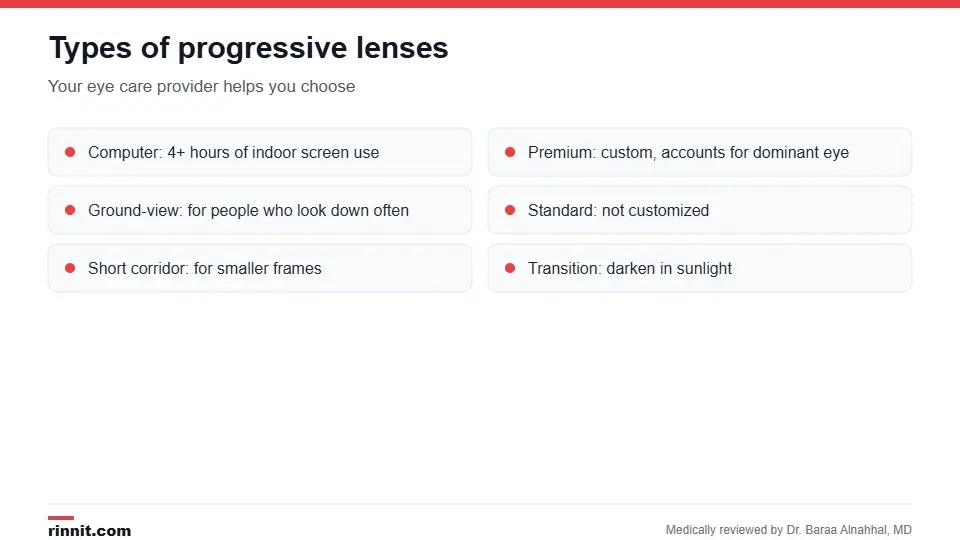
Your eye care provider helps choose the best type.
Type | Best for |
Computer progressive | More than four hours a day on a computer indoors |
Premium | Custom-made, accounting for your dominant eye |
Ground-view | People who often look down, such as golfers |
Standard | Not customized |
Short corridor | Smaller frames |
Transition | Darken automatically in sunlight |
Sources: [1]
Getting fitted
You'll have an eye exam and answer questions about your health and symptoms. Your provider finds where you see most clearly and chooses the best prescriptions for distance and reading. Get fitted by an ophthalmologist, optometrist or optician. Sources: [1]
Pros and cons
Pros | Cons |
One pair for multiple distances | Cost more than bifocals or trifocals |
No visible lines | Fewer frame shape and size choices |
Less eye strain, with no image jump | Blurry side (peripheral) vision |
Sources: [1]
Adjusting to progressive lenses
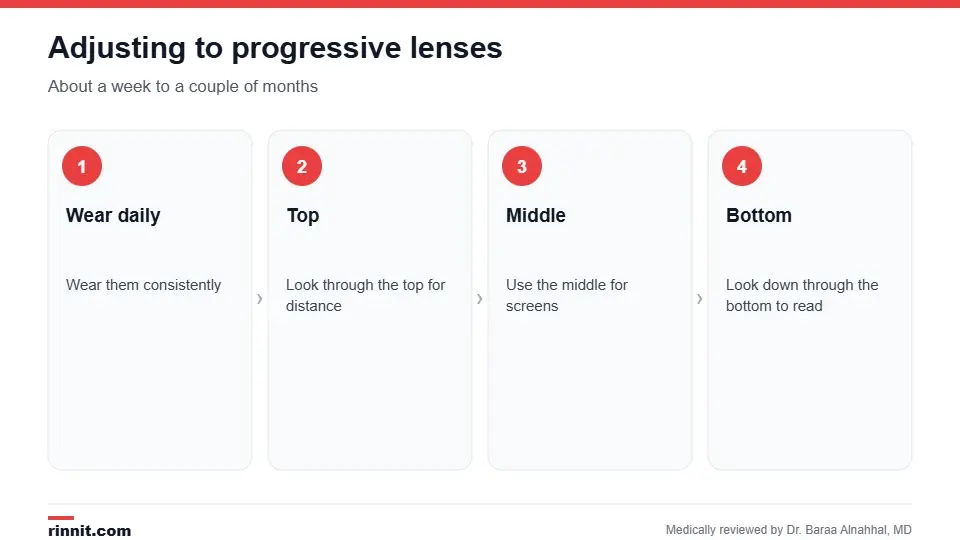
Some people return to bifocals or trifocals.
Adjusting takes about a week for some people and up to a couple of months for others. You may need to remind yourself which zone to use. Some people switch back to bifocals or trifocals. Sources: [1]
When to see your eye care provider
Adults and children should have eye exams every one to two years.
See your provider for any vision changes.
In young children, watch for squinting or holding objects closer. Sources: [1]
Conclusion
Progressive lenses let you see clearly up close, in the middle and far away with one pair of glasses. A careful fitting and a little patience while you adjust make the biggest difference.
Keep learning: read about presbyopia and eyeglasses.
Frequently asked questions
What are progressive lenses?
Glasses lenses that correct near, middle and far vision without lines.
Who needs progressive lenses?
Mainly people with presbyopia, usually after age 40.
How are they different from bifocals?
They change strength gradually and have no visible line.
How long does it take to get used to them?
About a week to a couple of months.
Are progressive lenses safe?
Yes. They don't really have risks or complications.
Why is my side vision blurry?
Blurred peripheral vision is a common drawback.
Can children wear progressive lenses?
Yes, sometimes for nearsightedness, though the benefit is small.
What are computer progressives?
Lenses designed for long hours of indoor computer use.
Are progressive lenses expensive?
They cost more than bifocals but may cost less than three pairs of glasses.
How often should I get my eyes checked?
Every one to two years.
Related Reading
Presbyopia: Complete Guide to Age-Related Near Vision Loss, Symptoms, and Treatment Options the condition progressive lenses correct.
Eyeglasses: How They Work, Lens Types, Side Effects and Care types of glasses and how they work.
Eye Exam: What Happens, Tests Included and How Often to Go what happens during an eye exam.
Farsightedness (Hyperopia): Why Close Objects Look Blurry — Causes, Eye Exams, and Your Correction Options trouble seeing up close.
Refractive Lens Exchange: A Permanent Solution for Clearer Vision a surgical option for vision.
References
Cleveland Clinic. Progressive Lenses: What They Are & How They Work. Cleveland Clinic. Last updated October 2, 2023. https://my.clevelandclinic.org/health/treatments/progressive-lenses
Walline JJ, Lindsley KB, Vedula SS, et al. Interventions to slow progression of myopia in children. Cochrane Database of Systematic Reviews. 2020;1(1):CD004916. PMID 31930781. https://doi.org/10.1002/14651858.CD004916.pub4
Gwiazda J, Hyman L, Hussein M, et al. A randomized clinical trial of progressive addition lenses versus single vision lenses on the progression of myopia in children. Investigative Ophthalmology & Visual Science. 2003;44(4):1492-1500. PMID 12657584. https://doi.org/10.1167/iovs.02-0816
Medical disclaimer
This article is for general education only and does not replace advice from a qualified healthcare professional. Talk to your doctor about your own diagnosis and treatment, and seek emergency care right away for severe or sudden symptoms.



Comments