Eyeglasses: How They Work, Lens Types, Side Effects and Care

Updated: 6 days ago
Written and medically reviewed by Dr. Baraa Alnahhal, MD · Last reviewed: October 2026 · How we review
Quick Answer: What are eyeglasses?
Eyeglasses are medical devices made of lenses mounted in a frame that bend light before it enters your eyes, so it focuses correctly on the retina. They correct nearsightedness, farsightedness, astigmatism and presbyopia, and some lenses treat double vision. They improve vision but don't cure the underlying error, and you need a current prescription from an eye exam. [1]
What the research says
Blue-light lenses probably don't ease screen eye strain. A systematic review of 17 randomized trials found little or no difference in visual fatigue or sharpness of vision compared with standard clear lenses over short follow-up, and effects on sleep were inconclusive. (Singh et al., Cochrane Database Syst Rev, 2023) [2]
Glasses help children learn. In a trial of 3,177 children with myopia in rural western China, giving free glasses raised math test scores by 0.11 standard deviations compared with a prescription alone. Only 15% of these children wore glasses at the start. (Ma et al., BMJ, 2014) [3]
Millions still lack glasses for near vision. About 1.8 billion people (25% of the world) had presbyopia in 2015, and 826 million had near vision impairment because they had no glasses or inadequate ones, an unmet need of 45%. (Fricke et al., Ophthalmology, 2018) [4]
Eyeglasses at a glance
Question | Short answer |
What they are | Lenses in a frame that change how light reaches your eyes |
What they treat | Nearsightedness, farsightedness, astigmatism, presbyopia, some double vision |
What you need first | An eye exam and a current prescription |
Adjusting time | Usually a few days; prism changes can take longer |
Common side effects | Mild eye strain, headaches, fit discomfort, edge distortion |
How often to check | Eye exam every year or two, or as your eye doctor advises |
Cure or treatment? | Treatment: glasses correct vision while you wear them |
What do eyeglasses correct?
Eyeglasses correct refractive errors, which happen when your eye can't bend light to land exactly on the retina. Prescription glasses are one of the most common medical devices people use. [1]
Condition | What you notice | What glasses do |
Nearsightedness (myopia) | Close objects are clear; far objects are blurry | Sharpen distance vision |
Far objects are clear; close objects are blurry | Sharpen near vision | |
Blur at all distances; "starburst" rays around lights, especially at night | Correct uneven focusing | |
Trouble focusing up close as you age | Add power for reading and close work | |
Two images of one object | Prism lenses shift light so the brain sees one picture |
[1]
How do eyeglasses work?
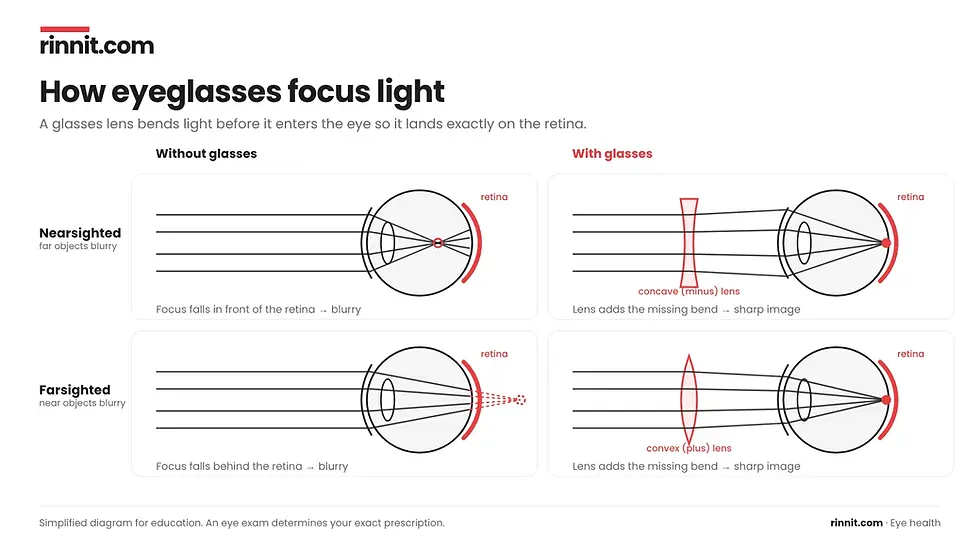
Eyeglasses work by adding the extra bend to light that your eyes can't provide on their own. [1]
Light enters your eye through the cornea and then the lens. Together, they bend the light so it lands on the retina at just the right distance. With a refractive error, your eyes can't bend light correctly, so things look blurry and out of focus. [1]
A glasses lens sits in front of the eye and pre-bends the light. The result is a sharp image on the retina, close up and far away.
Glasses can also help with double vision caused by eye misalignment. When both eyes line up, your brain merges their images into one picture. When they don't, your brain receives two competing pictures. Special prism lenses can fix this. [1]
What happens at an eye exam for glasses?
An eye exam checks your vision and eye health before you get prescription glasses. Your eye doctor tests whether you have 20/20 vision. [1]
If you don't, they work out how far off from 20/20 you are and what correction you need. If you already wear glasses, they check your current prescription and adjust it if needed. [1]
What are the types of prescription eyeglass lenses?
Prescription eyeglass lenses are grouped by how many prescriptions one lens holds and how they are arranged. [1]
Lens type | How it works | Best for |
Single-vision | One prescription across the whole lens | One distance only (near or far) |
Bifocal | Two prescriptions with a visible line; looks like a lens within a lens | Distance plus reading |
Trifocal | Three prescriptions separated by visible lines | Distance, middle and near |
Progressive | Power changes gradually from top to bottom with no line; the lower part is for close-up | Smooth vision at all distances |
Reading glasses | Single-vision lenses for near work; often sold without a prescription | Presbyopia (reading up close) |
Prism | Shifts where light enters the eye | Double vision from eye misalignment |
Bifocals, trifocals and progressives are all multifocal lenses, meaning more than one prescription sits in a single lens. [1]

What special lenses can be added to eyeglasses?
Special lenses add a specific function, and many come with or without a prescription built in. [1]
Feature | What it does | Good to know |
Prescription sunglasses | Block sunlight while correcting vision | Useful if you wear glasses all the time |
Blue-light glasses or coating | Filter certain wavelengths of light | Sold to ease screen strain, but trials show little or no benefit for eye strain [2] |
Photochromic lenses | Darken automatically in ultraviolet light | The darkening material is in the lens or a surface coating |
If screen time tires your eyes, simple habits often help more than a filter. See our guide to eye strain and the 20-20-20 rule.
What are the benefits of wearing eyeglasses?
Eyeglasses let you see clearly and do your usual activities, but they treat refractive errors rather than cure them. [1]
Modern glasses are lighter, more durable and more effective than ever. They can correct any kind of refractive error, and some lenses handle several problems at once. [1] For children, the benefit reaches the classroom: one large trial linked free glasses to better math scores. [3]
What side effects can eyeglasses cause?
Eyeglasses cause very few side effects, and the ones they do cause are usually mild and fixable. [1]
Side effect | Why it happens | What helps |
Adjustment blur or edge distortion | New prescription; some lenses distort slightly near the outer edge by design | Give it a few days; tell your eye doctor if it persists |
Discomfort at nose, ears or temples | Frames don't fit well | An eye doctor or optician can adjust or repair the frame |
Eye strain or headaches | New prescription, heavy reading or computer work, or an outdated prescription | Usually fades in days with a new pair; update a prescription that is a year or two old |
[1]
How long does it take to adjust to new eyeglasses?
Adjusting to new eyeglasses usually takes only a few days. [1]
Some changes take longer. Prism corrections for eye alignment, for example, often need extra time. Your eye doctor will tell you what to expect for your prescription. [1]
How should you clean and store eyeglasses?
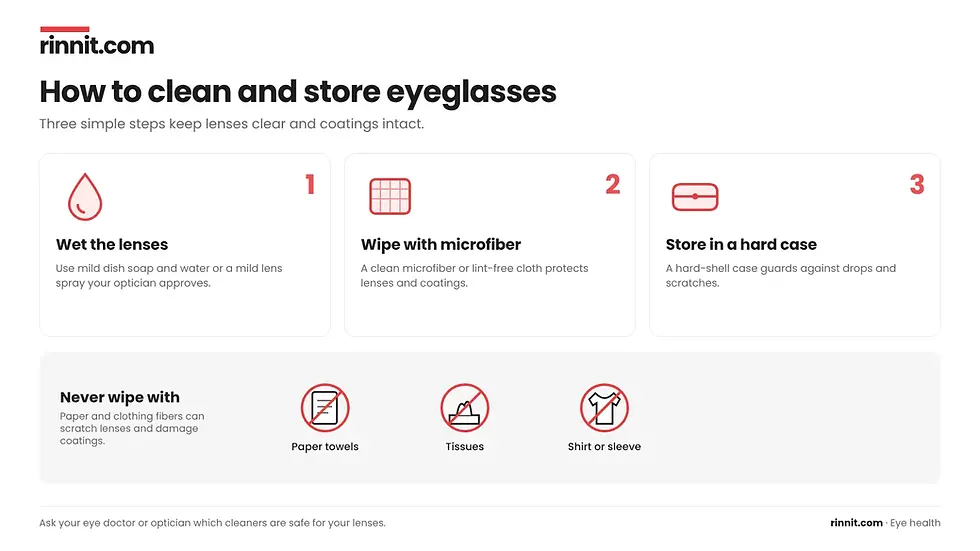
Clean eyeglasses with water and a mild cleaner, dry them with a microfiber cloth, and store them in a hard-shell case. [1]
Cleaning steps
Wet the lenses with mild dish soap and water or a mild cleaning spray. Ask your eye doctor or optician which cleaners are safe for your lenses.
Wipe with a microfiber or lint-free cloth. Never use paper towels, tissues, toilet paper or anything made from paper. These can scratch lenses and damage coatings.
Skip your shirt or sleeve. Clothing fibers can scratch or scuff the lenses.
Storage: keep glasses in a hard-shell case when you're not wearing them to protect them from drops and scratches. If you don't have one, a clean, dry spot away from anything that could scratch them works in a pinch. [1]
When should you see an eye doctor about your eyeglasses?
You should have an eye exam every year or two, and sooner if your vision changes. Your eye doctor will tell you how often you need checks. [1]
Call your eye doctor if you notice:
Tired or strained eyes
Headaches
Eye pain
Light sensitivity
Any change in your vision
These checkups also help catch other eye diseases early.
Is it safe to order eyeglasses online?
Ordering eyeglasses online can save money if you have a current prescription and the right measurements. [1]
Check | Why it matters |
A current prescription | You need a valid one; a prescription more than a year or two old is out of date. Online eye tests and apps don't replace an eye doctor |
A paper copy of your prescription | In the U.S., your eye care provider will give you a paper copy for free |
Your pupillary distance | The distance between your pupils is needed to make glasses correctly; ask your eye doctor or optician to measure it |
Bring-your-own-frame options | Buying frames separately and fitting lenses later can save a lot |
Warranty and maintenance terms | Check whether they cover frames, lenses or both |
[1]
Key takeaways
Eyeglasses bend light so it focuses on your retina, correcting nearsightedness, farsightedness, astigmatism and presbyopia.
Prism lenses can fix double vision caused by eye misalignment.
Lens choices range from single-vision to bifocal, trifocal and progressive.
Most people adjust to new glasses within a few days.
Clean lenses with soap and water and a microfiber cloth, never paper or clothing.
Blue-light lenses show little or no benefit for screen eye strain in trials.
Get an eye exam every year or two, and sooner if your vision changes.
Conclusion
Eyeglasses are a simple, proven way to see clearly again. They work by correcting how light reaches your retina, and the right lens type depends on the distances you need to see. Side effects are rare and mild, and good care keeps your lenses clear for longer.
Blurry vision, squinting or frequent headaches are worth an eye exam. Book one if your last check was more than a year or two ago, and bring this guide along to talk through lens options with your eye doctor. If glasses aren't the right fit for you, read about other options such as refractive lens exchange.
FAQ
What are eyeglasses used for?
Eyeglasses are used to correct refractive errors such as nearsightedness, farsightedness, astigmatism and presbyopia. Some lenses also treat double vision caused by eye misalignment. [1]
How do eyeglasses work?
Eyeglasses work by bending light before it enters your eye so it focuses directly on the retina. This adds the focusing power your cornea and lens can't provide on their own. [1]
What is the difference between bifocal and progressive lenses?
Bifocal lenses hold two prescriptions separated by a visible line. Progressive lenses change power gradually from top to bottom with no line, and the lower part is for close-up vision. [1]
How long does it take to get used to new glasses?
Most people get used to new glasses in a few days. Prism corrections and other larger changes can take longer, so tell your eye doctor if discomfort continues. [1]
Do glasses make your eyes weaker?
Glasses do not weaken your eyes. In a trial of middle school students with poor vision, those given free glasses had slightly better uncorrected vision after nine months than those who weren't, with no sign of harm. [5]
Do blue-light glasses reduce eye strain?
Blue-light glasses probably don't reduce eye strain from screens. A review of 17 trials found little or no difference in visual fatigue compared with regular clear lenses over short follow-up. [2]
How often should I replace my glasses prescription?
Most people need an eye exam every year or two. A prescription more than a year or two old is considered out of date, and you should get checked sooner if your vision changes. [1]
Can I buy reading glasses without a prescription?
Yes, reading glasses for close-up vision are often sold without a prescription at pharmacies and retail stores. An eye exam is still the best way to check your overall eye health. [1]
How should I clean my glasses?
Rinse your lenses with water, wash with a drop of mild dish soap, then dry them with a clean microfiber cloth. Avoid paper towels and clothing, which can scratch lenses.
What lenses are best for children's glasses?
Polycarbonate or similar impact-resistant lenses are usually recommended for children because they are lighter and less likely to shatter. They are also a good choice for sports.
Related Reading
Progressive Lenses: Types, How They Work and Adjusting explains progressive lenses for presbyopia.
Retinoscopy: How Eye Doctors Measure Your Prescription explains the light-reflex eye test used to measure a glasses prescription.
References
Cleveland Clinic. Eyeglasses (Glasses): How They Work & Types. Cleveland Clinic. Last updated May 30, 2025. https://my.clevelandclinic.org/health/treatments/eyeglasses
Singh S, Keller PR, Busija L, et al. Blue-light filtering spectacle lenses for visual performance, sleep, and macular health in adults. Cochrane Database Syst Rev. 2023;8(8):CD013244. PMID 37593770. https://doi.org/10.1002/14651858.CD013244.pub2
Ma X, Zhou Z, Yi H, et al. Effect of providing free glasses on children's educational outcomes in China: cluster randomized controlled trial. BMJ. 2014;349:g5740. PMID 25249453. https://doi.org/10.1136/bmj.g5740
Fricke TR, Tahhan N, Resnikoff S, et al. Global prevalence of presbyopia and vision impairment from uncorrected presbyopia: systematic review, meta-analysis, and modelling. Ophthalmology. 2018;125(10):1492-1499. PMID 29753495. https://doi.org/10.1016/j.ophtha.2018.04.013
Ma Y, Zhang X, Li H, et al. Safety of eyeglasses wear for visual acuity among middle school students in northwestern rural China: a cluster-randomised controlled trial. BMJ Open Ophthalmol. 2020;5(1):e000572. PMID 33083554. https://doi.org/10.1136/bmjophth-2020-000572
Medical disclaimer
This article is for general information only and is not a substitute for professional medical advice, diagnosis or treatment. Always ask your eye doctor or another qualified health professional about any questions you have regarding your vision or eye health.



Comments