Eye Strain: The Complete Guide to Symptoms, Causes, Treatment and the 20-20-20 Rule

Updated: 2 days ago
Medically reviewed by Dr. Baraa Alnahhal, MD · Last reviewed: November 9, 2026
Quick Answer
Eye strain, also called eye fatigue or asthenopia, is a common condition caused by intense eye use such as reading, using digital devices or driving long distances. It causes dry, burning or blurry eyes, headache and neck pain, but usually isn't serious. The main treatment is the 20-20-20 rule, plus lubricating eye drops and lighting adjustments.
What the research says
Digital eye strain is very common. A review found that estimates suggest the prevalence of digital eye strain may be 50% or more among computer users; symptoms are typically transient but can be frequent and persistent, and management approaches include correcting refractive error and presbyopia, managing dry eye, and incorporating regular screen breaks (PubMed: Sheppard & Wolffsohn, BMJ Open Ophthalmol, 2018 [1]).
Evidence for the exact 20-20-20 numbers is limited, but breaks may still help. In a study of 30 young adults doing a 40-minute demanding tablet reading task, 20-second breaks every 5, 10, 20, or 40 minutes made no significant difference to symptoms (P=0.70), reading speed, or accuracy, and the authors noted relatively little peer-reviewed evidence for the rule (PubMed: Johnson & Rosenfield, Optom Vis Sci, 2023 [2]). In a separate study of 24 young adults, reported eye irritation or burning and eye strain were greater with no break than with three breaks or self-paced breaks during a 40-minute reading task (PubMed: Redondo et al., Exp Eye Res, 2025 [3]).
Blue-light filtering glasses may not ease eye strain. A Cochrane systematic review of 17 randomized trials found that blue-light filtering lenses may make no difference to eye strain (visual fatigue scores) compared with non-filtering lenses over less than one week of follow-up (low-certainty evidence), and effects on sleep quality were uncertain (PubMed: Singh et al., Cochrane Database Syst Rev, 2023 [4]).
What Is Eye Strain? An Overview
Eye strain is a common condition caused by intense use of your eyes, such as by reading, using digital devices or driving long distances [5]. Other names for eye strain are eye fatigue and asthenopia [5].
Eye strain can cause discomfort, but it's usually not a serious condition [5]. There are many things you can do to reduce or prevent it. If you can't relieve your eye strain with lifestyle changes, including the use of artificial tears, there's a chance it may be a symptom of something more serious than eye fatigue [5]. That's why getting an eye exam is always a good idea.
Key Point | What It Means |
Definition | A common condition caused by intense use of your eyes |
Other names | Eye fatigue; asthenopia |
Most common cause today | Extended use of computers and digital devices (digital eye strain) |
Duration | Can be temporary or long-lasting |
Severity | Uncomfortable but usually not serious |
How common | Temporary strain very common; an estimated 2 out of 3 people in the U.S. report digital eye strain symptoms |
Types of eye strain
In recent years, the main common cause of eye strain is the extended use of computers or other digital devices, such as cell phones or tablets. The term for this type of eye strain is digital eye strain [5].
Eye strain can be temporary or long-lasting [5].
How common is eye strain?
Temporary eye strain is very common. Most people find that their eyes are tired after a long day [5].
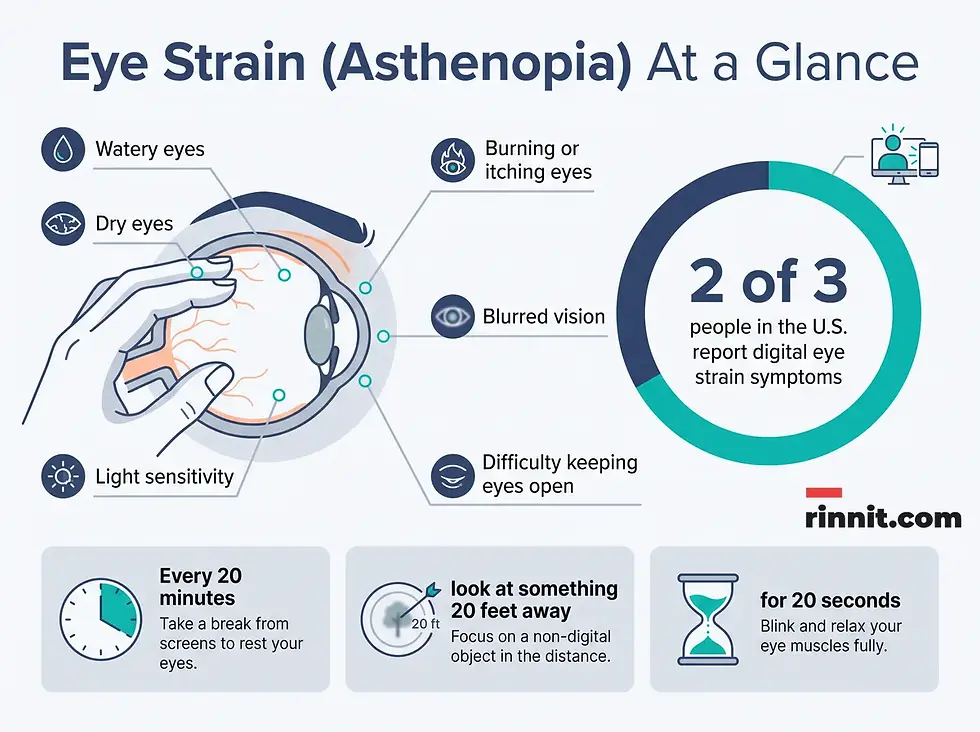
Digital eye strain is also very common. An estimated 2 out of 3 people in the U.S. report digital eye strain symptoms [5].
Symptoms of Eye Strain
Symptoms of eye strain affect your eyes as well as other parts of your body.
Body Area | Symptom | How It Feels |
Eyes | Watery eyes | Excess tearing |
Eyes | Dry eyes | Scratchy, sandy feeling |
Eyes | Blurred vision | Vision becomes unclear |
Eyes | Sensitivity to light | Bright light becomes painful |
Eyes | Burning eyes | A hot, irritated sensation |
Eyes | Itching eyes | An urge to rub the eye |
Eyes | Difficulty keeping eyes open | Eyelids feel heavy |
Rest of body | Headache | Aching in the head |
Rest of body | Neck pain | Soreness in the neck |
Rest of body | Shoulder pain | Soreness in the shoulders |
Rest of body | Back pain | Aching in the back |
Rest of body | Difficulty concentrating | Trouble focusing on tasks |
Eye strain symptoms affecting the eyes include watery eyes, dry eyes, blurred vision, sensitivity to light, burning eyes, itching eyes and difficulty keeping your eyes open [5]. Body-wide symptoms include headache, neck pain, shoulder pain, back pain and difficulty concentrating [5].
What Causes Eye Strain?
Eye strain is caused by intensely focusing your eyes during a task [5]. Causes can include driving, reading, computer and cell phone use, playing video games, doing detailed work such as writing, sewing or crafting, not having enough available light while doing a task, and not blinking enough [5].
People with prior eye conditions, like uncorrected vision or eye muscle imbalance, are at greater risk of eye strain [5]. Stress and fatigue can also contribute to eye strain [5].
Cause | How It Leads to Strain |
Driving | Sustained focus on the road, often for long distances |
Reading | Prolonged close-up focus |
Computer and cell phone use | The leading modern cause — digital eye strain |
Playing video games | Extended intense screen focus |
Detailed work | Writing, sewing or crafting demands close, continuous focus |
Insufficient light | Your eyes work harder in dim conditions |
Not blinking enough | Eyes dry out without adequate lubrication |
Prior eye conditions | Uncorrected vision or eye muscle imbalance raises risk |
Stress and fatigue | Contribute to eye strain |

Causes of digital eye strain
Digital eye strain has several distinct causes. Researchers have found that when people use computers or other digital screens, they blink less [5]. This leads to dry eyes, which can contribute to eye strain [5].
Digital devices can also cause eye strain because of their glare, or when there's poor contrast between the words on the screen and the background [5]. Improper distance from the screen and poor lighting can also lead to eye strain [5].
One of the most important things you can do for your eyes in these cases is to use eye drops like artificial tears [5].
What are the risk factors for eye strain?
Risk factors for eye strain can include working in front of a computer or screen for long periods of time, doing tasks that require your eyes to focus for extended periods of time, having dry eyes, having muscle problems within your eye, and driving long distances, especially if there's wind or air blowing directly at your eyes [5].
How Is Eye Strain Diagnosed?
Most times, eye strain will disappear on its own [5]. In those cases, you don't need to see a healthcare provider — you can usually treat temporary eye strain with some simple lifestyle changes and by being aware of what kinds of tasks bother your eyes.
But if your eye strain is severe or long term, you should make an appointment with a medical provider to rule out any more serious conditions [5].
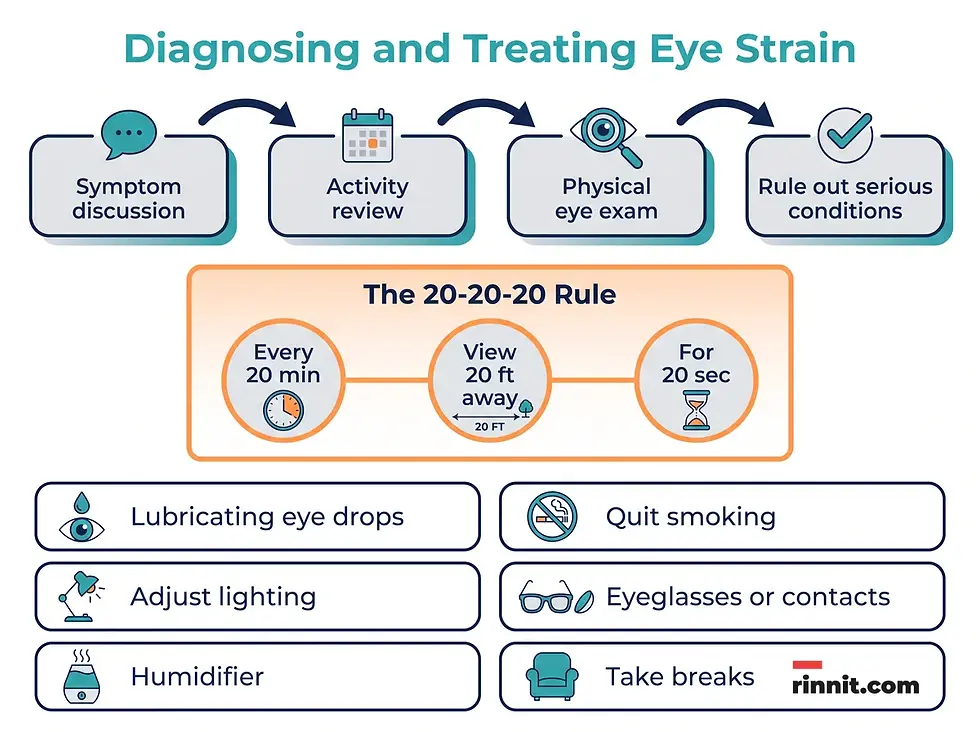
A healthcare provider or eye care provider can diagnose eye strain in their office. During this visit, they'll discuss what your symptoms are, when your symptoms started, when your symptoms occur, and what tasks you might be doing when symptoms happen [5].
Your provider may also do a physical exam to look for muscle imbalance, uncorrected refractive errors and other issues with the eye itself [5]. Refractive errors are things like nearsightedness (myopia) or farsightedness (hyperopia) [5].
Diagnostic Step | What Happens |
Symptom discussion | What your symptoms are, when they started and when they occur |
Activity review | What tasks you might be doing when symptoms happen |
Physical exam | Looks for muscle imbalance, uncorrected refractive errors (myopia, hyperopia) and other eye issues |
When to skip the visit | Most temporary eye strain disappears on its own — lifestyle changes are usually enough |
How Is Eye Strain Treated?
You can usually treat eye strain with lifestyle changes. These may include wearing eyeglasses or contact lenses for certain types of activities [5]. Taking breaks from reading, writing and driving can also help reduce eye strain [5].
One main suggestion for reducing digital eye strain is to follow the 20-20-20 rule. This rule says to take a 20-second break to view something 20 feet away from you every 20 minutes [5].
Treatment Tip | How It Helps |
The 20-20-20 rule | Every 20 minutes, view something 20 feet away for 20 seconds |
Eyeglasses or contact lenses | Corrects vision demands for certain activities |
Breaks from reading, writing, driving | Gives your eyes rest from intense focus |
Lubricating eye drops | One of the most important steps for digital eye strain |
Adjusted lighting | Matches light to your activity |
Humidifier | Adds moisture to dry air |
Quitting smoking | Smoking is harmful to your eyes |
Can Eye Strain Be Prevented?
In order to prevent eye strain, or lower your risk for eye strain, you may find it helpful to [5]:
Prevention Step | Why It Helps |
Choose screens that tilt and swivel | Lets you position the screen ergonomically |
Clean screens (and lenses) regularly | Smudges can reduce contrast and worsen strain |
Use a glare filter | Reduces harsh reflections on your screen |
Reduce glare through proper lighting | Poor lighting is a direct cause of eye strain |
Use an adjustable chair | Supports a comfortable viewing position |
Adjust your car's heaters | Keeps air from blowing directly into your eyes |
Use lubricating eye drops when eyes feel dry | Use them as frequently as your provider recommends |
Increase how often you blink | Screens make you blink less; conscious blinking helps |
Limit digital device time | Fewer screen hours means less strain, if possible |
Follow contact lens recommendations | Follow your provider's advice on cleaning and use |
Complications: The Blue Light Question
Eye strain can be irritating, but it's rarely more than a nuisance [5]. One thing to consider with digital eye strain is the question of blue light and how it affects your eyes.
The majority of blue light you see comes from the sun [5]. The sun emits visible light in a spectrum of colors: red, orange, yellow, green, blue, indigo and violet. The blue end of the spectrum has more energy and shorter wavelengths than the red end of the spectrum.
Blue light, which can also come from digital devices and light bulbs, is necessary for eye development, visual function and overall good health [5]. Some researchers think that recent increases in nearsightedness may be due to a lack of sunlight [5].
Other researchers think that too much exposure to blue light may eventually damage your retina [5]. Scientists will continue to study the effects of blue light on eye health [5].
Blue Light Fact | What the Science Says |
Main source | The majority of blue light you see comes from the sun |
Spectrum | Red, orange, yellow, green, blue, indigo and violet; the blue end has more energy and shorter wavelengths |
Also comes from | Digital devices and light bulbs |
Health role | Necessary for eye development, visual function and overall good health |
Nearsightedness link | Some researchers think increases in nearsightedness may be due to a lack of sunlight |
Retina question | Some researchers think too much blue light may eventually damage your retina |
Scientific status | Unresolved — scientists continue to study blue light's effects on eye health |
Outlook and Prognosis
In most cases, you can expect eye strain to improve relatively quickly after you stop doing the things that are causing the fatigue [5].
If eye strain doesn't improve quickly, or if you feel like you have eye strain all of the time, then you should consider speaking to a healthcare provider [5].
It's always a good idea to get an eye exam if you experience any changes in vision at all, including more frequent or long-lasting bouts of eye strain [5].
Living With Eye Strain
You should have regular appointments with an eye care provider — ask them to suggest a schedule [5]. If you have eye strain that's interfering with your ability to do your activities or with feeling healthy, call your eye care provider and make an appointment [5].
Situation | What To Do |
Regular care | Keep routine appointments with an eye care provider; ask for a suggested schedule |
Interfering with life | Call your eye care provider and make an appointment if strain interferes with your activities or feeling healthy |
New or worsening eye pain | Always get immediate medical aid, especially if it comes on suddenly |
Sudden loss of vision | Go to an emergency room |
Emergency warning: Always get immediate medical aid if you have new or worsening eye pain, especially if it comes on suddenly. Go to an emergency room if you have a sudden loss of vision.
If you're discussing eye strain with your provider, you may want to ask questions like: What do you suggest I do to prevent eye strain? Do you recommend a certain type of artificial tears or eye drops? Are there home remedies for eye strain that you prefer? When should I contact you about eye strain or other issues with eye health [5]?
Normally, eye strain is uncomfortable and irritating, but it's not dangerous [5]. If you find that you're having difficulty with tired eyes, one good place to start would be an eye exam — you can combine tips from your eye care provider with adjustments to your lifestyle and your environment.
Take the Next Step
Schedule an eye exam today if eye strain is interfering with your day. An eye care specialist can check for uncorrected vision or eye muscle imbalance and give you personalized prevention tips, including the 20-20-20 rule and the right lubricating eye drops for you.
Conclusion: Your Eyes Just Need a Break
Eye strain — also called eye fatigue or asthenopia — is an extremely common condition caused by intense use of your eyes, and an estimated 2 out of 3 people in the U.S. report digital eye strain symptoms. The good news is that it's usually not serious and improves quickly once you stop the activity causing it. The single most effective habit is the 20-20-20 rule: every 20 minutes, look at something 20 feet away for 20 seconds. Combine that with lubricating eye drops, better lighting, screen cleanup and fewer device hours, and most people find lasting relief. If your strain is severe, long-lasting or paired with new eye pain or vision changes, see a provider — some symptoms need an exam to rule out something more serious.
Related on Rinnit: Eye Infection: The Complete Guide · Eye Diseases: The Complete Guide · Watery eyes (epiphora) · Back pain · Farsightedness (hyperopia)
Further reading: Cleveland Clinic — Eye Strain
Frequently Asked Questions
1. What is eye strain?
Eye strain is a common condition caused by intense use of your eyes, such as by reading, using digital devices or driving long distances. Other names for eye strain are eye fatigue and asthenopia. It causes discomfort but is usually not a serious condition.
2. How common is eye strain?
Temporary eye strain is very common — most people find that their eyes are tired after a long day. Digital eye strain is also very common: an estimated 2 out of 3 people in the U.S. report digital eye strain symptoms.
3. What are the symptoms of eye strain?
Symptoms affecting the eyes include watery eyes, dry eyes, blurred vision, sensitivity to light, burning eyes, itching eyes and difficulty keeping your eyes open. Symptoms affecting other parts of the body include headache, neck pain, shoulder pain, back pain and difficulty concentrating.
4. What causes eye strain?
Eye strain is caused by intensely focusing your eyes during a task, including driving, reading, computer and cell phone use, playing video games, detailed work like writing or sewing, not enough light while doing a task, and not blinking enough. Uncorrected vision, eye muscle imbalance, stress and fatigue also contribute.
5. What is the 20-20-20 rule?
The 20-20-20 rule is the main suggestion for reducing digital eye strain. It says to take a 20-second break to view something 20 feet away from you every 20 minutes.
6. How is eye strain treated?
Eye strain is usually treated with lifestyle changes, including wearing eyeglasses or contact lenses for certain activities, taking breaks from reading, writing and driving, using lubricating eye drops, adjusting your lighting, using a humidifier and quitting smoking.
7. Does blue light from screens damage my eyes?
The question is still being studied. Blue light is necessary for eye development, visual function and overall health, and most of the blue light you see comes from the sun. Some researchers think recent increases in nearsightedness may be due to a lack of sunlight, while others think too much blue light exposure may eventually damage your retina. Scientists continue to study the effects of blue light on eye health.
8. How long does eye strain last?
In most cases, eye strain improves relatively quickly after you stop doing the things that are causing the fatigue. If it doesn't improve quickly, or you feel like you have eye strain all of the time, speak to a healthcare provider.
9. Can eye strain cause headaches and back pain?
Yes. Symptoms of eye strain affect other parts of your body, including headache, neck pain, shoulder pain, back pain and difficulty concentrating — not just your eyes.
10. When should I see a provider about eye strain?
See a provider if eye strain is severe, long term, or interferes with your activities or feeling healthy. Get an eye exam for any vision changes, including more frequent or long-lasting bouts of eye strain. Go to an emergency room for sudden loss of vision or new, sudden eye pain.
11. How can I prevent eye strain?
Choose screens that tilt and swivel; clean screens and lenses regularly; use a glare filter; reduce glare with proper lighting; use an adjustable chair; adjust your car's heaters so air doesn't blow into your eyes; use lubricating eye drops as your provider recommends; blink more; limit digital device time; and follow your provider's contact lens recommendations.
References
Sheppard AL, Wolffsohn JS. Digital eye strain: prevalence, measurement and amelioration. BMJ Open Ophthalmol. 2018;3(1):e000146. doi:10.1136/bmjophth-2018-000146. PMID: 29963645.
Johnson S, Rosenfield M. 20-20-20 rule: are these numbers justified? Optom Vis Sci. 2023;100(1):52-56. doi:10.1097/OPX.0000000000001971. PMID: 36473088.
Redondo B, Jiménez R, Vera J, Rosenfield M. The impact of break schedules on digital eye strain symptoms and ocular accommodation during prolonged near work. Exp Eye Res. 2025;258:110463. doi:10.1016/j.exer.2025.110463. PMID: 40466853.
Singh S, Keller PR, Busija L, et al. Blue-light filtering spectacle lenses for visual performance, sleep, and macular health in adults. Cochrane Database Syst Rev. 2023;8(8):CD013244. doi:10.1002/14651858.CD013244.pub2. PMID: 37593770.
Cleveland Clinic. Eye strain. Cleveland Clinic Health Library. Medically reviewed; last updated July 14, 2023. https://my.clevelandclinic.org/health/diseases/21059-eye-strain
Medical Disclaimer
This article is for informational purposes only and does not constitute medical advice. Always seek the advice of your physician or other qualified health provider with any questions you may have regarding a medical condition. Never disregard professional medical advice or delay in seeking it because of something you have read here.



Comments