Retinoscopy: How Eye Doctors Measure Your Prescription

Updated: 2 days ago
Written and medically reviewed by Dr. Baraa Alnahhal, MD · Last reviewed: November 2026 · How we review
Quick Answer
Retinoscopy is an eye test that uses a handheld light and the reflection from the retina to measure refractive errors, such as nearsightedness, farsightedness and astigmatism, and work out a glasses prescription. Because you don't have to answer questions, it's useful for babies, young children and people who can't communicate easily. It's quick and has almost no risks.
What the research says
Retinoscopy remains the check for children: an American Academy of Ophthalmology review found cycloplegic autorefraction usually differed from cycloplegic retinoscopy by less than 0.5 diopters on average, but individual results varied, so retinoscopy is valuable to confirm results in individual children (Wilson LB et al., Ophthalmology, 2020) [2]
Drops matter in children: in 142 children aged 3–15, machine readings without drops overestimated nearsightedness and underestimated farsightedness, and the authors concluded manual retinoscopy was still the most accurate method (Rotsos T et al., Clin Ophthalmol, 2009) [3]
Key takeaways
Measures refractive errors using light reflected from the retina.
Works without answers from the patient, so it's ideal for babies and young children.
Standard retinoscopy uses drops; dynamic retinoscopy doesn't.
Quick, with almost no risks.
Results become a prescription for glasses or contacts.
How does retinoscopy work?

The glow in the pupil guides the prescription.
Light passes through the cornea and lens, reflects off the retina and creates a glow in the pupil called the red reflex. With perfect focus, the reflected light leaves the eye evenly. A refractive error bends it unevenly. The specialist places lenses in front of your eye, using a phoropter or handheld lenses, and watches how the glow moves, its angle (which shows astigmatism) and how it looks. The lens that neutralizes the movement gives the prescription. Sources: [1]
Who is it useful for?
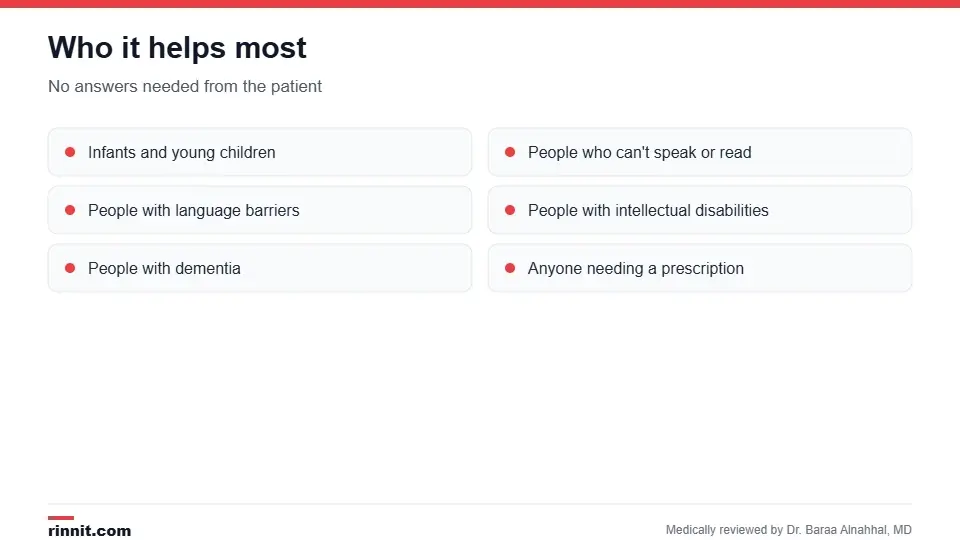
Retinoscopy doesn't require answers from the patient.
Infants and young children, including those being checked for lazy eye (amblyopia).
People with language barriers.
People with intellectual disabilities.
People with dementia or other age-related brain conditions.
Anyone who needs vision correction, as part of a routine eye exam. Sources: [1]
Types of retinoscopy
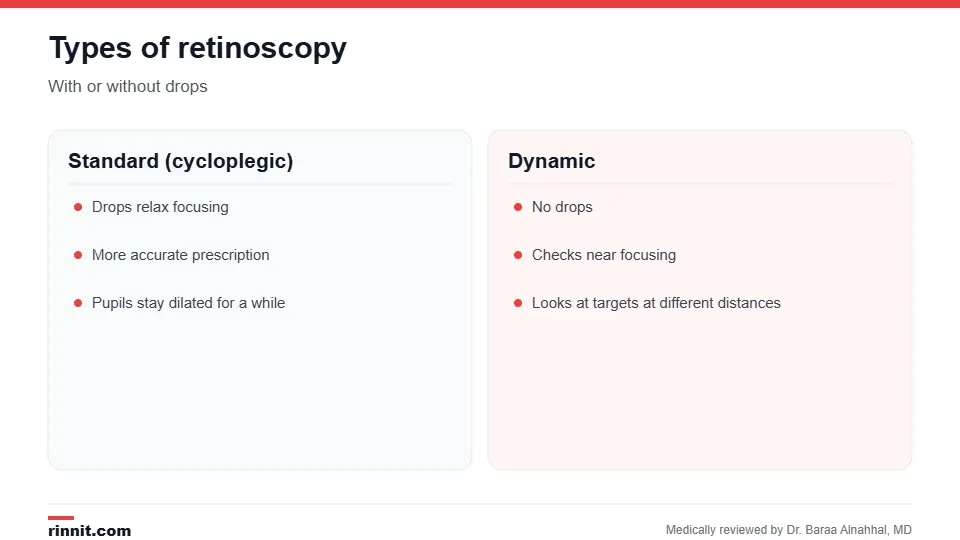
Drops relax focusing for a more accurate result.
Type | Drops | What it checks |
Standard (cycloplegic) | Yes, to stop the eye from focusing automatically | Your full prescription, more accurately |
Dynamic | No | How well the eyes focus up close (accommodation) |
Sources: [1, 2, 3]
How do I prepare?
Usually no preparation is needed. Your eye specialist will tell you if you need to stop wearing contact lenses beforehand. Mention if you're sensitive to light. Sources: [1]
What happens during the test?
You sit in a dim room facing the specialist and look at a target. They shine a light into each eye and switch lenses while watching the reflection. If cycloplegic drops were used, your pupils stay dilated for a while afterward, and you may be given temporary sunglasses. Sources: [1]
Risks
Retinoscopy has almost no risks. Cycloplegic drops can cause minor side effects, such as temporary blurred vision and light sensitivity. Sources: [1]
Understanding your results
The specialist calculates your prescription, which works the same as one from a standard refraction test. If you need correction for farsightedness, nearsightedness or astigmatism, options include eyeglasses, contact lenses or, for some adults, surgery such as LASIK or PRK. Sources: [1]
Conclusion
Retinoscopy is a simple, reliable way to measure how your eyes focus, especially for people who can't describe what they see. It remains a cornerstone of children's eye care.
Keep learning: read about refractive errors and lazy eye.
Frequently asked questions
What is retinoscopy?
An eye test that measures refractive errors using reflected light.
What does it measure?
Nearsightedness, farsightedness and astigmatism.
Why is it used for children?
It doesn't require the child to answer questions.
Does it hurt?
No.
Will I get eye drops?
Often, for standard retinoscopy.
What is dynamic retinoscopy?
A version without drops that checks near focusing.
How long do drops last?
It varies; your pupils may stay dilated for several hours.
Do I need to prepare?
Usually not; ask about contact lenses.
Is it the same as an autorefractor?
No. Retinoscopy is done by a specialist with handheld tools.
What happens after the test?
You get a prescription for glasses or contacts if needed.
Related Reading
Hirschberg Test (Corneal Light Reflex): How Eye Alignment Is Checked explains the light test used to check eye alignment.
Refractive Errors: Symptoms, Causes, Types, and Treatment the focusing problems retinoscopy measures.
Eye Exam: What Happens, Tests Included and How Often to Go where retinoscopy is often done.
Lazy Eye (Amblyopia): Symptoms, Causes, Treatment & Complete Guide a childhood condition found with eye testing.
Astigmatism: Symptoms, Causes & Treatment Options — Complete Guide an uneven focus retinoscopy detects.
Eyeglasses: How They Work, Lens Types, Side Effects and Care how glasses correct refractive errors.
References
Cleveland Clinic. Retinoscopy: What It Is, Test Details & How To Prepare. Cleveland Clinic. Last updated January 13, 2025. https://my.clevelandclinic.org/health/diagnostics/retinoscopy
Wilson LB, Melia M, Kraker RT, et al. Accuracy of autorefraction in children: a report by the American Academy of Ophthalmology. Ophthalmology. 2020;127(9):1259-1267. PMID 32317177. https://doi.org/10.1016/j.ophtha.2020.03.004
Rotsos T, Grigoriou D, Kokkolaki A, et al. A comparison of manifest refractions, cycloplegic refractions and retinoscopy on the RMA-3000 autorefractometer in children aged 3 to 15 years. Clin Ophthalmol. 2009;3:429-431. PMID 19684866. https://doi.org/10.2147/opth.s5145
Medical disclaimer
This article is for general education only and does not replace advice from a qualified healthcare professional. Talk to your doctor about your own diagnosis and treatment, and seek emergency care right away for severe or sudden symptoms.



Comments