Artificial Tears: Types, Uses and How to Use Them

Updated: 2 days ago
Written and medically reviewed by Dr. Baraa Alnahhal, MD · Last reviewed: November 2026 · How we review
Quick Answer
Artificial tears are over-the-counter eye drops, gels and ointments that lubricate dry eyes, relieving dryness, burning, itching, redness and irritation. Use preserved drops no more than 4 to 6 times a day; preservative-free drops are better for frequent use. Gels and ointments last longer but can blur vision. If you need them often, see an eye care provider.
What the research says
Most brands work about equally well: a Cochrane review of 43 trials with 3,497 people with dry eye found it was uncertain whether different over-the-counter artificial tears differ in relief, and they may be generally safe, though the evidence was low quality (Pucker AD et al., Cochrane Database of Systematic Reviews, 2016) [2]
Preservative-free and preserved drops performed similarly: a review of 4 trials found no meaningful difference between preservative-free and preserved artificial tears for symptoms, tear production or burning (Ribeiro MVMR et al., Arquivos Brasileiros de Oftalmologia, 2019) [3]
Key takeaways
Artificial tears lubricate dry, irritated eyes.
They come as drops, gels and ointments.
Limit preserved drops to 4 to 6 times a day.
Gels and ointments can blur vision for a while.
See an eye care provider if you need them often.
What are artificial tears?
Your tear film has three layers: mucus, water and oil. Artificial tears add to the water or oil layer to keep the surface of your eye moist and smooth. In the U.S., almost 5 million people age 50 and older have severe dry eye, and dry eye is twice as common in women. Sources: [1]
When to use them
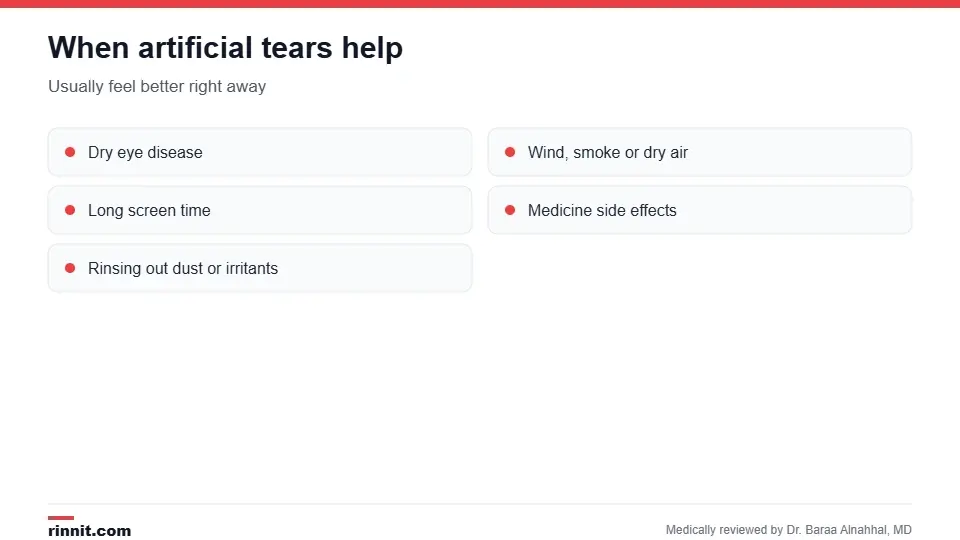
They usually make eyes feel better right away.
Dry eye disease.
Windy, smoky or dry environments.
Eye strain from long computer use or fatigue.
Side effects of medicines such as allergy pills or some antidepressants.
Aging.
Rinsing out dust, hair or other irritants. Sources: [1]
Types of artificial tears

Ask your provider which type fits you.
Type | Pros | Cons |
Preserved drops | Longer shelf life | Can irritate eyes; limit to 4 to 6 times a day; discard 3 to 4 months after opening |
Preservative-free drops | Gentler for frequent use | Often single-use vials; discard after 24 hours |
Gels and ointments | Last longer | Blur vision; don't use with contact lenses |
Contact lens drops | Made to use with lenses | Check the label |
Artificial tears differ from medicated eye drops, which may contain decongestants, antihistamines, steroids or antibiotics. Overusing redness-relief drops can cause rebound redness. Sources: [1]
How to use eye drops

Don't rub your eyes afterward.
Wash your hands.
Tilt your head back and look up.
Gently pull down your lower eyelid.
Squeeze in the drop without letting the tip touch your eye.
Close your eye and press lightly on the inner corner near your nose.
Don't rub your eyes afterward. Sources: [1]
Side effects
Side effect | What to do |
Blurred vision | Wait until it clears before driving |
Burning or itching | Don't rub; try a preservative-free product |
Allergic reaction | Get help for swelling, trouble breathing or dizziness |
Products with preservatives are more likely to cause side effects. Sources: [1, 3]
When to call your provider
You need artificial tears every day or more often than recommended.
They don't help.
You have side effects.
Get immediate help for vision loss or a severe reaction, and call 911 for trouble breathing. Sources: [1]
Conclusion
Artificial tears are a simple, safe way to soothe dry, irritated eyes. Choosing the right type and using it correctly helps, and frequent need is a sign to see an eye care provider.
Frequently asked questions
What are artificial tears?
Over-the-counter drops, gels or ointments that lubricate dry eyes.
How often can I use artificial tears?
Preserved drops up to 4 to 6 times a day; preservative-free more often.
What's the difference between preserved and preservative-free drops?
Preserved drops last longer but can irritate; preservative-free drops are gentler.
Can I use artificial tears with contacts?
Use drops made for contact lenses and avoid gels and ointments.
Why do gels blur my vision?
They're thicker so they last longer, but they blur vision for a while.
How long do artificial tears last after opening?
Preserved bottles 3 to 4 months; single-use vials 24 hours.
Are artificial tears the same as redness drops?
No. Redness drops contain decongestants and can cause rebound redness.
Do artificial tears work right away?
Usually, yes.
Are artificial tears safe?
Yes, for most people; preservatives can cause irritation.
When should I see a provider?
If you need them often or they don't help.
Related Reading
Punctal Plugs: Types, Placement and Side Effects explains punctal plugs for dry eye.
Dry Eyes: Symptoms, Causes, Treatment & Relief — Complete Guide the main reason for artificial tears.
Eye Drops: Types, Uses, Risks and How to Use Them Safely an overview of medicated eye drops.
Blepharitis: Symptoms, Causes, and Treatment eyelid inflammation that can dry the eyes.
Allergic Conjunctivitis: Why Your Eyes Itch Every Spring — and the Simple Habits and Eyedrops That Stop It itchy, irritated allergy eyes.
LASIK Eye Surgery: Procedure, Recovery and Results a surgery that can cause temporary dry eye.
References
Cleveland Clinic. Artificial Tears: What They Are and When To Use Them. Cleveland Clinic. Last updated February 21, 2023. https://my.clevelandclinic.org/health/treatments/24804-artificial-tears
Pucker AD, Ng SM, Nichols JJ. Over the counter (OTC) artificial tear drops for dry eye syndrome. Cochrane Database of Systematic Reviews. 2016;2(2):CD009729. PMID 26905373. https://doi.org/10.1002/14651858.CD009729.pub2
Ribeiro MVMR, Barbosa FT, Ribeiro LEF, et al. Effectiveness of using preservative-free artificial tears versus preserved lubricants for the treatment of dry eyes: a systematic review. Arquivos Brasileiros de Oftalmologia. 2019;82(5):436-445. PMID 31508669. https://doi.org/10.5935/0004-2749.20190097
Medical disclaimer
This article is for general education only and does not replace advice from a qualified healthcare professional. Talk to your doctor about your own diagnosis and treatment, and seek emergency care right away for severe or sudden symptoms.



Comments