Punctal Plugs: Types, Placement and Side Effects

Updated: 2 days ago
Written and medically reviewed by Dr. Baraa Alnahhal, MD · Last reviewed: November 2026 · How we review
Quick Answer
Punctal plugs are tiny inserts placed in the puncta, the small openings in the eyelids that drain tears, to slow tear drainage so the eyes stay moist. They're mainly used for dry eye. They can be temporary, semi-permanent or permanent. Placement takes a few minutes. Plugs are generally safe; the most common problem is a plug falling out.
What the research says
Plugs improved tears and symptoms: across 17 studies of 1,658 patients, punctal plugs improved tear film stability by 1.8 seconds, tear production by 3.1 mm and dry eye symptom scores by 20.6 points, with 86% of plugs retained (Chen KY et al., Contact Lens & Anterior Eye, 2025) [2]
Plugs helped, but some fell out: an American Academy of Ophthalmology review of 27 studies found plugs gave at least 50% symptom improvement in moderate dry eye; plugs fell out in about 40% of patients, and about 10% needed removal for irritation (Marcet MM et al., Ophthalmology, 2015) [3]
Key takeaways
Punctal plugs block tear drainage to keep eyes moist.
They mainly treat dry eye.
Types include temporary, semi-permanent and permanent plugs.
Placement takes just a few minutes.
Plugs falling out is the most common problem.
What are punctal plugs?
You have one punctum in each upper and lower eyelid, each about the width of three human hairs. A plug has a collar at the top that keeps it from sliding deeper. The first dissolvable plug was developed in 1961 and silicone plugs in 1975. Learn about tears. Sources: [1]
What they treat

Plugs also help other dry eye treatments stay in the eye longer.
Dry eye from poor tear quality, fast evaporation or too few tears.
Dry eye linked to Sjögren's syndrome, graft-versus-host disease or lupus.
Corneal damage, such as recurrent corneal erosions.
Dryness from medicines like antidepressants or beta-blockers, low humidity or smoke.
Watery eyes from narrowed puncta, using perforated plugs. Sources: [1]
Plugs also help treatments like artificial tears stay in your eyes longer. Sources: [1]
Types of punctal plugs
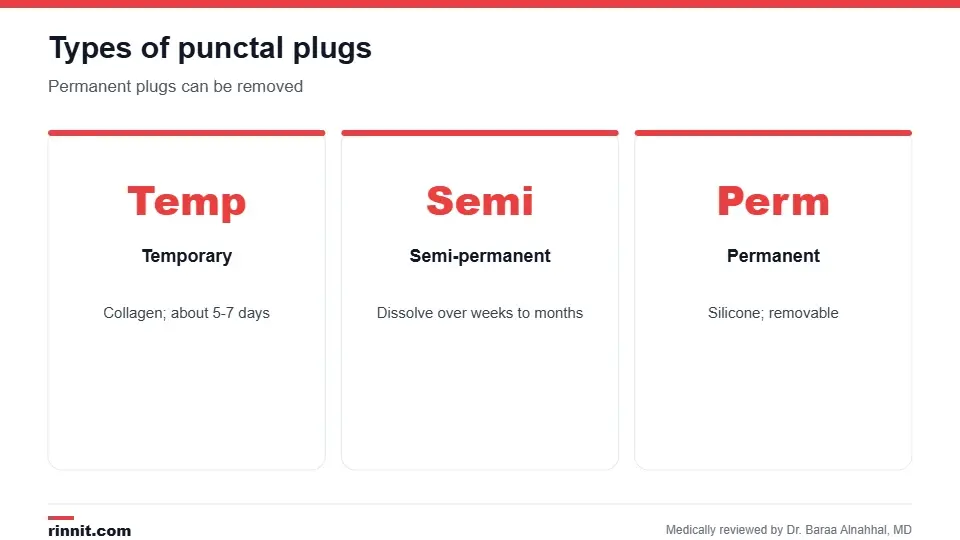
Permanent plugs can be removed by your provider.
Type | How long it lasts | Material |
Temporary | About 5 to 7 days | Collagen |
Semi-permanent | Weeks to months | Dissolvable material |
Permanent | Until removed | Silicone |
Medicated | Varies | Releases medicine |
Perforated | Varies | Hollow center for watery eyes |
Sources: [1]
How they're placed
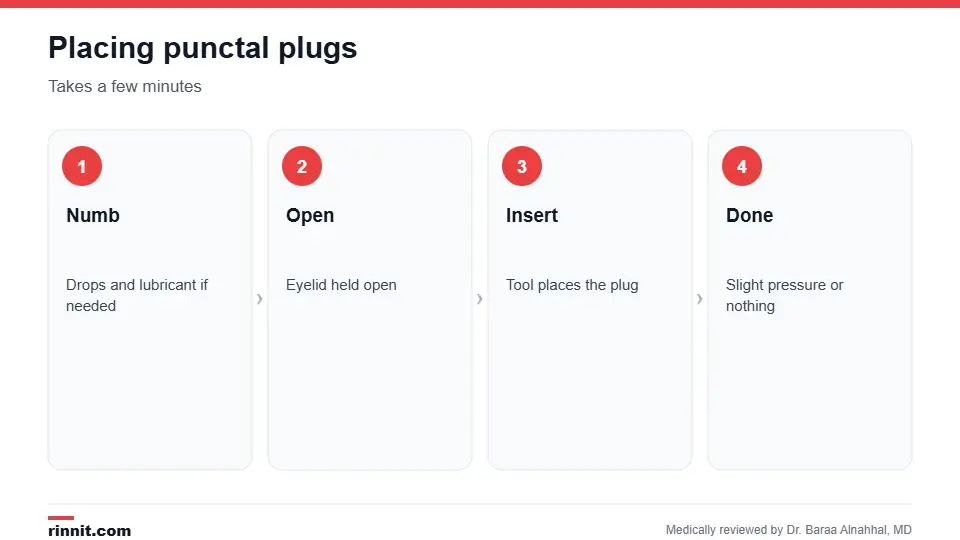
You may feel slight pressure or nothing at all.
Your provider may apply numbing drops and a lubricant.
Your eyelid is held open.
A special tool places the plug without touching your eye.
The process takes a few minutes in the office. Sources: [1]
You may feel slight pressure or a tug, or nothing if your eye is numbed. Sources: [1]
Risks
Type | Examples |
Common | Plug falling out (more often from upper lids), watery eyes, irritation from a shifted plug |
Rare | Pyogenic granuloma, narrowing of the tear duct opening, plug moving deeper, toxic tear syndrome |
Most complications are minor. Sources: [1, 3]
After placement
Many people feel less dryness within hours or days.
Avoid rubbing your eyes.
Keep using prescribed treatments, such as artificial tears.
Wash your hands before touching your eyes or face. Sources: [1]
Results
Over the past 30 years, nearly every study has found plugs effective in more than 70% of people. Results depend on the plug type and your condition. Sources: [1, 2]
When to call your provider
Eye pain, irritation or redness.
A feeling that something is stuck in your eye.
Unusually watery or dry eyes.
Eyelid swelling, redness or pain. Sources: [1]
Conclusion
Punctal plugs are a quick, low-risk way to keep your eyes moist when dry eye drops alone aren't enough. Your provider can help you choose the right type of plug.
Keep learning: read about dry eye and artificial tears.
Frequently asked questions
What are punctal plugs?
Tiny inserts that block tear drainage to keep your eyes moist.
What do punctal plugs treat?
Mainly dry eye.
Does getting punctal plugs hurt?
You may feel slight pressure or nothing at all.
How long does placement take?
A few minutes.
How long do punctal plugs last?
From about a week to permanently, depending on the type.
Can punctal plugs be removed?
Yes. Permanent plugs can be removed by your provider.
How soon will my eyes feel better?
Often within hours or days.
Can punctal plugs fall out?
Yes. It's the most common problem.
Can I still use eye drops?
Yes. Keep using prescribed treatments.
Are punctal plugs safe?
Yes. Complications are usually minor and uncommon.
Related Reading
Dry Eyes: Symptoms, Causes, Treatment & Relief — Complete Guide the main condition plugs treat.
Artificial Tears: Types, Uses and How to Use Them drops that work alongside plugs.
Understanding Sjögren’s Syndrome: Managing Chronic Dryness a cause of severe dry eye.
Tears: The Essential Shield for Your Eye Health how tears protect your eyes.
Blocked Tear Duct (Nasolacrimal Duct Obstruction): Symptoms, Causes, and Treatment blocked tear drainage.
References
Cleveland Clinic. Punctal Plugs: How They Work and Side Effects. Cleveland Clinic. Last updated September 14, 2023. https://my.clevelandclinic.org/health/treatments/25249-punctal-plugs
Chen KY, Chan HC, Chan CM. How effective and safe are punctal plugs in treating dry eye disease? A systematic review and meta-analysis. Cont Lens Anterior Eye. 2025;48(5):102438. PMID 40393913. https://doi.org/10.1016/j.clae.2025.102438
Marcet MM, Shtein RM, Bradley EA, et al. Safety and efficacy of lacrimal drainage system plugs for dry eye syndrome: a report by the American Academy of Ophthalmology. Ophthalmology. 2015;122(8):1681-1687. PMID 26038339. https://doi.org/10.1016/j.ophtha.2015.04.034
Medical disclaimer
This article is for general education only and does not replace advice from a qualified healthcare professional. Talk to your doctor about your own diagnosis and treatment, and seek emergency care right away for severe or sudden symptoms.



Comments