Blocked Tear Duct (Nasolacrimal Duct Obstruction): Symptoms, Causes, and Treatment

Updated: 3 days ago
Medically reviewed by Dr. Baraa Alnahhal, MD · Last reviewed: October 2026
Quick Answer: What is a blocked tear duct (nasolacrimal duct obstruction)?
A blocked tear duct (nasolacrimal duct obstruction) is a partial or complete blockage that stops tears from draining into the nose, causing a very watery eye, crusting, discharge and sometimes painful swelling. It is most common in newborns, who usually improve without treatment during the first year. Adults may need probing, stenting, balloon dilation or dacryocystorhinostomy surgery.
What the research says
In babies, early probing did not beat waiting. A systematic review of four randomized trials (423 children) found no difference in resolution rates between early probing and observation or late probing (risk ratio 1.00, 95% CI 0.76 to 1.33; low-certainty evidence). In complex cases, one trial found better results with silicone stent intubation than with late probing (Farat et al., Arq Bras Oftalmol, 2021) [3].
For older children, silicone tubes did better than probing. A meta-analysis of 23 studies found silicone tube intubation was more likely to resolve symptoms than probing (risk ratio 1.11; 95% CI 1.04 to 1.20), especially in children over 12 months, and found no significant difference between intubation and balloon dilation (Alruwaili et al., J Craniofac Surg, 2024) [4].
In adults, surgery has the highest pooled success rates. A meta-analysis of 55 studies (9,337 procedures) for acquired blockage below the tear canals found mean success of 89.8% for external dacryocystorhinostomy and 89.5% for endoscopic dacryocystorhinostomy, compared with 48.9% for balloon dilation and 54.4% for probing with stenting. The review found no statistical difference between the external and endoscopic approaches (Vinciguerra et al., Clin Otolaryngol, 2020) [5].
How do tears drain, and what happens when a tear duct is blocked?
Every time you blink, a thin film of tears wipes across the surface of the eye. Most tears are produced by the lacrimal glands, which sit inside the upper lids above each eye. The excess tears that remain need somewhere to go, and that is the job of the tear drainage system.
Tears drain through tiny openings called puncta, located at the inside corners of the upper and lower eyelids. From there they flow through small canals called canaliculi into the lacrimal sac on the side of the nose, then down the nasolacrimal duct and into the nose, where they are absorbed again. A blockage can happen at any point along this path. When tears sit stagnant instead of draining, the eye waters and the risk of infection and irritation rises.
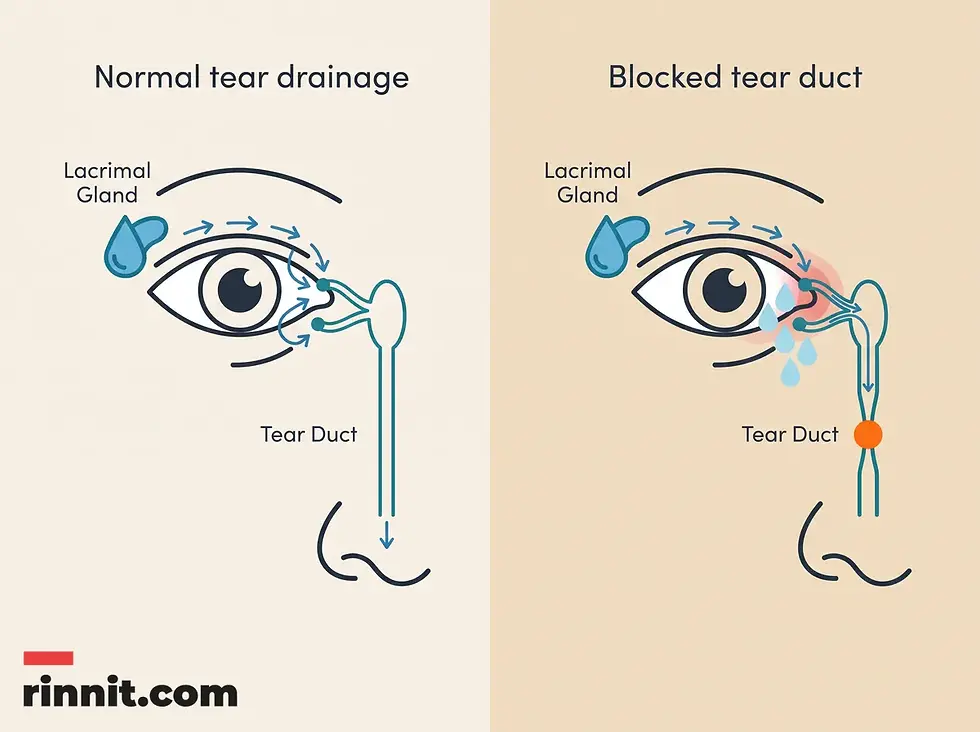
What are the symptoms of a blocked tear duct?
The most obvious sign is an eye that tears constantly. Depending on the cause and how long the blockage has been present, other symptoms can appear as well.

Symptom | What it looks like |
Constant watering | The eye tears all day, in situations where most people's eyes stay dry |
Redness | The white part of the eye looks red or irritated |
Crusting | Eyelids crust over, especially after sleep |
Discharge | Mucus or pus appears on the lids and the surface of the eye |
Swelling and pain | A painful swelling develops near the inside corner of the eye |
Recurrent infections | The eye gets infected or irritated again and again, sometimes like pink eye |
Blurred vision | Tears pooling on the eye's surface blur what you see |
When should you see a doctor for a blocked tear duct?
See a healthcare professional if your eye tears constantly for several days, or if it becomes infected often or all the time. Get medical care right away for a painful, red, swollen bump near the inner corner of the eye, fever, or redness spreading to the eyelid, which can mean the tear sac is infected. There is a practical reason not to wait on this one: a blocked tear duct can occasionally be caused by a tumor pressing on the tear drainage system, and finding it early gives you more treatment options.
What causes a blocked tear duct?
The cause matters because treatment follows the cause. The same blocked drainage system can result from very different problems at different ages.
Cause | Who it affects | How it happens |
Blockage at birth | Newborns | The drainage system has not fully developed, or a thin tissue membrane still covers the duct's opening into the nose |
Age-related changes | Older adults | The puncta gradually narrow, causing blockage |
Infection or inflammation | Any age | Long-standing inflammation of the eyes, tear system, or nose blocks the ducts |
Injury or trauma | Any age | Facial injury damages bone or scars the area near the drainage system; even dirt particles or loose skin cells can lodge in the duct |
Tumor | Any age | A growth in the nose or along the tear drainage system presses on it |
Eye drops | Any age | Rarely, long-term use of certain medicines, such as glaucoma drops |
Cancer treatments | Any age | Chemotherapy and radiation can be a possible side effect |
Who is at risk of a blocked tear duct?
A blocked tear duct is more likely with certain factors, including older age, eye irritation, past surgery near the eye and some medical treatments. Older adults face higher risk because of age-related narrowing. Eyes that are constantly irritated, red, or inflamed raise the risk, as does previous eye, eyelid, nasal, or sinus surgery, which can leave scarring in the duct system. People who use topical glaucoma medicines on the eye surface carry higher risk, and radiation or chemotherapy, especially radiation focused on the face or head, is another recognized risk factor.
What complications can an untreated blocked tear duct cause?
Stagnant tears create a breeding ground. Bacteria, viruses, and fungi grow more easily in tears that cannot drain, which is why blocked tear ducts lead to frequent eye infections and inflammation. Any part of the drainage system can become affected, including the conjunctiva, the clear membrane over the surface of the eye.
How is a blocked tear duct diagnosed?
Diagnosis starts with a symptom history and an eye exam. The provider may also check the inside of your nose for structural changes that could cause blockage. From there, a few simple tests locate the problem.
Test | What happens | What it shows |
Tear drainage test | One drop of special dye is placed on the surface of each eye | If most of the dye is still on the surface after 5 minutes, a blocked tear duct may be diagnosed |
Irrigation and probing | Saline is flushed through the tear drainage system, or a slender instrument is passed through the puncta | Whether tears drain and where the blockage sits; probing can sometimes treat the condition on its own |
Eye imaging | Contrast dye is passed through the drainage system, then X-ray, CT, or MRI is performed | The exact location and cause of the blockage |
What are the treatment options for a blocked tear duct?
Treatment depends on the cause and on age, and more than one approach may be needed.
Babies and Watchful Waiting
Many babies with blocked tear ducts get better without any treatment at all, as the drainage system matures during the first months of life. A care team may teach a special massage technique to help open the thin membrane over the duct's opening into the nose. The same patience applies after facial injury: providers often wait a few months to see whether the blockage clears as swelling goes down, since ducts may unblock on their own.

Medicines
If an infection is present, antibiotic eye drops or pills fight it. Medicines treat the infection, not the blockage itself.
Dilation, Probing, and Flushing
For infants who need more than waiting, the procedure is usually done under general anesthesia. The provider enlarges the punctal openings with a dilation tool and threads a thin probe through the puncta into the drainage system. For adults whose puncta have only partially narrowed, the puncta can be widened with a small probe and then flushed. This is a simple outpatient procedure that often provides at least temporary relief.
Stenting (Intubation)
This is usually done under general anesthesia. A thin tube of silicone or polyurethane is threaded through one or both puncta, through the drainage system, and into the nose, with a small loop of tubing visible in the corner of the eye. The tube stays in place for about three months and is then removed. One possible complication is inflammation caused by the tube itself.
Balloon Catheter Dilation
If other treatments fail or the blockage returns, a catheter is threaded through the blockage in the nose. The small balloon on its tip is inflated and deflated a few times to open the blockage. This approach is usually done under general anesthetic and tends to be effective for infants and toddlers, and for adults with partial blockage.
Surgery for Tumors and Blocked Ducts
When a tumor is the cause, treating the cause comes first: surgery to remove the tumor or other treatments to shrink it. When the drainage system itself stays blocked, the main operation is a dacryocystorhinostomy, which reopens the passageway so tears can drain into the nose again.
Dacryocystorhinostomy: How the Surgery Works
The surgery can be performed under general anesthetic, or under local anesthetic in an outpatient setting, and the exact steps vary with the location and extent of the blockage and the surgeon's experience.
Approach | How it is done | Key trade-off |
External | A cut is made on the side of the nose near the lacrimal sac; the sac is connected to the nasal cavity; a stent holds the new passageway open while the cut is stitched closed | Leaves a small scar; Mayo Clinic describes it as having higher success rates |
Endoscopic (endonasal) | A microscopic camera and tiny instruments pass through the nasal opening to the duct system | No cut and no scar; Mayo Clinic notes lower success rates, although the pooled data above found similar results in adults |
After surgery, a nasal decongestant spray and eye drops help prevent infection and reduce inflammation. Stents are typically removed after healing, at about six to twelve weeks.
How can you prevent a blocked tear duct later in life?
You cannot prevent the congenital form, but you can lower the risk of blockage later in life. Treat eye inflammation or infections promptly. Wash your hands thoroughly and often, and avoid rubbing your eyes. Replace eyeliner and mascara regularly, never share these cosmetics, and keep contact lenses clean according to your eye care specialist's and the manufacturer's recommendations.
Conclusion
A blocked tear duct is common, understandable, and almost always treatable. In newborns it usually resolves on its own as the drainage system matures in the first year of life. In adults, the path is clearer too: the blockage can be located with a dye test, irrigation, and imaging, then addressed with probing, stenting, balloon dilation, or a small reconstructive surgery. Because a persistently watering eye can occasionally hide a tumor, and because stagnant tears invite repeated infections, a constant watering eye deserves an evaluation rather than a shrug.
Take the next step: See an eye care professional if your eye tears constantly for several days or gets infected repeatedly. If your baby has a watering eye, ask about the massage technique, since most cases resolve with time and technique.
FAQ
Is a blocked tear duct the same as watery eyes from allergies or crying?
Not the same, though they look alike. Allergy and emotion tears eventually drain; with a blocked tear duct, the drainage path itself is narrowed or closed, so tears keep pooling. If one eye waters constantly for days, especially with crusting, discharge, or repeated infections, it is worth an evaluation.
Do all babies with blocked tear ducts need treatment?
No. Many newborns get better without any treatment as the drainage system matures during the first months of life. Care teams often start with watchful waiting and a gentle massage technique; procedures are reserved for babies who do not improve.
Does blocked tear duct surgery leave a scar?
It depends on the approach. The traditional external surgery makes a cut beside the nose and heals with a small scar. The endoscopic approach passes instruments through the nose, leaving no cut and no scar.
Can a blocked tear duct cause vision damage?
The blockage itself does not damage vision, but the stagnant tears it leaves behind invite repeated infections and inflammation of the eye's surface. Prompt treatment protects the eye and keeps vision comfortable.
Why do some people with blocked tear ducts also use glaucoma eye drops?
Long-term use of certain eye drops, including some glaucoma medicines, is a rare but recognized cause of blockage. If you use eye drops regularly and your eyes water constantly, mention it at your appointment.
Disclaimer: This article is for general educational purposes only and is not a substitute for professional medical advice, diagnosis, or treatment. Always consult a qualified healthcare provider for questions about a medical condition.
How long does a blocked tear duct last in babies?
Most babies get better on their own as the tear drainage system matures during the first year of life. Your child's provider will tell you if a procedure is needed.
How do you massage a baby's blocked tear duct?
A provider can show you a gentle massage at the inner corner of the eye, next to the nose, to help open the duct. Wash your hands first and follow the exact steps your provider teaches.
What causes a blocked tear duct in adults?
Common causes include age-related narrowing of the duct, infection or swelling, injury to the face or nose, past surgery near the eye, some medicines and cancer treatments, and, rarely, a tumor.
Can a blocked tear duct get infected?
Yes. Tears that cannot drain can lead to infection of the tear sac. Get care right away for a painful, red, swollen bump near the inner corner of the eye, especially with fever.
How is a blocked tear duct diagnosed?
An eye care professional examines the eye and may use a dye test to see whether tears drain normally. Flushing the duct with fluid or imaging tests can show where the blockage is.
Related Reading
Punctal Plugs: Types, Placement and Side Effects explains punctal plugs for dry eye.
References
Mayo Clinic Staff. Blocked tear duct - Symptoms & causes. Mayo Clinic. August 18, 2025. https://www.mayoclinic.org/diseases-conditions/blocked-tear-duct/symptoms-causes/syc-20351369
Mayo Clinic Staff. Blocked tear duct - Diagnosis and treatment. Mayo Clinic. August 18, 2025. https://www.mayoclinic.org/diseases-conditions/blocked-tear-duct/diagnosis-treatment/drc-20351375
Farat JG, et al. Probing for congenital nasolacrimal duct obstruction: a systematic review and meta-analysis of randomized clinical trials. Arq Bras Oftalmol. 2021;84(1):91-98. PMID 33470349. https://doi.org/10.5935/0004-2749.20210005
Alruwaili R, et al. Comparative Analysis of Silicone Tube Intubation Versus Probing and Balloon Dilation for Congenital Nasolacrimal Duct Obstruction: A Systematic Review and Meta-Analysis. J Craniofac Surg. 2024;35(4):1114-1119. PMID 38727216. https://doi.org/10.1097/SCS.0000000000010273
Vinciguerra A, et al. Best treatments available for distal acquired lacrimal obstruction: A systematic review and meta-analysis. Clin Otolaryngol. 2020;45(4):545-557. PMID 32304619. https://doi.org/10.1111/coa.13551



Comments