Hemorrhoidectomy: Purpose, Procedure, Recovery and Risks

Updated: 3 days ago
Written and medically reviewed by Dr. Baraa Alnahhal, MD · Last reviewed: November 2026 · How we review
Quick Answer: What is a hemorrhoidectomy?
A hemorrhoidectomy is surgery to remove hemorrhoids, the swollen blood vessels in the anus. It's usually saved for hemorrhoids that prolapse, clot or keep coming back after less invasive treatments. Most people go home the same day, but recovery takes two to four weeks and can be painful. Hemorrhoids removed this way generally do not come back. [1]
What the research says
Traditional hemorrhoid removal keeps hemorrhoids away better than the stapled method. In a review of randomized trials, hemorrhoids came back in 37 of 479 people after stapled surgery versus 9 of 476 after conventional removal, and people who had conventional surgery were more likely to be free of symptoms over the long term. (Lumb et al., Cochrane Database of Systematic Reviews, 2006) [2]
The stapled method hurts less at first, but traditional removal does better over two years. In a trial of 777 people with grade II to IV hemorrhoids, stapled surgery was less painful in the short term, but after six weeks the traditional hemorrhoidectomy group had better quality of life, fewer symptoms and fewer repeat procedures over 24 months. (Watson et al., Health Technology Assessment, 2017) [3]
Sealing devices can make the first days less painful. A review of 12 trials with 1,142 people found less pain on the day after surgery with a LigaSure sealing device than with a conventional hemorrhoidectomy, and people returned to work about 4.9 days sooner, with no difference in complications or bowel control. (Nienhuijs and de Hingh, Cochrane Database of Systematic Reviews, 2009) [4]
Key takeaways
A hemorrhoidectomy surgically removes problem hemorrhoids and seals their blood vessels. [1]
Only about 10% of people treated for hemorrhoid symptoms need surgery. [1]
Most people go home the same day, and average recovery takes two to four weeks. [1]
Pain is usually worst with the first bowel movement and is often gone by about two weeks. [1]
Surgery succeeds about 95% of the time when other treatments have failed. [1]
What is a hemorrhoidectomy used for?
A hemorrhoidectomy removes hemorrhoids, which are enlarged blood vessels in the anus. Most hemorrhoids are harmless and never need surgery. [1]
About 5% of people develop hemorrhoid symptoms. Of those, around 30% seek treatment, and about 10% of the people who are treated need surgery. A hemorrhoidectomy is usually reserved for hemorrhoids that cause complications or keep returning. [1] If you are pregnant, our guide to hemorrhoids during pregnancy covers relief and management.
Why might you need a hemorrhoidectomy?
Surgery may be recommended when hemorrhoids cause one of four complications. [1]
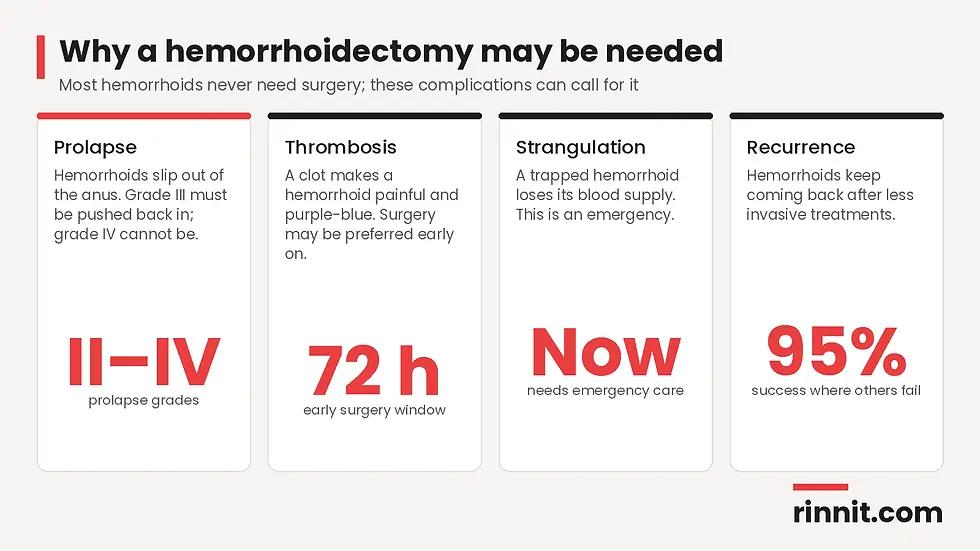
A hemorrhoidectomy is usually reserved for complications or hemorrhoids that keep coming back.
Complication | What happens | Why surgery may help |
Prolapse | Hemorrhoids slip out of the anus. Grade II come out only during bowel movements, grade III must be pushed back in by hand, and grade IV cannot be pushed back in | Removes hemorrhoids that keep falling out |
Thrombosis | A blood clot makes a hemorrhoid painful and purple-blue, and it sometimes bursts | It often heals on its own, but surgery may be preferred in the first 72 hours |
Strangulation | A trapped hemorrhoid loses its blood supply | This is an emergency, because the tissue can die without treatment |
Recurrence | Hemorrhoids return after less invasive treatments | Surgery succeeds about 95% of the time when other treatments have failed |
Source: [1]
Who should not have a hemorrhoidectomy?
Your provider may not recommend a hemorrhoidectomy if you have a condition that raises the risk of serious complications. These include: [1]
A weakened immune system (immunosuppression)
A bleeding disorder
Portal hypertension (high blood pressure in the veins that carry blood to the liver)
If surgery is not a good fit, your care team can talk with you about other options. One office-based alternative is hemorrhoid banding.
How do you prepare for a hemorrhoidectomy?
Preparation is simple, but it helps to plan ahead for the recovery period. [1]
Talk with your surgeon. Your surgeon reviews the risks and benefits of surgery and asks for your informed consent. [1]
Medicines. Your surgeon will tell you which medicines to stop before the operation. [1]
Fasting. You will be asked to stop eating and drinking eight hours before the procedure. [1]
Bowel preparation. If you are constipated, your surgeon may give you an enema to clear the anal canal. [1]
Transport. Arrange for someone else to drive you home after surgery. [1]
What happens during a hemorrhoidectomy?
A hemorrhoidectomy is a short operation done while you are under anesthesia. [1]
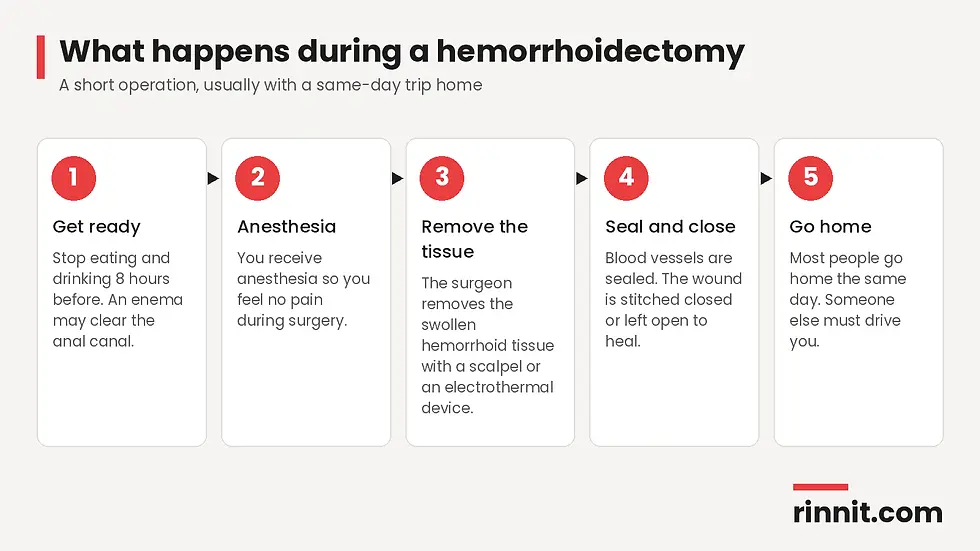
The operation is short, and most people go home the same day.
Preparation: You arrive having fasted for eight hours, and an enema may be given if needed.
Anesthesia: You receive anesthesia so you do not feel pain during the surgery.
Removing the tissue: The surgeon finds the hemorrhoids and removes the affected tissue.
Sealing and closing: The surgeon seals the blood vessels. The wound is either stitched closed or left open to heal, depending on where it is and how wide it is.
Going home: Most people go home the same day once the anesthesia starts to wear off.
Source: [1]
Open and closed hemorrhoidectomy
In a closed hemorrhoidectomy, the surgeon stitches the wound shut. In an open hemorrhoidectomy, the wound is left open to heal. The choice depends on the location and width of the wound. [1]
Surgical tools
The traditional method uses a scalpel to remove the tissue and dissolvable stitches to close the wound. More recently, surgeons have started using electrothermal devices that cut and seal the tissue and blood vessels at the same time, which may help healing go faster. [1] [4]
Hemorrhoidectomy at a glance
Item | Typical detail |
Setting | Usually home the same day |
Anesthesia | Yes, so you feel no pain during surgery |
Fasting | No food or drink for 8 hours before |
Wound | Stitched closed or left open |
Tools | Scalpel and dissolvable stitches, or an electrothermal device |
Average recovery | 2 to 4 weeks |
Heavy exercise or manual labor | May need to wait 6 to 8 weeks |
Source: [1]
What happens after a hemorrhoidectomy?
You will usually be able to go home on the day of surgery, but someone else needs to drive you. The anesthesia takes a few hours to wear off, and pain starts as it does. [1]
You can take over-the-counter or prescription pain relievers, and your care team will give you detailed instructions on how to look after yourself at home. [1]
Some effects are expected while you heal: [1]
Bleeding: Some bleeding is normal, especially with bowel movements, and it can last up to a month. It should not be heavy. Straining can split the wound open, so try not to strain.
Swelling: Swelling and skin tags at the wound can feel like the hemorrhoids are coming back, but they usually go away as you heal. Ice wrapped in a towel for 10 minutes at a time, several times a day, can help, as can lying on your stomach with a pillow under your hips.
Pain: Pain is fairly high but can be managed with medicine. Start taking your pain medicine before the pain begins.
How long does recovery from a hemorrhoidectomy take?
Average recovery takes two to four weeks, and most people say their pain is gone after about two weeks. You may need to wait six to eight weeks before doing strenuous exercise or manual labor. Complications can make recovery longer. [1]
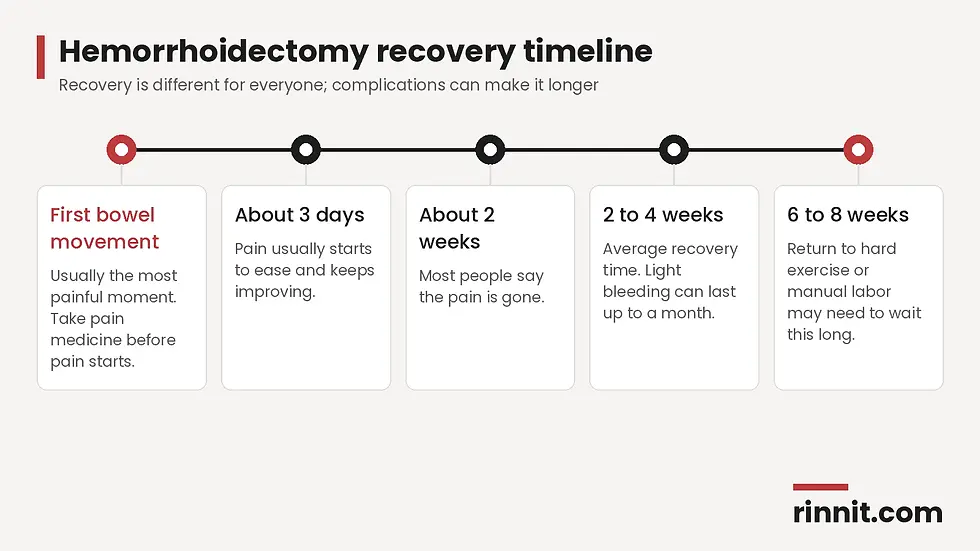
Recovery is different for everyone, but pain usually improves steadily over the first two weeks.
How painful is recovery?
On a pain scale of 1 to 10, pain after a hemorrhoidectomy is typically moderate to severe. The worst pain usually comes with the first bowel movement. Pain typically improves after about three days and keeps improving over the next two weeks. [1]
Some things raise the chance of more pain, including existing disease, infection, constipation and emergency surgery. Electrosurgery, local anesthesia, methylene blue injection and a glyceryl trinitrate (GTN) ointment applied to the area may reduce pain. [1]
Tips for easier bowel movements
Keeping stools soft protects the wound and reduces pain. [1]
Add fiber to your diet slowly and drink plenty of water.
Avoid spicy foods.
Unfiltered apple juice or prune juice may help.
Use laxatives as your provider advises.
Do not read on the toilet.
Use a step stool to raise your feet.
Use gentle wipes.
Apply lidocaine cream before a bowel movement.
If constipation is a long-standing problem for you, our guide to constipation explains causes and treatment.
Helping the wound heal
These steps support healing at home: [1]
Sitz baths: Soak your bottom in 3 to 4 inches of warm water a few times a day.
Ice: Apply a towel-wrapped ice pack for about 10 minutes at a time, a few times a day.
Pain medicine: Use the oral and topical pain relievers your provider prescribes.
Rest: Avoid returning to normal activities too quickly.
Prevent constipation: Keep stools soft while you heal.
Long-term habits: Healthy bowel habits help prevent new hemorrhoids.
What are the benefits and risks of a hemorrhoidectomy?
The main benefit is lasting relief. Hemorrhoids that are surgically removed generally do not come back, and surgery is also an option for urgent problems such as thrombosed or strangulated hemorrhoids. The trade-off is that recovery takes longer than with other hemorrhoid treatments. [1] Research also shows that traditional removal keeps hemorrhoids away better than the stapled method. [2] [3]
Like any surgery, a hemorrhoidectomy carries risks: [1]
Risk | What it means |
Blood clots | Clots can form after surgery |
Reaction to anesthesia | A bad reaction to the medicine used during surgery |
Wound infection | Germs enter the wound, which may become red and hot |
Excessive bleeding | More bleeding than expected, including a rare bleed after surgery |
Slow healing | The wound takes longer than expected to heal |
Urinary retention | Pain makes it hard to pass urine |
Constipation | Pain makes it hard to have a bowel movement |
Anal stenosis | Scarring narrows the anus |
Fecal incontinence | Damage to muscles or nerves affects bowel control |
Source: [1]
Serious complications are described as rare when the surgery is done carefully. [1] Narrowing of the anus after surgery is explained in our guide to anal stenosis.
When should you call a doctor after a hemorrhoidectomy?
Your provider will schedule a follow-up visit a few weeks after surgery. Contact them sooner if you have: [1]
Fever
Heavy bleeding
Pain that is severe or not controlled by medicine
Pain that lasts more than two weeks
A wound that is red and hot
Trouble urinating or having a bowel movement
Conclusion
A hemorrhoidectomy removes hemorrhoids that cause complications or keep coming back after other treatments. The operation is short, but recovery takes time and can be painful, especially in the first few days. [1]
The good news is that recovery is temporary, while hemorrhoid symptoms can be ongoing, and removed hemorrhoids generally do not return. Talk with your care team about whether surgery or a less invasive treatment suits you best. [1]
Keep learning: Read our guides to hemorrhoid banding and anal fissures. For more on all hemorrhoid treatment options, see this guide to treating hemorrhoids.
FAQ
What is a hemorrhoidectomy?
A hemorrhoidectomy is surgery to remove hemorrhoids, the enlarged blood vessels in the anus that can cause pain and bleeding. The surgeon removes the affected tissue and seals the blood vessels. [1]
Who needs a hemorrhoidectomy?
It may be needed for hemorrhoids that prolapse, clot (thrombosis), get trapped and lose their blood supply (strangulation), or keep coming back after less invasive treatments. [1]
Is a hemorrhoidectomy major surgery?
The operation itself is short and not very complicated, but recovery can take two to eight weeks and varies from person to person. [1]
Do you go home the same day after a hemorrhoidectomy?
Usually, yes. Most people go home on the day of surgery, but someone else needs to drive them. [1]
How painful is recovery after a hemorrhoidectomy?
Pain is usually moderate to severe. The first bowel movement is often the most painful, pain usually improves after about three days, and most people say it is gone by about two weeks. [1]
How long does it take to recover from a hemorrhoidectomy?
Average recovery is two to four weeks. You may need to wait six to eight weeks before strenuous exercise or manual labor. [1]
Is bleeding normal after a hemorrhoidectomy?
Some bleeding is normal, especially with bowel movements, and it can last up to a month. It should not be heavy, so call your provider if it is. [1]
How can I make bowel movements easier after surgery?
Add fiber slowly, drink plenty of water, avoid spicy foods, use laxatives as advised, raise your feet on a step stool and apply lidocaine cream before a bowel movement. [1]
What are the risks of a hemorrhoidectomy?
Risks include blood clots, anesthesia reactions, infection, heavy bleeding, slow healing, trouble urinating, constipation and, rarely, narrowing of the anus or loss of bowel control. [1]
Do hemorrhoids come back after a hemorrhoidectomy?
Hemorrhoids that are surgically removed generally do not come back. Surgery succeeds about 95% of the time when other treatments have failed. [1]
When should I call a doctor after a hemorrhoidectomy?
Call your provider for fever, heavy bleeding, pain that is not controlled or lasts beyond two weeks, a red and hot wound, or trouble urinating or having a bowel movement. [1]
How do I prepare for a hemorrhoidectomy?
Your surgeon reviews the risks and benefits and asks for your consent, tells you which medicines to stop, and asks you to stop eating and drinking eight hours before the procedure [1]. If you're constipated you may be given an enema, and you'll need someone to drive you home [1].
Related Reading
Pudendal Nerve Block: Uses, Procedure and Side Effects explains pudendal nerve blocks.
Sitz Bath: How to Take One, Benefits and Uses explains how a warm sitz bath eases pain and helps healing.
References
Cleveland Clinic. Hemorrhoidectomy: Surgery, Recovery & Complications. Cleveland Clinic. Last updated October 11, 2023. https://my.clevelandclinic.org/health/procedures/hemorrhoidectomy
Lumb KJ, Colquhoun PH, Malthaner RA, et al. Stapled versus conventional surgery for hemorrhoids. Cochrane Database Syst Rev. 2006;2006(4):CD005393. PMID 17054255. https://doi.org/10.1002/14651858.CD005393.pub2
Watson AJ, Cook J, Hudson J, et al. A pragmatic multicentre randomised controlled trial comparing stapled haemorrhoidopexy with traditional excisional surgery for haemorrhoidal disease: the eTHoS study. Health Technol Assess. 2017;21(70):1-224. PMID 29205150. https://doi.org/10.3310/hta21700
Nienhuijs S, de Hingh I. Conventional versus LigaSure hemorrhoidectomy for patients with symptomatic Hemorrhoids. Cochrane Database Syst Rev. 2009;2009(1):CD006761. PMID 19160300. https://doi.org/10.1002/14651858.CD006761.pub2
Medical disclaimer
This article is for general education only and does not replace advice from a qualified healthcare professional. Talk to your doctor about your own diagnosis and treatment, and seek emergency care right away for severe or sudden symptoms.



Comments