Dry Macular Degeneration: Complete Guide to Symptoms, Causes & Treatment

Updated: 2 days ago
Medically reviewed by Dr. Baraa Alnahhal, MD · Last reviewed: October 2026
Quick Answer
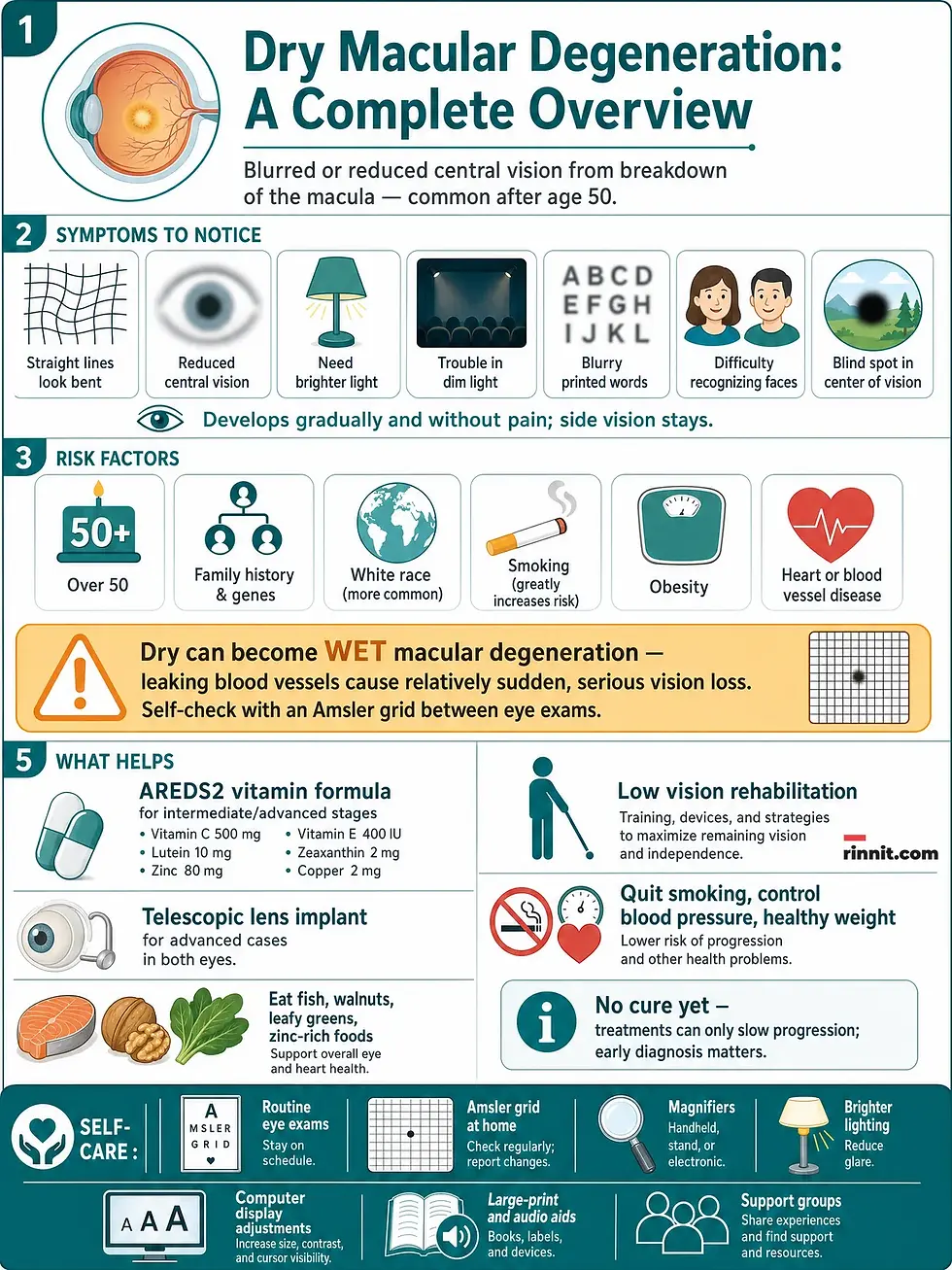
Dry macular degeneration (dry AMD) is an eye condition that blurs or reduces central vision as the macula, the center of the retina, breaks down. It is common after 50, develops gradually and painlessly, and spares side vision. Damage cannot be reversed, but AREDS2 supplements, not smoking and eye exams can slow it. It can become the dangerous wet form.
What the research says
Adding lutein, zeaxanthin, or fish oil to the standard vitamin formula did not significantly slow progression. In AREDS2, 4,203 people aged 50 to 85 at risk of advanced AMD were followed for a median of 5 years; 5-year progression to advanced AMD was 31% with placebo, 29% with lutein + zeaxanthin, 31% with DHA + EPA, and 30% with both (lutein + zeaxanthin hazard ratio 0.90, 98.7% CI 0.76–1.07), while beta carotene was linked to more lung cancers (23 [2.0%] vs 11 [0.9%]), mostly in former smokers — so lutein + zeaxanthin was suggested as a substitute for it. (AREDS2 Research Group, JAMA, 2013) [3]
Antioxidant multivitamins modestly lower the chance of reaching late AMD. A Cochrane review of 19 trials found moderate-certainty evidence that people with AMD taking antioxidant vitamin and mineral supplements were less likely to progress to late AMD (odds ratio 0.72, 95% CI 0.58–0.90; 2,445 participants, 3 trials), mostly from the original AREDS trial, while lutein and zeaxanthin on their own showed similar or slightly reduced risk (relative risk 0.94, 95% CI 0.87–1.01; low-certainty evidence). (Evans and Lawrenson, Cochrane Database Syst Rev, 2017) [4]
Age, smoking, and drusen predict who is likelier to get worse. A meta-analysis of 18 cohort studies (38,697 people) found higher odds of AMD with each 5 years of age (odds ratio 1.14, 95% CI 1.09–1.19), with current smoking (1.28, 95% CI 1.07–1.52), and with drusen covering more than 10% of the grid (7.85, 95% CI 4.66–13.23). (Tian and Zhang, Front Med, 2025) [5]
Dry Macular Degeneration at a Glance
At a Glance | Details |
What it is | An eye condition causing blurred or reduced central vision from breakdown of the macula |
Who it affects | Common in people over 50; may start in one eye or both |
How it develops | Gradually, without pain, over years |
What's affected | Central vision only — side vision is preserved |
Total blindness? | No — vision loss is typically central; some people have only mild loss |
Can it worsen? | Yes — can progress to wet macular degeneration, which threatens serious vision loss |
Main risk factors | Age over 50, family history, smoking, obesity, cardiovascular disease |
Diagnosis | Dilated eye exam, drusen check, Amsler grid, angiography, OCT imaging |
Treatment | No reversal; AREDS2 supplements, lifestyle changes, low vision rehab, telescopic lens implant |
Outlook | Early detection + self-care may delay vision loss |
What Is Dry Macular Degeneration?
Dry macular degeneration is an eye condition that causes blurred vision or reduced central vision. It's caused by the breakdown of the macula — the area of the retina at the back of the eye responsible for clear vision in the direct line of sight. The condition is common among people over 50.
It may start in one eye and later develop in the other, or appear in both eyes at the same time. Over time, vision may worsen and affect everyday activities such as reading, driving, and recognizing faces. Importantly, having dry macular degeneration doesn't mean you'll lose all your sight: vision loss is typically central, and people retain their side vision. Some people experience only mild central vision loss; in others it can be more severe.
Early detection and self-care measures may delay vision loss — which is why understanding the symptoms matters.
Understanding the Macula
To understand this condition, a quick anatomy lesson helps. The macula is located at the back of the eye, in the center of the retina. A healthy macula allows for clear central vision. It's made up of densely packed light-sensitive cells: cones, which give the eye color vision, and rods, which let the eye see shades of gray.
As dry macular degeneration develops, tissue in the macula may thin and lose the cells responsible for vision. Yellow deposits called drusen form under the retina — and people with macular degeneration often have many of them.

Symptoms: The 7 Changes to Notice
Symptoms usually develop gradually and without pain. They may include:
Symptom | What You Notice |
Visual distortions | Straight lines seem bent |
Reduced central vision | In one or both eyes |
Need for brighter light | When reading or doing close-up work |
Trouble in dim light | Increased difficulty adapting — such as entering a dimly lit restaurant or theater |
Blurry printed words | Increasing blurriness of text |
Difficulty recognizing faces | Faces become hard to make out |
A blind spot | A well-defined blurry spot in the center of your field of vision |
Dry macular degeneration can affect one or both eyes. If only one eye is affected, you may not notice any changes — the good eye compensates for the affected one. And because the condition doesn't affect side vision, it does not cause total blindness.
Dry vs. Wet: The Warning You Shouldn't Ignore
Dry macular degeneration is one of two types of age-related macular degeneration. The distinction matters enormously:
Feature | Dry AMD | Wet AMD |
How common | More common | Less common |
Speed | Progresses slowly over years | Relatively sudden change in vision |
Mechanism | Macula tissue thins, cells lost | Blood vessels grow and leak under the retina |
Vision loss | Usually gradual, typically central | Serious vision loss — complete if left untreated |
Treatment | Slow progression; no reversal | Can be treated with medicines |
This is the key message: dry AMD can progress to wet AMD, and wet AMD can quickly cause complete vision loss if left untreated. Regular self-checks with an Amsler grid between eye exams help tell you if the change has happened — because the wet form is treatable.
When to See a Doctor
See your eye care professional if you notice changes, distortion, or blind spots in your central vision, or if you lose the ability to see fine detail. These changes may be the first sign of macular degeneration — particularly if you're over age 60.
Causes: What We Know
No one knows exactly what causes dry macular degeneration. Research suggests it may be a combination of genes and other factors, including smoking, obesity, and diet.
The condition develops as the eye ages. Over time, the tissue in the macula may thin and lose the cells responsible for vision — and yellow drusen deposits accumulate under the retina.
Risk Factors
Risk Factor | How It Raises Risk |
Age | Most common in people over 50 |
Family history and genetics | The disease has a hereditary component — it runs in families; several genes have been identified |
Race | More common in white people |
Smoking | Cigarettes or regular tobacco smoke exposure greatly increases risk |
Obesity | May increase the chance that early or intermediate AMD progresses to the serious form |
Cardiovascular disease | Heart or blood vessel disease raises risk |
Complications
The complications extend beyond the eye itself. People whose dry AMD has progressed to central vision loss face a higher risk of depression and social isolation. With profound vision loss, people may experience visual hallucinations — a condition called Charles Bonnet syndrome. And as covered above, the disease may progress to wet macular degeneration, which can quickly cause complete vision loss if left untreated.
Diagnosis: Five Tools Eye Doctors Use
An eye care professional may diagnose dry macular degeneration by reviewing medical and family history and doing a complete eye exam. Other tests may follow:
Test | What Happens | What It Reveals |
Examination of the back of the eye | Drops dilate the pupils; a special tool examines the back of the eye | The mottled appearance from drusen — yellow deposits under the retina; people with AMD often have many |
Amsler grid | A grid test for changes in the center of the vision field | Straight lines look faded, broken, or distorted if AMD is present |
Fluorescein angiography | A dye is injected into an arm vein and travels to highlight the eye's blood vessels; a special camera photographs the journey | Retinal or blood vessel changes |
Indocyanine green angiography | Like fluorescein angiography, using a different injected dye | May identify specific types of AMD, used alongside fluorescein |
Optical coherence tomography (OCT) | Noninvasive imaging displays detailed cross sections of the retina | Areas of thinning, thickening, or swelling caused by fluid from leaking blood vessels |
The drusen pattern also tells the story of stage: yellow drusen deposits on color retinal photographs indicate early-stage dry AMD, while the advanced stage means the eye has lost the light-sensitive cells of the macula — known as atrophy.
Treatment: Slowing What Can't Be Reversed
There is no way to reverse damage from dry macular degeneration — but there are many clinical trials in progress. If the condition is diagnosed early, you can take steps to help slow its progression: vitamin supplements, eating healthy, and not smoking.
Vitamin Supplements (AREDS2)
For people with intermediate or advanced disease, a high-dose formulation of antioxidant vitamins and minerals may help reduce the risk of vision loss. Research from the Age-Related Eye Disease Study 2 (AREDS2) supports a formulation containing:
Nutrient | Dose |
Vitamin C | 500 mg |
Vitamin E | 400 IU |
Lutein | 10 mg |
Zeaxanthin | 2 mg |
Zinc (as zinc oxide) | 80 mg |
Copper (as cupric oxide) | 2 mg |
Important nuance: the evidence doesn't show benefit from these supplements in early-stage dry AMD. Ask your eye doctor if supplements are right for you.
Low Vision Rehabilitation
Dry AMD doesn't affect side vision and typically doesn't cause total blindness — but it can reduce or eliminate the central vision needed to read, drive, and recognize faces. A low vision rehabilitation specialist, occupational therapist, or trained eye doctor can help you find ways to adapt to changing vision.
Telescopic Lens Implant
For some people with advanced dry AMD in both eyes, an option to improve vision is surgery to implant a telescopic lens in one eye. The lens — which looks like a tiny plastic tube — magnifies your field of vision and may improve both distance and close-up vision. It has a very narrow field of view, making it useful in urban settings as an aid for seeing street signs.
Lifestyle and Home Remedies
Even after diagnosis, these steps may help slow vision loss:
Don't smoke. If you smoke, ask a healthcare professional for help quitting.
Choose a healthy diet. The antioxidant vitamins in fruits and vegetables contribute to eye health — kale, spinach, broccoli, squash, and other vegetables are high in lutein and zeaxanthin, nutrients that may benefit people with AMD. Zinc-rich foods — beef, pork, lamb, milk, cheese, yogurt, whole-grain cereals, whole-wheat bread — may also help. Healthy unsaturated fat like olive oil is a good choice, and research shows a diet high in omega-3 fatty acids (salmon, tuna, walnuts) may lower the risk of advanced AMD. But the same benefit is not shown from omega-3 supplements like fish oil pills.
Manage your other medical conditions. If you have cardiovascular disease or high blood pressure, take your medicine and follow your team's instructions.
Maintain a healthy weight and exercise regularly. If you need to lose weight, reduce calories and increase daily exercise.
Have routine eye exams. Ask your eye doctor about the recommended schedule, and between checkups do a self-assessment with an Amsler grid — the step that helps catch the shift to treatable wet AMD.
Coping and Support: Adapting Daily Life
Living with changing vision involves practical adaptation:
Adaptation | Practical Steps |
Eyeglasses | Keep your prescription current; if new glasses don't help, ask for a referral to a low vision specialist |
Magnifiers | Hand-held lenses, lenses worn like glasses, or a closed-circuit TV system that projects magnified reading material on a screen |
Computer adjustments | Increase font size, add contrast, add speech-output systems or assistive technologies |
Reading aids and voice interfaces | Large-print books, tablet apps for low vision, audiobooks, voice recognition features |
Special appliances | Clocks, radios, and phones with extra-large numbers; a larger high-definition TV; sit closer to the screen |
Brighter home lighting | Helps with reading and daily activities, and may reduce fall risk |
Transportation | Check with your doctor whether it's safe to drive; be extra cautious at night, in heavy traffic, or bad weather; use public transportation, family help, shuttle services, volunteer driving networks, or ride-sharing |
Emotional support | Talk to a counselor, join a support group, and spend time with supportive family and friends |
Prevention
Routine eye exams are the foundation for identifying early signs. Beyond that, five measures may reduce the risk of developing dry macular degeneration:
Manage all medical conditions — control cardiovascular disease and high blood pressure with your healthcare team.
Don't smoke — smokers are more likely to develop AMD; ask for help quitting.
Maintain a healthy weight and exercise regularly.
Choose a diet rich in fruits and vegetables — their antioxidant vitamins reduce risk.
Include fish in your diet — omega-3 fatty acids (also in walnuts) may reduce risk.
Preparing for Your Appointment
You'll likely need a dilated eye exam, so make an appointment with an eye care specialist — an optometrist or an ophthalmologist.
What You Can Do
Before your appointment: ask whether you need to do anything to prepare; list any symptoms, including those that seem unrelated; list all medicines, vitamins, and supplements with doses; bring a family member or friend — pupils will be dilated and vision affected afterward, so you may need a driver; and write down your questions.
Questions to Ask Your Eye Doctor
Do I have dry or wet macular degeneration?
How advanced is my macular degeneration?
Is it safe for me to drive?
Will I experience further vision loss?
Can my condition be treated?
Will taking a vitamin or mineral supplement help prevent further vision loss?
What's the best way to monitor my vision for changes?
What changes in my symptoms should I call you about?
What low vision aids might be helpful to me?
What lifestyle changes can I make to protect my vision?
What Your Doctor Will Ask
Be ready to answer: When did you first notice your vision problem? Does it affect one or both eyes? Do you have trouble seeing near, at a distance, or both? Do you smoke or did you ever smoke — how much? What types of foods do you eat? Do you have other medical conditions, such as high cholesterol, high blood pressure, or diabetes? Do you have a family history of macular degeneration?
Frequently Asked Questions (FAQ)
What is dry macular degeneration?
Dry macular degeneration is an eye condition that causes blurred or reduced central vision due to the breakdown of the macula, the center of the retina responsible for clear central vision. It's common in people over 50.
What causes dry macular degeneration?
No one knows exactly. Research suggests a combination of genes and other factors — including smoking, obesity, and diet. The condition develops as the eye ages, and tissue in the macula thins and loses the cells responsible for vision.
What are the early symptoms?
Symptoms develop gradually and without pain: straight lines look bent, central vision is reduced, you need brighter light for reading, dim light becomes harder to handle, printed words blur, faces are hard to recognize, or a well-defined blind spot appears in your central vision.
Does dry macular degeneration cause blindness?
No. Vision loss is typically central, and people retain their side vision. Some experience only mild central vision loss. However, the condition can progress to wet AMD, which can quickly cause serious vision loss if untreated.
What is the difference between dry and wet AMD?
Dry AMD is more common and progresses slowly over years. Wet AMD happens when blood vessels grow and leak under the retina, causing a relatively sudden change in vision and serious vision loss — but it can be treated with medicines.
How is dry AMD treated?
Damage cannot be reversed. For intermediate or advanced disease, AREDS2 vitamin supplements may reduce the risk of vision loss. Low vision rehabilitation, lifestyle changes (no smoking, healthy diet, exercise), and telescopic lens implants for some advanced cases can help. Routine eye exams and Amsler grid self-checks are essential.
Conclusion
Three lessons anchor this guide: the macula is your vision's center stage — when it thins, the blur falls exactly where you need it most (reading, driving, faces), while side vision quietly endures; slow doesn't mean harmless — dry AMD drifts over years but can transform into wet AMD, whose leaking blood vessels cause sudden, severe vision loss, making the Amsler grid your at-home early alarm; and slowing is the winning move — no treatment reverses the damage, but AREDS2 supplements for the right stage, a smoke-free and omega-3-rich life, blood pressure control, and routine eye exams can meaningfully delay vision loss.
This guide walked you through what dry AMD is, the macula's anatomy, all seven symptoms, the dry-vs-wet comparison that could save your sight, the five diagnostic tests, every treatment and lifestyle lever, and the full list of coping tools for daily life. If you're over 50 and notice any central vision change, the single most important step is a dilated eye exam — because early detection is what makes everything else possible.
What to do next: If you found this guide useful, explore more in-depth health guides on rinnit.com — including our guide to acne, which also covers how visible changes affect daily confidence and self-care.
Your Next Steps
Share your thoughts — leave a comment below and tell us what topics you'd like covered next.
Stay updated — sign up on rinnit.com to receive new guides as they're published.
This content is provided for general informational purposes only and is not a substitute for professional medical advice, diagnosis, or treatment. Always seek the advice of a qualified healthcare provider with any questions about a medical condition.
Related Reading
Amsler Grid Eye Test: How to Check Your Central Vision at Home explains the at-home grid used to check central vision.
Fluorescein Angiography: How the Eye Dye Test Works, How to Prepare and What Results Mean explains the eye dye test that shows changes in the retina's blood vessels.
Visual Field Test: Types, What to Expect and What Results Mean explains the test that maps your side vision.
Optical Coherence Tomography (OCT) Eye Test: What It Shows and What to Expect explains the eye scan used to image the retina and optic nerve.
Fundus Photography: What It Shows, What to Expect and Who Needs It explains the eye photos used to check the retina and optic nerve.
References
Mayo Clinic Staff. Dry macular degeneration - Symptoms and causes. Mayo Clinic. December 6, 2024. https://www.mayoclinic.org/diseases-conditions/dry-macular-degeneration/symptoms-causes/syc-20350375
Mayo Clinic Staff. Dry macular degeneration - Diagnosis and treatment. Mayo Clinic. December 6, 2024. https://www.mayoclinic.org/diseases-conditions/dry-macular-degeneration/diagnosis-treatment/drc-20350381
Age-Related Eye Disease Study 2 Research Group. Lutein + zeaxanthin and omega-3 fatty acids for age-related macular degeneration: the Age-Related Eye Disease Study 2 (AREDS2) randomized clinical trial. JAMA. 2013;309(19):2005-15. PMID 23644932. https://doi.org/10.1001/jama.2013.4997
Evans JR, et al. Antioxidant vitamin and mineral supplements for slowing the progression of age-related macular degeneration. Cochrane Database Syst Rev. 2017;7(7):CD000254. PMID 28756618. https://doi.org/10.1002/14651858.CD000254.pub4
Tian M, et al. Identification of risk factors for the progression of age-related macular degeneration: a systematic review and meta-analysis of cohort studies. Front Med (Lausanne). 2025;12:1544765. PMID 40771483. https://doi.org/10.3389/fmed.2025.1544765



Comments