Amsler Grid Eye Test: How to Check Your Central Vision at Home

Updated: 2 days ago
Written and medically reviewed by Dr. Baraa Alnahhal, MD · Last reviewed: November 2026 · How we review
Quick Answer
The Amsler grid is a chart of straight lines with a dot in the center that helps you check your central vision at home. It's used mainly by people with macular degeneration. Cover one eye at a time and stare at the dot. If any lines look wavy, blurry, faded or missing, call your eye specialist right away.
What the research says
The grid is easy to use but misses some changes: a meta-analysis of 10 studies (1,890 eyes) found the Amsler grid detected neovascular (wet) macular degeneration with a sensitivity of 67% to 71%; the authors advise that people at risk keep regular eye exams no matter what their Amsler results show (Bjerager J et al., JAMA Ophthalmology, 2023) [2]
Newer home monitoring is being tested: the HOME study, a multicenter randomized trial, was designed to test whether a home device using preferential hyperacuity perimetry with telemonitoring could detect wet AMD earlier, with better vision at diagnosis, than standard self-monitoring (Chew EY et al., Contemporary Clinical Trials, 2014) [3]
Key takeaways
The Amsler grid checks your central vision for distortion or missing areas.
It's used mainly for macular degeneration and other macular conditions.
Test one eye at a time at normal reading distance, wearing your glasses.
Wavy, blurry, dark or missing lines need a prompt call to your eye specialist.
It doesn't replace regular eye exams.
What is the Amsler grid?
The grid is a 10 cm square divided into 20 boxes on each side, with a central dot. Because the macula handles what you look at directly, changes in it can make straight lines look bent, faded or partly missing. Checking the grid regularly helps you notice these changes early, when treatment may help most. Sources: [1, 2]
Who should use it
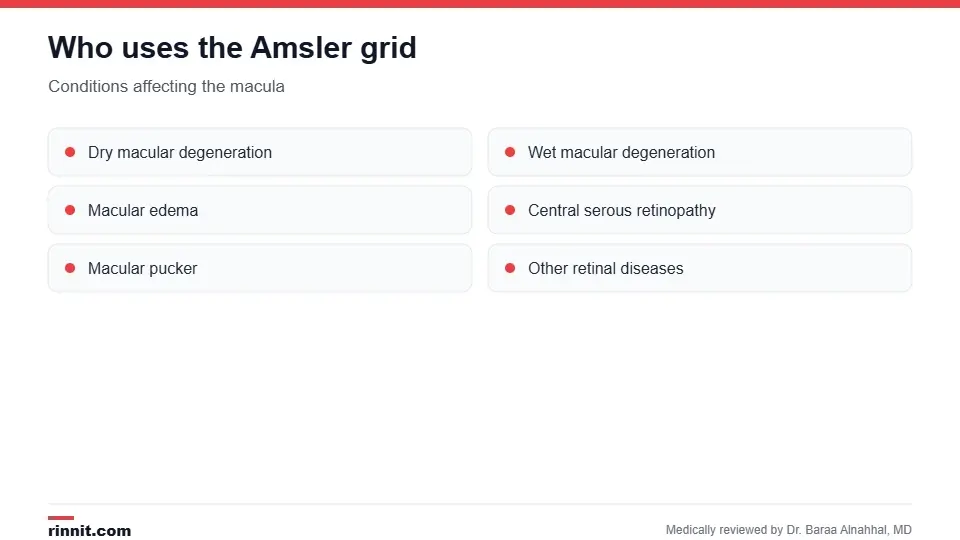
Your eye specialist will tell you if you should use it.
Dry or wet macular degeneration.
Macular edema, including diabetes-related macular edema.
Central serous retinopathy and abnormal new blood vessel growth.
Blind spots, injury-related macular damage, some pituitary tumors and other retinal diseases. Sources: [1]
How to use the Amsler grid
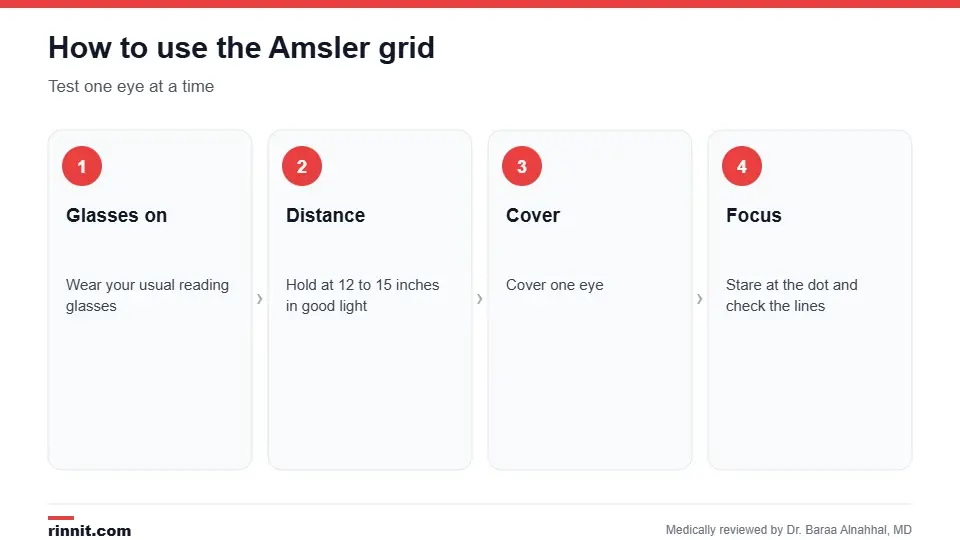
Use the same distance and lighting each time.
Wear your usual reading glasses or contacts.
Hold the grid 12 to 15 inches (30 to 38 cm) from your eyes, at the same distance each time, in good light.
Cover one eye.
Look only at the center dot and, without moving your eye, check that all four corners are visible and all lines are straight, solid and clear, with no dark or blank areas.
Repeat with the other eye. Sources: [1]
Warning signs
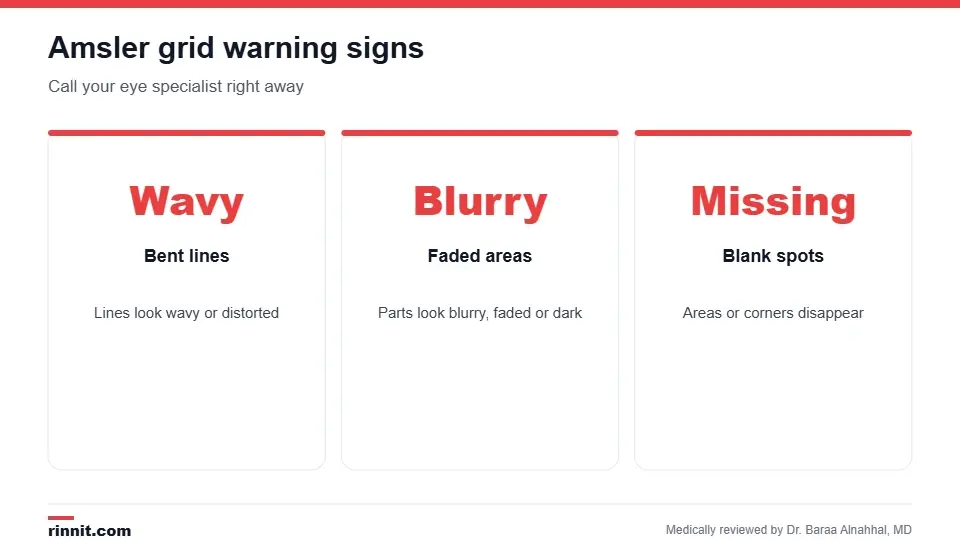
Any new change needs a prompt call to your eye specialist.
Wavy, bent or blurry lines.
Faded or darker areas.
Blank or missing areas.
Not being able to see all four corners. Sources: [1]
If you notice any of these, call your eye specialist right away. Sudden changes may need urgent treatment, especially in wet macular degeneration. Phone and tablet Amsler apps exist, but check with your specialist before relying on one. Sources: [1, 2]
Limits of the test
The Amsler grid is easy and inexpensive, but it can miss changes, especially if you have one strong eye that compensates. That's why regular eye exams and imaging such as retinal imaging remain important. Sources: [2, 3]
Conclusion
The Amsler grid is a quick daily check that helps you catch macular changes early. Use it the same way each time, and call your eye specialist promptly if anything looks different.
Keep learning: read about macular degeneration and the eye exam.
Frequently asked questions
What is the Amsler grid used for?
To check central vision for distortion or missing areas.
Who should use an Amsler grid?
Mainly people with macular degeneration or other macular conditions.
How often should I use it?
Often daily, as your eye specialist advises.
How far away should I hold it?
About 12 to 15 inches, at normal reading distance.
Should I wear my glasses?
Yes, wear your usual reading glasses or contacts.
Why test one eye at a time?
A healthy eye can hide changes in the other.
What is an abnormal result?
Wavy, blurry, faded, dark or missing lines.
What should I do if the grid looks different?
Call your eye specialist right away.
Can I use an app instead?
Ask your eye specialist first.
Does the Amsler grid replace eye exams?
No. Regular exams are still needed.
Related Reading
Dry Macular Degeneration: Complete Guide to Symptoms, Causes & Treatment the main condition the grid helps monitor.
Geographic Atrophy: Understanding Advanced Dry Macular Degeneration an advanced form of dry macular degeneration.
Epiretinal Membrane (Macular Pucker): Symptoms, Causes, Diagnosis, Treatment and Outlook — What You Need to Know a macular condition that distorts vision.
Eye Exam: What Happens, Tests Included and How Often to Go the regular checkup you still need.
Retinal Imaging: Fundus Photos, OCT and Angiography Explained photos and scans of the retina.
References
Cleveland Clinic. Amsler Grid Eye Test: What It Is, Types & Uses. Cleveland Clinic. Last updated November 3, 2023. https://my.clevelandclinic.org/health/diagnostics/amsler-grid-eye-test
Bjerager J, Schneider M, Potapenko I, et al. Diagnostic accuracy of the Amsler grid test for detecting neovascular age-related macular degeneration: a systematic review and meta-analysis. JAMA Ophthalmology. 2023;141(4):315-323. PMID 36795396. https://doi.org/10.1001/jamaophthalmol.2022.6396
Chew EY, Clemons TE, Bressler SB, et al. Randomized trial of the ForeseeHome monitoring device for early detection of neovascular age-related macular degeneration. The HOme Monitoring of the Eye (HOME) study design - HOME Study report number 1. Contemporary Clinical Trials. 2014;37(2):294-300. PMID 24530651. https://doi.org/10.1016/j.cct.2014.02.003
Medical disclaimer
This article is for general education only and does not replace advice from a qualified healthcare professional. Talk to your doctor about your own diagnosis and treatment, and seek emergency care right away for severe or sudden symptoms.



Comments