Cystoid Macular Edema: What It Is, Symptoms, Causes, Diagnosis, Treatment and Outlook — What You Need to Know

Updated: 2 days ago
Medically reviewed by Dr. Baraa Alnahhal, MD · Last reviewed: September 2026

Quick answer
Cystoid macular edema is fluid swelling in the macula, the central part of the retina responsible for sharp central vision, color, and fine detail, that forms in cyst-like patterns. It often follows cataract surgery or other eye surgery and can also be caused by diabetes, retinal vein blockage, eye inflammation, injury, or certain medications. Untreated, it can cause vision loss, but treatment (eye drops, injections, lasers, or surgery) typically stabilizes vision and reverses damage.
TL;DR
Cystoid macular edema causes blurred, distorted, dim, or discolored central vision, though some people notice no symptoms at all. Treatment depends on the underlying cause, and with care, vision usually stabilizes and damage can be reversed.
What this guide can and cannot tell you: the clinical source behind this article contains no prevalence statistics or numerical data for this condition. None are presented here, and nothing is invented to fill the gap.
What is cystoid macular edema?
Cystoid macular edema is a type of swelling (edema) that happens in your macula. Your macula is the central part of your retina. It plays an important role in your sight because it is responsible for your central vision. It helps you see color and fine details, like individual bricks on buildings or leaves on trees.
Sometimes when your macula swells with fluid, it does so in cyst-like patterns (cystoid). Objects may appear blurry or wavy, especially in your central vision.
What are the symptoms of cystoid macular edema?
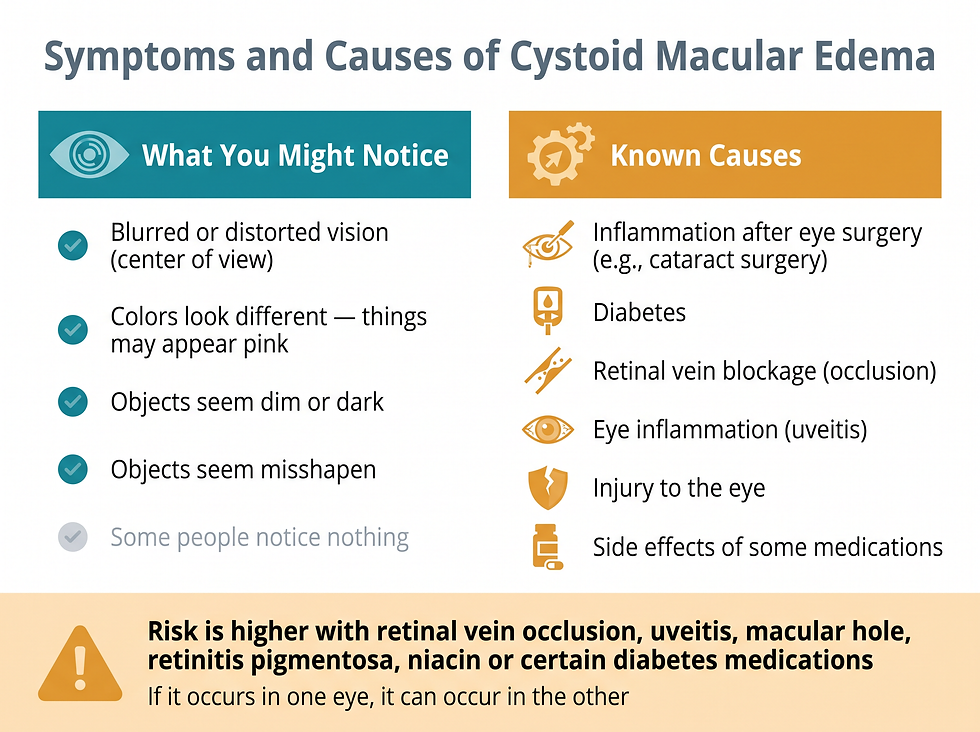
If you have cystoid macular edema, you might not notice any symptoms. Or you might notice changes in your vision.
Symptom | What it feels like |
Blurred or distorted vision | Typically in the middle of your field of view |
Color changes | Colors appear different than usual; things may look pink even when they are not |
Dim or dark objects | Objects seem dim, dark, or misshapen |
Because symptoms can be subtle or absent, regular eye exams matter, especially after eye surgery.
What causes cystoid macular edema?
There are many known causes of cystoid macular edema. These include inflammation after eye surgery (including cataract surgery and repair of a detached retina), diabetes, blockage in the veins of your retina (retinal vein occlusion), inflammation of your eye, injury to your eye, and side effects of medications.
Who is at higher risk?
Cystoid macular edema often develops after surgery for cataracts. You may be more at risk of developing it after surgery if you have certain medical conditions.
Risk factor | How it increases risk |
Retinal vein occlusion (RVO) | Vein blockage raises post-surgery risk |
Eye inflammation increases risk | |
Epiretinal membrane (macular pucker) | Retinal surface condition raises risk |
Macular hole | Macula defect increases risk |
Diabetes | Raises both development and post-surgery risk |
Retinitis pigmentosa | Inherited retinal condition raises risk |
Some medications, including vitamin B3 (niacin) and diabetes medications, can also increase your risk for cystoid macular edema. Also, if you have cystoid macular edema in one eye, you might get it in your other eye.
What are the complications of cystoid macular edema?
Untreated cystoid macular edema could lead to vision loss and low vision.
How is cystoid macular edema diagnosed?
Your provider may use one or more of these tests to diagnose cystoid macular edema:
Diagnostic test | What it does |
Dilated retinal exam | A special lens lets your provider see your macula and identify the cyst-like swelling |
Fluorescein angiography | A special camera system identifies leaking blood vessels and the cystoid macular edema that might come with it |
Optical coherence tomography (OCT) | A noninvasive test that uses a special light to create a high-resolution cross-sectional image of your retina; one of the best ways to diagnose cystoid macular edema |
How is cystoid macular edema treated?
Treatment depends on what is causing your cystoid macular edema. Only an eye care provider can recommend the right treatment. You may need to see a retina specialist, an ophthalmologist trained in retinal diseases. With treatment, your vision will likely improve.
Treatment option | What it does |
Anti-inflammatory eye drops | Steroidal or nonsteroidal drops reduce inflammation |
Vitreous injections | Medications injected into the eye's gel stop new blood vessels from forming and leaking |
Eye pressure drugs | May help the swelling decrease |
Laser treatment (photocoagulation) | Stops blood vessels from leaking |
Vitrectomy (surgery) | Removes the gel that fills your eye |
Do treatments have side effects?
The chance is low for complications or side effects related to treating cystoid macular edema, but risks always exist. There is a risk of bleeding or infection with injections. Injections can also cause eye redness and irritation. This may be from the injections themselves or the cleaning solution used to reduce the chance of infection before the injection.
How soon can I return to work after treatment?
Usually there are no restrictions after treatment. You do not have to wait to go back to work or school unless you have a vitrectomy. Recovering from a vitrectomy will take longer than other therapies. You may need to be off work for one to three weeks.

What is the outlook for cystoid macular edema?
If you have cystoid macular edema and get treatment, you will likely stabilize your vision and reverse damage. You will need to have regular appointments with your eye care provider. Without treatment, cystoid macular edema can cause worsening vision loss.
How can I reduce my risk?
You may be able to reduce your risk of developing cystoid macular edema by managing chronic conditions like diabetes and high blood pressure (hypertension), getting regular eye exams, quitting smoking, eating a nutritious diet, getting regular physical activity, and using protective eyewear when working or participating in sports to help prevent eye injury and the infections that can follow them.
Prevention step | Why it helps |
Manage diabetes and high blood pressure | Chronic conditions affect the eyes |
Get regular eye exams | Catch problems that develop quickly |
Quit smoking | Reduces eye disease risk |
Eat a nutritious diet | Supports overall eye health |
Get regular physical activity | Supports circulation and health |
Wear protective eyewear | Prevents eye injury and follow-on infections |
When should I see my healthcare provider?
It is important to follow the suggestions of your eye care provider if you have a medical condition that can affect your eyesight, including cystoid macular edema. Regular appointments will help you and your provider identify any issues that may develop quickly. Always contact your provider about any changes in your vision, such as blurred vision or distorted vision.
Emergency guidance: If you have any sudden loss of vision or a wound that punctures your eye, go to the emergency room. You need immediate medical care.
Good questions to ask your provider include: What do I need to know about cystoid macular edema? What treatment do you recommend? What are the side effects of this treatment? What can I expect in the future? Are there warning symptoms I should watch out for? What type of appointment schedule should I follow? Do you recommend any lifestyle changes? Do you recommend testing my family members for cystoid macular edema?
Conclusion: early detection and early treatment lead to the best results
Eye diseases can be frightening, but cystoid macular edema is highly treatable when caught early. The macula controls the sharpest, most detailed part of your vision, and when it swells with fluid in cyst-like patterns, central vision becomes blurry, wavy, dim, or discolored. The condition most often follows cataract or other eye surgery and is linked to diabetes, retinal vein blockage, eye inflammation, injury, and certain medications. With the right treatment, whether eye drops, injections, laser therapy, or vitrectomy, vision usually stabilizes and damage is often reversed. The essentials are: keep every eye exam appointment, report any vision change promptly, and go to the emergency room immediately for sudden vision loss or a puncture wound to the eye.
Your next step: if you have noticed blurred, wavy, dim, or discolored central vision, especially after cataract surgery, schedule an evaluation with your eye care provider. If you have sudden vision loss or an eye injury, seek emergency care right away.
Frequently asked questions
What is cystoid macular edema?
Cystoid macular edema is a type of swelling that happens in the macula, the central part of the retina responsible for central vision. The macula swells with fluid in cyst-like patterns.
What does cystoid macular edema do to your vision?
It typically blurs or distorts vision in the middle of your field of view. Objects may appear dim, dark, or misshapen, and colors may look different than usual.
Does cystoid macular edema always cause symptoms?
No. You might not notice any symptoms at all, which is why regular eye exams are important, especially after eye surgery.
Why do things look pink with cystoid macular edema?
The swelling can change how you perceive color, so objects may look pink even when they are not.
What causes cystoid macular edema?
Known causes include inflammation after eye surgery (including cataract surgery and detached retina repair), diabetes, retinal vein occlusion, eye inflammation, eye injury, and side effects of medications.
Is cystoid macular edema common after cataract surgery?
Cystoid macular edema often develops after surgery for cataracts.
What increases my risk of cystoid macular edema?
Risk increases if you have retinal vein occlusion, uveitis, epiretinal membrane (macular pucker), macular hole, diabetes, or retinitis pigmentosa. Vitamin B3 (niacin) and some diabetes medications also increase risk.
Can cystoid macular edema affect both eyes?
Yes. If you have cystoid macular edema in one eye, you might get it in your other eye. Keep all follow-up appointments.
Is cystoid macular edema dangerous?
Untreated cystoid macular edema could lead to vision loss and low vision. With treatment, vision usually stabilizes and damage can be reversed.
How is cystoid macular edema diagnosed?
Through a dilated retinal exam, fluorescein angiography to identify leaking blood vessels, and optical coherence tomography (OCT), one of the best diagnostic tools for this condition.
What is a dilated retinal exam?
Your provider uses a special lens to see your macula and identify cyst-like swelling.
What is optical coherence tomography (OCT)?
OCT is a noninvasive test that uses a special light to create a high-resolution cross-sectional image of tissues, including the retina.
How is cystoid macular edema treated?
Treatment depends on the underlying cause and may include anti-inflammatory eye drops, injections into the eye's gel (vitreous), drugs that treat eye pressure, laser treatment (photocoagulation), or vitrectomy surgery.
What do the injections for cystoid macular edema do?
Injected medications stop new blood vessels from forming and leaking.
Do the treatments have side effects?
The chance of complications is low, but risks include bleeding or infection with injections, and eye redness or irritation from the injections or the cleaning solution used beforehand.
When can I go back to work after treatment?
Usually there are no restrictions after treatment. The exception is vitrectomy, which may require one to three weeks off work.
Can cystoid macular edema be cured?
With treatment, you will likely stabilize your vision and reverse damage. Treatment depends on the underlying cause, and only an eye care provider can recommend the right approach.
What happens without treatment?
Without treatment, cystoid macular edema can cause worsening vision loss.
How can I prevent cystoid macular edema?
Manage chronic conditions like diabetes and high blood pressure, get regular eye exams, quit smoking, eat a nutritious diet, exercise regularly, and wear protective eyewear to prevent eye injury.
Can medications cause cystoid macular edema?
Yes. Vitamin B3 (niacin) and some diabetes medications can increase your risk.
Should my family be tested for cystoid macular edema?
It is a valid question to ask your provider. Risk is driven mainly by conditions and medications rather than heredity alone.
When should I go to the emergency room?
If you have any sudden loss of vision or a wound that punctures your eye, go to the emergency room immediately. You need immediate medical care.
What should I ask my eye care provider?
Ask what you need to know about the condition, what treatment is recommended, its side effects, what to expect in the future, warning symptoms to watch for, your appointment schedule, recommended lifestyle changes, and whether family members should be tested.
External references
Cleveland Clinic: Cystoid Macular Edema (primary source, medically reviewed, last updated Oct 16, 2023)
Disclaimer: This article is for general educational purposes only and does not constitute medical advice. It is based on a single referenced clinical source and should not replace professional diagnosis or treatment. If you have changes in your vision or have been diagnosed with cystoid macular edema, please consult a qualified eye care provider. If you experience sudden vision loss or an eye puncture wound, go to the emergency room immediately.
Comments