Epiretinal Membrane (Macular Pucker): Symptoms, Causes, Diagnosis, Treatment and Outlook — What You Need to Know

Updated: 2 days ago
Medically reviewed by Dr. Baraa Alnahhal, MD · Last reviewed: September 2026
Quick Answer: An epiretinal membrane (ERM) is a layer of wrinkled, bumpy scar tissue that forms on the macula — the part of the retina responsible for your central vision — which is why it is also called a macular pucker. The most common symptom is seeing distorted, wavy lines in the center of your vision (metamorphopsia), especially when looking at straight-edged objects. Most ERMs develop naturally with age as the gel inside the eye thins, usually in just one eye, and most do not need treatment. An eye doctor diagnoses it with a dilated eye exam, an Amsler grid test or OCT imaging. If needed, treatment ranges from new glasses and magnifying aids to surgery (vitrectomy), but it is rare for a macular pucker to cause blindness.
TL;DR: Epiretinal Membrane at a Glance
Epiretinal membrane is a small patch of puckered scar tissue on the retina's macula that distorts central vision. It is overwhelmingly an age-related change, is found in roughly 2 in 10 people over 75, and most often needs no treatment — only regular monitoring by an eye doctor. The main warning sign is wavy or distorted lines when looking at objects with straight edges.
Limitation statement: All prevalence and outcome figures in this article come directly from the source and its cited research. No additional statistics are provided or given here.
Fact | What the source says |
What it is | Wrinkled, bumpy scar tissue on the macula (also called macular pucker) |
Main cause | Natural aging — the eye's vitreous gel thins and no longer presses flat against the retina |
Most common symptom | Distorted, wavy lines in the center of vision (metamorphopsia) |
Usually affects | One eye; both eyes at once is less common |
Prevalence estimate | Around 2 in 10 people over 75 |
Treatment | Often none needed — monitoring; glasses, vision aids, or vitrectomy surgery if required |
Blindness risk | Rare |
Emergency signs | Sudden vision loss or severe eye pain → call 911 or go to the ER |
What Is an Epiretinal Membrane (ERM)?
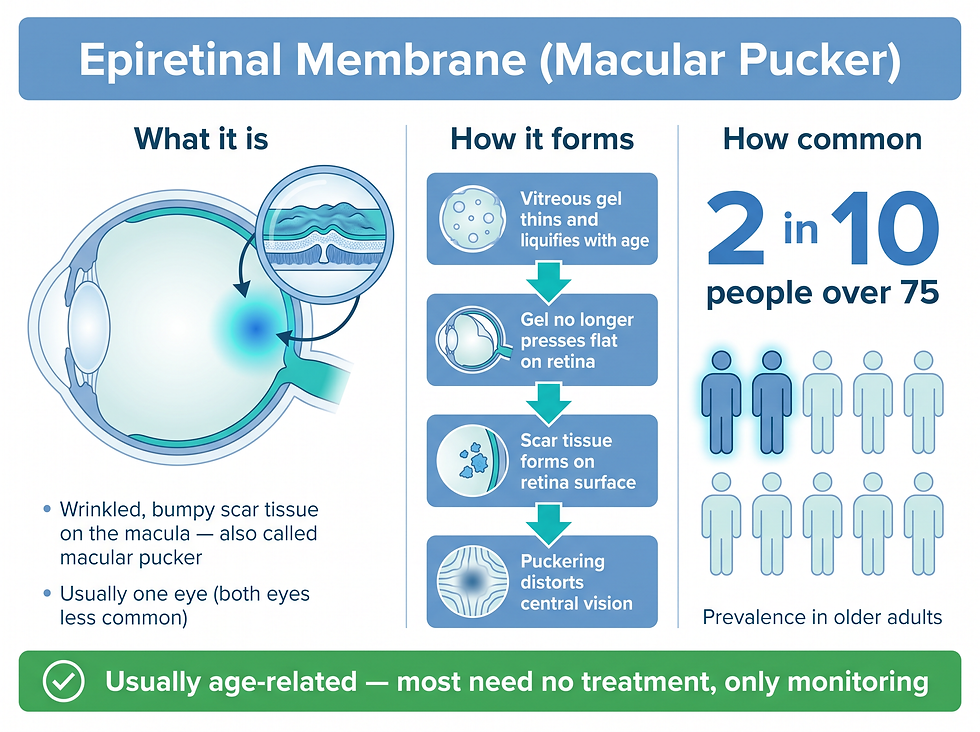
An epiretinal membrane (ERM) is a layer of wrinkled, bumpy tissue that forms on the retina in your eye. Eye doctors also call it macular pucker or scar tissue. An epiretinal membrane can affect your vision by causing distortion in what you see through that eye.
The retina is at the back of your eye. It contains special nerve cells that react to light. The macula is a small part of your retina that's responsible for what you see right in front of you. This is called your central vision.
ERMs usually form in only one of your eyes. But they can happen in both of your eyes at the same time. This is less common.
How does an epiretinal membrane form?
Most epiretinal membranes happen without a known cause. Healthcare providers call this idiopathic. They usually develop naturally as you age.
Your eyes are full of a gel called vitreous humor. Usually, the vitreous humor is pressed flat up against your retina. As you get older, the gel naturally thins out and becomes more like a liquid. As the gel liquifies, it might not press against your retina like it should. This can cause scar tissue to form on the surface of your retina. It causes the puckering that affects your vision.
How common is epiretinal membrane?
Your risk increases as you age. Epiretinal membranes are most common in people over 50. Experts estimate that around 2 in 10 people over 75 have an ERM.
What Are the Symptoms of an Epiretinal Membrane?
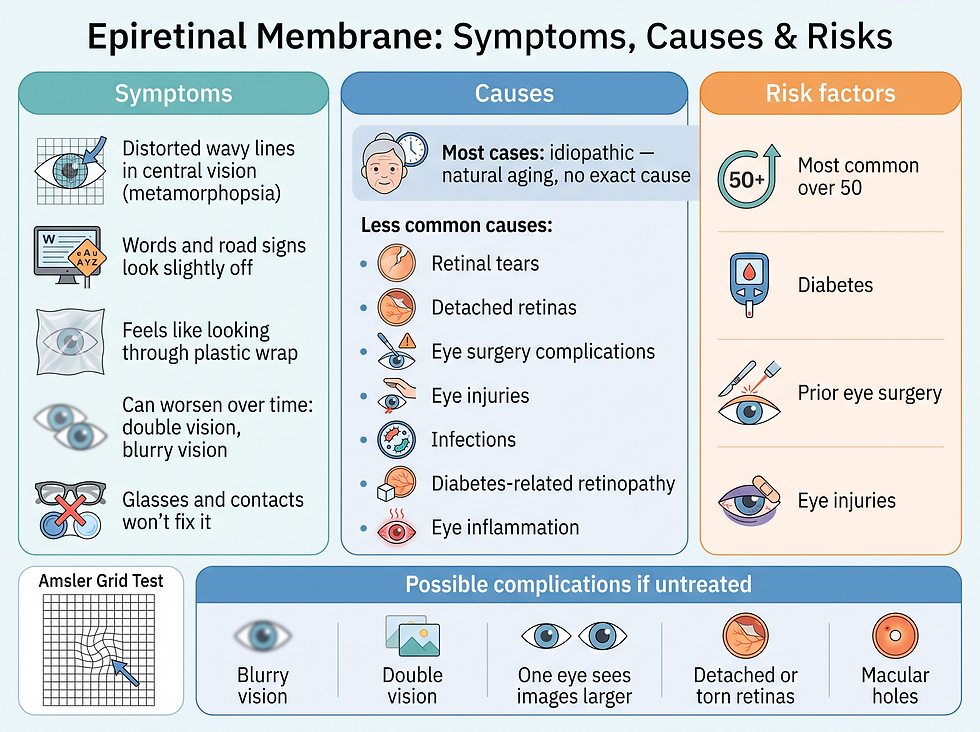
Seeing distorted, wavy lines in the center of your vision is the most common symptom of an epiretinal membrane. Eye doctors call this metamorphopsia. It'll be most noticeable when you're looking at something with straight lines. Words on a screen or symbols on road signs might look slightly off. It might feel like you're looking through plastic wrap or cellophane.
The distortion in your vision may get worse over time. At first, small details will look wavy or out of focus. If the ERM gets worse, it may start to affect your vision more noticeably. More severe epiretinal membranes can cause double vision and blurry vision. Wearing your glasses or contacts won't fix these issues.
Symptom | Details |
Distorted, wavy lines | Most common symptom — in the center of your vision (metamorphopsia) |
Slightly off appearance | Words on a screen or road signs look distorted |
Plastic wrap feeling | It might feel like you're looking through plastic wrap or cellophane |
Wavy or out-of-focus details | Small details blur or bend at first |
Double vision | Can occur with more severe membranes |
Blurry vision | Can occur with more severe membranes |
Can you have an epiretinal membrane without symptoms?
Some people don't notice vision changes from an ERM. Our brains are sometimes too good at adjusting to obstacles, and you might "get used" to having distorted vision. If this happens to you, your eye doctor will still be able to see and diagnose an epiretinal membrane.
What Causes Epiretinal Membranes?
Anything that damages your retina can also cause scar tissue to form on it. Most ERMs are idiopathic (no exact cause) and age-related, but secondary causes do occur:
Cause | Details |
Retinal tears | Damage that can trigger scar tissue |
Detached retinas | A medical emergency that can lead to puckering |
Complications from eye surgery | Surgery-related trauma to the retina |
Eye injuries | Physical damage to the eye |
Infections | Inflammatory damage to the retina |
Diabetes-related retinopathy | Blood vessel damage in the retina |
Eye inflammation | General inflammatory conditions |
These causes are less common. Macular pucker usually happens without an exact cause.
What are the risk factors for epiretinal membrane?
Risk factor | Details |
Age over 50 | Risk increases as you age; most common in this group |
Diabetes | Or any of the conditions that can cause an ERM |
Eye surgery | Having had eye surgery increases risk |
Eye injuries | Trauma listed above increases risk |
What complications can an untreated ERM cause?
Untreated epiretinal membranes can sometimes cause complications in your eyes and vision:
Complication | Details |
Blurry vision | Ongoing loss of sharpness |
Double vision | Images appear doubled |
Size difference between eyes | An image appearing larger in one eye than the other |
Detached or torn retinas | Serious structural damage |
Macular holes | A defect in the center of the retina |
How Is a Macular Pucker Diagnosed?
An eye doctor can diagnose an epiretinal membrane with a routine eye exam. Your eye doctor will dilate your eyes and look inside them to see your retinas. Tell your eye doctor when you first noticed changes in your vision, and let them know how quickly symptoms started or changed.
You might need a few other tests:
Test | What it does |
Dilated eye exam | The doctor looks inside your dilated eyes to see your retinas |
Amsler grid eye test | Checks for distorted vision — you look at a page of small squares formed by horizontal and vertical lines and tell your eye doctor if any lines look wavy or distorted |
Optical coherence tomography (OCT) | An imaging method that takes pictures of your retina |
What Are the Treatment Options for an Epiretinal Membrane?

You may not need any treatment for an ERM. It depends on how much it affects your vision and its cause. Your eye doctor will monitor it to make sure it doesn't change too much or increase your risk of complications.
If you do need treatment, options can include:
Treatment option | What it does |
New glasses or contacts | Can't correct the epiretinal membrane, but can help you see more clearly or compensate for changes in your eyes |
Vision aids | Magnifying devices to help you see more clearly; more lamps or a reading light to help you focus on screens or printed words |
Surgery (vitrectomy) | Suggested if you have a high risk of complications — an eye surgeon removes the membrane or scar tissue from your retina with a vitrectomy |
You might need treatments for the cause if a health condition or injury leads to an ERM. Your eye doctor will tell you what to expect.
What Is the Outlook for Macular Pucker?
Most ERMs don't need treatment. You'll need regular eye exams. Your eye doctor will monitor your eyes for any changes. This is the best way to catch warning signs of complications.
An epiretinal membrane might change your vision. But it's rare for it to cause blindness. You may have to adjust to the wavy appearance in your central vision. Your eye doctor can help you get used to any changes in your sight.
When Should You See Your Eye Doctor?
Visit an eye doctor if you notice any changes in your eyes or vision. See your eye doctor for regular eye exams as often as they suggest.
EMERGENCY: Go to the emergency room or call 911 (or your local emergency services number) if you suddenly lose your vision or have severe eye pain.
Clinical care-team note (verbatim from the source): "Finding out you have scar tissue inside your eye can be scary. But many cases of epiretinal membrane don't need treatment. Your eye doctor will discuss your options. They'll help you find the right ways to manage your eye health and any adjustments you need to make. It's important to get regular eye exams. Your eye doctor will tell you how often you'll need checkups. They'll tell you which changes or symptoms to watch out for, too. Don't hesitate to call your eye doctor if anything changes or feels off. The sooner you get eye issues examined, the better."
Conclusion: A Common, Usually Manageable Change in Aging Eyes
Epiretinal membrane — macular pucker — is a surprisingly common age-related change that turns your sharpest central vision slightly wavy. It usually forms in one eye, stems from the eye's natural aging process rather than disease, and most often never needs treatment beyond watchful monitoring. The reassuring statistics speak for themselves: around 2 in 10 people over 75 have one, and blindness is rare. The practical takeaway is vigilance, not alarm — because this condition is diagnosed with a simple dilated eye exam, an Amsler grid test or OCT imaging, catching it early is entirely within reach.
Take these three steps:
Watch for wavy lines — if straight-edged objects like words on a screen or road signs look bent or "through plastic wrap," book an eye exam rather than waiting.
Keep your eye appointments — most ERMs only need regular monitoring, and your eye doctor can catch warning signs before complications develop.
Know the emergencies — sudden vision loss or severe eye pain always warrants calling 911 or going to the emergency room.
This article provides general information and is not a substitute for professional medical advice. Always consult a qualified healthcare provider for diagnosis and treatment.
Frequently Asked Questions
What is an epiretinal membrane?
An epiretinal membrane (ERM) is a layer of wrinkled, bumpy tissue that forms on the retina in your eye. Eye doctors also call it macular pucker or scar tissue.
What is macular pucker?
Macular pucker is another name for an epiretinal membrane — wrinkled scar tissue on the macula, the small part of the retina responsible for central vision.
What does an epiretinal membrane feel like?
It might feel like you're looking through plastic wrap or cellophane.
What are the symptoms of macular pucker?
The most common symptom is seeing distorted, wavy lines in the center of your vision (metamorphopsia), especially with straight-edged objects like words on a screen or road signs.
What is metamorphopsia?
Metamorphopsia is what eye doctors call the distorted, wavy lines seen in the center of your vision — the most common symptom of an epiretinal membrane.
Does macular pucker affect one eye or both?
ERMs usually form in only one of your eyes. But they can happen in both eyes at the same time — this is less common.
Does epiretinal membrane get worse over time?
The distortion may get worse over time. At first, small details look wavy or out of focus. If the ERM gets worse, it may affect your vision more noticeably, causing double vision and blurry vision.
Do glasses fix an epiretinal membrane?
No. Wearing your glasses or contacts won't fix the distortion, double vision or blurriness caused by a more severe ERM.
Can you have an epiretinal membrane without knowing?
Yes. Some people don't notice vision changes because our brains adjust to obstacles — you might "get used" to distorted vision. Your eye doctor will still be able to see and diagnose it.
What causes an epiretinal membrane?
Most happen without a known cause (idiopathic) and develop naturally as you age. The eye's vitreous gel thins and liquifies, may stop pressing flat against the retina, and scar tissue forms, causing the puckering.
What is vitreous humor?
Vitreous humor is the gel that fills your eyes. It is usually pressed flat up against the retina, but as you age it thins and becomes more liquid, which can trigger scar tissue formation.
Can diabetes cause macular pucker?
Yes. Diabetes-related retinopathy is one of the conditions that can damage the retina and cause scar tissue to form.
Can eye surgery cause an epiretinal membrane?
Yes. Complications from eye surgery are one of the less common causes.
What else can cause an epiretinal membrane?
Retinal tears, detached retinas, eye injuries, infections and eye inflammation can all damage the retina and lead to scar tissue formation.
Who is most at risk for macular pucker?
Epiretinal membranes are most common in people over 50. Risk increases as you age.
How common is epiretinal membrane?
Experts estimate that around 2 in 10 people over 75 have an ERM.
Can an epiretinal membrane cause double vision?
Yes. More severe epiretinal membranes can cause double vision and blurry vision.
Can an untreated epiretinal membrane cause complications?
Yes. Complications can include blurry vision, double vision, an image appearing larger in one eye than the other, detached or torn retinas, and macular holes.
How is macular pucker diagnosed?
An eye doctor diagnoses it with a routine dilated eye exam, and may add an Amsler grid test or optical coherence tomography (OCT).
What is an Amsler grid test?
A test that checks for distorted vision. You look at a page of small squares formed by horizontal and vertical lines and tell your eye doctor if any lines look wavy or distorted.
What is optical coherence tomography?
OCT is an imaging method that takes pictures of your retina.
Does epiretinal membrane need treatment?
You may not need any treatment. It depends on how much the ERM affects your vision and its cause. Your eye doctor will monitor it to ensure it doesn't change too much or raise complication risk.
What are the treatment options for macular pucker?
Options include new glasses or contacts (which help you see more clearly but can't correct the membrane), vision aids like magnifying devices and reading lights, and surgery (vitrectomy) to remove the membrane if complication risk is high.
What is a vitrectomy?
A procedure in which an eye surgeon removes the membrane or scar tissue from your retina. It is suggested when you have a high risk of complications.
Can an epiretinal membrane cause blindness?
An epiretinal membrane might change your vision, but it's rare for it to cause blindness.
Do I need regular eye exams with macular pucker?
Yes. Regular eye exams are the best way to catch warning signs of complications. Your eye doctor will monitor your eyes for any changes.
When should I see an eye doctor for my vision?
Visit an eye doctor if you notice any changes in your eyes or vision, and go for regular eye exams as often as they suggest.
When is epiretinal membrane an emergency?
Go to the emergency room or call 911 (or your local emergency services number) if you suddenly lose your vision or have severe eye pain.
Is an epiretinal membrane the same as a detached retina?
No. A detached retina is a separate, serious condition that can itself be one of the causes of an epiretinal membrane — and is a potential complication of untreated ERM.
What should I do if lines look wavy in one eye?
Book an eye exam. The wavy-line distortion (metamorphopsia) is the hallmark symptom of an epiretinal membrane, and it is easily checked with a dilated exam and Amsler grid test.
Additional Resources
For further reading, these authoritative external references support the information above:
Content reviewed and produced following the Rinnit editorial framework. Last updated: September 28, 2026.
Comments