Cupping Therapy: How It Works, Types, Benefits, and Risks

Updated: 6 days ago
Written and medically reviewed by Dr. Baraa Alnahhal, MD · Last reviewed: October 2026 · How we review
Quick Answer: What is cupping therapy?
Cupping therapy is a traditional treatment in which cups placed on the skin create suction that pulls the skin upward and increases blood flow to the area. People mainly use it for back pain, neck pain and headaches. Evidence for its benefits is mixed, it leaves round bruise-like marks, and pregnant people and those with bleeding disorders should avoid it. [1][2]
What the research says
Cupping lowers pain scores in chronic muscle and joint pain, but not function. A meta-analysis of randomized trials found cupping reduced pain intensity in people with chronic musculoskeletal pain (standardized mean difference −1.17; moderate-quality evidence), but it did not improve physical disability or mental health. (Jia et al., BMJ Open, 2025)
Relief for low back pain looks short-term. Across 11 trials with 921 adults, cupping improved pain at the end of 2–8 weeks of treatment (effect size 1.09), but the benefit was not sustained at 1 month or at 3–6 months, and results varied widely between studies. (Zhang et al., Complementary Therapies in Medicine, 2024)
Most cupping studies are low quality. A review of 72 trials with 5,720 participants found reported benefits for pain, sleep and quality of life, but every trial carried a high risk of bias, and the evidence that side effects were less common than in comparison groups was rated low to very low. (Wang et al., Journal of Traditional Chinese Medicine, 2025)
Key takeaways
Cupping uses suction to lift the skin and draw blood toward the treated area.
It is mostly used for pain: back, neck, shoulder, knee, headaches and migraines.
The three main methods are dry, running (moving) and wet (bleeding) cupping.
Round red marks are normal and usually fade within one to two weeks.
Risks are generally low, but burns, skin infection and fainting can happen.
Avoid cupping if you are pregnant or have anemia, a pacemaker, a bleeding or clotting disorder, heart disease, eczema, psoriasis or epilepsy.
Use cupping alongside standard medical care, not instead of it.
What is cupping therapy?
Cupping therapy is an ancient healing technique in which a provider places cups on the skin and uses suction to pull the skin upward, mainly to ease pain. [1]
The cups can go on your back, stomach, arms, legs or other areas. A vacuum inside each cup draws the skin and the tissue underneath up into the cup.
Cupping is a form of traditional medicine that began in China and West Asia. People have practiced it for thousands of years.
You may also hear it called cupping, cup therapy or suction cup therapy.
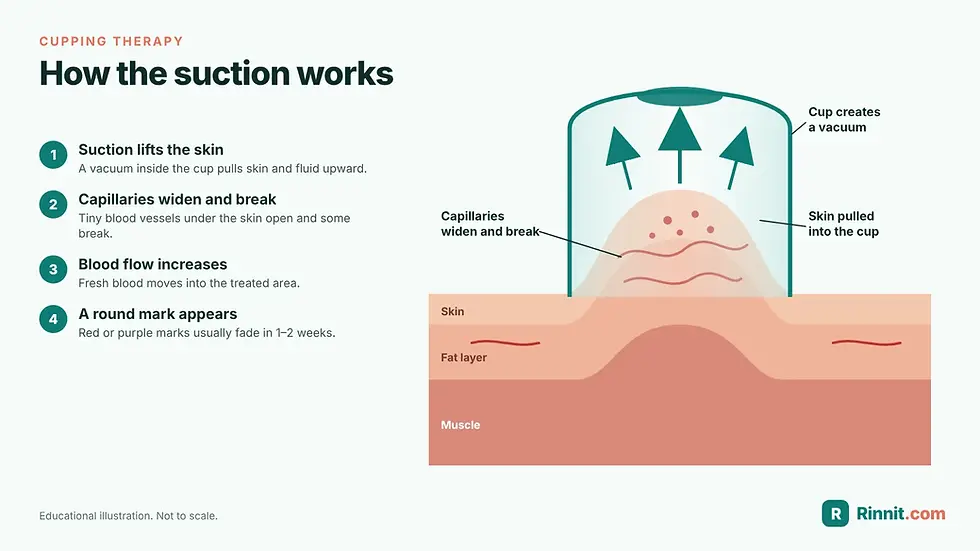
Image: How cupping suction affects the skin and the tiny blood vessels underneath.
What is cupping therapy used for?
Cupping therapy is used mostly to relieve conditions that cause pain, and some people also use it for long-term (chronic) health problems. [1]
People report using cupping to ease symptoms of:
Area | Conditions people use cupping for |
Joints | Arthritis, including rheumatoid arthritis |
Muscles and spine | |
Nerves | |
Head | Headaches and migraines |
Breathing | Asthma and other breathing problems |
Digestion | Gut disorders such as irritable bowel syndrome (IBS) |
Heart and blood vessels | High blood pressure (hypertension) |
Being on this list does not mean cupping is proven to work for each condition. It means people use it for these problems.
How does cupping therapy work?
How cupping therapy eases pain is still not fully understood, and there is not a lot of research on it. [1][5]
Here is the main idea, step by step:
Suction lifts the skin. The vacuum inside the cup pulls skin and fluid into the treated area.
Tiny blood vessels open and break. The pull widens and breaks small capillaries under the skin.
Blood flow increases. The body sends fresh blood to the area, which is thought to support normal healing.
Marks appear. The broken capillaries leave the round red or purple marks cupping is known for.
Because of this effect, some people believe cupping releases toxins. This has not been proven.
What are the types of cupping therapy?
The three main types of cupping therapy are dry cupping, running cupping and wet (bleeding) cupping, and they differ in how the suction is made and whether the skin is punctured. [1]
Type | How it is done | Skin punctured? |
Dry cupping | The inside of the cup is heated (traditionally with a burning alcohol-soaked cotton ball) to push out oxygen and create a vacuum. A modern version uses a suction device instead of heat. | No |
Running cupping | Lotion or oil goes on the skin first. The provider then glides the cups in different directions over the area, like a massage. | No |
Wet (bleeding) cupping | The provider lightly punctures the skin with a needle, then places the cups. Blood is drawn into the cup. | Yes |
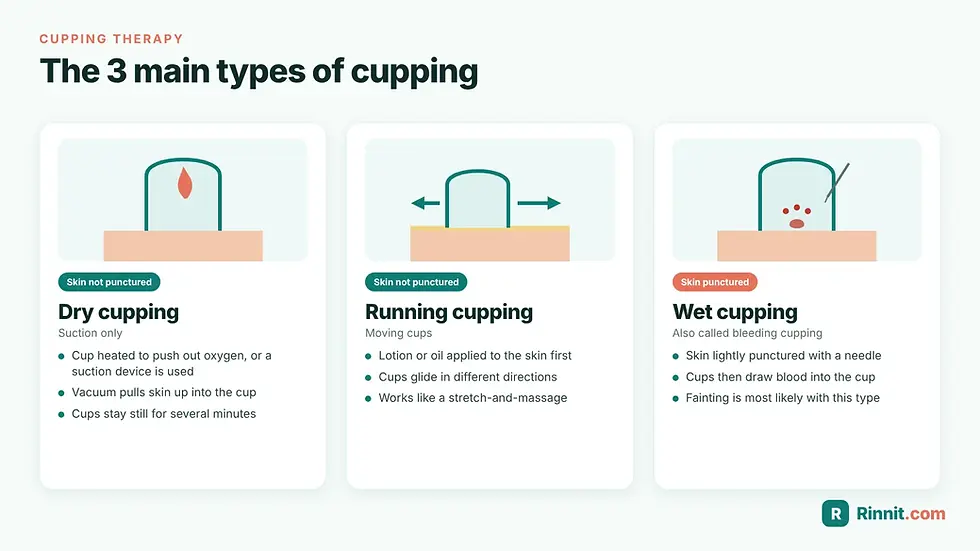
Image: The three main cupping methods side by side.
What are cupping cups made of?
Cupping cups are most often made of glass or plastic. Some providers use cups made of:
Bamboo
Ceramic
Metal
Silicone
What happens during a cupping therapy session?
During a cupping therapy session, a provider places several cups on your skin and usually leaves them in place for several minutes. [1]
Number of cups: Most sessions use 3 to 5 cups. Some use up to 7. More than 7 in one session is uncommon.
Time: The cups stay on for several minutes.
Movement: Some treatments briefly move the cups to stretch and massage the area.
Does cupping therapy hurt?
Cupping therapy should not be painful, although you may feel your skin tighten while the cups are on. [1]
Afterward, you may feel bruised and a little sore. You should not have severe discomfort.
Who can perform cupping therapy?
Cupping therapy can be performed by several types of trained practitioners. [1] These include:
Chiropractors
Massage therapists
Medical doctors
Physical therapists
Always ask about a practitioner's training and experience before your first session.
What do cupping therapy marks look like, and how long do they last?
Cupping therapy marks are red, round marks that usually fade within one to two weeks. [1]
They form because suction breaks tiny capillaries under the skin. The marks look like bruises, but they are not true bruises caused by injured muscle fibers.
What are the benefits of cupping therapy?
The benefits most often reported by people who have had cupping therapy are less pain, looser muscles and better movement. [1]
People say cupping:
Reduces pain and inflammation
Decreases muscle tightness
Improves blood flow
Increases range of motion
These are reported experiences. Research findings are mixed (see the research box above).
How effective is cupping therapy?
The effectiveness of cupping therapy is uncertain, because the evidence is mixed and many studies are small or low quality. [1][2][3][4][6][7]
Experts have suggested several reasons cupping might help. It may work through a mix of them:
Proposed effect | What it means |
Relaxation | Encourages whole-body comfort |
Higher pain threshold | You may feel pain less easily |
Less inflammation | May calm swelling in tissues |
Better circulation | Increases blood flow to the area |
Nerve stimulation | Stimulates the peripheral nervous system |
Other claimed effects | Removing toxins, lowering cholesterol and LDL, helping prevent heart disease such as atherosclerosis, increasing red blood cells |
These are theories, not proven effects. The "other claimed effects" row in particular has little reliable evidence behind it.
Most healthcare providers see cupping as a complementary therapy. That means using it together with standard medical treatment, not as a stand-alone treatment.
What are the risks and side effects of cupping therapy?
The risks of cupping therapy are generally low, but bruising, burns, skin infection and, rarely, fainting can occur. [1]
Side effect | Why it happens |
Bruising | Suction breaks small blood vessels |
Burns | Heated cups can burn the skin |
Fatigue | Tiredness after treatment |
Headaches | Can follow a session |
Muscle tension or soreness | Tissue is pulled and stretched |
Nausea | Feeling sick to your stomach |
Skin infection, itching or scarring | Especially if the skin is broken |
Fainting (vasovagal syncope) is rare. It happens when blood pressure and heart rate suddenly drop. It is most common after wet cupping in people who tend to faint with needle sticks. Learn more about why fainting happens.
Who should not get cupping therapy?
Cupping therapy is not recommended during pregnancy or for people with certain blood, heart, skin or seizure conditions. [1]
Researchers know very little about how cupping affects pregnancy, so you should not have it if you are pregnant.
You should also avoid cupping if you have:
Anemia (low red blood cells)
A pacemaker
A bleeding disorder such as hemophilia
A blood clotting problem, such as deep vein thrombosis (DVT), or a history of stroke
Cardiovascular (heart and blood vessel) disease
A skin condition such as eczema or psoriasis
Seizures (epilepsy)
Even with a low risk of complications, cupping is not for everyone. Talk to your healthcare provider before trying cupping or any other alternative treatment.

Image: Who should skip cupping, and the warning signs to watch for afterward.
When should you call a doctor after cupping therapy?
You should call your healthcare provider after cupping therapy if you get a burn, severe pain or signs of a skin infection. [1]
Contact your provider if you notice:
Burns on the treated skin
Extreme pain or soreness
Fever or other signs of skin infection, such as redness, tenderness or yellow discharge
What questions should you ask before trying cupping therapy?
The most useful questions to ask before trying cupping therapy are whether it fits your symptoms and whether anything makes it unsafe for you. [1]
Bring these to your next appointment:
Could cupping help my specific symptoms?
Are there other treatments I should try along with cupping?
What is your experience with cupping therapy?
Is there any reason I should not try cupping?
Can you recommend a qualified cupping practitioner, or how can I find one?
For a deeper clinical look at cupping methods and safety, see this clinical review of cupping therapy and this public health summary on cupping safety.
Conclusion
Cupping therapy is an ancient treatment that uses suction to lift the skin and draw blood to sore areas. Many people say it eases pain, loosens tight muscles and helps them move better. The research is mixed: it may lower pain in the short term, but the overall quality of the evidence is low.
The risks are usually small. Still, the marks, possible burns and the chance of infection mean it is worth choosing a trained practitioner. If you are pregnant or have a bleeding, clotting, heart, skin or seizure condition, skip it.
Think of cupping as an add-on to standard care, not a replacement.
Thinking about trying cupping for back or neck pain? Save this guide, share it with someone who's curious, and bring the questions above to your doctor. For more plain-language guides on pain relief and treatments, explore our back pain guide and acupuncture guide.
FAQ
Is cupping therapy safe?
Cupping therapy is generally low risk for most healthy adults when done by a trained practitioner. Possible side effects include bruising, burns, soreness, nausea, skin infection and, rarely, fainting.
How long do cupping marks last?
Cupping marks usually fade within one to two weeks. They look like bruises but are not true bruises from injured muscle.
Does cupping therapy hurt?
Cupping therapy should not hurt. You may feel skin tightness during the session and some mild soreness afterward, but not severe pain.
What is the difference between dry and wet cupping?
Dry cupping uses suction only, without breaking the skin. Wet (bleeding) cupping adds light needle punctures before the cups go on, so a small amount of blood is drawn into the cup.
How many cups are used in one session?
Most cupping sessions use 3 to 5 cups. Some use up to 7, and more than 7 is uncommon.
Does cupping remove toxins from the body?
Some people believe cupping releases toxins, but this has not been proven.
Can I get cupping while pregnant?
No. Little is known about how cupping affects pregnancy, so it is not recommended if you are pregnant.
Who should avoid cupping therapy?
People who are pregnant or have anemia, a pacemaker, a bleeding or clotting disorder, a history of stroke, heart disease, eczema, psoriasis or epilepsy should avoid cupping.
Can cupping replace my regular treatment?
No. Cupping is best used as a complementary therapy alongside standard medical care, not as a replacement.
How long does a cupping session take?
The cups are often left on for several minutes, and the full session may take longer depending on the method and areas treated. Ask your provider what to expect before you start.
Related Reading
Acupuncture: Benefits, Procedure, and What to Expect explains how acupuncture works and what research shows.
Myofascial Release Therapy: How It Works, What It Treats, and What to Expect describes a hands-on therapy for muscle and connective tissue pain.
Energy Healing: Types, Benefits, Risks and What the Research Really Shows covers energy therapies such as Reiki and their evidence.
Understanding Integrative Medicine: A Holistic Approach to Wellness explains how complementary therapies fit with standard medical care.
References
Cleveland Clinic. Cupping Therapy: Definition, Types & Benefits. Cleveland Clinic. Last updated June 7, 2023. https://my.clevelandclinic.org/health/treatments/16554-cupping
Jia Y, Dong X, Chai Y, et al. Effects of cupping therapy on chronic musculoskeletal pain and collateral problems: a systematic review and meta-analysis. BMJ Open. 2025;15(5):e087340. PMID 40441767. https://doi.org/10.1136/bmjopen-2024-087340
Zhang Z, Pasapula M, Wang Z, et al. The effectiveness of cupping therapy on low back pain: A systematic review and meta-analysis of randomized control trials. Complement Ther Med. 2024;80:103013. PMID 38184285. https://doi.org/10.1016/j.ctim.2024.103013
Wang Y, Dong S, Li B, et al. Update evidence of effectiveness on pain relieving of cupping therapy: a systematic review and Meta-analysis of randomized controlled trials. J Tradit Chin Med. 2025;45(2):234-253. PMID 40151111. https://doi.org/10.19852/j.cnki.jtcm.2025.02.002
Al-Bedah AMN, Elsubai IS, Qureshi NA, et al. The medical perspective of cupping therapy: Effects and mechanisms of action. J Tradit Complement Med. 2019;9(2):90-97. PMID 30963043. https://doi.org/10.1016/j.jtcme.2018.03.003
Choi TY, Ang L, Ku B, et al. Evidence Map of Cupping Therapy. J Clin Med. 2021;10(8):1750. PMID 33920643. https://doi.org/10.3390/jcm10081750
Wang SZ, Lu YH, Wu M, et al. Cupping Therapy for Diseases: An Overview of Scientific Evidence from 2009 to 2019. Chin J Integr Med. 2021;27(5):394-400. PMID 32524396. https://doi.org/10.1007/s11655-020-3060-y
Sina RE, Bokhari AA. Cupping therapy. StatPearls. Last updated October 30, 2023. https://www.ncbi.nlm.nih.gov/books/NBK538253/
National Center for Complementary and Integrative Health. Cupping. NCCIH. Last updated November 2018. https://www.nccih.nih.gov/health/cupping
Medical disclaimer
This article is for general education only and does not replace professional medical advice, diagnosis or treatment. Talk to your doctor or another qualified healthcare provider before starting cupping or any new therapy, especially if you are pregnant or have a medical condition.



Comments