Energy Healing: Types, Benefits, Risks and What the Research Really Shows

Updated: 6 days ago
Written and medically reviewed by Dr. Baraa Alnahhal, MD · Last reviewed: October 2026 · How we review
Quick Answer: What is energy healing?
Energy healing is a group of complementary therapies, such as Reiki, acupuncture and qigong, that aim to restore balance to a proposed energy field in and around the body. Most methods carry little risk and rarely cause side effects, but few are well studied. Use energy healing alongside regular medical care, never in place of it. [1]
What the research says
Acupuncture eases chronic pain beyond placebo. A pooled analysis of raw data from 39 trials and 20,827 patients found acupuncture beat both sham and no acupuncture for back, neck, joint, headache and shoulder pain, and the benefit fell only about 15% after one year. (Vickers et al., J Pain, 2018) [2]
Reiki lowered anxiety in short courses. A meta-analysis of 824 adults found a clear drop in anxiety scores (SMD −0.82), mainly with ≤3 or 6–8 sessions; results before surgery and in cancer care were less consistent. (Guo et al., BMC Palliat Care, 2024) [3]
Reiki gave a small quality-of-life boost. Across randomized trials with 661 participants, Reiki produced a small but significant improvement in quality of life (SMD 0.28). (Liu et al., Syst Rev, 2025) [4]
Key takeaways
Energy healing is a complementary therapy — it works alongside standard medical care, not instead of it. [1]
Practitioners believe an invisible energy flows through and around the body, and that rebalancing it supports health. [1]
Acupuncture and Reiki have the most research behind them; most other methods are not studied enough to give success rates. [1]
Energy therapies carry very little risk and usually cause no side effects. [1]
Keep seeing your regular doctor and tell them about any energy therapy you try. [1]

What is energy healing and how is it supposed to work?
Energy healing, also called energy medicine, is a type of complementary therapy that claims to channel subtle energy into your body to restore balance. [1]
Energy healers believe an invisible field of energy surrounds and flows through the human body. In their view, guiding healing energy can rebalance this flow and help restore health. [1]
These therapies focus on the link between mind and body. The idea is that aligning the two creates balance, which in turn supports your overall health and well-being. [1]
It is important to be clear about one point. Energy healing is not scientifically proven to be effective, but it is likely safe. [1]
What are the main types of energy healing?
The nine most common types of energy healing are Reiki, acupuncture, pranic healing, qigong, Emotional Freedom Technique, Therapeutic Touch, Polarity Therapy, Quantum Touch and reflexology. [1]
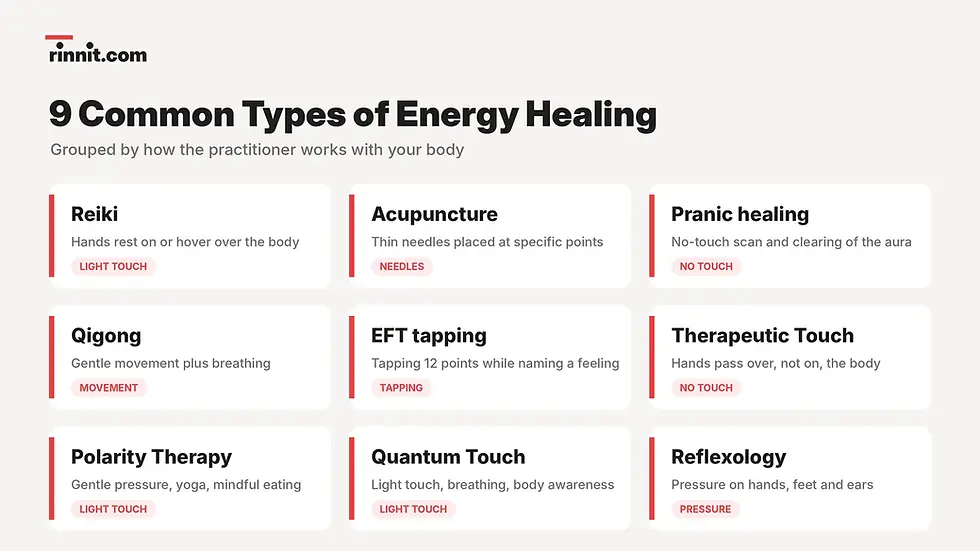
Energy healing types at a glance
Type | Origin of the name | How a session works | Touch style |
Reiki | Japanese: "rei" (higher power) + "ki" (life-force energy) | Hands rest lightly on or hover over the body to guide energy | Light touch or none |
Acupuncture | Traditional Chinese medicine | Very thin steel needles placed at points on the head, neck, face and back | Needles |
Pranic healing | Sanskrit: "prana" (life force) | Healer scans the aura for blockages and clears them | No touch |
Qigong | Chinese: "qi" (vital energy) + "gong" (training) | Body movement and breathing to improve energy flow | Movement |
Emotional Freedom Technique (EFT) | Exposure therapy / counseling | Tapping 12 acupressure points while focusing on a feeling and repeating positive thoughts | Tapping (can self-tap) |
Therapeutic Touch (TT) | Despite the name, a non-touch method | Hands pass over the body to find and clear imbalances | No touch |
Polarity Therapy (PT) | Body and habit-based | Gentle pressure plus daily yoga and mindful eating | Light touch |
Quantum Touch (QT) | Based on the body's self-healing ability | Light touch on painful areas, breathing techniques, body awareness | Light touch |
Reflexology | Pressure-point method | Pressure on points in the hands, feet and ears along 12 pathways | Pressure |
How does Reiki work?
Reiki is a light-touch or no-touch method in which a practitioner channels energy through their hands into your body. [1]
The practitioner places their hands lightly on you or holds them just above your body. They focus their attention and allow energy to flow through their hands. The aim is to join body and mind and support natural healing. [1]
How does acupuncture work in energy healing?
Acupuncture is a form of traditional Chinese medicine in which very thin steel needles are inserted into specific points on the body to rebalance energy flow. [1]
Common sites include the head, neck, face and back. The goal is to stimulate these points to relieve pain and other symptoms. [1] For a full walkthrough of a session, see our guide to acupuncture benefits, procedure and what to expect.
How does qigong work?
Qigong is a traditional Chinese practice that uses body movement and breathing to improve the flow of "qi," or vital energy, through the body. [1]
Practitioners use it to help lower blood pressure, reduce pain and improve sleep, and to support physical and mental health. [1] It shares many features with yoga therapy.
How does Emotional Freedom Technique (EFT) work?
Emotional Freedom Technique (EFT) is a tapping method in which a therapist taps 12 acupressure points while you focus on a negative emotion and repeat positive thoughts. [1]
You can also learn where these points are and tap them yourself. [1]
What are Therapeutic Touch and pranic healing?
Therapeutic Touch and pranic healing are both non-touch energy healing methods that aim to find and clear blockages in your energy field. [1]
In Therapeutic Touch, the healer first enters a focused state, then passes their hands over your body to find and clear imbalances. [1] In pranic healing, the healer scans your aura for blockages and scatters fresh energy over you to recharge the body. [1]
What are Polarity Therapy, Quantum Touch and reflexology?
Polarity Therapy, Quantum Touch and reflexology are energy healing methods that combine gentle touch or pressure with breathing, movement or daily habits. [1]
Polarity Therapy uses gentle touch and pressure on specific areas, plus daily yoga and a mindful relationship with food. [1]
Quantum Touch follows three steps: light touch where you have pain, breathing techniques, then paying attention to changing sensations. [1]
Reflexology applies pressure to points on the hands, feet and ears to relieve pain and reduce stress. [1]
What is energy healing used for?
Energy healing is most commonly used for mental health concerns, especially to reduce stress and anxiety. [1]
Practitioners use it for a wide range of other health conditions as well. [1] If anxiety is your main concern, our guide to anxiety disorders explains proven first-line treatments.
Researchers are also studying energy healing in people receiving cancer treatment. They want to know whether it can: [1]
Boost the immune system
Improve quality of life
Reduce side effects of treatment
Does energy healing actually work?
Energy healing has limited scientific proof: acupuncture and Reiki show some benefits in clinical trials, but most other techniques have not been studied enough. [1]
Many energy healers and the people who use these therapies report benefits. However, researchers have not carefully studied most techniques, and the ones they have studied show limited effectiveness. More high-quality evidence is needed. [1]

Evidence at a glance
Method | What was studied | Study size | Result |
Acupuncture | Chronic pain (back, neck, osteoarthritis, headache, shoulder) | 39 trials, 20,827 patients [2] | Better than sham and no acupuncture; ~15% effect loss at 1 year [2] |
Reiki | Anxiety | 824 adults [3] | Clear reduction (SMD −0.82) [3] |
Reiki | Quality of life | 661 participants, RCTs [4] | Small improvement (SMD 0.28) [4] |
Most other methods | Various | Too few quality studies [1] | No reliable success rates [1] |
What are the potential benefits of energy healing?
Energy healing may improve quality of life, sleep, relaxation and some mental health symptoms, although there is very little evidence that it cures or treats physical diseases. [1]
The techniques are safe and do not take much time. Potential benefits include: [1]
Better quality of life
A better night's sleep (see our sleep basics guide)
A deep sense of peace and relaxation
Fewer symptoms of certain mental health conditions
Is energy healing safe?
Energy healing is generally safe: the therapies carry very little risk and do not usually cause side effects. Acupuncture can cause soreness or minor bleeding and, rarely, infection or a collapsed lung, so choose a licensed practitioner who uses sterile, single-use needles. [1]
The main risk is indirect. Relying on energy healing instead of proven care can delay treatment you need. That is why these therapies should always be used in addition to standard medicine. [1]
Do | Don't |
Tell your doctor before starting any energy therapy | Stop or delay prescribed treatment |
Keep all regular checkups and tests | Use energy healing to treat a serious or worsening illness on its own |
Ask your doctor which methods they recommend or advise against | Assume a method is proven because others report benefits |
When should you talk to your doctor about energy healing?
You should talk to your primary care doctor before starting energy healing and keep seeing them throughout. [1]
Your doctor can tell you which methods they recommend and which to avoid, and help you find options that fit with your regular care. [1] This approach is the core idea behind integrative medicine. If you live with long-term pain, also read what chronic pain is and how it's managed.
What are the five elements in energy healing?
The five natural elements in energy healing are earth, water, fire, air and space, each linked to a different kind of balance and well-being. [1]
Time in nature can reduce stress, lower blood pressure and may help prevent conditions such as stroke and heart disease. [1]
Element | Linked to | Possible benefit |
Earth | Strength and stability | Feeling grounded and calm; better sleep, less pain |
Water | Life-sustaining, cooling energy | Less stress, a positive sense of well-being |
Fire | Light, heat and energy of the sun | Supports circadian rhythm and vitamin D |
Air | Movement and lightness | Provides oxygen; supports a healthy immune system |
Space | Openness, where all elements meet | Less stress; staying in the present moment |
Source for table: [1]
Conclusion
Energy healing covers a wide range of practices, from hands-on Reiki to needle-based acupuncture to movement-based qigong. All share the belief that restoring the body's energy flow supports health.
The honest picture is mixed. Acupuncture has solid evidence for chronic pain, and Reiki shows promise for anxiety and quality of life. Most other methods remain largely untested. The good news is that these therapies are low risk.
If you are curious, treat energy healing as a possible add-on for relaxation and well-being — and keep your doctor in the loop.
Want clear, doctor-reviewed answers to your health questions? Explore more guides in the Rinnit Health Library and follow us on Instagram and YouTube for new research made simple.
FAQ
What is energy healing?
Energy healing is a group of complementary therapies that aim to restore balance to an energy field believed to surround and flow through the body. Common types include Reiki, acupuncture, qigong and reflexology.
Does energy healing actually work?
Energy healing has limited scientific proof. Acupuncture and Reiki show some benefits in clinical trials, but most other methods have not been studied enough to give reliable success rates.
Is energy healing safe?
Energy healing is generally safe because the therapies carry very little risk and rarely cause side effects. The main danger is using it instead of proven medical treatment.
What conditions is energy healing used for?
Energy healing is most often used to reduce stress and anxiety. Researchers are also studying whether it can improve quality of life and ease treatment side effects in people with cancer.
What happens during a Reiki session?
During Reiki, a practitioner places their hands lightly on your body or holds them just above it. They focus their attention and aim to guide energy through their hands into your body.
Can energy healing replace medical treatment?
No. Energy healing should only be used in addition to standard medical care, never in place of it. Keep seeing your doctor and tell them about any energy therapy you use.
Is acupuncture a form of energy healing?
Yes. Acupuncture is a traditional Chinese medicine practice that places very thin needles at specific points to rebalance energy flow. It is one of the best-studied energy therapies, especially for chronic pain.
What are the five elements in energy healing?
The five elements are earth, water, fire, air and space. Each is linked to a different quality, such as stability for earth and calm for water.
Do energy healers need a license?
In most places, there is no license required to practice energy healing, and training varies widely. Ask about a practitioner's training and experience, and be careful of anyone who promises a cure.
Can energy healing help during cancer treatment?
Some people use therapies like Reiki to feel more relaxed or less stressed during cancer care. Energy healing does not treat cancer itself, so keep your regular treatment and tell your cancer team what you are using.
Further reading
Related Reading
Acupuncture: Benefits, Procedure, and What to Expect explains how acupuncture is done and what research shows.
Understanding Integrative Medicine: A Holistic Approach to Wellness describes how complementary therapies can fit alongside standard care.
Craniosacral Therapy: Benefits, Risks and What to Expect covers a gentle hands-on therapy and its possible benefits.
Cupping Therapy: How It Works, Types, Benefits, and Risks explains how cupping works, its types and its risks.
References
Cleveland Clinic. Energy Healing (Energy Medicine): Definition, Types & Benefits. Cleveland Clinic. Last updated September 23, 2025. https://my.clevelandclinic.org/health/treatments/energy-healing
Vickers AJ, Vertosick EA, Lewith G, et al. Acupuncture for chronic pain: update of an individual patient data meta-analysis. J Pain. 2018;19(5):455-474. PMID 29198932. https://doi.org/10.1016/j.jpain.2017.11.005
Guo X, Long Y, Qin Z, et al. Therapeutic effects of Reiki on interventions for anxiety: a meta-analysis. BMC Palliat Care. 2024;23(1):147. PMID 38872168. https://doi.org/10.1186/s12904-024-01439-x
Liu K, Qin Z, Qin Y, et al. Effects of Reiki therapy on quality of life: a meta-analysis of randomized controlled trials. Syst Rev. 2025;14(1):72. PMID 40148929. https://doi.org/10.1186/s13643-025-02811-5
Medical disclaimer
This article is for general educational purposes only and is not a substitute for professional medical advice, diagnosis or treatment. Always talk to a qualified healthcare provider about your health and before starting any new therapy.



Comments