Craniosacral Therapy: Benefits, Risks and What to Expect

Updated: 6 days ago
Written and medically reviewed by Dr. Baraa Alnahhal, MD · Last reviewed: October 2026 · How we review
Quick Answer
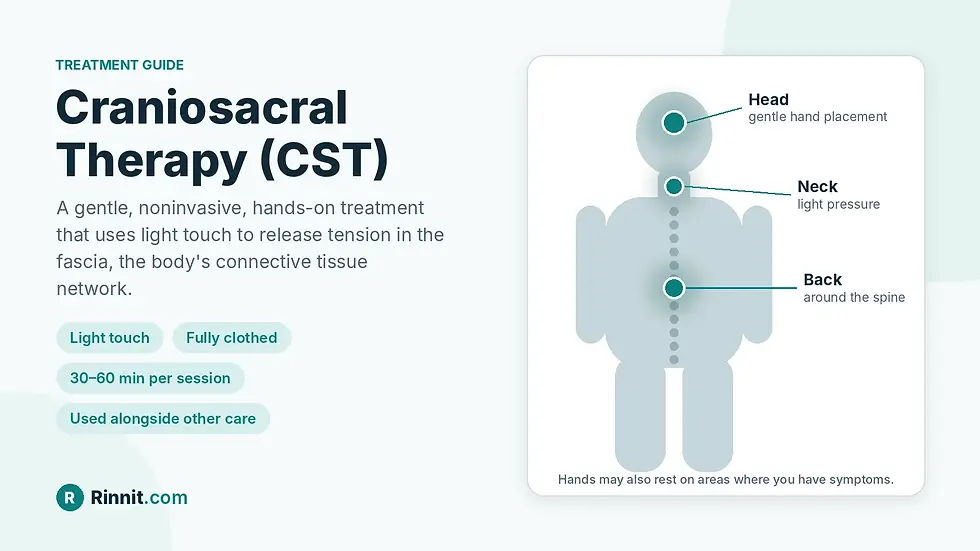
Craniosacral therapy (CST) is a gentle, noninvasive, hands-on treatment in which a trained therapist uses light touch on the head, neck and back to release tension in the fascia, the body's connective tissue network. It may ease chronic pain, headaches, neck pain and cancer-treatment side effects, and it is used alongside other care, not instead of it. [1][2]
What the research says
Chronic pain improved more than with sham or usual care, for up to six months. A review pooling 10 randomized trials with 681 people (neck and back pain, migraine, headache, fibromyalgia, tennis elbow and pelvic girdle pain) found craniosacral therapy reduced pain and disability more than sham treatment (pain effect size −0.63), with benefits still seen at six months (−0.59). No serious side effects were reported in the five trials that tracked safety. (Haller et al., BMC Musculoskeletal Disorders, 2019)
Neck pain dropped more than with a light-touch sham. In 54 people with chronic neck pain who had 8 weekly sessions, pain was 21 points lower (on a 100-point scale) than sham at week 8 and 16.8 points lower at week 20. By week 20, 78% of the craniosacral group reached a meaningful improvement. No serious side effects occurred. (Haller et al., Clinical Journal of Pain, 2016)
Low back pain: less pain, but disability scores similar to massage. In 64 people with chronic low back pain, 10 sessions of craniosacral therapy reduced pain intensity more than 10 sessions of classic massage, but the main disability score did not differ significantly between groups. (Castro-Sánchez et al., Journal of Alternative and Complementary Medicine, 2016)
Key takeaways
Craniosacral therapy uses light hand pressure on the head, neck and back while you stay fully clothed.
It aims to release tension in the fascia, which may help connected parts of the body work better.
It may help manage chronic pain, fibromyalgia, migraine, post-concussion syndrome, TMJ syndrome and more.
A session lasts 30 minutes to 1 hour, and several sessions may be needed.
Side effects are usually mild: dizziness, tiredness, lightheadedness or mild discomfort.
It should be added to, not replace, the treatment your healthcare provider recommends.
Craniosacral therapy at a glance
Question | Short answer |
What is it? | A gentle, noninvasive, hands-on technique |
Main goal | Release tension in the fascia (fascial clearance) |
Where is touch applied? | Head, neck, back (around the spine) and symptom areas |
Clothing | You stay fully clothed |
Session length | 30 minutes to 1 hour |
Number of sessions | Often several, over weeks to months |
Common side effects | Dizziness, tiredness, lightheadedness, mild discomfort |
Who performs it | Chiropractors, osteopathic doctors (DOs), physical and occupational therapists, licensed massage therapists |
Suitable for | Adults and children, depending on the condition |
How does craniosacral therapy work?
Craniosacral therapy works by placing the hands gently on the body to release tension in the fascia. Fascia (pronounced "fash-ee-uh") comes from the Latin word for band.
It is a casing that wraps your organs, glands, nerves, muscles, blood vessels, brain and spinal cord. Together, it forms one body-wide connective tissue network.
Because the body is connected in both structure and function, tension in one area can affect another. The goal of craniosacral therapy is to relieve that tension, which may help connected parts of the body work better through:
Self-regulation
Self-correction
Self-healing
You may also see it written as "cranial sacral therapy." Both names refer to the same treatment.
What conditions can craniosacral therapy help with?
Craniosacral therapy may help manage the symptoms of several pain-related and neurological conditions. Your healthcare provider may recommend it in addition to your main treatment.
Condition | Related guide |
Chronic pain | — |
Complex regional pain syndrome | — |
Fibromyalgia | — |
Headaches, including migraine | |
Neuralgia (nerve pain) | — |
Post-concussion syndrome | |
Scoliosis | |
Stroke | |
Temporomandibular joint (TMJ) syndrome |
People also use it for neck pain and for relief from the side effects of cancer treatment.
Who should not have craniosacral therapy right now?
Craniosacral therapy may suit both adults and children, but some recent health problems mean you should wait. Your healthcare provider may delay treatment until you are well enough if you recently had:
Blood clots
Brain swelling
A brain aneurysm
Any condition that affects cerebrospinal fluid pressure, flow or buildup
Your healthcare provider will tell you whether you are a good candidate.

What happens during a craniosacral therapy session?
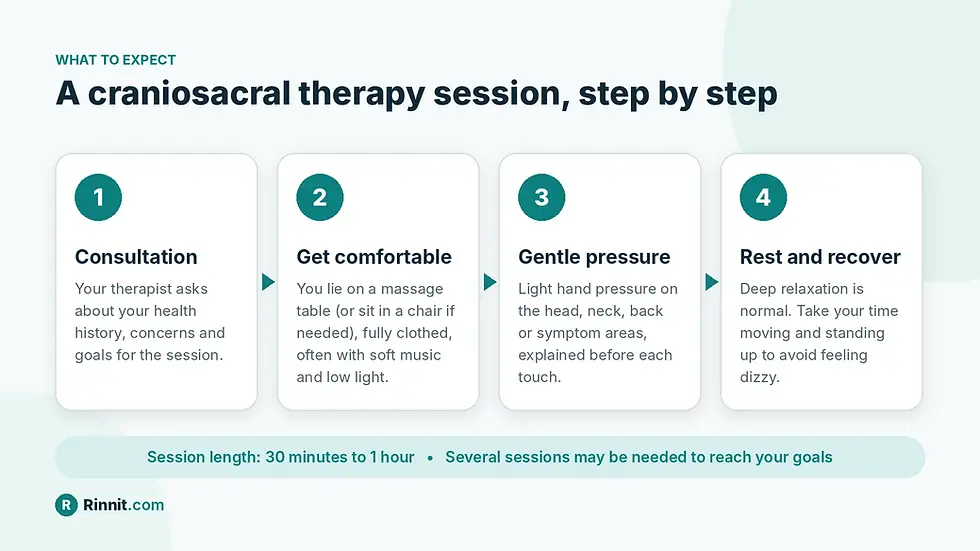
A craniosacral therapy session is similar to a massage, except you stay fully clothed. The room may have soft music and low lighting to help you relax.
1. Consultation. Your therapist asks about your health history, your concerns and your goals for the session.
2. Getting comfortable. You lie on a massage table. If needed, you can sit in a chair instead.
3. Gentle pressure. Your therapist uses their hands to apply light pressure to your head, neck, back (around the spine) or the areas where you have symptoms. They explain what they are doing before they touch you and check in to make sure you are comfortable.
4. Relaxation. Many people feel deeply relaxed during the session. This is normal.
If you feel uncomfortable at any point, tell your therapist.
How long does a craniosacral therapy session take?
A craniosacral therapy session takes between 30 minutes and 1 hour. You may need several sessions to reach your goals.
Who performs craniosacral therapy?
Craniosacral therapy is performed by healthcare providers and therapists trained in the technique.
Chiropractors
Doctors of osteopathic medicine (DOs)
Physical therapists
Occupational therapists
Licensed massage therapists
Can you do craniosacral therapy on yourself?
Craniosacral therapy itself is done only by trained professionals educated in this method. However, you can learn to massage your own head and neck to relax at home between appointments.
What are the benefits of craniosacral therapy?
The main benefits of craniosacral therapy may include:
Pain relief
Relaxation
Better emotional well-being
Stress relief
Many people report symptom relief after treatment. Results vary from person to person and depend on the reason for therapy. Research on how well it works for different conditions is ongoing.
Is craniosacral therapy safe?
Craniosacral therapy is generally safe because it is gentle and noninvasive, with minimal risks. Side effects are usually mild.
Possible side effect | Helpful tip |
Dizziness | Take your time moving and standing up |
Lightheadedness | Stand up slowly to help prevent falls |
Tiredness | Give yourself a few moments before getting up |
Mild discomfort | Tell your therapist |
How soon does craniosacral therapy work?
Craniosacral therapy can bring relief right after one session for some people. Others need a couple of days for their body to process the treatment.
Depending on your goals, it may take several sessions over a few weeks to months before you notice results.
When should you call a doctor after craniosacral therapy?
Call your healthcare provider if you have severe pain, discomfort, or new or worsening symptoms after a craniosacral therapy session. If something does not feel right in your body, ask your provider for advice.
Conclusion
Craniosacral therapy is a gentle, noninvasive, hands-on treatment that may ease pain, tension and stress by releasing tension in the fascia. Sessions are calm, short and done fully clothed, and side effects are usually mild.
It works best as part of a wider care plan, not as a replacement for medical treatment. Some recent conditions, such as a concussion or blood clots, may mean waiting.
Thinking about trying craniosacral therapy? Talk with your healthcare provider about whether it fits your treatment plan, then look for a trained chiropractor, osteopathic doctor, physical or occupational therapist, or licensed massage therapist. For more on the conditions it may help, read our guides on migraine, neck pain and TMJ disorders.
FAQ
What does craniosacral therapy feel like?
Craniosacral therapy feels like very light, gentle touch on the head, neck and back. Many people feel deeply relaxed during a session.
Is craniosacral therapy painful?
Craniosacral therapy is not meant to be painful. It uses light pressure, and some people feel mild discomfort. Tell your therapist if anything feels uncomfortable.
How many craniosacral therapy sessions do I need?
Many people need several craniosacral therapy sessions over a few weeks to months, depending on their goals.
Can children have craniosacral therapy?
Yes. Craniosacral therapy may benefit both adults and children with many different conditions. A healthcare provider decides whether it is suitable.
Does craniosacral therapy work for migraines?
Craniosacral therapy may help manage headaches, including migraines. A review of 10 trials that included people with migraine and headache found it reduced chronic pain more than sham treatment.
What should I do after a craniosacral therapy session?
After a craniosacral therapy session, take your time moving and standing up, because you may feel dizzy or lightheaded. Call your provider if symptoms get worse.
Is craniosacral therapy backed by science?
Research on craniosacral therapy is limited and results are mixed. Some people report relief, but more high-quality studies are needed to know how well it works for different conditions.
Who performs craniosacral therapy?
It is usually done by trained chiropractors, osteopathic doctors, physical or occupational therapists, or licensed massage therapists. Ask about a practitioner's training before your first session.
Who should wait before having craniosacral therapy?
People who recently had a concussion, blood clots, brain swelling or a brain aneurysm may need to wait. Talk with your healthcare provider first if you have any condition that affects the brain or spinal fluid.
Is craniosacral therapy the same as massage?
No. Craniosacral therapy uses very light touch, while massage often uses firmer pressure on muscles. You also stay fully clothed during craniosacral therapy.
Related Reading
Osteopathic Manipulative Treatment (OMT): What It Treats and What to Expect explains hands-on osteopathic treatment and what it helps.
Myofascial Release Therapy: How It Works, What It Treats, and What to Expect describes gentle pressure therapy for fascia and muscle pain.
TMJ Disorders: Symptoms, Causes, Diagnosis, Treatment and Self-Care covers jaw joint pain, its causes and treatment options.
Post-Concussion Syndrome: Symptoms, Causes, and Treatment — What to Do When Concussion Symptoms Last explains lingering symptoms after a concussion and how they are managed.
References
Cleveland Clinic. Craniosacral Therapy Technique: What Is It, Benefits & Risks. Cleveland Clinic. Last updated September 5, 2023. https://my.clevelandclinic.org/health/treatments/17677-craniosacral-therapy
Haller H, Lauche R, Sundberg T, et al. Craniosacral therapy for chronic pain: a systematic review and meta-analysis of randomized controlled trials. BMC Musculoskelet Disord. 2019;21(1):1. PMID 31892357. https://doi.org/10.1186/s12891-019-3017-y
Haller H, Lauche R, Cramer H, et al. Craniosacral therapy for the treatment of chronic neck pain: a randomized sham-controlled trial. Clin J Pain. 2016;32(5):441-449. PMID 26340656. https://doi.org/10.1097/AJP.0000000000000290
Castro-Sánchez AM, Lara-Palomo IC, Matarán-Peñarrocha GA, et al. Benefits of craniosacral therapy in patients with chronic low back pain: a randomized controlled trial. J Altern Complement Med. 2016;22(8):650-657. PMID 27347698. https://doi.org/10.1089/acm.2016.0068
Disclaimer
This article is for general education and does not replace advice from your doctor or another qualified healthcare provider. Always talk with your provider before starting a new treatment.



Comments