Calf Implants: Surgery, Types, Recovery, Risks, and Results

Updated: 6 days ago
Written and medically reviewed by Dr. Baraa Alnahhal, MD · Last reviewed: October 31, 2026 · How we review
Quick Answer: What are calf implants?
Calf implants are soft silicone implants that a plastic surgeon places through a small incision in the crease behind the knee to make the lower legs look fuller and more defined. They are used for cosmetic shaping, bodybuilding goals or reconstruction after injury or birth defects. Most people return to work in about two weeks. [1] [2]
What the research says
Complications are uncommon overall. A review of 26 studies covering 1,498 patients and 2,629 treated calves found an overall complication rate of about 4.5%. Implants placed above the muscle had a 5.7% rate, implants placed under the muscle 0.92%, and fat grafting 1.5%. (Melita et al., Aesthetic Plastic Surgery, 2019) [2]
Placement above the muscle can be safe in experienced hands. In 134 patients treated between 2003 and 2015, implants placed beneath the muscle's outer covering had a complication rate below 1% and a short recovery. (Andjelkov et al., Plastic and Reconstructive Surgery, 2017) [3]
Most patients are satisfied, but rare serious events happen. Among 50 patients (60 calf corrections), the surgeon rated results excellent to good in 30 of 37 followed patients. One bodybuilder developed acute compartment syndrome, a surgical emergency. (Niechajev & Krag, Aesthetic Plastic Surgery, 2017) [4]
Key takeaways
Calf implants are usually made of medical-grade silicone, either solid or gel-filled.
They can sit above the calf muscle (faster recovery, more risk of shifting) or under it (longer recovery, more natural look).
Surgery is usually outpatient, with an incision hidden in the back-of-knee crease.
Expect about two weeks off work and around six weeks before most activities.
Swelling takes several months to fully settle before you see the final result.
What are calf implants?
Calf implants are shaped silicone implants that give the lower legs a fuller, more contoured look and make the calf muscles appear larger and more muscular. [1] [6]
A plastic surgeon inserts them through small incisions in the natural creases behind the knees. This keeps the scars out of easy view.
You may also hear the procedure called:
Calf augmentation
Calf enhancement
Calf enlargement
Which muscles do calf implants enhance?
Calf implants enhance the gastrocnemius, the muscle that forms the visible bulk and shape of the back of the lower leg. Beneath it sits the soleus, a wide, flat muscle you can't see from the outside. [5]
Together, these calf muscles run from the knee down to the Achilles tendon. They let you point your foot, walk, run, and jump.
Why do people get calf implants?
People get calf implants to improve leg shape, correct a leg imbalance, or create a more muscular look, and both men and women choose the procedure. [1]
Reason | Who it usually helps |
|---|---|
Cosmetic shaping | People whose calves look small or out of proportion with their thighs |
Bodybuilding | Athletes who can't build more calf size through training alone |
Reconstruction | People with leg injuries or birth defects that cause muscle imbalance |
Masculine contour | People who want a more muscular, defined lower leg |
Who is a good candidate for calf implants?
A good candidate for calf implants is an adult who already trains their calves, does not smoke, and has realistic expectations. [1]
Specifically, the ideal candidate:
Exercises and strength-trains to build the calf muscles.
Has a fully developed adult skeleton and muscles.
Doesn't smoke, or can quit before surgery.
Understands what the surgery can and can't change.
Smoking matters. Nicotine raises the risk of surgical complications and slows wound healing.
What types of calf implants are there?
Calf implants come in two main materials, solid silicone and silicone gel, and in different shapes and sizes. [1]
Medical-grade silicone is soft and rubbery, with a look and feel similar to muscle.
Feature | Solid silicone | Silicone gel-filled |
|---|---|---|
Can be sculpted before insertion | Yes | No |
Edge you may feel under the skin | More likely | Less likely |
Can leak or rupture | No | Rarely |
Capsular contracture (scar tightening) | Less typical | Possible |
Your surgeon measures your legs before surgery to choose the right shape and size. You may get one or two implants per leg.
Most people get matching implants in both legs for symmetry. People with a muscle imbalance may need different sizes on each side.
Where are calf implants placed?
Calf implants are placed either above the gastrocnemius muscle, just under its tough outer covering (fascia), or beneath the muscle itself, and each option trades recovery speed against a natural result. [1] [2]

Above the muscle (subfascial) | Under the muscle (submuscular) | |
|---|---|---|
How invasive | Less invasive | More invasive |
Recovery | Faster, less pain | Slightly longer, more painful |
Risk of shifting | Higher; may need a second surgery | Lower; implant is held more securely |
Look and feel | Implant may be seen or felt | More natural look and feel |
What happens before calf implant surgery?
Before calf implant surgery, you'll have checks to confirm you're healthy enough for an operation. [1]
Your surgeon may ask you to:
Have a physical exam and blood tests.
Have photos taken for planning and before-and-after comparison.
Stop eating and drinking for a set time before surgery.
Pause certain medicines, vitamins, and supplements.
Take antibiotics to lower the chance of infection.
Stop smoking.
Plan for someone to drive you home. Calf implant surgery is usually outpatient, so most people go home the same day.
How is calf implant surgery done?
Calf implant surgery is done with you lying face down, usually under general anesthesia, through a small cut behind each knee. [1]

The surgeon then follows these steps:
Makes a small incision in the skin crease behind the knee.
Creates a pocket above or beneath the gastrocnemius muscle using special instruments.
Works carefully around the nerves; a branch of the sciatic nerve that controls lower-leg and foot movement and feeling runs nearby.
Slides the implant through the incision into the pocket.
Sometimes places a thin drain to remove fluid and limit swelling.
Closes the incision with stitches and covers it with a bandage.
Wraps the leg in a compression bandage or garment.
Repeats the same steps on the other leg.
Can other procedures be done at the same time?
Yes, calf implants are sometimes combined with body contouring procedures. For example, liposuction can remove fat from the hips, buttocks, or thighs during the same operation.
Some people also have fat transfer. The surgeon removes fat with liposuction, purifies it, and injects it into the lower legs for extra volume. More than one session may be needed.
What is recovery like after calf implants?
Recovery after calf implants usually means a few days of pain and stiffness, about two weeks off work, and around six weeks before most activities. [1]
Your lower legs will feel swollen and sore at first. The skin may look shiny as it stretches over the implant.
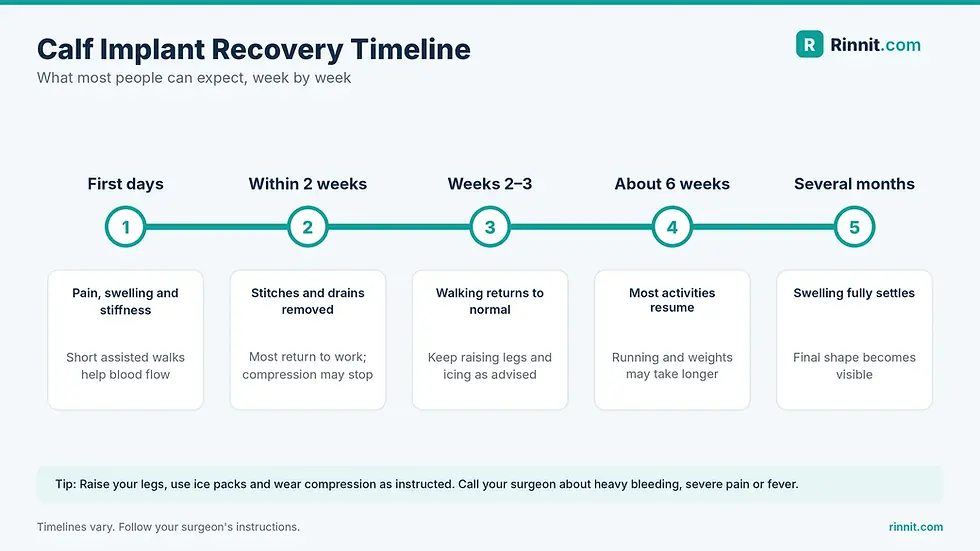
Time after surgery | What to expect |
|---|---|
First few days | Pain, swelling, and stiffness; have someone help you walk to prevent falls |
Weeks 2 to 3 | Walking pattern returns to normal |
Within 2 weeks | Stitches (if not dissolvable) and drains removed; compression may stop; most return to work |
About 6 weeks | Most daily activities resume |
After 6 weeks | Running, cycling, and strength training may need longer; follow your surgeon's advice |
Several months | Swelling fully settles and final shape shows |
Walking early helps, even though it feels stiff. It keeps blood flowing to the lower legs.
How can you help your recovery at home?
You can help your recovery by keeping your legs raised, managing pain, and following your surgeon's wound-care instructions. Simple steps include:
Raise your legs when sitting or lying down.
Use acetaminophen-based pain relievers, prescribed or over the counter.
Apply ice packs to the legs.
Finish any antibiotics you were prescribed.
Wear compression bandages as instructed to hold the implants in place and limit swelling (edema).
What are the risks and side effects of calf implants?
The risks of calf implants include bleeding, infection, implant shifting, nerve injury, and scar tightening around gel implants, though only a small share of people have significant problems. [1] [2]
Risk | What it means |
|---|---|
Bleeding, bruising, blood clots | Expected bruising is common; blood clots are less common but serious |
Infection | Pus at the incision or fever needs prompt care |
Implant shifting | More likely with implants placed above the muscle; may need surgery |
Palpable edge | You may feel the implant's edge, more often with solid implants |
Capsular contracture | Scar tissue tightens around a gel implant, causing pain and firmness |
Leak or rupture | Rare, gel implants only; requires replacement surgery |
Extrusion | The implant pushes through the tissue or wound |
Nerve damage and numbness | From injury to nearby nerves |
Muscle spasms | Sudden tightening of the calf (muscle spasms) |
Skin changes | Discoloration, sensitivity, and swelling |
Reaction | To anesthesia or the implant |
Rarely, pressure builds inside the leg after surgery. This is called compartment syndrome and needs emergency treatment. [4]
Swelling, pain, and warmth in one calf can also signal deep vein thrombosis (DVT).
What are the benefits of calf implants?
The main benefit of calf implants is a fuller, more shapely lower leg that stays in place without ongoing training. [1]
The implants can:
Create more contoured calves.
Add volume to thin calves.
Balance the lower legs with the thighs.
Make the right and left legs more symmetrical.
Correct leg shape changes from birth defects or injury.
What results can you expect from calf implants?
Results from calf implants are visible right away, but the full effect appears once swelling settles over several months. [1]
Most people are pleased with how their legs look. If you're not happy with the result, talk to your surgeon. A second surgery with different implants is an option.
When correctly positioned, most calf implants look and feel like natural muscle.
When should you call your doctor after calf implant surgery?
You should call your doctor after calf implant surgery if you notice heavy bleeding, severe pain, or signs of infection. [1]
Contact your surgeon if you have:
Excessive bleeding, swelling, or bruising.
Muscle spasms.
Nausea and vomiting.
Severe pain.
Pus from the incision or a fever.
Get emergency care for severe, worsening calf pain with tightness, or sudden chest pain or shortness of breath.
Conclusion
Calf implants can give the lower legs the shape and volume that exercise alone may not provide. The choice of implant material and placement shapes your recovery, your risks, and how natural the result looks.
Realistic expectations matter. Meet with more than one board-certified plastic surgeon, ask about their experience with calf augmentation, and review their before-and-after photos.
Next step: Bookmark this guide for your surgical consultation, and explore our related guides on calf muscle anatomy, liposuction, and fat transfer to compare your options. Subscribe to Rinnit for clear, evidence-based health guides every week.
Frequently Asked Questions
Are calf implants permanent?
Calf implants are long-lasting but removable. Silicone gel implants can break down over the years and may need replacing. Implants that shift may also need surgery to remove or reposition them.
Can people tell you have calf implants?
Most people can't tell when calf implants are correctly placed, because they look and feel like natural muscle. Rarely, an implant placed above the muscle has an edge you can feel through the skin.
Where are the scars from calf implants?
The scars from calf implants sit in the natural skin crease behind each knee. This location helps hide them.
How long does calf implant surgery recovery take?
Calf implant recovery usually takes about two weeks before returning to work and around six weeks before most activities. Running, cycling, and weight training may take longer.
When can I walk after calf implants?
You can walk soon after calf implant surgery, and walking is encouraged to keep blood flowing. Have someone help you for the first couple of days. Your normal gait usually returns by the second or third week.
Are calf implants safe?
Calf implants are considered safe for most people, with a low rate of significant complications. Possible problems include infection, shifting, rupture of gel implants, and nerve injury.
Can calf implants be combined with liposuction or fat transfer?
Yes, calf implants are often combined with liposuction or fat transfer. Liposuction can reshape nearby areas, and fat transfer can add extra volume to the lower legs.
Do calf implants make you stronger?
No, calf implants change how the calves look but do not add muscle strength. Strength still comes from training the calf muscles.
Are calf implants painful?
Most people have pain and stiffness in the calves for a few days after surgery, which is treated with medicine. Call your doctor if pain is severe or keeps getting worse.
When can I go back to work after calf implants?
Most people need about two weeks off work. Jobs that keep you on your feet may need more time, so ask your surgeon.
Related Reading
Pec Implants: Surgery, Recovery and Results explains chest implant surgery for a more muscular look.
Calf Muscle: Anatomy, Function, and Common Conditions describes how the calf muscles work and common problems.
Butt Implants: What the Surgery Involves, Recovery Timeline, Risks, and BBL Comparison covers silicone butt implant surgery, recovery and complications.
Fat Transfer: A Natural Approach to Volume Enhancement describes how fat transfer moves your own fat to add volume.
References
Cleveland Clinic. Calf Implants: Surgery, Recovery, Side Effects & Scars. Cleveland Clinic. Last updated June 13, 2022. https://my.clevelandclinic.org/health/treatments/23253-calf-implants
Melita D, Innocenti A. Surgical Calf Augmentation Techniques: Personal Experience, Literature Review and Analysis of Complications. Aesthetic Plast Surg. 2019;43(4):973-979. PMID: 30868304. https://doi.org/10.1007/s00266-019-01347-z
Andjelkov K, Sforza M, Husein R, et al. Safety and Efficacy of Subfascial Calf Augmentation. Plast Reconstr Surg. 2017;139(3):657e-669e. PMID: 28234831. https://doi.org/10.1097/PRS.0000000000003120
Niechajev I, Krag C. Calf Augmentation and Restoration: Long-Term Results and the Review of the Reported Complications. Aesthetic Plast Surg. 2017;41(5):1115-1131. PMID: 28488211. https://doi.org/10.1007/s00266-017-0885-0
Binstead JT, Varacallo MA. Anatomy, Bony Pelvis and Lower Limb: Calf. In: StatPearls [Internet]. Treasure Island (FL): StatPearls Publishing; updated January 31, 2026. PMID: 29083629. https://pubmed.ncbi.nlm.nih.gov/29083629/
The Aesthetic Society. Calf Implants. The Aesthetic Society. Accessed October 30, 2026. https://www.theaestheticsociety.org/procedures/body/calf-implants
Medical disclaimer
This article is for general education and does not replace advice from a qualified healthcare professional. Talk to a board-certified plastic surgeon about whether calf implants are right for you.



Comments