Calf Muscle: Anatomy, Function, and Common Conditions

Updated: 2 days ago
Medically reviewed by Dr. Baraa Alnahhal, MD · Last reviewed: October 2026
Quick Answer: What is the calf muscle?
The calf muscle is a group of three skeletal muscles in the back of the lower leg: the gastrocnemius, soleus and plantaris. [1] They join to form the Achilles tendon, connecting the leg to the heel. [1] They propel the body forward during walking or running, allow foot flexion and ankle rotation, and support standing and upright posture. [1]
What the research says
Older age and a previous calf strain are the strongest known risk factors for another calf strain. A systematic review of 10 studies (5,397 athletes and 518 calf or lower-leg muscle injuries across football, Australian football, rugby union, basketball, and triathlon) found age and prior calf strain were the most predictive risk factors. Previous injuries to other leg muscles or the knee showed only limited evidence of association, and height, weight, sex, and side dominance lacked evidence. The authors noted the small number of studies and high risk of bias (PubMed: Green and Pizzari, Br J Sports Med, 2017) [2].
Most muscle strains in sport happen without contact, and calf strains follow a typical stretched-calf pattern. A systematic review and meta-analysis of video-analysis studies covering 728 indirect and non-contact muscle injuries found 74% were non-contact and 26% were indirect-contact, mostly during running or sport-specific moves involving changes in muscle-tendon length under active contraction. For calf injuries, the typical pattern was ankle dorsiflexion with the knee close to extension, with the ankle in more than 10° of dorsiflexion at the assumed time of injury (PubMed: Finnern et al., Br J Sports Med, 2026) [3].
Magnesium supplements are unlikely to prevent leg cramps in older adults. A Cochrane review of 11 trials (735 participants) found that, for idiopathic cramps largely in older adults, magnesium made little difference compared with placebo: the change in cramps per week at four weeks was −0.18 (95% CI −0.84 to 0.49; 5 studies, 307 participants; moderate-certainty evidence), and the share of people with a 25% or better reduction in cramps was no different (RR 1.04, 95% CI 0.84–1.29; high-certainty evidence). Evidence for pregnancy-related cramps was conflicting, and oral magnesium caused mostly gastrointestinal side effects (PubMed: Garrison et al., Cochrane Database Syst Rev, 2020) [4].
What is the anatomy of the calf muscle?
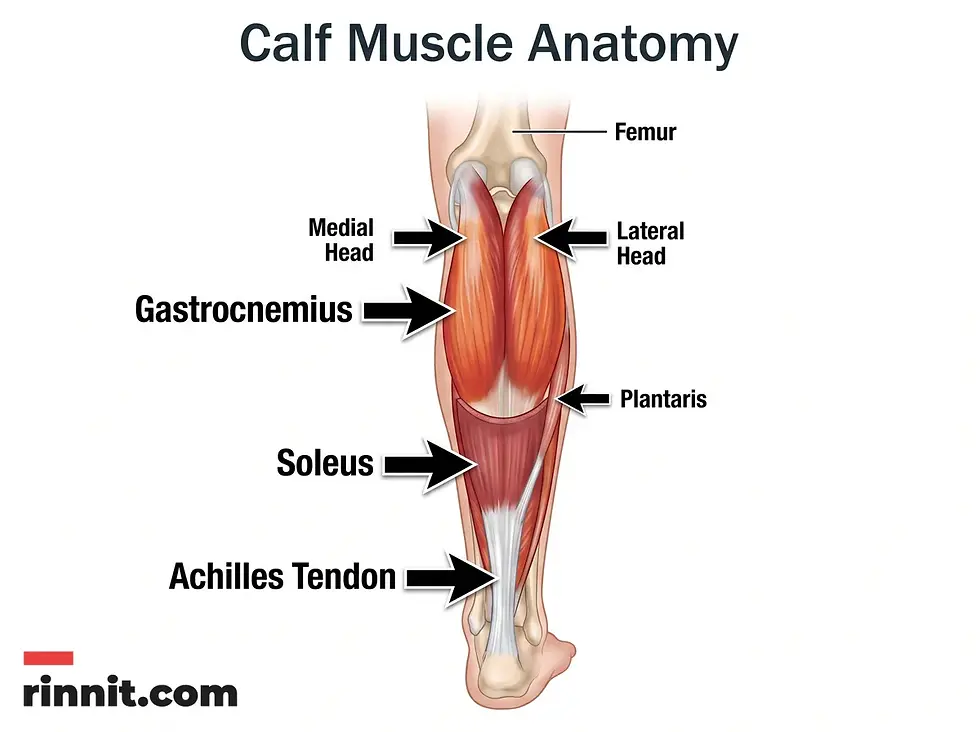
The calf muscle, medically known as the triceps surae, is composed of three distinct muscles located behind the shin bone. [1] The most prominent is the gastrocnemius, which sits just below the skin and forms the visible bulk of the calf. [1] It features two “heads” that originate at the thighbone and extend down to the heel. [1] Deeper than the gastrocnemius lies the soleus, a wide and flat muscle that is crucial for supporting the legs while standing. [1] The third, the plantaris, is a small muscle that runs between the two larger ones, though it is absent in approximately 10% of the population. [1]
These muscles are classified as skeletal muscles and are made of individual fibers bundled together, giving them a striated or striped appearance under a microscope. [1] They all eventually attach to the Achilles tendon above the heel, which is the thickest tendon in the human body. Because the gastrocnemius crosses both the knee and ankle joints, it is more frequently subjected to strains than the soleus, which only crosses the ankle. [1]
Muscle Name | Location and Characteristics | Primary Function |
Gastrocnemius | Superficial; visible bulk with two heads. | Walking, running, jumping, and knee locking. |
Soleus | Deep to gastrocnemius; wide and flat. | Posture support and ankle movement. |
Plantaris | Small; runs between larger muscles. | Assists in foot flexion (absent in 10% of people). |
What does the calf muscle do in daily movement?

The primary purpose of the calf muscle is to provide the power necessary for propulsion and stabilization. When you walk or run, these muscles contract to push you forward, a movement known as plantar flexion. [1] They also allow you to stand on your toes, rotate your ankle, and jump. [1] Beyond movement, the calf muscles play a vital role in static stability, helping you maintain balance and an upright posture while standing. [1]
In addition to foot movement, the gastrocnemius helps “lock” the knee joint, providing stability when the leg is fully extended. [1] This multi-joint involvement makes the calf muscle complex essential for nearly all forms of lower-body mobility. Whether you are performing a sudden sprint in a soccer match or simply standing in line, your calf muscles are constantly working to support your body's weight and facilitate movement.
What are common calf muscle conditions and injuries?

Calf muscle strains are among the most frequent injuries in athletes, particularly those involved in sports requiring quick starts and stops like soccer or basketball. [1] A strain occurs when muscle fibers are stretched too far or torn due to overuse or sudden exertion. [1] Another common issue is “tennis leg,” a specific type of gastrocnemius strain that often happens when a player pushes off suddenly while the foot is flexed. [1]
Leg cramps, or painful muscle spasms, are also highly prevalent, especially as people age. [1] Approximately 75% of individuals over the age of 50 have experienced leg cramps, which can be triggered by dehydration, certain medications, or pregnancy. [1] A more severe but rare condition is compartment syndrome, where pressure builds up within the muscle, potentially restricting blood flow and requiring immediate medical intervention. [1]
Condition | Primary Symptoms | Common Causes |
Muscle Strain | Sharp pain, stiffness, bruising. | Strenuous exercise or sudden stops. |
Leg Cramps | Sudden, intense pain and spasms. | Dehydration, age, or medications. |
Tennis Leg | Sudden “pop” or sharp pain in calf. | Sudden push-off during sports. |
Compartment Syndrome | Severe pain, swelling, numbness. | Trauma or extreme overexertion. |
How can you care for your calf muscles and prevent injury?
Maintaining healthy calf muscles involves a combination of lifestyle habits and proper exercise techniques. Staying hydrated is one of the simplest ways to prevent painful leg cramps. [1] Additionally, warming up and stretching before physical activity is crucial, as warm muscles are more flexible and less likely to tear under stress. [1] Gradually increasing the intensity of your workouts also allows the muscle fibers to adapt without being overwhelmed. [1]
Weight management is another important factor, as carrying excess body weight puts additional pressure on the lower legs and increases the risk of strains. [1] If you experience persistent calf pain, swelling, or discoloration that does not improve with rest, it is essential to consult a healthcare provider. These symptoms could indicate more serious issues such as deep vein thrombosis (DVT) or nerve damage. [1]
Conclusion
The calf muscles are the engine room of our lower legs, providing the strength and stability needed for everything from basic walking to high-performance athletics. By understanding the anatomy of the gastrocnemius and soleus and following basic care principles like hydration and proper warm-ups, you can ensure these vital muscles remain healthy and functional throughout your life.
If you encounter sudden, severe pain or notice red flags like warmth and swelling in your calf, seek medical advice promptly. Protecting your calf health is a fundamental part of maintaining overall mobility and long-term physical wellness.
Frequently Asked Questions
1. What are the two main muscles in the calf?
The two primary muscles are the gastrocnemius, which is closer to the surface, and the soleus, which sits deeper.
2. What is the triceps surae?
Triceps surae is the collective medical name for the gastrocnemius, soleus, and plantaris muscles.
3. Why is the gastrocnemius more prone to injury?
The gastrocnemius is more susceptible to strains because it crosses two joints—the knee and the ankle—subjecting it to more complex stresses.
4. What is "tennis leg"?
Tennis leg is a strain of the gastrocnemius muscle that typically occurs during sudden movements while the foot is flexed.
5. How common are leg cramps in older adults?
About 75% of people over the age of 50 have experienced leg cramps at some point.
6. What is the role of the Achilles tendon?
The Achilles tendon connects the calf muscles to the heel bone, allowing them to pull on the foot for movement.
7. Can dehydration cause calf pain?
Yes, dehydration is a common cause of painful muscle cramps and spasms in the calves.
8. What are the signs of a calf strain?
Common signs include sharp or dull pain, tightness, stiffness, and sometimes visible bruising or a bulge.
9. How can I prevent calf injuries?
Prevention strategies include staying hydrated, warming up before exercise, and maintaining a healthy weight.
10. When is calf pain an emergency?
Seek immediate help if you have severe pain accompanied by swelling, warmth, discoloration, or numbness.
Related Reading
Understanding Torn Calf Muscles: Symptoms, Causes, and Care explains calf muscle tears and how they heal.
Achilles Tendon Rupture: Complete Guide to Symptoms, Causes, and Treatment Options covers a tear of the tendon that joins the calf to the heel.
Understanding Leg Cramps: Causes, Relief, and Prevention Strategies explains why calf cramps happen and how to prevent them.
Deep Vein Thrombosis (DVT): Symptoms, Causes, Diagnosis & Treatment — Complete Guide describes leg blood clots that can mimic calf muscle pain.
References
Cleveland Clinic. What Is the Calf Muscle? Cleveland Clinic. Dec. 18, 2023. https://my.clevelandclinic.org/health/body/21662-calf-muscle
Green B, Pizzari T. Calf muscle strain injuries in sport: a systematic review of risk factors for injury. Br J Sports Med. 2017;51(16):1189-1194. PMID 28259848. https://doi.org/10.1136/bjsports-2016-097177
Finnern LS, Wilke J, Willwacher S, et al. Qualitative and quantitative situational characteristics of muscle strains in sports: a systematic review and meta-analysis. Br J Sports Med. 2026;60(3):211-226. PMID 41558842. https://doi.org/10.1136/bjsports-2025-110327
Garrison SR, Korownyk CS, Kolber MR, et al. Magnesium for skeletal muscle cramps. Cochrane Database Syst Rev. 2020;9(9):CD009402. PMID 32956536. https://doi.org/10.1002/14651858.CD009402.pub3
Medical Disclaimer
This article is for informational purposes only and does not constitute medical advice. Always seek the advice of your physician or other qualified health provider with any questions you may have regarding a medical condition. Never disregard professional medical advice or delay in seeking it because of something you have read here.



Comments