Achilles Tendon Rupture: Complete Guide to Symptoms, Causes, and Treatment Options

Updated: 2 days ago
Medically reviewed by Dr. Baraa Alnahhal, MD · Last reviewed: September 2026
Quick Answer: What Is an Achilles Tendon Rupture?
An Achilles tendon rupture is a tear — partway or all the way through — in the strong cord that joins the calf muscles to the heel bone, usually from a sudden force during sports. It typically happens with an audible pop, sharp pain near the heel, and difficulty pushing off when walking. Treatment is either surgery or nonsurgical care with a boot or cast — and recent studies suggest both approaches work equally well.
TL;DR
What it is: A tear of the Achilles tendon, the strong cord joining the calf muscles to the heel bone.
How it feels: A pop or snap, sharp pain near the heel, a feeling of being kicked in the calf, and trouble pushing off or standing on tiptoes.
Who's at risk: Most often ages 30–40; men up to five times more likely; common in jumping sports like basketball, soccer, volleyball, and tennis.
Diagnosis: Physical exam (including the calf-squeeze test) plus ultrasound or MRI to see whether the tear is partial or complete.
Treatment: Surgery or nonsurgical care (walking boot or cast, crutches, ice, pain relievers); both work equally well.
Recovery: Physical therapy follows either path; most people return to their former activity level within 18 to 24 months.
Achilles Tendon Rupture at a Glance
Topic | Quick Summary |
What it is | A tear — partway or all the way — in the Achilles tendon caused by stretching it too far |
What the tendon does | Helps point the foot downward, rise on the toes, and push off while walking |
Classic moment | A pop or snap, then sharp pain in the back of the ankle and lower leg; walking becomes hard |
Key risk factors | Ages 30–40 (peak); male sex (up to 5x more likely); jumping and cutting sports; steroid shots in the ankle; fluoroquinolone antibiotics; obesity |
Diagnosis | Exam for a gap in the tendon, calf-squeeze test, plus ultrasound or MRI |
Nonsurgical care | Walking boot with heel wedge or cast, crutches, ice, over-the-counter pain relievers |
Surgery | Incision in the back of the lower leg; the torn tendon is stitched together, sometimes with donated tissue |
Rehab highlight | Functional rehabilitation starts earlier and focuses on the whole body |
Return to activity | Most people within 18 to 24 months |
Prevention | 10% training increase per week, calf stretching and strengthening, safer surfaces, varied exercise |
What Is an Achilles Tendon Rupture?
The Achilles tendon (uh-KILL-eez) is a strong fibrous cord that joins the calf muscles at the back of the lower leg to the heel bone. Stretching the tendon too far can make it tear partway or all the way — the tear is called a rupture.
This injury mainly happens while playing sports, especially jumping sports for fun, but it can happen to anyone.
The Achilles tendon helps with pointing the foot downward, rising on the toes, and pushing off on the foot while walking. People use their Achilles tendons every time they walk and move their feet.
If the tendon ruptures, there may be a pop, then a sharp pain in the back of the ankle and lower leg, which is likely to make walking hard. Many people have surgery to repair the tear. But for many people, treatment without surgery works just as well.
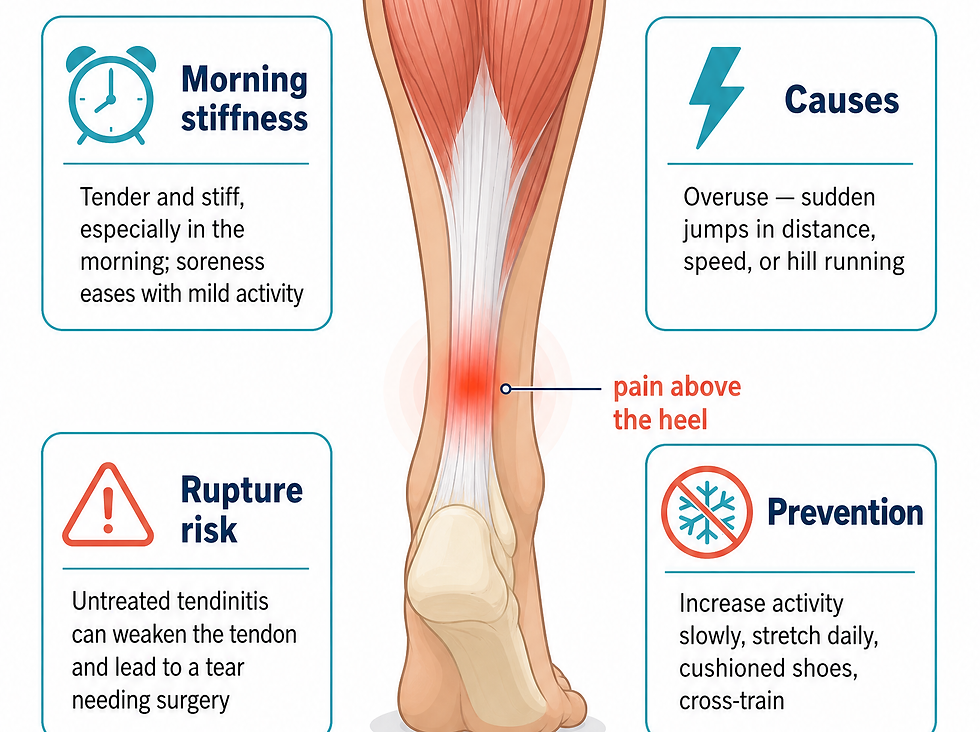
If you're dealing with heel or tendon pain before a rupture happens, our guide to Achilles tendinitis explains the warning signs that can come first.
Symptoms of a Ruptured Achilles Tendon
Some people have no symptoms with an Achilles tendon rupture. But most people:
Feel as though they have been kicked in the calf
Have sharp pain and swelling near the heel
Find it hard to bend the foot downward or "push off" the injured foot when walking
Find it hard to stand on the toes on the injured foot
Hear a popping or snapping sound at the time of the injury

Act fast: Talk with a healthcare professional right away if you hear a pop in your heel — especially if it is hard to walk afterward.
Causes: The Sudden Force That Tears the Tendon
The cause of Achilles tendon rupture is often an injury that puts sudden force on the Achilles tendon. It can happen from:
Jumping or sharp cutting and pivoting in a sport
Falling from a height or landing from a jump
Stepping into a hole
Risk Factors
Factors that may raise the risk of Achilles tendon rupture include:
Age — the peak age for rupture is 30 to 40
Sex assigned at birth — people assigned male at birth are up to five times more likely to have a rupture than people assigned female at birth
Sports played for fun — injuries happen more often in sports involving running, jumping, and sudden starts and stops, including soccer, basketball, volleyball, and tennis
Steroid shots — healthcare professionals sometimes inject steroids into an ankle joint to reduce pain and swelling, but steroid medicines can weaken nearby tendons and have been linked to ruptures
Certain antibiotics — fluoroquinolone antibiotics, such as ciprofloxacin (Cipro) or levofloxacin, raise the risk
Obesity — excess weight puts more strain on the tendon
How a Ruptured Achilles Is Diagnosed
To diagnose an Achilles tendon rupture, a healthcare professional checks the lower leg for tenderness and swelling. There may be a gap in the tendon if it has torn all the way.
The professional might ask you to kneel on a chair or lie face down with your feet hanging over the end of the exam table, then squeeze your calf muscle to see if your foot flexes. If it doesn't, you likely have ruptured your Achilles tendon.
An ultrasound or MRI can show whether the tendon is torn partly or all the way. These painless procedures take pictures of the tissues inside the body.
Diagnostic Step | What It Shows |
Physical exam | Tenderness, swelling, and possibly a gap in the tendon |
Calf-squeeze test | Whether the foot flexes when the calf is squeezed — no flexing means a likely rupture |
Ultrasound or MRI | Whether the tendon is torn partly or all the way |
Treatment Options
Treatment often depends on your age, how active you are, and how bad the injury is. Younger and more active people, especially athletes, tend to choose surgery for a tendon torn all the way. Older people and those not active in sports are more likely to opt for nonsurgical treatment.
Recent studies suggest that both types of treatment work equally well.

Treatment Without Surgery
This approach most often involves:
Keeping the ankle still for a few weeks — usually with a walking boot with a heel wedge that brings the torn edges closer together, or a cast with the foot flexed down for a few weeks
Resting the tendon and keeping weight off it by using crutches
Icing the area
Over-the-counter pain relievers
Nonsurgical treatment avoids surgery's risks, such as infection. But it might increase the chance of another rupture, and recovery can take longer. Recent studies suggest that rehabilitation involving moving and bearing weight early may help healing.
Surgery
The procedure most often involves the surgeon making a cut, called an incision, in the back of the lower leg, then stitching the torn tendon together. Depending on the condition of the torn tissue, the surgeon might use donated tissue to make the repair.
Possible complications include infection and nerve damage. Minimally invasive procedures have lower infection rates than open procedures.
Rehabilitation: The Path Back to Activity
After either treatment, physical therapy exercises can strengthen the leg muscles and the Achilles tendon. Most people return to their former level of activity within 18 to 24 months after the injury.
A type of rehabilitation known as functional rehabilitation starts earlier and moves faster than other types of physical therapy. It focuses on the whole body rather than just the injury, with the purpose of getting people back to where they were before the tear — as an athlete, a worker, or in everyday life.
Some studies suggest that minimally invasive surgical repair with functional rehabilitation may offer the best results, including a lower risk of infection and of the tendon tearing again — though study in this area is ongoing.
Prevention: Protect the Tendon Before It Tears
To reduce your chance of Achilles tendon issues:
Stretch and strengthen calf muscles. Stretch your calves until you feel a pull, but not pain — and don't bounce during a stretch. Calf-strengthening exercises help the muscle and tendon take on more force and protect against injury.
Wall calf stretch: Stand at arm's length from a wall or chair. Put your palms flat against the wall or hold the chair. Keep one leg back with the knee straight and heel flat on the floor. Slowly bend your elbows and front knee, moving your hips forward until you feel a stretch in your calf. Hold for 30 to 60 seconds, then switch legs and repeat.
Vary your exercises. Mix high-impact sports such as running with low-impact sports such as walking, biking, or swimming. Limit activities that put a lot of stress on your Achilles tendons, such as hill running and jumping.
Choose safer running surfaces. Don't run on hard or slippery surfaces. Wear athletic shoes that fit well and have good cushioning.
Add to your training slowly. Injuries often happen after training harder or all of a sudden. Add to how long, how far, how hard, and how often you train by no more than 10% a week.
Preparing for Your Appointment
People with an Achilles tendon rupture often seek treatment right away at a hospital's emergency department. You might also talk with doctors who specialize in sports medicine or orthopedic surgery.
Before your appointment, write a list that includes:
Detailed descriptions of the symptoms and how and when the injury happened
Information about past medical conditions
All medications, vitamins, and dietary supplements you take, including doses
Questions to ask your healthcare professional
Your healthcare professional may ask how the injury happened, whether you felt or heard a pop or snap, and whether you can stand on tiptoe on that foot.
Frequently Asked Questions
What is an Achilles tendon rupture?
It is a tear — partway or all the way through — in the Achilles tendon, the strong cord that joins the calf muscles to the heel bone. Stretching the tendon too far, usually during sports, causes the tear.
How do I know if my Achilles tendon has ruptured?
Most people hear a pop or snap at the moment of injury, feel sharp pain and swelling near the heel, feel as though they were kicked in the calf, and find it hard to push off when walking or stand on the toes of the injured foot.
Who is most at risk for an Achilles tendon rupture?
People ages 30 to 40 — the peak age — and people assigned male at birth, who are up to five times more likely to rupture than people assigned female at birth. Jumping and cutting sports, steroid shots in the ankle, fluoroquinolone antibiotics, and obesity all raise the risk.
Is surgery always needed for a ruptured Achilles tendon?
No. Surgery and nonsurgical treatment both work equally well. Younger, more active people often choose surgery for a complete tear, while older or less active people often opt for a walking boot or cast — but the decision depends on your age, activity level, and the injury's severity.
How long does it take to recover from an Achilles tendon rupture?
Physical therapy follows either treatment, and most people return to their former level of activity within 18 to 24 months. Functional rehabilitation — which starts earlier and focuses on the whole body — may speed the return.
How can I prevent an Achilles tendon rupture?
Stretch and strengthen your calf muscles, vary high- and low-impact exercise, run only on safe surfaces in well-cushioned shoes, and increase your training by no more than 10% a week.
Conclusion: What to Remember About Achilles Tendon Rupture
A ruptured Achilles tendon is a serious injury, but it is one that both medicine and patience can overcome. The three lessons to carry from this guide are:
A pop in your heel is never something to walk off. Sharp pain, swelling, and trouble pushing off after a snap mean a rupture — get care right away.
You have two proven paths. Surgery and nonsurgical care work equally well; the right choice depends on your age, activity level, and the tear itself.
Return to your former self is realistic. With physical therapy — ideally functional rehabilitation — most people are back to their previous activity level within 18 to 24 months.
This guide gives you one clear, plain-language place to understand Achilles tendon rupture, from the moment of the tear to full recovery. If you suspect you've ruptured your tendon, the best next step is to seek medical care immediately.
Want to catch tendon problems before they tear? Read our Achilles tendinitis guide on rinnit.com, where early treatment can prevent the rupture entirely.
References
Mayo Clinic. Achilles tendon rupture — Symptoms & causes. mayoclinic.org
Mayo Clinic. Achilles tendon rupture — Diagnosis & treatment. mayoclinic.org
This article is for informational purposes only and is not a substitute for professional medical advice. Always consult a qualified healthcare provider for diagnosis and treatment.
Comments