Thompson Test for Achilles Tendon Rupture: How It's Done and What Results Mean

Updated: 2 days ago
Written and medically reviewed by Dr. Baraa Alnahhal, MD · Last reviewed: November 2026 · How we review
Quick Answer: What is the Thompson test?
The Thompson test, also called the calf squeeze test, is an in-office exam for a torn (ruptured) Achilles tendon. You lie face down while the provider squeezes your calf. If the foot moves, the tendon is likely intact; if it doesn't, the tendon may be torn. You'll usually still need an ultrasound or MRI to confirm the diagnosis. [1]
What the research says
It's one of the most widely used checks for Achilles rupture. In a survey of 127 US orthopedic surgeons about chronic Achilles ruptures, 96% used the Thompson calf-squeeze test and 97% felt for a gap in the tendon to diagnose a rupture, while 37% used the Matles test. (Villarreal et al., American Journal of Orthopedics, 2012) [2]
Doctors also use it to check for re-tears after treatment. In a randomized trial of 144 people with acute Achilles rupture, re-rupture was defined partly by a positive Thompson test; it occurred in 2 people treated with surgery and 3 treated without surgery, with no clinically important difference in strength or function. (Willits et al., The Journal of Bone and Joint Surgery, 2010) [3]
Key takeaways
The Thompson test is a fast, equipment-free physical exam for Achilles tendon rupture. [1]
A positive result (no foot movement when the calf is squeezed) suggests a torn tendon. [1]
The test shouldn't make your pain worse, and no preparation is needed. [1]
Imaging such as ultrasound or MRI is usually needed to confirm a rupture. [1]
See a provider promptly after a pop or sudden pain at the back of the ankle, even if you can still walk. [1]
What is the Thompson test?
The Thompson test is a physical exam providers use to diagnose an Achilles tendon rupture. Your Achilles tendon connects your calf muscle to your heel bone (calcaneus), so when the calf is squeezed, the heel normally moves a little. If the heel doesn't move, the tendon may be torn. [1]
When is the Thompson test done?
Your provider will do this test if they suspect a torn Achilles tendon. It's usually part of the first exam if you have symptoms such as a pop you heard or felt in your ankle, pain or swelling, especially after a sports injury. Because it needs no special equipment, it can be done during a regular visit. [1]
How is the Thompson test done?
The test takes only a moment: [1]

You lie on your stomach with your feet and ankles hanging over the edge of the exam table.
Your provider gently squeezes your calf muscle.
They watch whether your heel and foot move during the squeeze.
They may test both legs to compare the injured side with the healthy side.
How do you prepare?
No preparation is needed. Go to a healthcare provider right away if you think you've torn your Achilles tendon, especially if you heard or felt a pop at the back of your ankle at the time of the injury. [1]
What does it feel like?
Try to relax your leg during the test, because tense muscles can make the result harder to read. The test shouldn't make your pain or other symptoms worse; tell your provider if anything hurts. [1]
What do Thompson test results mean?
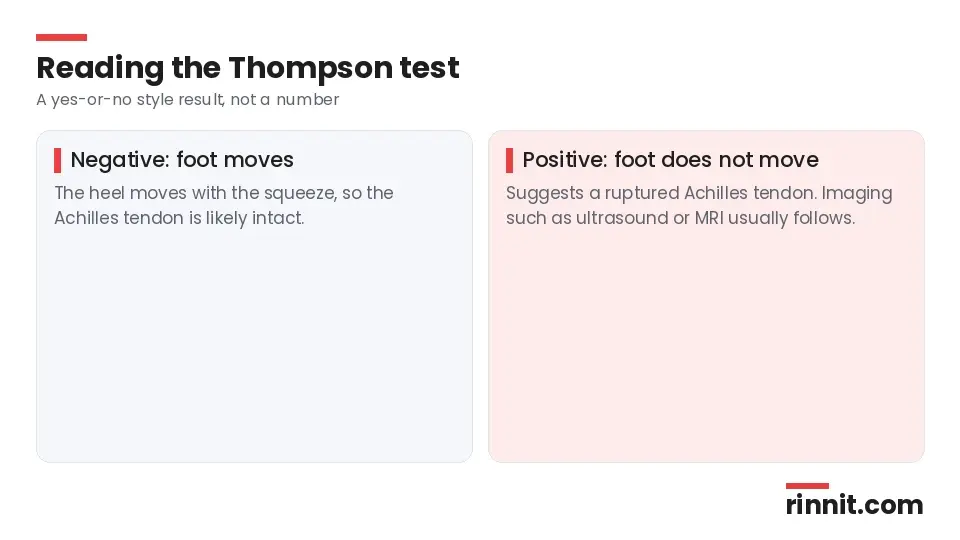
The Thompson test doesn't give a number. It works more like a true-or-false question about whether your tendon is ruptured. [1]
Result | What your provider sees | What it suggests |
Negative | Your heel and foot move when the calf is squeezed | The Achilles tendon is likely intact |
Positive | Your foot doesn't move, or there are other signs of rupture | The Achilles tendon is likely ruptured |
Sources: [1]
Your provider will suggest treatment based on all their findings. Many people need surgery to repair a ruptured Achilles tendon, so talk with your provider about what to expect. [1] Research shows that both surgical and nonsurgical treatment with early rehabilitation can work well for some people. [3]
What happens after the Thompson test?
If your provider thinks your tendon might be torn, you'll probably need at least one imaging test, such as an ultrasound or an MRI, to take pictures of the tendon and the area around it. [1]
Other physical tests for Achilles tendon rupture

Test | How it works | Sign of a rupture |
Thompson test | Your provider squeezes your calf while you lie face down | Your foot doesn't move |
Matles test | You lie face down with your feet off the table or your knees bent to 90 degrees | The foot on the injured side hangs loose and flat instead of slightly pointed |
Palpation | Your provider feels along the tendon through your skin | A gap where the tendon is torn |
Sources: [1]
Whichever checks are used, imaging is usually still needed to confirm the injury. [1]
Can you walk with a ruptured Achilles tendon?
Most people can still walk and move the ankle with a ruptured Achilles tendon, but it may be painful or difficult. Putting your full weight on the injured leg can make the injury worse, so use crutches, a walker or other aids if you have them until you're seen. [1]
See a provider right away if you think you've injured your Achilles tendon, even if you can walk or put some weight on it. [1]
When should you see a provider?
Get checked if you have any signs of a torn Achilles tendon: [1]
A snap or pop at the back of your ankle, especially during intense activity
Sudden, sharp pain at the back of your ankle
Difficulty walking after an injury
Conclusion
The Thompson test is usually the first way a provider checks for a ruptured Achilles tendon. It's safe, simple and takes seconds, though imaging is often still needed to confirm the diagnosis and plan treatment. [1]
Recovering from an Achilles rupture takes time and effort, so getting seen early after a pop or sudden heel pain gives you the best start.
Keep learning: Read our guide to Achilles tendon rupture or our article on the McMurray test for another common physical exam test. For more background, see the AAOS page on Achilles tendon rupture.
FAQ
What is the Thompson test?
A physical exam in which your provider squeezes your calf to check whether your Achilles tendon is torn. [1]
What does a positive Thompson test mean?
Your foot didn't move when your calf was squeezed, which suggests a ruptured Achilles tendon. [1]
What does a negative Thompson test mean?
Your heel moved normally, so your Achilles tendon is likely intact. [1]
Does the Thompson test hurt?
It shouldn't make your pain or symptoms worse; tell your provider if anything hurts. [1]
Do I need to prepare for the Thompson test?
No. It's a quick in-office exam with no preparation. [1]
Is the Thompson test enough to diagnose a rupture?
Usually not on its own; an ultrasound or MRI is often needed to confirm it. [1]
What other tests check for Achilles rupture?
The Matles test and feeling along the tendon for a gap (palpation). [1]
Can I walk with a torn Achilles tendon?
Often yes, but it may be painful, and putting full weight on it can make the injury worse. [1]
What are the signs of a torn Achilles tendon?
A pop or snap at the back of the ankle, sudden sharp pain there and trouble walking. [1]
Will I need surgery after a positive Thompson test?
Many people need surgery, but your provider will recommend treatment based on all the findings. [1]
Related Reading
Achilles Tendon Rupture: Complete Guide to Symptoms, Causes, and Treatment Options explains the injury the Thompson test checks for and how it's treated.
Achilles Tendon Rupture: Symptoms, Causes, Diagnosis, and Recovery covers how an Achilles rupture is diagnosed and what recovery looks like.
References
Cleveland Clinic. Thompson Test for Achilles Tendon Rupture. Cleveland Clinic. Last updated October 24, 2023. https://my.clevelandclinic.org/health/diagnostics/thompson-test-for-achilles-tendon-rupture
Villarreal AD, Andersen CR, Panchbhavi VK. A survey on management of chronic achilles tendon ruptures. Am J Orthop (Belle Mead NJ). 2012;41(3):126-131. PMID 22530209. https://pubmed.ncbi.nlm.nih.gov/22530209/
Willits K, Amendola A, Bryant D, et al. Operative versus nonoperative treatment of acute Achilles tendon ruptures: a multicenter randomized trial using accelerated functional rehabilitation. J Bone Joint Surg Am. 2010;92(17):2767-2775. PMID 21037028. https://doi.org/10.2106/JBJS.I.01401
Medical disclaimer
This article is for general education only and does not replace advice from a qualified healthcare professional. Talk to your doctor about your own diagnosis and treatment, and seek emergency care right away for severe or sudden symptoms.



Comments