Pec Implants: Surgery, Recovery and Results

Updated: 2 days ago
Written and medically reviewed by Dr. Baraa Alnahhal, MD · Last reviewed: November 2026 · How we review
Quick Answer
Pec (pectoral) implants are solid silicone implants placed under the chest muscles to make the chest look fuller and more muscular. People choose them for cosmetic reasons or for reconstruction of conditions like pectus excavatum and Poland syndrome. It's outpatient surgery through an incision in each armpit. Most people return to work in about a week.
What the research says
Pectoral implants improved chest contour: in a series of 21 men given pectoral implants for cosmetic reasons, muscle atrophy or muscle injury, results were satisfying, with significant chest-contour improvement and no major complications (Benito-Ruiz J et al., Aesthetic Plastic Surgery, 2008) [2]
Reconstruction for Poland syndrome was safe: in 52 adolescents with Poland syndrome treated with a staged plan that included chest-wall surgery, fat grafting and breast or pectoral implants, there were no major complications over an average of 5.9 years (Romanini MV et al., Plastic and Reconstructive Surgery Global Open, 2024) [3]
Key takeaways
Pec implants are solid silicone implants that shape the chest.
They're used for cosmetic or reconstructive reasons.
They're placed through armpit incisions.
Most people return to work in about a week.
Implants may last about 20 years.
What are pec implants?
The implants are firm like muscle and don't leak like gel breast implants. They come in many shapes and sizes, and custom implants can be made for reconstruction. They sit between the pectoralis major and pectoralis minor muscles. Sources: [1]
Who they're for
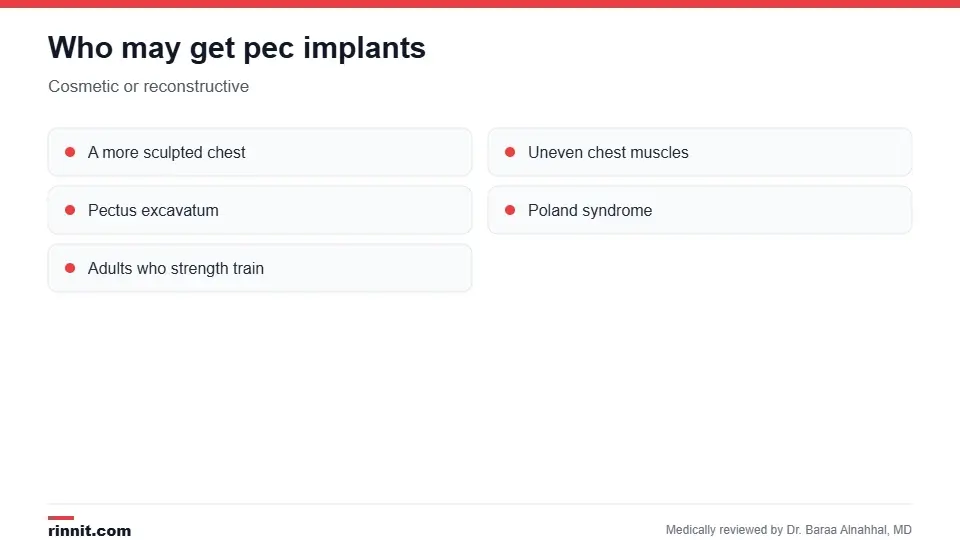
A plastic surgeon helps you decide.
People who want a more sculpted chest than exercise alone gives.
People with uneven or underdeveloped chest muscles.
Poland syndrome. Sources: [1]
Ideal candidates strength train, have fully developed adult muscles, don't smoke and have realistic expectations. Sources: [1]
Implants vs. fat transfer

Liposuction or a tummy tuck can be combined.
Feature | Pec implants | Fat transfer |
Material | Solid silicone | Your own fat |
Invasiveness | Surgery through the armpit | Less invasive |
How long it lasts | About 20 years | Should last a lifetime |
Learn about fat transfer. Sources: [1]
How to prepare
A physical exam, blood tests and photos.
Stop certain medicines, vitamins and supplements as directed.
Quit smoking several weeks before.
Don't use lotion or deodorant on surgery day.
Follow fasting instructions and take antibiotics if prescribed. Sources: [1]
What happens during surgery

You usually go home the same day.
You get general anesthesia or heavy sedation.
A two-inch incision is made in each armpit.
A pocket is made between the pectoralis major and minor.
The implants are slid into place.
Incisions are closed, and you wear a compression garment. Sources: [1]
Risks
Implant shifting, which may need repositioning.
Allergic reaction.
Bleeding, bruising or blood clots.
Scar tissue around the implant.
Infection.
Muscle spasms.
Nerve damage and numbness.
A result that looks unnatural to you. Sources: [1, 2, 3]
Recovery
Expect pain and stiffness for about a week.
Use ice packs and over-the-counter pain relievers.
Incisions heal in about two weeks.
Return to work and light activity in about a week.
Don't raise your arms above your head until cleared.
Wear a compression garment for up to six weeks. Sources: [1]
Results
Most swelling goes down in six weeks, and full results show in three to six months. Armpit hair hides the scars. Implants may last about 20 years. If you're unhappy, corrective surgery, removal or different implants are options. Sources: [1]
When to call your provider
Heavy bleeding, swelling or bruising.
Muscle spasms.
Nausea and vomiting.
Severe pain.
Pus or fever. Sources: [1]
Conclusion
Pec implants can give your chest a more defined, muscular look or restore its shape after a birth condition. An experienced plastic surgeon can help you choose the right size and shape.
Keep learning: read about pectus excavatum and gynecomastia surgery.
Frequently asked questions
What are pec implants?
Solid silicone implants that make the chest look more muscular.
Can they leak?
No. They're solid silicone.
Where is the incision?
In each armpit, so scars are hidden.
Is it outpatient surgery?
Yes. You usually go home the same day.
When can I go back to work?
In about a week.
When can I lift weights?
Only when your surgeon says it's OK.
How long until I see final results?
Three to six months.
How long do pec implants last?
About 20 years.
Are there alternatives?
Yes, fat transfer to the chest.
Who is a good candidate?
Adults who strength train, don't smoke and have realistic goals.
Related Reading
Pectus Excavatum: What a Sunken Breastbone Means for Your Heart, Lungs, and Confidence a sunken chest.
Understanding Poland Syndrome: Causes, Symptoms, and Treatment Options missing chest muscles.
Gynecomastia Surgery: A Guide to Male Breast Reduction another male chest surgery.
Fat Transfer: A Natural Approach to Volume Enhancement an implant alternative.
Pectus Carinatum: Understanding Symptoms, Causes, and Modern Correction Options a chest wall condition.
References
Cleveland Clinic. Pec (Pectoral) Implants: Surgery, Scars, Before & After. Cleveland Clinic. Last updated March 6, 2024. https://my.clevelandclinic.org/health/treatments/pec-pectoral-implants
Benito-Ruiz J, Raigosa JM, Manzano-Surroca M, et al. Male chest enhancement: pectoral implants. Aesthetic Plastic Surgery. 2008;32(1):101-104. PMID 17676376. https://doi.org/10.1007/s00266-007-9018-5
Romanini MV, Forlini V, Valle M, et al. Surgical algorithm of Poland syndrome based on thorax, breast, and nipple-areola complex classification. Plastic and Reconstructive Surgery Global Open. 2024;12(11):e6261. PMID 39583780. https://doi.org/10.1097/GOX.0000000000006261
Medical disclaimer
This article is for general education only and does not replace advice from a qualified healthcare professional. Talk to your doctor about your own diagnosis and treatment, and seek emergency care right away for severe or sudden symptoms.



Comments